First Impressions in B2B Pitches Aren’t About Charisma. They’re About Risk
You have won pitches you thought you’d lost, and lost pitches you’d already mentally banked.
The deciding variable was not your performance in the room. It was a risk verdict the buyer reached in the first few minutes — before your best slide — and then repeated to people you never met.
When a 50-to-200-person firm rebrands ahead of a growth phase, the honest question under the exercise is rarely “do we look good enough?”
It’s “do we look safe enough to hand a difficult, expensive decision to?”
Different question. Most firms answer the first one and lose on the second.
Before you refine a single pitch, it’s worth understanding how buyers actually buy professional services — because the judgement starts far earlier than the meeting.
- First impressions in B2B are risk assessments, not charisma. Buyers classify firms as safe, risky, or interchangeable within minutes.
- Most shortlist decisions happen before meetings; winners were usually on the buyer's initial list, roughly 95% of the time.
- Your impression becomes a compressed message handed to colleagues; make it one defensible sentence so it survives internal translation.
- Don't polish for impressiveness; prove judgement with sector specific evidence and front-load proof that reduces perceived risk.
What B2B Buyers Actually Judge in the First 5 Minutes

In the opening minutes of a pitch, B2B buyers are not deciding whether they like you.
They are classifying risk — unconsciously sorting your firm into interchangeable, impressive-but-dangerous, or credible enough to investigate further.
The winning firm is rarely the one that makes the strongest impression.
It’s the one that strikes the right balance between confidence and buyer scepticism.
- Thin-slice judgement in a high-stakes purchase is a risk assessment, not a likeability contest.
- Edelman and LinkedIn report that 95% of business clients are not actively in-market at any given time, which means most of your impression is formed before any pitch — through reputation, ideas and relevance.
- Polish gains attention; evidence of judgement earns credibility. They are not the same signal.
First impressions in B2B pitches are formed by the buyer’s early risk assessment — judging whether a firm is credible enough to trust with an expensive, uncertain decision.
This piece is one facet of the broader subject of how brand psychology shapes commercial decisions; here, the focus is narrow and specific — the pitch itself.
“Surely It Just Comes Down to Charisma and a Sharp Deck?”
Hold that objection, because intelligent people hold it for good reasons. Charismatic pitch leads do win more than their share.
Polished decks do outperform scruffy ones. The seven-second-impression research is real, and the instinct that presentation matters is not wrong — it’s just incomplete in a way that costs mid-sized firms specific deals.
Here’s what the charisma model can’t explain. If likeability decided pitches, the most charming firm would win every time, and it doesn’t.
A £6m consultancy with a magnetic founder loses to a duller competitor when the buyer’s committee decides the charming firm feels risky — too dependent on one person, too creative to trust with the compliance-heavy work, too slick to be straight with them.
Polish that isn’t backed by evidence of judgement doesn’t lower risk. It raises it.
The buyer has been sold to before, and recalls the last vendor who overpromised.
The Impression Isn’t Made in the Room. It’s Made Before You Walk In
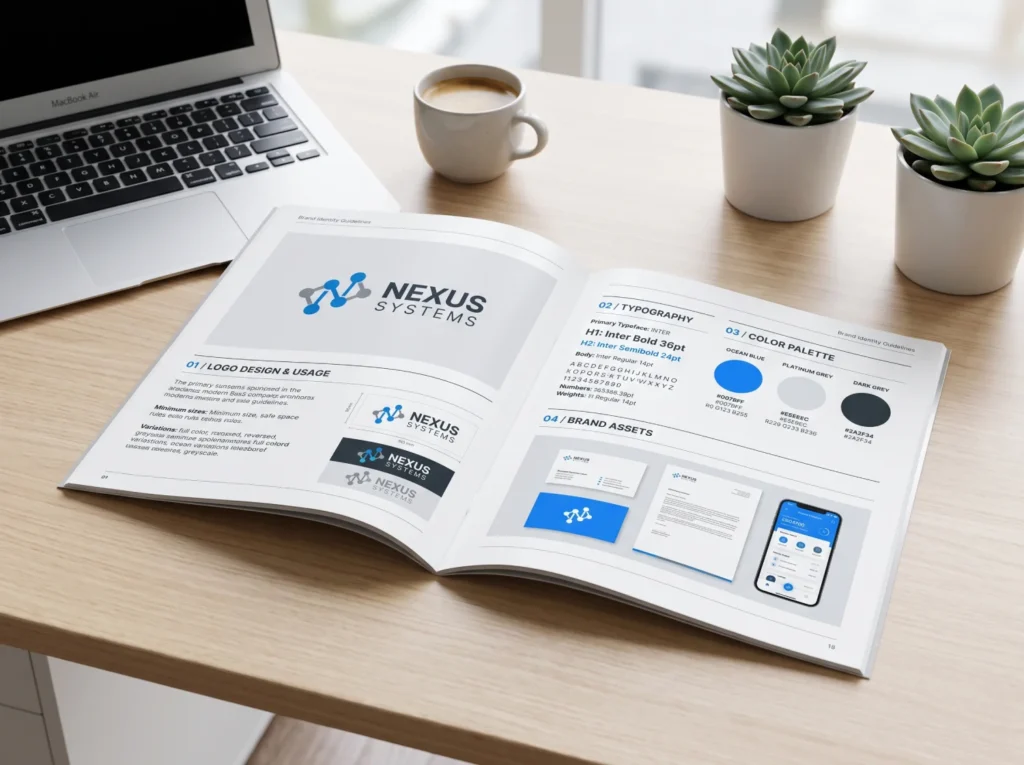
By the time you present, the buyer has usually already decided whether you belong on the list.
6sense’s 2025 B2B Buyer Experience research found that buyers build most of their shortlist before speaking to any seller, and that among won deals, the winning vendor was already on the buyer’s initial shortlist in roughly 95% of cases.
Read that carefully: the pitch rarely creates a shortlist place. It defends one you already earned — or exposes that you never had it.
So, a rebrand that only makes you look more impressive is repainting a house the buyer has already driven past and filed under “same as the other three.”
The pre-pitch impression is the one worth the money. This is where distinctiveness and differentiation get confused — and optimising the wrong one quietly loses the round before the meeting.
What Happens to Your Impression After You Leave the Room
Your first impression does not stay with the person you pitched. It becomes shorthand they repeat — badly, compressed, and without you there to defend it.
More than 40% of B2B deals stall because of internal misalignment within buying groups, according to Edelman and LinkedIn’s 2025 research.
The person in the room is not the buyer. They are a messenger carrying your impression to people who have never met you.
Think about what that messenger actually transmits. Not your deck. A sentence:
“They understand our sector.” “They’ve done this before.” “They seem a bit generic.” “Creative, but can they manage the risk?” “Their proposal would be hard to defend to procurement.”
Every one of those is a risk verdict, not an aesthetic one.
The 2025 Edelman–LinkedIn B2B Thought Leadership report, drawing on nearly 2,000 global professionals, centres on exactly this problem — the “hidden buyers” who shape decisions but never join the call.
Your impression has to survive translation by someone with a fraction of your fluency in your own language. If your positioning needs you in the room to make sense, it dies in the corridor afterwards.
“The pitch you deliver is not the pitch that gets decided on. What gets decided on is a one-line summary, repeated by someone who liked you, to someone who wasn’t there — and if that line sounds interchangeable, you lose to a firm that gave the messenger something sharper to carry.”
There’s a defensible objection here: surely a genuinely strong pitch overcomes a weak summary?
Sometimes.
But you’re betting your win rate on a messenger’s recall against a committee’s risk-aversion, and the 40% stall figure is what that bet costs at scale.
The firms that win give the room a sentence engineered to travel.
What This Changes Before Your Next Pitch

Three things change once you accept the impression is a risk verdict, formed early and repeated by someone else.
Stop polishing for “impressive.” A polished deck to a buyer who’s been overpromised before reads like a used-car forecourt rather than reassurance.
Start proving judgement instead — 73% of B2B decision-makers in the 2024 Edelman–LinkedIn study trusted a firm’s published thinking over its marketing materials as a gauge of capability.
And write your case as one sentence a stranger could repeat without mangling it, because that stranger — not you — is who delivers the pitch that gets decided on.
| The Default Approach | What It Costs | The Better Approach | Why It Works |
| Make the deck more polished | Reads as “sold to before” — sheen triggers scepticism | Make the judgement visible — show how you think | Evidence of judgement lowers perceived risk; polish alone raises it |
| Pitch to the person in the room | Deal stalls when your case can’t survive internal retelling | Arm the messenger with one defensible sentence | 40%+ of deals stall on internal misalignment (Edelman/LinkedIn 2025) |
| Rebrand to look bigger/slicker | Buyer files you under “looks like everyone else” | Rebrand for sector legibility and risk-clarity | The winner is pre-shortlisted 95% of the time (6sense 2025) |
| Lead with capability breadth | Breadth reads as “generalist” — higher perceived risk | Lead with specific, sector-relevant evidence | Specificity signals “done this before” — the core risk-reducer |
| Save proof for later slides | Buyer’s risk verdict is set before you reach them | Front-load the proof that answers “can we trust them?” | Thin-slice judgement forms in the first few minutes |
Sell Certainty, Not Charisma
The firm that wins the pitch is not the one that impressed hardest. It’s the one that made itself the least risky credible option — early, in public, and in a form simple enough for a stranger to repeat.
Charisma and a sharp deck still matter, but they matter as delivery, not as the argument. The argument the buyer is actually making is, “Can I defend this choice to people who weren’t in the room?”
If your firm is rebranding ahead of a growth phase or acquisition, the test is not whether the new identity looks more impressive.
It’s whether it makes you legibly, specifically, provably safe to choose.
Find out exactly where your brand is raising perceived risk instead of lowering it: request a free Brand Equity Audit™ — a structured diagnostic that shows where your brand is losing commercial ground, and what to do about it.
Frequently Asked Questions
Do first impressions really matter in B2B sales, or is it all about price and capability?
Yes, but not as charisma. The first impression is a risk assessment. Buyers decide early whether a firm looks credible enough to trust with an expensive, uncertain decision. That verdict shapes how they weigh price and capability afterwards rather than the reverse.
What are B2B buyers actually judging in the first few minutes of a pitch?
Risk, not likeability. Buyers unconsciously sort a firm into interchangeable, impressive-but-dangerous, or credible-enough-to-investigate. They are answering one question: Does this firm understand our situation well enough to be trusted with a difficult decision?
Why do we lose pitches that felt like they went well in the room?
Because the person you pitched becomes a messenger. More than 40% of B2B deals stall on internal misalignment (Edelman/LinkedIn, 2025). If your impression compresses into a generic sentence when repeated to colleagues who weren’t there, it loses to a firm that was easier to defend.
How do you reduce perceived risk in a B2B pitch?
Show judgement, not just polish. Lead with specific, sector-relevant evidence that signals “we’ve done this before,” front-load proof that answers “can we trust them?”, and give the room one defensible sentence they can repeat accurately without you present.
Should we rebrand before pitching for larger clients?
Only if the rebrand improves risk-legibility, not just aesthetics. A slicker identity that makes you look like everyone else raises perceived risk. A rebrand that makes you specifically and provably credible within a defined sector lowers it — and the winner is pre-shortlisted 95% of the time (6sense, 2025).
Is the “seven-second first impression” rule true for B2B?
Partly. Snap judgements are real, but in B2B the judgement is about risk classification, not instant likeability — and much of it forms before the meeting through reputation and published thinking, since 95% of buyers aren’t actively in-market when they first encounter you.
