The Brand Flip: Why Neumeier’s Logic Wins in 2026
We see a lot of branding consultants who seem to be stuck in 1998.
They talk about “brand control” and “message management” as if they can still dictate how a person feels about a business through a slick TV advert or a curated Instagram.
It’s delusional.
If you think you own your brand, you’ve already lost the battle for the marketplace today.
Business owners spend millions attempting to “position” themselves, only to find that a single Reddit thread or an LLM’s unsympathetic summary has more influence over their reputation than their entire marketing department.
This lack of control is terrifying to the average CEO, but for the strategic expert, it represents the single greatest opportunity for growth.
Ignoring the shift from company-driven branding to customer-led identity costs more than just “engagement.” It leads to a high Cost of Acquisition (CAC) that never plateaus and a brand equity that evaporates the moment you stop paying Google.
When 70% of your audience would rather read an article than see your ad, ‘the Flip’ stops being a strategic choice and becomes a survival tactic. If you aren’t providing value through content, you’re essentially invisible.
- The Power Shift: Brands moved from company-driven control to customer-driven meaning, empowering buyers over corporate messaging.
- Tribes not Segments: Success comes from building tribes of shared identity and values, not demographic segments or mass audiences.
- Experience over Messaging: Replace advertising with doing; product and rituals create belonging, not feature lists or slogans.
- Algorithmic Authority: In 2026, AI-driven sentiment and Entity signals reward decentralised, tribe-led evidence over corporate copy.
- Measure Commitment: Track sentiment, referrals and willingness to pay for the brand’s survival, not impressions or vanity metrics.
What is The Brand Flip?
Marty Neumeier’s The Brand Flip isn’t just another framework; it’s a roadmap for the moment the steering wheel of brand authority was ripped out of the boardroom and handed directly to the people buying the products.
A brand isn’t the logo on your business card. It’s that split-second ‘gut feeling’ someone has when they hear your name—and in 2026, that feeling is shaped more by Reddit threads and group chats than by your marketing folks with their ‘pro’ Canva account.
The Brand Flip
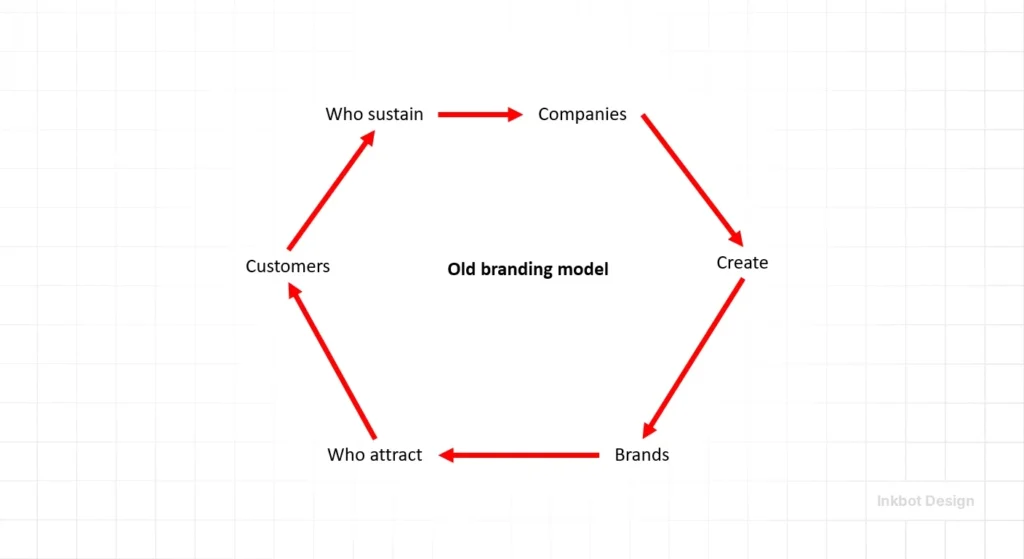
The Brand Flip is about the bridge between the company and the customer. In this 2026-relevant manifesto, Marty Neumeier argues that the “Industrial Age” of branding is dead. We have moved from a world where companies own brands to a world where customers own brands.
As an Amazon Partner, when you buy through our links, we may earn a commission.
The 3 Core Elements of The Brand Flip:
- The Power Shift: The move from “Company-Driven” (selling products) to “Customer-Driven” (building meaning).
- The Tribe: Shifting focus from “Segments” (demographics) to “Tribes” (shared interest and values).
- The Experience: Replacing “Messaging” with “Doing,” where the product itself becomes a vehicle for the customer’s personal identity.
The Evolution of the Brand-Customer Relationship
To understand why “The Brand Flip” is critical in 2026, we have to look at the wreckage of the Industrial Age.
We used to live in a “push” economy. You made a thing, you bought a billboard, you shouted about the thing, and people bought it because they didn’t have many other choices.
That model died with the proliferation of choice. But the “Digital Age” didn’t actually fix it; it just made the shouting louder and more frequent. Now, we are in the “Identity Age.”
From Segments to Tribes
In the old world, marketers talked about “18-35-year-old males with a high disposable income.” This is a segment. It’s a spreadsheet entry. It has no soul.
Neumeier argues—and our work at Inkbot Design confirms—that people don’t buy things to solve problems anymore; they buy things to join a tribe. They ask, “If I buy this, what does it say about me?”
A McKinsey & Company study finds that 71% of consumers expect companies to deliver personalised interactions. True personalisation isn’t putting a first name in an email; it’s aligning with the customer’s self-identity.
The Death of the USP
The Unique Selling Proposition (USP) is a relic.
In 2026, features are commoditised in a matter of weeks. If you launch a software feature on Monday, a competitor has cloned it with AI by Friday. Your technical advantage is a fleeting shadow.
The only thing that cannot be cloned is the “Meaning” your customers attach to your brand. When you flip the brand, you stop competing on features and start competing on belonging.
This is why the best books on branding consistently point toward emotional resonance over technical specs.
Debunking the “Social Media is Community” Myth
Here is an uncomfortable truth that most agencies won’t tell you: your 50,000 Instagram followers are not a community. They are an audience. There is a massive technical difference.
An audience looks at you. A community looks at each other.
Many businesses fail the “Brand Flip” because they think “engaging” with customers on X or LinkedIn constitutes building a tribe. It doesn’t.
Gartner data suggests that “passive” followers rarely convert into brand advocates.
Why Your “Community” is Failing:
- Platform Dependency: You are building on rented land. When the algorithm changes, your “community” disappears.
- One-Way Dialogue: You are still the one talking. In a flipped brand, the customers talk to each other about how you fit into their lives.
- Lack of Shared Rituals: A tribe needs more than a hashtag. It needs a shared goal or a common enemy.
Real-World Failure: The “New Coke” Disaster vs. Harley Davidson
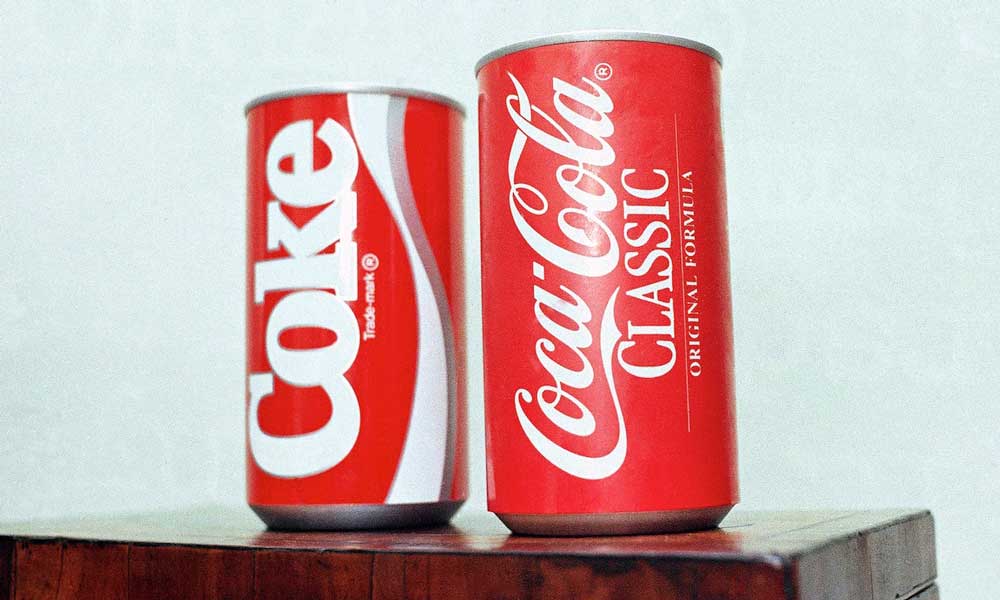
When Coca-Cola changed its formula in the 80s, they thought they were managing a product. They didn’t realise they were messing with a piece of their customers’ identities.
The backlash wasn’t about taste; it was about a perceived betrayal of the tribe.
Contrast this with Harley-Davidson. They don’t sell motorcycles; they sell the “Rebel” identity. Their customers literally tattoo the company logo on their bodies.
You don’t see people getting tattoos of the “Salesforce” logo, do you? That is the difference between a product and a flipped brand.
Understanding the Neumeier Trilogy: Which Framework Do You Need?
To fully implement The Brand Flip, you must understand its place within Liquid Agency’s broader strategic philosophy. Neumeier’s work is often viewed as a trilogy of transformation.
| Feature | The Brand Gap | Zag | The Brand Flip |
| Primary Focus | The bridge between logic and magic (Strategy + Creativity). | Radical differentiation in a crowded market. | The shift of power from company to customer. |
| Core Question | Who are we? | What makes us “only”? | Who are they (the customers)? |
| Key Output | A cohesive brand identity and message. | A “Zag”—a high-speed strategy for growth. | A Brand Tribe and a customer-led ecosystem. |
| 2026 Context | Essential for internal alignment. | Essential for breaking through AI noise. | Essential for long-term sentiment and authority. |
The State of The Brand Flip in 2026
We have entered the era of the “Algorithmic Brand.” In 2026, your brand is often interpreted by an AI before it ever reaches a human eye. Generative Engine Optimisation (GEO) is the new frontier.
When a user asks an AI, “Which branding agency should I use for a high-end tech startup?”, the AI doesn’t just look at your keywords. It looks at the “Sentiment” and “Entity Density” of what the web says about you.
The Algorithmic Value of the Tribe
In 2026, a business’s perception is determined by “Sentiment Analysis” performed by advanced Large Language Models.
These systems do not just count keywords; they map the relationship between your business (the Entity) and the discussions happening around it.
When you successfully flip your brand, your tribe becomes your primary marketing force. They produce what we call “Distributed Proof”.
- Example: When a user asks an AI assistant for a “sustainable skincare recommendation,” the AI parses millions of peer-to-peer conversations. If your tribe is actively discussing your B Corp certification or your plastic-free supply chain on Reddit, Substack, or private forums, the AI perceives this as high-authority validation.
- The “Flip” Advantage: A company-driven brand relies on its own website—a single point of failure. A flipped brand relies on its tribe—a decentralised network that AI systems trust far more than corporate copy.
We see this in our brand identity services. We no longer just design a logo; we design an “Entity” that is decentralised and customer-validated.
The Masterclass: 10 Insights from “The Brand Flip”
1. The Definition of Brand
“A brand is a person’s gut feeling about a product, service, or company.”
Inkbot Insight: This is the bedrock of Neumeier’s philosophy. It reminds us that you don’t own your brand; your customers do.
Application: To influence this “gut feeling” in 2026, you must look beyond visuals. Optimise your semantic entity—ensure that when AI agents (like the one you’re talking to) aggregate data about you, the sentiment is consistent, trustworthy, and authoritative.
2. The Power of “Who”
“The question is no longer ‘What are we selling?’ but ‘Who are we becoming?'”
Inkbot Insight: This aligns with Jen Kem’s archetype mapping. Modern consumers don’t buy into a product; they buy into a better version of themselves.
Application: Identify the Hero’s Journey your customer is on. Are you the Mentor or the Tool? Shift your messaging from features to the “Transformation Narrative.”
3. The Death of the USP
“The USP (Unique Selling Proposition) has been replaced by the VBT (Value-Based Trust).”
Inkbot Insight: Features are easily replicated by AI and global manufacturing. Trust is the only non-fungible asset.
Application: Build brand equity (per David Aaker) by being radically transparent. Use “Proof Points”—case studies, verified reviews, and ethical supply chain data—to anchor your value in reality, not just rhetoric.
4. Segmenting by Tribe
“Don’t segment by demographics. Segment by tribes.”
Inkbot Insight: In a globalised market, Kubi Springer’s work teaches us that cultural resonance beats age or income brackets every time.
Application: Stop targeting “Females, 25-40.” Start targeting “Urban Minimalists who value Sustainability.” Use social listening and neural analytics to find the digital campfires where your tribe gathers.
5. The Meaning of Meaning
“When products become commodities, and services become modules, meaning becomes the new currency.”
Inkbot Insight: In the “sea of sameness” caused by algorithmic design, meaning is your lighthouse.
Application: Infuse your brand identity with a “Why.” Why do you exist beyond profit? This purpose should be the “North Star” for every piece of content in your 2026 SEO roadmap.
6. The Logic of Design
“Design is the silent ambassador of your brand.”
Inkbot Insight: Aesthetics are the first point of neural contact. Before a word is read, a feeling is formed.
Application: Ensure your visual identity—from your logo to your UI—is “frictionless.” In 2026, design must be inclusive and accessible (Springer) while maintaining the architectural precision of a premium brand.
7. The Role of Community
“A brand is not a monologue, but a conversation.”
Inkbot Insight: The “Flip” is about moving from “Push” marketing to “Pull” ecosystems.
Application: Build a “Brand Community” (or a “Tribe”). Give your customers a platform to talk to each other, not just listen to you. User-generated content is the most potent form of semantic validation.
8. Differentiation through “Onlyness”
“If you can’t say why you’re the ‘only’, you’re just another.”
Inkbot Insight: This is the “Onlyness Test.” It requires the analytical depth of Neumeier’s “Zag” philosophy.
Application: Complete this sentence: “Our brand is the only [Category] that [Benefit] for [Tribe] in [Market] during [Occasion].” If you can’t fill it in, you’re invisible.
9. The Concept of the “Flipped” Funnel
“The traditional sales funnel is upside down. It should start with the customer, not the product.”
Inkbot Insight: We no longer “capture” leads; we “cultivate” fans.
Application: Focus on Brand Depth over Brand Reach. High-value, hyper-personalised experiences for a smaller group of loyalists will drive more growth through “The Flip” than broad, shallow advertising.
10. Agility as Strategy
“The goal of branding is to move the customer from awareness to insistence.”
Inkbot Insight: This is the ultimate goal of Aaker’s Brand Equity model. Insistence means no substitutes are accepted.
Application: To reach “Insistence” in 2026, you must be agile. Monitor your brand’s “Semantic Health” in real-time. Pivot your tactics, but never your core purpose.
The 18-Step Framework (The Condensed Version)
Neumeier outlines a rigorous process for flipping a brand. You cannot just “decide” to be customer-centric on a Tuesday morning. It requires a fundamental re-engineering of your business logic.
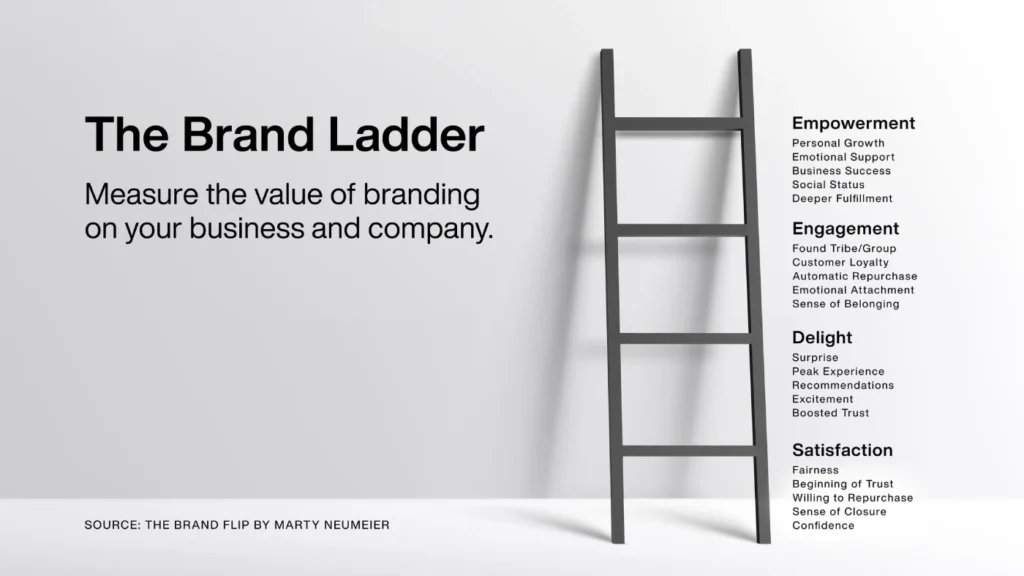
1. From Product to Meaning
Stop asking “What does our product do?” and start asking “What does our product mean to the person using it?” This is the core of the best marketing books philosophy.
2. From Features to Benefits
This is Marketing 101, but the “Flip” takes it further. It moves from “Functional Benefits” to “Identity Benefits.”
3. From Transactions to Relationships
A transaction ends at the checkout. A relationship begins there. If your post-purchase experience is just a “Rate your purchase” email, you are failing.
4. From “Selling” to “Enrolling”
When you sell, you are the protagonist. When you enrol, the customer is the protagonist, and you are the guide. This mirrors the “Hero’s Journey” framework used in high-level brand strategy.
The Flip-o-Meter: A Diagnostic for 2026
How do you know if your brand is truly flipped? Marty Neumeier introduced the “Flip-o-Meter”, a series of questions to gauge your customer-centricity. We have adapted these for the current digital landscape:
- Identity: Do customers use our brand to define who they are?
- Product: Is our product a vehicle for the customer’s personal growth?
- Community: Do our customers talk to each other more than they talk to us?
- Interface: Is our user experience designed for the customer’s ease of use or for our internal efficiency?
- Evidence: Is our “Meaning” backed by real-world action, or just slogans?
The Brand Flip Benchmark: A score of 8/10 or higher on the Flip-o-Meter indicates a brand that is likely to survive “The Great De-averaging” of the mid-2020s. Brands scoring below 4/10 are at high risk of being commoditised by generic, AI-driven alternatives.
The Verdict
Marty Neumeier’s The Brand Flip is not a “nice-to-read” book for your flight to a marketing conference. It is a technical manual for anyone who wants to remain relevant in an increasingly hostile economy to “middle-man” brands.
In 2026, the cost of being “just another company” is too high. If you don’t provide a platform for a tribe, you will be replaced by a generic AI-generated alternative that is cheaper and faster.
The “Flip” is about moving from “What we make” to “Who they are.” It is the most profitable move a business can make.
If you’re ready to stop shouting into the void and start building a brand that actually resonates, it’s time to look at your strategy through a different lens.
Whether you’re diving into the best business strategy books or looking for a direct audit of your current identity, the direction is clear: give up control to gain influence.
Are you ready to flip your brand before the market flips on you? Request a Quote for a Brand Strategy Audit
FAQ: The Brand Flip & Modern Strategy
What is the main difference between The Brand Gap and The Brand Flip?
The Brand Gap focuses on the “bridge” between strategy and creativity (the “what”). The Brand Flip focuses on the “bridge” between the company and the customer (the “who”). The former concerns internal alignment; the latter, external tribalism.
How do I know if my brand needs a “flip”?
If your CAC is rising while your customer lifetime value (LTV) is stagnating, or if your brand is primarily compared to competitors based on price rather than “feeling,” you are likely stuck in a company-driven model.
Does The Brand Flip work for B2B companies?
Yes. In fact, it is often more effective in B2B. Business buyers are still humans who want to feel part of a group of “innovators” or “safe pairs of hands.” B2B brands like Slack or Salesforce have successfully flipped by focusing on the “community of experts.”
Can a small business afford to “flip” its brand?
A small business cannot afford not to. Small businesses have a natural advantage in building tribes because they can be more personal and agile than massive corporations.
How does The Brand Flip impact SEO in 2026?
It shifts the focus to Entity-based SEO. By building a tribe that mentions your brand across the web, you increase your “Entity Authority,” which helps search engines and AI models trust your business as a primary source.
Is “The Tribe” just another word for “Target Audience”?
No. A target audience is a group you aim at. A tribe is a group that organises itself around its values. You don’t “target” a tribe; you “lead” it or “serve” it.
How do I start building a brand tribe?
Start by identifying your “Brand Purpose” beyond profit. Find the group of people who are most passionate about that purpose and give them a place to talk—not just to you, but to each other.
What is the “Flip-o-Meter”?
It is a tool Neumeier uses to measure how much a brand has shifted from company-centric to customer-centric across 18 different criteria, including “Value,” “Interface,” and “Community.”
Can you flip a brand that is already failing?
Often, a failing brand is failing because it hasn’t flipped. Re-aligning with a core tribe is often the only way to revitalise a dying brand without spending millions on a rebrand that is only skin-deep.
Why is “Design” so important in The Brand Flip?
Design is the visual language of the tribe. It’s the “uniform” that members wear to recognise one another. Without great design, your tribe has no way to signal its belonging.
Does the Brand Flip require a massive budget?
No. It requires a massive shift in mindset. It’s about reallocating your existing budget from “interruption marketing” to “community building.”
Who should lead the Brand Flip in a company?
It must start with the CEO/Founder, but be executed by the Creative Director or Brand Strategist. It is a business-wide shift, not just a marketing project.