Is Studying Graphic Design Still a Relevant Profession for Students?
Graphic design is a career that has proven to be profitable and popular.
However, many have recently questioned the value of this degree.
Some professionals claim that experience outweighs education in this field, while others believe any degree can contribute significantly to success, even outside graphic design.
In this article, we discuss whether high school students should pursue higher education in graphic design and its relevance.
- Graphic design remains relevant; degrees teach design thinking, history, and networks essential for senior roles.
- AI co‑pilots like Adobe Firefly and Figma AI shift junior roles toward prompt curation and workflow management.
- Spatial and 3D skills (Blender, Spline) and motion tools are increasingly required for immersive and environmental design.
- Choose education by ROI: university for breadth and leadership; bootcamps for fast, portfolio‑focused entry into industry.
- Key skills: technical tools (Figma, Photoshop), accessibility (WCAG), empathy, critical thinking and business acumen.
The 2026 Design Reality: Co-piloting with Artificial Intelligence

The graphic design landscape in 2026 has shifted from fear of replacement to mastery of Generative AI co-piloting.
While the “Is graphic design dead?” question was common in 2023, the reality today is that design roles have evolved.
You are no longer just an “image maker”; you are a Creative Director of machine-assisted workflows.
Studying design now requires understanding how to integrate tools like Adobe Firefly, Midjourney v7, and Figma AI into your creative process.
These tools handle the “production grunt work”—such as generating 50 variations of a social media banner or instantly resizing assets—allowing you to focus on high-level branding strategy and human-centric empathy.
A student who learns to “prompt” and “curate” alongside traditional Typography and Layout skills is significantly more employable than one who resists these technological shifts.
Scenario: A junior designer at a London agency uses AI to moodboard five distinct directions for a client in 20 minutes, then uses Illustrator to refine the chosen vector-based logo, ensuring it meets ISO standards for scalability.
Beyond the Screen: The Rise of Spatial and 3D Design
In 2026, the definition of “graphic” has expanded into three dimensions. With the mainstream adoption of mixed-reality headsets and spatial computing, designers are increasingly tasked with creating assets for augmented reality (AR) and virtual environments.
- 3D Modelling: Proficiency in Blender or Spline is no longer “optional” for high-end digital roles.
- Interactive Graphics: Using Lottie files and After Effects to create motion that responds to user movement.
- Environmental Branding: Designing for physical spaces where digital overlays provide information (wayfinding).
If you are choosing a study path, look for programmes that include “Spatial Design” or “Immersive Media” in their curriculum. This specialisation often commands 20–30% higher starting salaries than traditional print-focused roles.
Pros of Studying Graphic Design
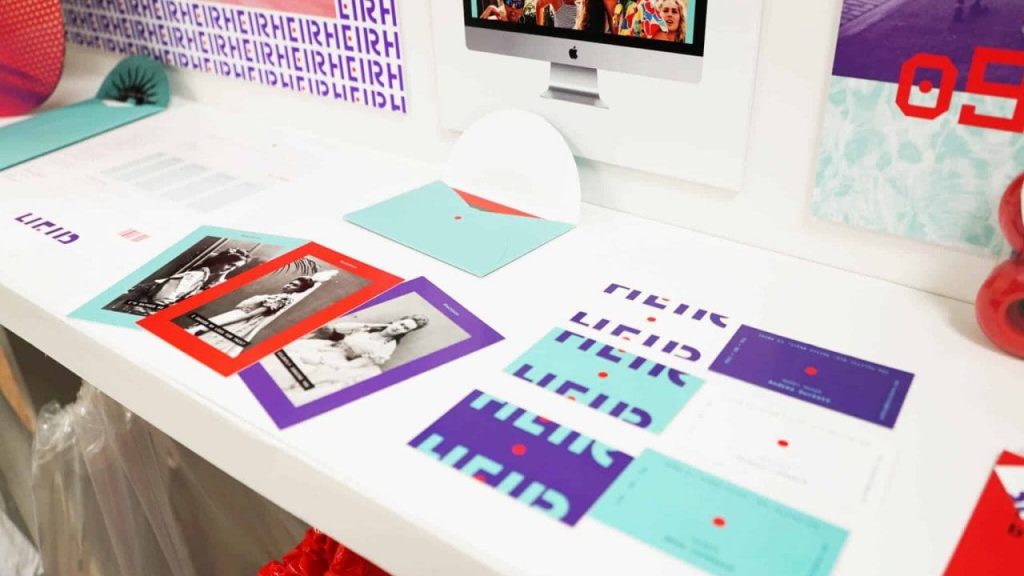
Studying graphic design at a college or university has advantages, such as improved employability and a deeper understanding. Let’s take a closer look.
Exhaustive curriculum
The most significant benefit of taking design as a major is the wide range of courses.
Design history, technical skills, and different styles are just some things you will learn during your four-year program.
To know if this school is right for you, try looking through graphic design lesson plans for high school or college online – it will give you an idea about what will be taught there.
Professional teachers
There’s nothing better than being taught by someone who does this thing professionally.
And when these professionals are certified teachers with years of experience – lucky us!
They can tell much more about current trends in markets and industries than any book or blog post could ever do. That guidance would only be possible if we chose self-education over formal schooling.
Those guys will push your limits, assigning tasks that seem repetitive and useless at first glance. But don’t worry – all those puzzles have one solution: they make us versatile specialists!
Teaming up with other students
Networking is a big part of university life – people from different walks of life come together, bringing their dreams and aspirations along with them.
Many students switch cities (and sometimes countries) to attend college, which can lead to life-changing experiences! Meeting peers who share similar values/goals can improve motivation levels.
On top of that, such an environment breeds competition among students, often leading to outstanding results within groups.
And remember, these folks won’t leave our lives after graduation either: they can become our colleagues someday, too!
Starting business ventures together post-graduation could be cool since everyone’s got the same educational background + lots of shared memories => deeper understanding & better group dynamics overall!
Constructive criticism
Receiving critique from someone working in the industry comes with many benefits, as they’ve seen it all before. It may seem harsh sometimes, like they’re trying to kill our creativity, but trust me, they know what’s best for us!
The ability to handle harsh feedback would serve well in future business endeavours. Plus, not all comments about our work would be harmful – sometimes professors might praise them, which is inspiring, too!
Learning different things
Education is a melting pot – everything gets thrown together there so that we can scoop up as much knowledge as possible within limited timeframes.
Apart from learning to draw nice pictures, we’ll also study typography, colour theory, professional software programs, advertisement composition techniques, etc.
It might sometimes feel overwhelming with all these new terms being thrown around left, right & centre.. but bear with me here: having a broad understanding of various areas within the design field will pay off later on when we least expect it!
Making a portfolio
The best thing about finishing college is that you will have much different work to show for it. While you are there, collect anything that you made.
You won’t use all of them; some will be garbage. But you should add some things to your portfolio.
This will save so much time for people looking to hire you in the future and give you an incredible bargaining chip when job hunting.
Structure each entry as a short case study that lists the brief, your role, constraints, process and the outcome, then add two images that show the problem and the result.
Host on a personal site for control and SEO, and mirror highlights to Behance or Dribbble for reach and community signals.
In our fieldwork, short narrative case studies outperform image‑only galleries when clients compare candidates with similar aesthetics.
Certification
There’s nothing more powerful than official recognition.
If someone says they completed a particular course or program, it carries more weight than saying they attended some school without showing the diploma.
This may be necessary for governmental positions or other jobs requiring greater responsibility; otherwise, applicants might get overlooked despite their experience and revolutionary methods because they lack qualifications that higher education would’ve provided.
In the United States, design programmes may be accredited by the National Association of Schools of Art and Design, which reviews curricula and outcomes on a periodic cycle.
Tool credentials like Adobe Certified Professional in Photoshop, Illustrator and InDesign validate software proficiency for employers who screen by skill tags.
Accreditation evaluates the institution and programme, while certifications verify the individual’s tool fluency, so list both clearly on your CV and portfolio.
Cons of Studying Graphic Design

Today’s most significant problem with the education system is that students are often taught with outdated materials.
This happens because updating the yearly curriculum is difficult, especially when the school has limited funds.
If you can’t afford to go to college with the newest technology, you should probably just take a couple of classes somewhere else.
Some offline courses imitate the college experience and teach similar skills using outdated techniques and concepts, wasting your time.
Subpar programs
Not all college programs are created equal. Some might provide the newest technology, and every app a designer could ever need; others might teach you how to use computers running on Windows 95.
Without talking to people who’ve graduated from them, it’s hard to know which college programs are worth it and which ones will just waste your money. They could even lie on their website to attract more students.
You never know if you’ll get a professor who works in his industry and knows what’s happening in the market or a theory professional who’s never talked to a client.
You might get both, just in different disciplines. With online courses, this is an impossible scenario if they take your money and then don’t give you enough relevant information so you can sue them for at least $100K.
High cost of studying
Education after high school is costly in the US.
Not everyone qualifies for student loan forgiveness programs (which not everyone knows about) because half require ten years of working for non-profit organisations that typically don’t pay very well anyway (also not common knowledge).
And not everybody wants to graduate with ~$30K debt hanging over their heads for decades afterwards.
An online or offline course will never put you in that much debt, though some courses, like Shillington School’s 3-month program, can cost up to $15,000.
Many vendors offer student and teacher plans for creative software through verified academic e‑mail, which reduces monthly costs while you learn.
Affinity Designer, Photo and Publisher from Serif run on a one‑time licence, which suits learners who want professional tools without subscriptions.
Open‑source options like GIMP, Inkscape and Blender are widely used in education and industry, supported by active foundations and communities.
These options let you practice workflows and build a portfolio without committing to high recurring fees, which keeps you flexible as you specialise.
But it’s more reasonable to start with a cheaper Coursera course to learn the basics.
If you’re moving to cities for college, you must also pay for housing. Student housing is expensive and of low quality. But renting an apartment near campus is even more challenging — now you’re paying rent and commuting daily, too.
Significant time investment
A college degree will take you an average of four years to finish.
That means four years of being unable to work full-time and support yourself like an independent adult (unless your parents are cool enough to help you through that period, in which case, congrats).
Unfortunately, this isn’t true for many students. They have to work while studying, leaving them less time to focus on learning.
A course will take you an average of two months, and after that, you can start looking for relevant jobs immediately. Even if it takes you a year to study various courses and create your portfolio, it’ll still be more efficient than four years studying one thing.
Not enough real-life practice
College removes you from the job market for four years, fills your head with obsolete knowledge, and then sends you back into the job market with no experience and often outdated knowledge.
Congratulations if you’ve managed to work and keep up during those four years. But most are in for a rude awakening upon graduation because they were not given what they needed.
Courses, on the other hand, are usually relevant and up to date with the industry. Most of them are designed to give you skills you can use immediately.
Lower employability rates
Many people do not find a job in their field for years after graduation. Some have already graduated from college and must take additional classes with more applicable curricula to learn current skills.
This happens because a college education takes a holistic approach. Usually, courses will target one aspect of design that you want to learn about.
When deciding between the two, consider whether you need broad knowledge of many design elements or deep knowledge of one or two aspects.
Stress
College is stressful as hell. Four years of constant deadlines, projects and ruthless critique from professors is too much for most people. They googled graphic design project ideas for high school/college to lighten their workload.
And yet, these same professors — who know exactly how stressed their students are — seem like they don’t care. Many have an attitude of “I was stressed out in school; so should you”.
An online/offline course is also going to be stressful. Many of those courses push you quite hard; some even function as boot camps. But when is it going to last, only a month or three? It’s much easier to swallow.
ROI Analysis: University Degree vs. Intensive Bootcamps
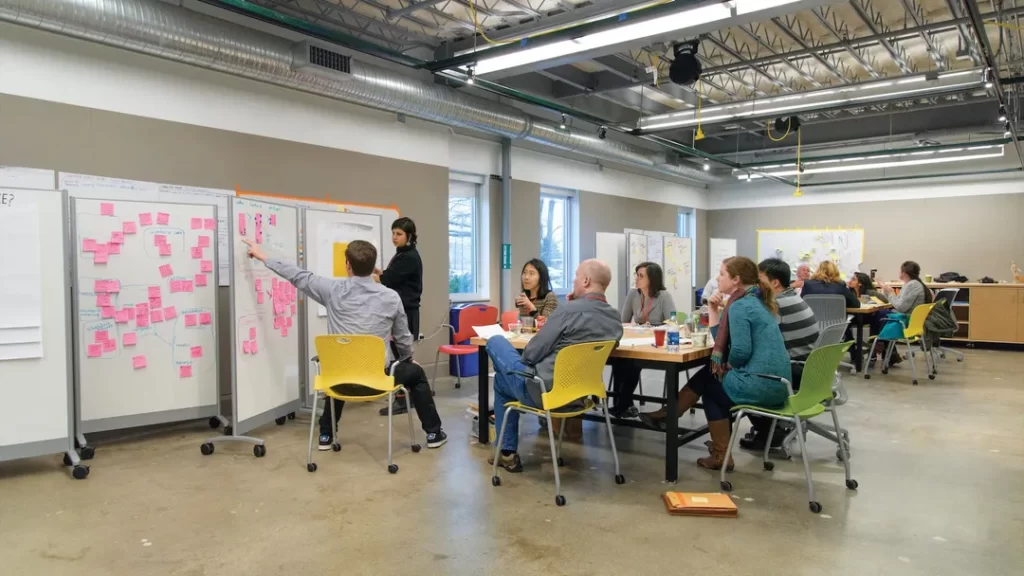
Choosing your education path in 2026 requires a cold look at the Return on Investment (ROI). The “prestige” of a degree is now weighed against the “speed to market” of a bootcamp.
| Feature | University (3–4 Years) | Intensive Bootcamp (3–12 Months) |
| Cost (UK) | £27,000–£45,000 (Tuition) | £5,000–£12,000 |
| Depth | Philosophical, Historical, Theoretical | Technical, Tool-based, Portfolio-focused |
| Network | Deep peer bonds, Alumni, Academic faculty | Industry mentors, Recent graduates |
| Best For | Future Creative Directors, Researchers | Career switchers, Freelancers, UI/UX roles |
| Credential | BA (Hons) / BFA | Digital Certificate / Industry Badge |
The “T-Shaped” Designer Strategy
Current industry advice suggests becoming a “T-Shaped” designer. This means having a broad understanding of many disciplines (learned through a degree’s holistic approach) but possessing deep, expert knowledge in one specific niche, such as Accessibility Design or FinTech Branding (often refined in a bootcamp or through self-study).
How to Verify Program Quality (Accreditation & Outcomes)
Check the National Association of Schools of Art and Design directory to confirm whether a U.S. programme is accredited and in good standing.
Review the U.S. Department of Education’s College Scorecard and IPEDS to compare costs, completion rates and earnings by institution and major.
For bootcamps or short courses, look for a published syllabus, instructor credentials, a defined capstone or portfolio requirement and transparent job‑placement methodology.
Ask for sample briefs and marking rubrics, then compare them with junior roles on major job boards to ensure alignment with current market requirements.
I once compared two “portfolio‑ready” courses and only one required client‑style briefs, stakeholder revisions and file‑handover specs, which matched entry‑level job descriptions.
Skills You Need To Become A Graphic Designer
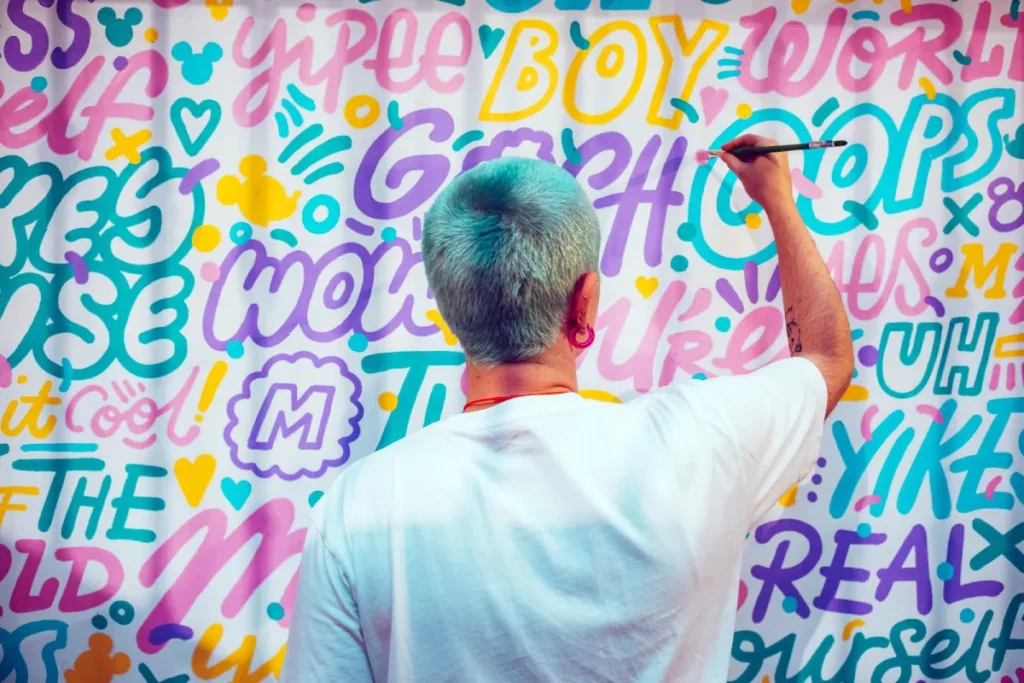
Creativity is not the only thing you need to become a graphic designer. This job requires a wide range of hard and soft skills.
Let’s take a closer look at some of them.
Hard Skills
A designer’s work is not just about Photoshop, even though you have to know this tool perfectly. But if you want to broaden your skill set and increase the chances of finding employment, learn other tools.
- Illustrator
- After Effects
- Figma
- CorelDRAW
- Sketch
- Blender
Mainstream tools include AI features that speed up ideation and production, such as Photoshop Generative Fill and Illustrator Generative Recolour, powered by Adobe Firefly; Canva’s Magic Design; and Figma AI, announced at Config 2024.
Use AI for rapid variants, content‑aware edits and palette exploration, then document prompts and rationale in your case study to show intent and control.
The State of Generative Design Tools in 2026, Adobe expanded Firefly models across Creative Cloud with commercial terms for enterprise, Figma began rolling out AI‑assisted editing and asset generation after its 2024 announcement, and Canva continued shipping AI‑assisted layout and copy features for non‑designers, per company announcements.
Baymard Institute’s 2025 UX research notes that users benefit when AI‑assisted imagery still respects accessibility and loading performance, so compress assets and keep contrast high in UI states.
I once audited a team that let AI outputs dictate colour and type, and simply adding manual QA and WCAG checks cut rework cycles in half.
Also, basic web design knowledge will come in handy. HTML, CSS, and the basics of UI/UX should be known for your career convenience.
Even if you don’t plan to work on website design directly, understanding where and how elements should be placed won’t hurt anyone.
However, ruling out web design completely from your career options is unwise.
And even then, you might create ad banners that will be placed on some websites. Therefore, knowing how an online advertisement is constructed is crucial.
Accessibility Basics (WCAG 2.1 AA)
Accessibility, quick definition, WCAG 2.1 AA is a W3C standard that sets testable requirements so people with disabilities can perceive, operate and understand digital products, which means designers must plan colour, type, structure and states for inclusive use.
- Target text contrast ratios of at least 4.5 to 1 for regular text, with 3 to 1 for large text, per WCAG 2.1 AA.
- Provide a non‑text contrast ratio of at least 3:1 for interactive components and meaningful graphics, per WCAG 2.1.
- Supply descriptive alt text for images and ensure focus states are visible, then test with a keyboard and a screen reader.
Touch target guidance from Apple Human Interface Guidelines suggests a minimum tappable area of 44 by 44 points, while Google Material Design recommends at least 48 dp, which improves mobile usability for all users.
The UK’s Design System embeds accessibility into components and guidance, demonstrating how large organisations operationalise WCAG across services.
BBC GEL has longstanding accessibility and typography guidance, which many media teams use to balance clarity and brand.
Transport for London’s use of Johnston type and high‑contrast signage improved legibility over the course of a century, a reminder that clarity outlasts trends.
Soft Skills
Creativity
Of course, one must possess creativity to become a designer. But it’s not enough.
Keeping your hand on the pulse of current trends and world events would be best.
Whatever happens in the world determines what people want to see or be attracted to. Beauty standards change faster than ever before – reflect it in your work.
Innovation
The ability to innovate/imagine outside the box matters, too.
Many artists claim that we’re already at that point where everything has been done before – whether it’s a movie plot, a musical production, or a poster – lots of things seem repetitive both online/offline.
If you want others to hear/see what you created, strive for novelty combined with a strong voice behind it.
Communication
Much negotiation happens between designers and clients; discussing branding strategies requires strong communication skills.
Talking about what should be done with somebody’s logo or website, who that person is, and what they want from it requires strong communication skills from both sides.
Sometimes, clients have outdated visions of things that no longer matter. Explaining this fact gently but firmly and offering an alternative idea might save the project’s future.
Negotiation
Very often, the client asks for changes to the final version of a project; sometimes, these alterations go beyond the initial instructions they gave.
In this case, troubleshooting or solving skills come in handy again: after a few more rounds were held between the parties involved, you will either make them see the light according to your vision or get paid extra money for doing so
Time management
This type of work needs time management. For a graphic designer, no matter how urgent the deadline is, they must meet it.
As a freelancer, your reputation with employers depends on this. Failure to complete a project on time will make them not want to hire you again.
This comes back to communication skills; you must discuss what suits both parties, including giving yourself enough time.
Business acumen
Knowing the trends in your market and negotiating well are vital, especially if you’re self-employed. Good business ethics will help one retain current customers and attract new ones.
Every step, from confirming orders ethically through accurate billing done up-to-code to final revisions, should be considered while doing any business, even with oneself, so that all bases might be covered; likewise, one should file taxes correctly, too.
Fonts are licensed under end‑user licence agreements, so desktop, webfont, app, and ebook licences differ by usage and seat, which you must confirm before delivery.
Creative Commons licences include conditions like Attribution, NonCommercial, ShareAlike and NoDerivatives, so check terms before remixing or using in paid work, per Creative Commons guidance.
Stock platforms like Adobe Stock and Shutterstock offer standard and extended licences, which vary by print runs, merchandise use and resale restrictions.
Monotype and other foundries enforce font licensing at the organisation level, so document purchases and keep receipts in your project archive.
Empathy
We must sometimes put ourselves in their shoes to communicate effectively with clients.
When someone asks for an old-fashioned design, what can easily escape our notice is that such styles appeal exclusively to their target audience.
Some people may not have enough money, but they can’t admit it openly due to fear or shame; therefore, recognising these signs and suggesting cheaper options would be helpful in most business settings.
Career Paths and UK Salary Benchmarks (2026)
The UK remains a global hub for the “Creative Industries,” contributing over £120bn to the economy annually.
- Junior Graphic Designer (Generalist): £24,000 – £30,000. Focuses on social media assets and basic layouts.
- UI/UX Designer: £35,000 – £55,000. Requires knowledge of Figma and user psychology.
- Motion/3D Designer: £40,000 – £60,000. High demand for advertising and gaming.
- Creative Lead / Art Director: £65,000+. Requires high-level strategy and team management.
Regional hubs like London, Manchester, and Bristol offer the highest density of roles, but 2026 has seen a massive rise in “Remote-First” agencies that hire based on the quality of your GitHub (for code-based design) or digital portfolio rather than your postcode.
Final words
It is a great responsibility to decide whether to attend college or pursue a course in graphic design, as this will shape one’s future.
However, this decision could be postponed if deemed urgent. For instance, abandoning such a plan midway through it is possible.
You may also temporarily interrupt your studies or even drop out of university because you are disenchanted with the program or overwhelmed by stress. Another example would be noticing that the course doesn’t meet your needs and joining a college as soon as possible.
Many young people with artistic talents dream of becoming graphic designers; this profession is excellent.
Look into the skills required for this field and evaluate your personality accordingly.
Check whether you possess the qualities required for creative jobs; if so, best of luck! If you go down this educational path, don’t forget to research college rankings to find a good school.
FAQ
Is it worth getting a graphic design degree in 2026?
Yes, if you want a deep foundation in design thinking, history, and a high-level network. However, if your goal is to start earning as quickly as possible in digital production, an intensive, industry-aligned bootcamp may offer a better immediate ROI.
How has AI changed the entry-level graphic design job market?
Entry-level roles now require “AI literacy.” Instead of just creating assets, juniors are expected to manage AI-driven workflows, curate outputs, and ensure all AI-generated content meets brand standards and legal copyright requirements.
Do I need to learn coding to be a graphic designer today?
While you don’t need to be a developer, understanding the basics of HTML, CSS, and how SVG code works is a massive advantage. It allows you to communicate effectively with engineering teams and understand the constraints of digital environments.
What is the most important skill for a designer in 2026?
Beyond technical tool proficiency, Empathy and Critical Thinking are the most vital. AI can create visuals, but it cannot understand human nuance, cultural context, or the complex emotional needs of a specific target audience.
Which software should I learn first?
Figma is currently the industry standard for digital and UI design. However, the Adobe Creative Cloud (specifically Photoshop and Illustrator) remains essential for high-fidelity asset creation and branding.