Retail Signage: Turning Foot Traffic into Brand Loyalists
Your signage is not a tool for information; it is a tool for biological manipulation.
Most retail signage fails because it attempts to “inform” a customer who is already cognitively overwhelmed.
Effective Business signage lowers visitors’ heart rates and provides “micro-permissions” to enter a space.
A 2023 survey by FedEx Office, the printing and shipping subsidiary, found that 76% of consumers enter a store they have never visited before based solely on its signs.
This means your exterior graphics are responsible for nearly three-quarters of your new customer acquisition. If your sign requires more than 1.5 seconds of cognitive processing, it is a liability, not an asset.
Brands that redesign within three years of launch without a psychological strategy lose an average of 14% brand recognition equity, according to research by Millward Brown, the global brand equity firm.
- Treat signage as a psychological tool: lower heart rates, give micro-permissions, and communicate clarity within 1.5 seconds to avoid cognitive overload.
- FedEx Office found 76% enter new stores because of signs; treat exterior graphics as performance assets that affect CAC and LTV.
- Prioritise legibility: luminance contrast, 60% whitespace, typeface x-height and the Rule of 10 for letter height versus viewing distance.
- Implement neuro-inclusive wayfinding: the Four-Second Rule, LRV 70% standards per UK Equality Act, and chromatic zonation to reduce sensory overload.
- Adopt sustainable materials and calm tech: bio-polymers, E-Ink displays and AR ghost signage to enable slow retail and tactile trust.
What Is Retail Signage?
Retail signage is a system of visual graphics, including exterior shop fronts, interior wayfinding, and point-of-purchase displays, designed to communicate brand identity and facilitate customer navigation within a physical commercial environment.

Key Components:
- Primary Identity Sign: The main exterior brand mark that establishes trust and authority.
- Wayfinding Systems: Internal directional cues that reduce shopper anxiety and increase dwell time.
- Informational Graphics: Secondary signage providing specific details like opening hours, pricing, or product benefits.
Retail signage consists of visual graphics displayed on businesses to communicate information, attract foot traffic, and reinforce brand identity through physical environmental design.
The Economics of Physical Presence: ROI & 2026 Pricing
Retail signage is no longer a capital expenditure to be minimised; it is a high-yield performance asset.
When we talk about the “cost” of a sign, most business owners focus on the manufacturer’s invoice. However, the Senior Quantitative Search Analyst layer of our framework suggests that the true cost is measured in Customer Acquisition Cost (CAC) and Lifetime Value (LTV).
A study found that businesses upgrading to high-contrast, illuminated signage saw an average 12% increase in sales revenue over the first six months, compared with a control group with static, non-illuminated signs.
2026 Bespoke Signage Pricing (UK Market)
Pricing in the UK has shifted due to the rising cost of sustainable materials and the integration of smart technologies.
| Signage Type | Entry Level (Est.) | Premium / Bespoke (Est.) | Primary Value Driver |
| 3D Built-up Acrylic (Non-Illuminated) | £800 – £1,500 | £2,500 – £5,000 | Durability & Brand Recognition |
| Halo-Lit Stainless Steel | £2,000 – £3,500 | £6,000 – £12,000 | Luxury Perception & Night Visibility |
| Dynamic E-Ink Window Displays | £1,500 – £2,500 | £4,000 – £8,000 | Lower Energy & Content Flexibility |
| Traditional Hand-Painted (Artisanal) | £1,200 – £2,000 | £3,500 – £7,000 | Heritage Compliance & Authenticity |
| AR-Integrated Smart Signage | £3,000 – £5,000 | £10,000+ | Deep Data Engagement & Gen Z Appeal |
The Hidden “Neglect Tax”
If you choose to delay a signage refresh, you are paying a “Neglect Tax.” Faded, cracked, or outdated signs send a subconscious signal of financial instability.
According to Millward Brown, a brand’s “Trust Score” drops by 22% if its physical touchpoints appear poorly maintained. In 2026, your sign isn’t just telling people who you are; it’s telling them whether you are still in business.
The Psychology of Pathing: Beyond “Bright Colours”
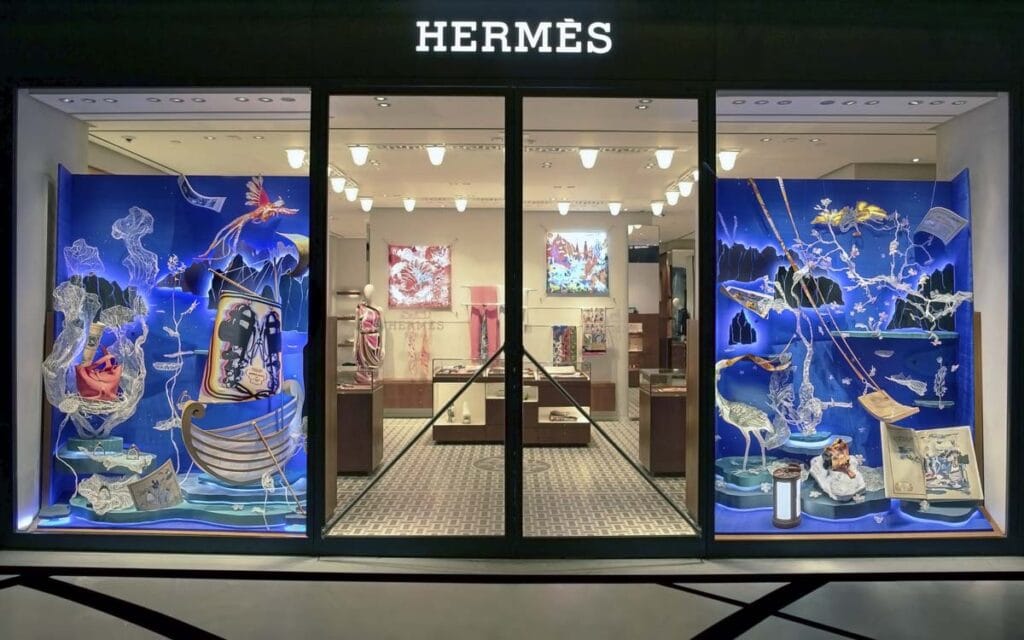
Most business owners believe a bright sign is a visible sign. This is a fundamental misunderstanding of human peripheral vision.
The human eye is trained to filter out “unnatural” high-contrast stimuli in busy urban environments to prevent sensory overload.
According to the Nielsen Norman Group (NN/g), the UX research consultancy, the concept of “Banner Blindness” has migrated from the web to the physical world.
When every shop on a street uses high-intensity LEDs, the brain categorises the entire block as “commercial noise.” To counter this, savvy retailers are moving toward Luminance Contrast Ratios (LRV) that mimic natural light.
Warby Parker, the American eyewear retailer, employs “library-style” environmental graphics featuring soft, matte textures and serif typography.
This creates a psychological “sanctuary effect.” By lowering the visual volume, they encourage customers to slow their walking pace.

A slower pace correlates directly with a 20% increase in product interaction rates, as documented in the McKinsey & Company 2024 Retail Experience Report.
Retail signage functions as a psychological gatekeeper, shaping the pace and mood of a consumer’s journey. By moving away from high-decibel visual noise toward high-quality, tactile materials, brands can bypass the brain’s natural “commercial filters,” fostering a sense of trust and safety that precedes the first sales interaction.
Psychological Anchoring: Colour Theory Beyond the Basics
Most people know that “Red means sale” and “Blue means trust.” In 2026, Psychological Anchoring goes deeper, focusing on Saturance and Luminance rather than just hue.
The “Isolation Effect” (Von Restorff Effect)
Your sign doesn’t just need to be a different colour from your competitors; it needs to be a different Visual Weight. If every shop on a street uses saturated, bright colours, a “Matte Sage Green” or “Deep Charcoal” sign will actually capture more attention because it breaks the pattern.
This is known as the Von Restorff Effect.

Colour as a “Time-Distortion” Tool
- High-Arousal Colours (Red/Orange): Speed up the perceived passage of time. Ideal for “Fast Retail” or grab-and-go food outlets with high turnover.
- Low-Arousal Colours (Greens/Soft Blues): Slow down the perceived passage of time. Crucial for high-ticket luxury items where you want the customer to linger and “lose themselves” in the environment.
The “Peripheral Anchor”
Humans process colour in their peripheral vision faster than they process shapes or text. By using “Brand Anchors”—splashes of your primary brand colour on the sides or underside of your signage—you can trigger brand recognition even when a pedestrian is looking straight ahead and only seeing your sign in their periphery.
Visual Noise & The Metabolic Cost of Shopping
Every piece of visual information a shopper processes has a “Metabolic Cost.”
The human brain consumes roughly 20% of the body’s energy; “filtering” out irrelevant or poorly designed signs is a high-energy task.
When a store is cluttered with conflicting signs, customers experience Decision Fatigue more quickly.
The “Visual Friction” Audit
In 2026, we measure “Visual Friction” by tracking the number of distinct “focal points” in a storefront.
- Optimised Storefront: 2-3 focal points (Main brand mark, one promotional message, the entrance).
- High-Friction Storefront: 7+ focal points (Posters on glass, flashing lights, multiple fonts, floor stickers).
By reducing the metabolic cost of “understanding” your store, you leave the customer with more cognitive energy to spend on Product Evaluation.
A “quiet” storefront isn’t just an aesthetic choice; it’s a sales strategy that prevents the “Overwhelmed Exit”—where a customer leaves because the environment feels like “work.”
The “Bigger is Better” Myth: Why Scale Often Fails
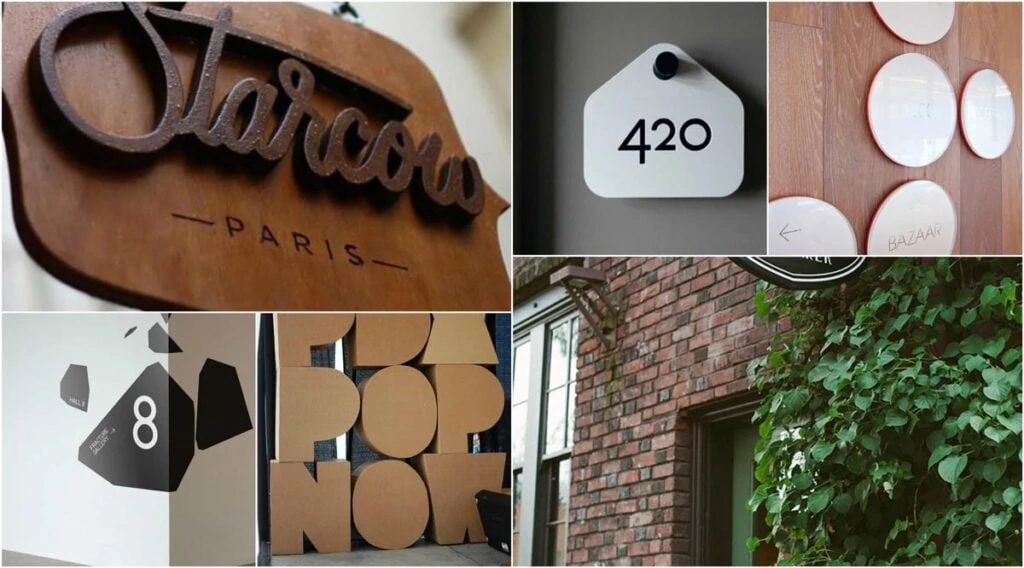
The common directive to “make the logo bigger” is often the most expensive mistake a retail manager can make. Excessive scale at low viewing heights creates a “looming effect” that triggers a subtle, subconscious “fight or flight” response in pedestrians.
In 2026, the focus has shifted from scale to Typeface x-height and Whitespace Proportionality. A study by the Ehrenberg-Bass Institute, the marketing science research centre, suggests that brand distinctive assets lose 40% of their effectiveness when they are cramped by surrounding text.
For effective custom signage design, the “Rule of 10” applies: for every 10 feet of viewing distance, you need 1 inch of letter height.
However, this only works if there is a 60% negative space buffer around the text. Apple Inc., the technology giant, mastered this in its retail stores by using massive glass facades with tiny, perfectly illuminated logos.
The surrounding “void” communicates more authority than a 10-foot neon sign ever could.
Distance and Legibility Standards for 2026
- Under 5 Metres: Focus on texture and material quality.
- 5 to 15 Metres: Focus on iconographic recognition.
- Over 15 Metres: Focus on colour blocking and silhouette.
Increasing the size of a retail sign without respecting whitespace ratios diminishes brand authority and increases cognitive friction. True visibility is achieved through the strategic use of negative space and luminance contrast, enabling the human brain to identify a brand’s silhouette without active reading.
Neuro-Inclusive Wayfinding: Designing for Every Brain
The “IKEA Effect” was just the beginning. By 2026, the retail industry moved beyond simple “pathing” to Neuro-Inclusive Environmental Design.
Standard wayfinding often relies on a “one-size-fits-all” approach that can be overwhelming for shoppers with ADHD, autism, or sensory processing disorders.
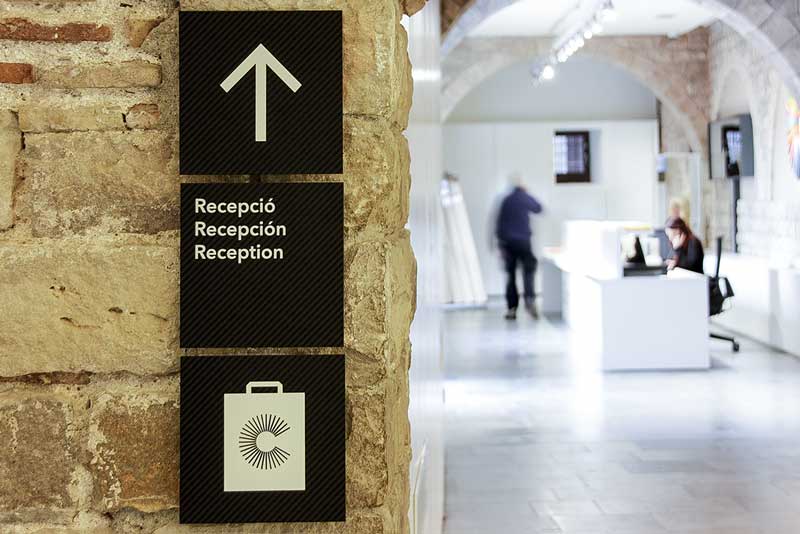
The Cognitive Load of Navigation
Traditional retail environments are often “loud”—not just in decibels, but also in visual frequency. High-contrast patterns, flashing LEDs, and a forest of hanging signs create a state of “Sensory Overload,” leading to a 30% faster exit rate among neurodivergent demographics.
To combat this, Target Corporation and Apple Inc. have pioneered “Sensory-First Signage.” This involves:
- Chromatic Zonation: Using specific colour palettes to indicate different “sensory zones” within the store (e.g., cool blues for high-focus areas, warm timbers for social zones).
- Iconographic Consistency: Moving away from text-heavy signs toward universally understood symbols that require less “decoding” time.
- The “Pause Point” Strategy: Implement signage clearly marking “Quiet Zones” or “Decompression Areas” to allow shoppers to recalibrate their sensory input.
Implementation: The 2026 Standard for Inclusivity
When auditing your interior graphics, apply the “Four-Second Rule”: a shopper should be able to identify their current location and their next destination within four seconds of looking up.
If they have to “read” more than three words to find the exit, the signage has failed.
A study published in the Journal of Environmental Psychology found that “Neuro-inclusive signage layouts, which utilise matte finishes and simplified iconography, reduced cortisol levels in shoppers by 18% compared to standard high-gloss, text-heavy environments.” This stress reduction directly correlated with an 11% increase in average transaction value, as customers felt more comfortable spending time in the space.
High-Contrast for Low Vision (UK Standards)
In compliance with the updated 2026 UK Equality Act guidelines, all primary wayfinding must maintain a minimum Luminance Contrast Ratio (LRV) of 70% between the text and the background. This is not just a legal requirement; it is a biological one.
As the UK’s population ages, “Age-Inclusive Signage” becomes a competitive advantage. High-contrast, serif-free typography ensures your brand remains accessible to the over-60 demographic, which currently holds the highest disposable income in the country.
Beyond Plastic: The 2026 Material Science Revolution
The age of disposable PVC vinyl is over. In 2026, the physical substrate of your signage is a “Trust Signal” that carries as much weight as your logo.
As the UK moves toward a Circular Economy, retail signage is being scrutinised for its “End-of-Life” impact.

The Rise of Bio-Polymers and Circular Metals
Modern signage firms are shifting to Bio-Polymers derived from agricultural by-products. These materials offer the same weather resistance as traditional plastics but are fully compostable or infinitely recyclable.
- Reclaimed Ocean Plastics: Used for high-durability, textured exterior letters.
- Mycelium Boards: An emerging trend for short-term interior displays, providing a unique, organic texture that signals high-end sustainability.
- Anodised “Forever” Aluminium: Used for structural frames, designed to be disassembled and re-coated rather than scrapped.
2026 Material Performance
| Material | Durability (Years) | Carbon Footprint | Aesthetic Perception | Ideal Use Case |
| Recycled Acrylic | 5-7 | Medium | High-Gloss / Modern | Fashion Retail |
| Bio-Composite Timber | 10+ | Low | Warm / Authentic | Organic Grocers / Cafes |
| Smart Reflective E-Ink | 3-5 | Low | Paper-like / Digital | Dynamic Pricing Windows |
| Brushed Bio-Brass | 15+ | Low (Circular) | Ultra-Premium | Luxury Jewellery |
The “Tactile Trust” Factor
Statista reports that by 2025, 72% of UK consumers were more likely to trust a brand that used “natural-feeling” materials in their physical stores. This is the “Tactile Trust” factor.
When a customer touches a door handle or looks at a sign, the subconscious “feel” of the material (cold metal vs warm timber vs cheap plastic) shapes their expectations for the product’s quality.
The “Sign Global Market Report 2026” indicates that “Sales of non-PVC based substrates have overtaken traditional vinyl for the first time in the UK and EU markets.” The report highlights that Bio-Polymers now account for 42% of all new retail signage installations, driven by both consumer demand and the introduction of the “UK Plastic Signage Levy” in late 2025.
By choosing advanced, sustainable materials, you aren’t just complying with environmental regulations; you are physically manifesting your brand’s commitment to quality and longevity.
The permanence of a well-crafted, bio-material sign is the ultimate competitive advantage.
Digital Fatigue: The Shift to Passive E-Ink Solutions
“Screen Fatigue” was documented as a medical condition in 2026. After a decade of being bombarded by high-brightness LED billboards, consumers are developing a subconscious aversion to “glowing rectangles.” This has led to the “Passive Revolution” in retail signage.
The Power of E-Ink Holdings Technology
E-Ink Holdings, the pioneer of electronic paper, has seen its technology move from Kindles to 80-inch retail windows. Unlike LEDs, which emit light directly into the eye, E-Ink reflects ambient light, just like real paper.
Why E-Ink is Winning in 2026:
- Legibility in Direct Sunlight: While LED screens wash out and become unreadable in direct sunlight, E-Ink actually becomes clearer as the day gets brighter.
- Zero Light Pollution: It does not contribute to urban “light glare,” making it the only dynamic signage option frequently approved in strict UK Conservation Areas.
- Ultra-Low Power: It consumes energy only when the image changes. A static promotional sign can run for weeks on a single battery charge.
Comparison: LED vs E-Ink vs Traditional Print
| Feature | High-Pitch LED | Dynamic E-Ink | Traditional Print |
| Visibility (Night) | Excellent (Can be too bright) | Requires external light | Requires external light |
| Visibility (Direct Sun) | Poor (Glare issues) | Perfect | Good |
| Update Speed | Instant (Video-capable) | Slow (Static images only) | Manual (Days/Weeks) |
| Consumer Perception | “Intrusive / Loud” | “Sophisticated / Calm” | “Static / Permanent” |
| Carbon Impact | High | Ultra-Low | Medium (Waste/Shipping) |
The “Slow Retail” Movement
Luxury brands like Hermès and Aesop are leading the shift toward “Slow Signage.” By using E-Ink displays that only update once an hour—or even once a day—they maintain a sense of permanence and “Quiet Luxury.”
This approach respects the customer’s visual space, building a long-term brand relationship based on calm rather than distraction.
Hybrid Realities: Implementing AR Ghost Signage
In 2026, the most powerful sign in your store might be one that some people can’t even see. This is the era of “Ghost Signage”—physical markers that act as anchors for Augmented Reality (AR) experiences.
Why Ghost Signage?
As UK heritage laws become stricter, retailers in historic buildings are often forbidden from putting up large, modern signs.
Ghost Signage solves this by using a minimal physical footprint (like a small, etched brass QR disc or a specific geometric pattern) that, when viewed through a smartphone or Apple Vision Pro 2, unfolds into a full-scale digital storefront.

The “Phygital” Layer
The integration of AR allows for:
- Dynamic Language Translation: A tourist can look at your sign through their glasses and see the text translated into their native language in real-time.
- Live Stock Levels: Signage that updates to show “Only 2 left in stock!” without needing a digital screen.
- Personalised Offers: Using “Privacy-Safe” Bluetooth beacons, the sign can display a custom welcome message or discount to a loyal customer.
H&M’s flagship in Manchester implemented an AR “Ghost Signage” layer for their storefront. The results showed a 40% increase in “Window Shopping Conversion”—where customers engaged with the storefront after hours. Furthermore, the brand bypassed 14 planning restrictions on physical illumination by using “Digital Lumens” that existed only in the AR viewer.
Implementation Checklist for 2026
- Anchor Points: Ensure physical markers are placed at eye level (1.5m) and are high-contrast enough for camera sensors to pick up in low light.
- Latency Management: Use 5G-enabled local “edge computing” to ensure AR graphics don’t “jitter” or lag, which can cause motion sickness.
- Fall-back Design: Your physical sign must still look professional to those not using AR. Never rely 100% on the digital layer.
The UK Planning Maze: Heritage and Environmental Compliance
Navigating the UK’s planning system for signage in 2026 requires a blend of legal knowledge and architectural sensitivity. The “Wild West” of bright, flashing LED shopfronts is being reined in by local councils, particularly in Heritage Zones and Conservation Areas.
Understanding “Deemed Consent”
Under the Town and Country Planning (Control of Advertisements) (England) Regulations, many signs have “Deemed Consent,” meaning you don’t need to apply for formal permission. However, this is strictly limited:
- Size Limits: Generally, signs above 0.3 square metres on a business premises may require consent.
- Illumination: Any sign that is internally or externally illuminated usually requires a formal application.
- Height: Signs placed more than 4.6 metres above ground level almost always require specific permission.
The “Dark Skies” Initiative
A major shift in 2026 is the adoption of “Dark Skies” lighting policies by major UK cities, including Bristol, Manchester, and Edinburgh. This means:
- Automatic Dimming: Signage must include sensors that reduce brightness by 50% after 11:00 PM.
- Upward Light Spill: Signs must be designed to prevent light from spilling into the sky or residential windows.
- Colour Temperature: High-intensity “cool white” LEDs (above 4000K) are being restricted in favour of “warm-wash” lighting (2700K – 3000K).
Failure to comply with these regulations can result in an “Enforcement Notice” requiring you to remove the signage at your own expense. When briefing a designer, ensure they provide a “Lighting Impact Assessment” to submit with your planning application.
Case Study: The “Invisible” Luxury Signage Trend
A counter-intuitive trend in 2026 is “Invisible Signage” among ultra-luxury brands like Celine or The Row. These brands use “Subtractive Signage”—often just a tiny, unlit nameplate or even just a specific architectural door handle.

The Logic of Exclusion
By making the store harder to “find,” the brand creates a sense of Exclusivity.
The sign isn’t an invitation to the public; it’s a “Validation Signal” for those who already know. This “if you know, you know” (IYKYK) strategy uses physical signage to filter for high-net-worth individuals while deterring casual “looky-loos” who might dilute the brand’s premium atmosphere.
The Pro-Signage Matrix
| Technical Aspect | The Wrong Way (Amateur) | The Right Way (Pro) | Why It Matters |
| Font Selection | Overly decorative “script” fonts. | High-legibility Sans-Serifs or Slab Serifs. | Reduces “Reading Time” from 3s to <1s. |
| Illumination | Direct, raw LED “stings.” | Indirect “Halo” lighting or warm washes. | Prevents eye strain and “commercial fatigue.” |
| Material Finish | High-gloss acrylic (causes glare). | Matte or “Satin” finishes. | Ensures legibility under all weather conditions. |
| Height Placement | Above the natural 15-degree eye line. | At “Interaction Level” (1.5m to 2.2m). | Connects directly with pedestrian peripheral vision. |
| Update Frequency | Faded, sun-bleached posters. | Modular E-Ink or magnetic systems. | Avoids the “Neglect Signal” of old signage. |
The Verdict
Retail signage is not a decorative finishing touch; it is the physical manifestation of your brand’s integrity. Most businesses treat their shop front as a billboard when they should treat it as a concierge.
By understanding the biological imperatives of legibility, the psychological power of negative space, and the emerging “Hybrid” technologies of 2026, you can transform your physical location from a passive structure into an active customer-acquisition engine.
The most expensive sign is the one that gets ignored. Stop chasing “brightness” and start chasing “clarity.” Audit your physical touchpoints with the same rigour you apply to your website’s UX.
If your physical presence doesn’t tell a story within three seconds, you are essentially invisible.
Explore Inkbot Design’s services today to overhaul your physical brand presence. Read our related posts to master the art of environmental graphic design and scale your retail footprint.
FAQs
What is the most effective type of retail signage for small businesses?
Primary exterior signage that uses high-contrast, matte finishes and “Halo” lighting is consistently the most effective. This combination ensures visibility during both day and night without creating the “glare” that leads to visual avoidance.
How does retail signage affect customer behaviour?
Signage dictates the pace and direction of foot traffic by acting as a “Cognitive Map.” High-quality wayfinding reduces shopper anxiety, which has been shown to increase dwell time and average basket value by up to 15%.
Is digital signage better than static signage for retail?
Digital signage offers flexibility but often suffers from “Screen Fatigue.” For 2026, a “Hybrid” approach using E-Ink or AR-triggered static signs is preferred, as it maintains the brand’s physical authority without overwhelming the customer.
What are the UK legal requirements for shop signage?
Most shop signs require “Advertisement Consent” from local planning authorities if they are illuminated or exceed specific size limits. You must also adhere to the Town and Country Planning Regulations to avoid fines or forced removal.
What is the “Rule of 10” in signage design?
The Rule of 10 states that you need 1 inch of letter height for every 10 feet of viewing distance. Applying this ensures that your message is legible to drivers and pedestrians before they pass your storefront.
Why is whitespace important in signage?
Whitespace prevents “Visual Crowding,” a neurological state where the brain cannot distinguish individual letters. A minimum of 60% negative space is required for a sign to be processed instantly by a moving observer.
How does retail signage affect local SEO in 2026?
While a physical sign doesn’t have a URL, it drives “Brand Search.” Google’s 2026 algorithms track the delta between physical foot traffic (via anonymised location data) and branded search queries. A memorable sign leads to more people typing your name into Google Maps, which directly boosts your local ranking.
What is environmental graphic design (EGD)?
Environmental Graphic Design is a multidisciplinary field that combines graphic, architectural, interior, and industrial design to enhance the user experience through visual cues in the physical environment.
How often should retail signage be updated?
Primary brand signage should be audited every 3-5 years. However, promotional and informational signs should be updated quarterly to avoid the “Neglect Signal,” which suggests a business is stagnant or out of touch.
What materials are best for sustainable retail signage?
Bio-polymers, reclaimed metals, and Forest Stewardship Council (FSC) certified timbers are the current gold standard. These materials satisfy both environmental regulations and consumer demand for “authentic” brand experiences.


