Psychographics vs Demographics for Customer Segmentation
There is a slide that consultants love to project on the wall during expensive strategy workshops. On the left, you have King Charles III. On the right, you have Ozzy Osbourne.
Look at the data:
- Sex: Male
- Year of Birth: 1948
- Nationality: British
- Marital Status: Remarried
- Children: Two
- Wealth: High Net Worth
- Residence: A castle (or castle-equivalent)
Demographically, they are the same person. If you target your luxury travel ads based on age, gender, and income, you are pitching the same holiday to the Prince of Wales and the Prince of Darkness.
One wants a quiet week painting watercolours in Transylvania; the other wants… well, whatever Ozzy wants these days.
This is the failure of demographics. It describes the skeleton of your customer, but it ignores the soul. Yet, most SMB owners and entrepreneurs still treat target audiences as a checklist of statistical traits. You are burning money on “Males, 18-35” while your competitors are stealing your market share by targeting “Anxious Status-Seekers.”
This article is not a fluff piece about “getting to know your customer.” It is a forensic breakdown of psychographics vs. demographics—why the old models are flawed, and how to fix them before your ad spend evaporates.
- Demographics tell you who the customer is; use them as filters for reach and logistics, not as the sole targeting method.
- Psychographics reveal why customers buy—values, fears, and motivations drive messaging and dramatically improve conversion.
- Best practice: layer demographics, psychographics, and behavioural triggers for precise, scalable segmentation and higher ROI.
The Direct Answer: What is the Difference?
To reduce the cost of retrieval, here is the technical distinction immediately.
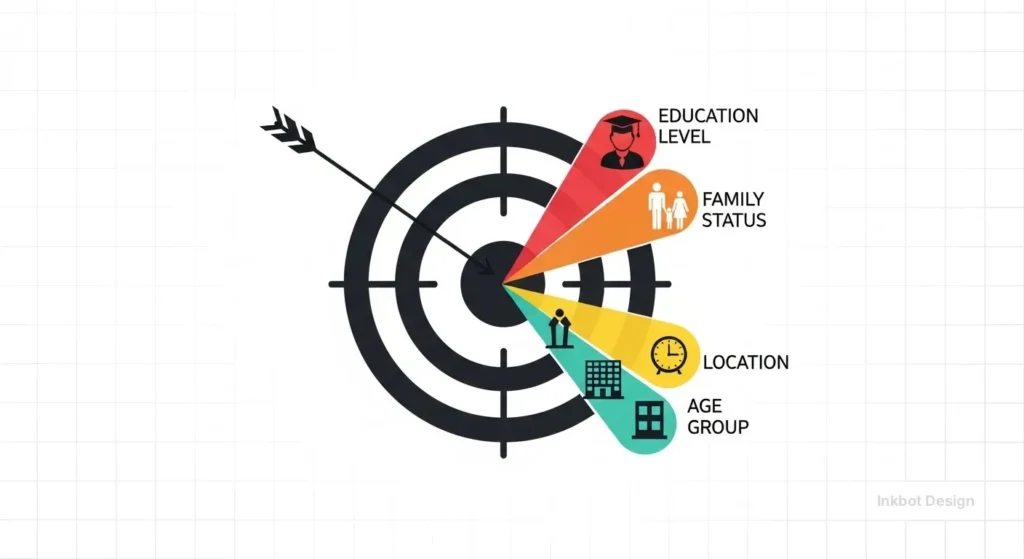
Demographics are the quantifiable statistics of a population. They explain “Who” the buyer is. They are objective, verifiable facts.
- Key Data Points: Age, Gender, Income, Job Title, Postcode, Education Level.
Psychographics are the intrinsic traits that drive behaviour. They explain “Why” they buy. They are subjective, qualitative, and often hidden.
- Key Data Points: Values, Attitudes, Interests, Lifestyle, Personality Traits (VALS), Opinions.
The Consultant’s Rule: Demographics help you reach the customer (media planning). Psychographics help you convert the customer (creative messaging).
1. Demographics: The Necessary Evil
We cannot discard demographics entirely. They are the scaffolding. You need to know if your customer can afford your product (Income) or if they live in a region where you ship (Location). But in 2026, relying solely on demographics is negligence.
The Limitations of “The Who”
Historically, marketers relied on demographics because that was the only data available at the time. In the Mad Men era, you bought TV slots based on Nielsen ratings for “Housewives, 25-45.”
The problem arises when you assume shared demographics equal shared intent.
Consider the demographic segment: “Unmarried Women, 28-32, London, £40k+ Salary.”
In this group, you have:
- The Career Climber: Saves 40% of income, hates clutter, buys high-end minimalist furniture.
- The Socialite: Spends 110% of income, buys fast fashion, eats out five nights a week.
If you sell investment ISAs, the demographic targeting hits both. But you wasted 50% of your budget on the Socialite who isn’t interested.
When Demographics Do Matter
Demographics are effectively filtering mechanisms. They are best used to exclude rather than include.
- B2B: If you sell Enterprise software, you must filter by Company Size (500+ employees).
- Luxury: If you sell £5,000 watches, you filter by Income.
- Local Services: If you are a plumber, Postcode is your god.
However, once you have filtered the pool, demographics become less useful. That is where the real work begins.
2. Psychographics: The Engine of Conversion
Psychographics classifies people according to their psychological attributes. It is the study of AIOs: Activities, Interests, and Opinions.
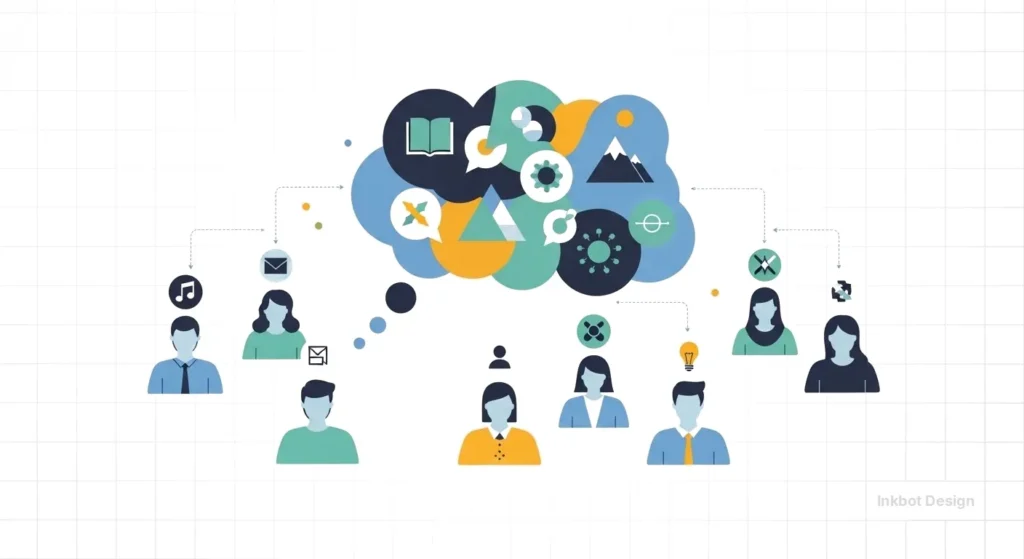
This is where you find the “Unique” attribute in your marketing strategy. While your competitor targets “Yoga Teachers” (Demographic/Job), you target “People who believe holistic health is a rebellion against Big Pharma” (Psychographic/Value).
The VALS Framework (Values, Attitudes, Lifestyles)
Developed by SRI International, the VALS framework is the gold standard for psychographic segmentation. It divides adults into eight types based on their resources and primary motivation.
- Innovators: Sophisticated, high self-esteem. Image is important as an expression of taste, not status.
- Thinkers: Mature, satisfied, reflective. Value order and knowledge.
- Achievers: Goal-oriented, conservative. They value stability and products that demonstrate success to peers.
- Experiencers: Young, enthusiastic, impulsive. They spend on fashion and entertainment.
- Believers: Conservative, conventional. Concrete beliefs based on family/religion.
- Strivers: Trendy and fun-loving. Motivated by achievement but lacks the resources of Achievers.
- Makers: Practical, self-sufficient. They express themselves by building or fixing things.
- Survivors: Narrowly focused lives. Cautious consumers.
If you are Inkbot Design, creating a brand identity for a new disruptive fintech app, we are not targeting “Bankers.” We are targeting Innovators who despise traditional banking friction, or Strivers who want to feel like they are gaming the system. The logo, tone of voice, and UX will differ significantly between these two psychographic profiles, even if they have the same bank balance.
The “Big Five” Personality Traits (OCEAN)
Advanced marketers use the OCEAN model to tailor messaging:
- Openness: Targets who love novelty (Early Adopters).
- Conscientiousness: Targets who love plans, data, and reliability.
- Extraversion: Targets who need social proof and community.
- Agreeableness: Targets who value harmony and charity.
- Neuroticism: Targets who respond to Fear, Uncertainty, and Doubt (FUD).
Real-World Application:
Cambridge Analytica (ethics aside) proved the power of this. They didn’t just target “Republicans.” They targeted “Neurotic Republicans” with fear-based ads and “Agreeable Republicans” with community-based ads. The result was a level of persuasion that demographics could never achieve.
Psychographics vs. Demographics
Demographics are just boring facts (Age, Income). Psychographics are the hidden triggers that drive purchases (Fears, Values).
Select a profile below to see how adding “Psychographics” completely changes the way you sell to them.
The Evidence: Real-World Failures and Successes
We promised you no fluff. Here is the data.
The Failure: Bic for Her (2012)
The Error: Lazy Demographic Segmentation.
Bic released a line of pens called “Bic for Her.” They took a standard product, made it pink, and increased the price.
The Logic: “Target Audience = Women.”
The Reality: Women do not have a psychographic need for “gendered writing instruments.” Their need is “a pen that works.”

The Result: Widespread mockery, a PR disaster, and Amazon reviews that became legendary for their sarcasm (“It fits perfectly in my delicate female hand…”).
The Lesson: Gender is a demographic. It is rarely a need state.
The Success: Harley-Davidson’s “Rubbies”
The Shift: From Outlaws to Weekend Warriors.
In the 1980s, Harley-Davidson was failing. Their demographic (blue-collar rebels) was ageing out or couldn’t afford new bikes.
The Insight: They identified a new psychographic segment: The “Rich Urban Biker” (Rubbie). These were doctors, lawyers, and accountants (high-income demographics) who craved a sense of freedom and rebellion on the weekends (psychographic need).

The Execution: Harley didn’t market “smooth rides for bad backs.” They marketed the spirit of the outlaw. They sold the leather jacket fantasy to men who wore suits Monday to Friday.
The Result: A Brand Turnaround That Became a Business School Case Study.
Note: According to a study by McKinsey, companies that leverage psychographic insights outperform their peers by 85% in sales growth. This is not a “nice to have.” It is a competitive moat.
Methodology: How to Gather Psychographic Data (Without Being Creepy)
This is the number one question we get at Inkbot Design: “I don’t have a million-pound budget for focus groups. How do I get this data?”
You don’t need a focus group. You need to be observant.
The “Digital Exhaust” Method
People leave trails of their psychographics everywhere.
- Reddit & Forums: Visit the Subreddits where your audience congregates. Don’t look at what they are buying. Take a look at what they are complaining about. Are they complaining about price (Price Sensitivity)? Or are they complaining about poor customer service (High Expectations/Status)?
- Review Mining: Read the 1-star and 5-star reviews of your competitors.
- 5-Star: “It made me feel so professional.” (Psychographic: Status/Identity).
- 1-Star: “Too complicated to set up.” (Psychographic: Low Tech-Patience/Convenience Seeker).
- Social Listening: Use tools to track keywords. If your audience frequently uses words like “sustainable,” “ethical,” or “carbon footprint,” you have a Values-based segment.
The “Jobs to Be Done” Interview
Stop asking customers “How old are you?” Ask them:
- “What was happening in your life the moment you decided you needed this product?”
- “What other solutions did you try and hate?”
- “What were you afraid would happen if you didn’t buy this?”
These questions reveal the Trigger, the Barrier, and the Anxiety. That is pure psychographics.
The Survey Trap (Warning)
Be careful with surveys. If you ask, “Do you care about the environment?”, 90% will say “Yes” (Social Desirability Bias).
Instead, ask for behavioural trade-offs: “Would you pay £5 extra for plastic-free packaging?”
The answer to that question reveals the truth.
B2B Context: Firmographics vs Psychographics
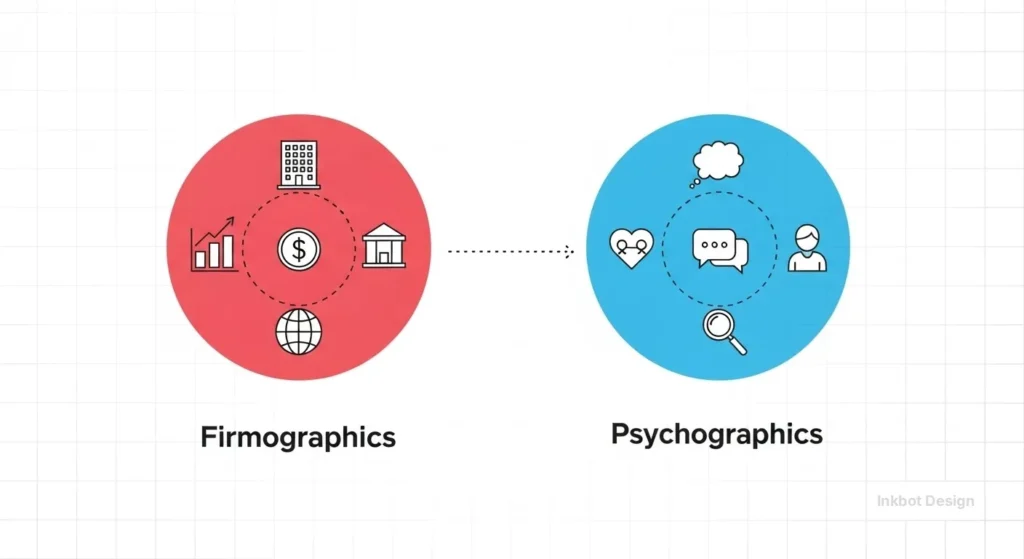
In B2B, we often replace Demographics with Firmographics (Company Size, Revenue, Industry). But B2B buyers are still humans. They have psychographics too.
A CTO at a startup (Risk-Taker, Speed-Oriented) has a different psychographic profile than a CTO at a bank (Risk-Averse, Compliance-Oriented), even if they buy the same server space.
B2B Psychographic Segments:
- The Scaler: Obsessed with growth hacking. Wants tools that deploy in minutes.
- The Stabiliser: Obsessed with uptime and security. Wants SLAs and 24/7 support.
- The Innovator: Wants to use the “coolest” new tech stack to attract talent.
If your digital marketing services pitch focuses on “Stability” to a “Scaler,” you will lose the deal.
| Feature | Demographics/Firmographics | Psychographics |
| Focus | Statistical Facts | Cognitive/Emotional Drivers |
| Example | “Manufacturing Co, £50M Rev” | “Risk-averse, fears downtime” |
| Marketing Use | List Building (Sales Nav) | Copywriting & Sales Scripts |
| Longevity | Changes slowly | Can change instantly with market mood |
| Cost to Acquire | Low (Public records) | High (Requires research/empathy) |
The Reality Check
I once audited a client, a premium coffee roaster. Their “Avatar” document was beautiful. It had a stock photo of a guy named “Barista Bob.”
It said: Bob is 28. He lives in Manchester. He likes coffee.
This is useless. It is barely a hallucination of a strategy.
We analysed their actual sales data and interviewed their top customers.
The reality? Their most profitable segment wasn’t “Barista Bob.” It was “The Home Perfectionist.”
- Demographics: 40-55, High Income, Suburban.
- Psychographics: Obsessive about gear. Values ritual over caffeine buzz. Sees coffee making as a moment of zen in a chaotic, high-stress corporate life.
We changed the copy from “Great tasting coffee for cool people” to “The precision roast for your morning ritual.”
Conversion rate increased by 220%.
Stop building “Bob.” Start building segments based on pain and desire.
You can map these psychographic shifts using customer journey mapping, ensuring you hit the right emotional note at every touchpoint.
The State of Segmentation in 2026: The AI Shift

We are moving into an era of Predictive Psychographics.
In the past, you had to guess psychographics. Now, AI platforms can analyse thousands of data points (click depth, scroll speed, vocabulary used in emails) to assign a psychographic score in real-time.
Recent Shift (2025-2026):
The death of the third-party cookie has actually helped psychographics. Because we can no longer easily track people across the web, brands are forced to build “First-Party Data” communities.
- Brands are now using quizzes (“What is your skin type?”) not just to recommend products, but to tag users with psychographic labels (“Anxious about ageing” vs “Prone to acne”).
- This data is owned by you, not Facebook. It is an asset on your balance sheet.
If you are not collecting zero-party data (data that users intentionally provide), you are falling behind.
Putting It Together: The Segmentation Stack
So, how do you actually use this? You layer them.
Step 1: The Filter (Demographics)
- Define the “Must-Haves.”
- Example: UK Residents, Household Income £60k+, Homeowners.
Step 2: The Focus (Psychographics)
- Define the “Values.”
- Example: Values aesthetics, hates DIY, wants “done-for-you” service, fears property devaluation.
Step 3: The Behaviour (Action)
- Define the “Triggers.”
- Example: Recently searched for “architects near me,” visited interior design blogs.
Step 4: The Message
- Don’t say: “We do landscaping for high-income homeowners.” (Demographic).
- Say: “Reclaim your weekend. We transform your garden into the sanctuary you deserve.” (Psychographic).
This approach creates market segmentation that is robust, scalable, and highly resonant.
The Verdict
The debate of Psychographics vs Demographics is a false dichotomy. You need both. But the hierarchy is clear.
Demographics are the Logistics of your marketing. They tell you where to place the ad and how much to bid.
Psychographics are the Persuasion of your marketing. They tell you what to say to get the credit card out.
If you rely only on demographics, you are shouting into a crowded room, hoping someone shares your birthday. If you master psychographics, you are whispering a secret into the ear of the one person who has been waiting to hear it.
Stop marketing to spreadsheets. Start marketing to minds.
Next Steps
If you are tired of guessing who your audience is and want a data-backed strategy to define them, we can help.
- Request a Quote: Let’s discuss your brand strategy. Contact Inkbot Design.
- Read More: Deep dive into how we handle Customer Journey Mapping to visualise these segments.
Frequently Asked Questions (FAQ)
What is the main difference between demographics and psychographics?
Demographics refer to statistical data that describe who your customers are (age, gender, income, location). Psychographics refer to qualitative data that describe why people buy (values, attitudes, interests, lifestyle, and personality). Demographics are the skeleton; psychographics are the soul.
Can I use psychographics for B2B marketing?
Absolutely. In B2B, this is often referred to as “firmographics,” combined with the personal psychographics of the decision-maker. For example, targeting a “Risk-Averse CIO” requires a completely different messaging strategy (with a focus on security/compliance) than targeting a “Growth-Obsessed Founder” (with a focus on speed/revenue), even if the companies are the same size.
How do I collect psychographic data without a large budget?
You don’t need expensive focus groups. Use “Digital Exhaust.” Analyse Reddit threads in your niche to see what users complain about. Read competitor reviews to understand the emotional triggers that drive their customers’ purchasing decisions. Use social listening tools to track value-based keywords. Additionally, consider implementing post-purchase surveys that ask, “Why did you buy today?” rather than simply, “How old are you?”
Why are demographics considered outdated by some marketers?
Demographics are not useless, but they are insufficient. Relying on them creates “False Positives.” As the King Charles vs. Ozzy Osbourne example demonstrates, two individuals with identical demographics can have distinctly different lifestyles and purchasing behaviours. In a hyper-competitive market, demographic targeting is often too broad and expensive.
What is the VALS framework in psychographics?
VALS (Values, Attitudes, and Lifestyles) is a research methodology that segments consumers into eight distinct types: Innovators, Thinkers, Achievers, Experiencers, Believers, Strivers, Makers, and Survivors. It helps marketers understand the primary motivation behind a purchase, such as “Ideals,” “Achievement,” or “Self-Expression.”
Are buyer personas the same as psychographics?
Not exactly. A buyer persona is a fictional representation of a target audience segment. Good personas are built using psychographic data. Bad personas are simply stock photos with fabricated names and demographic information. If your persona doesn’t include the character’s fears, values, and hidden desires, it is just a demographic profile in disguise.
How does AI impact psychographic segmentation?
AI enables “Predictive Psychographics.” Algorithms can analyse user behaviour (click patterns, content consumption, linguistic style) to predict personality traits and current mindset in real-time. This allows for dynamic creative optimisation—serving different ad copy to an “Introvert” vs. an “Extrovert” automatically.
What is zero-party data, and how does it relate to psychographics?
Zero-party data refers to information that a customer intentionally and proactively shares with a brand. Examples include preference centre data, purchase intentions, or quiz results (e.g., “I have dry skin and prefer vegan products”). This is pure psychographic gold because it comes directly from the user, bypassing the need to guess or infer via cookies.
Can psychographics help with customer retention?
Yes. While demographics help with acquisition, psychographics drive retention. By understanding a customer’s evolving values and lifestyle changes, you can adapt your product offers. For example, a bank that knows a customer values “Security” over “Yield” will offer different products during a recession, thereby increasing loyalty.
What are AIO variables?
Activities: What they do (Golf, Coding, Gardening).
Interests: What excites them (Technology, Fashion, Politics).
Opinions: What they believe (Environmentalism, Conservatism, Libertarianism).
Mapping these helps create content that resonates with the user’s worldview.