25 New Business Ideas in the Age of AI
If your business plan relies on being a mediocre middleman, you are in trouble.
Over the last decade, we have seen a boom in “digital plumbing”—agencies and freelancers who simply moved information from one place to another. Basic copywriting, entry-level coding, generic graphic design, and data entry.
That era is over. It didn’t just end; it was vaporised.
The release of advanced Large Language Models (LLMs) has commoditised average cognitive labour. Why would a client pay you £500 for a blog post that is “fine” when they can get “fine” for free in three seconds?
But here is the opportunity: Chaos creates cash.
The businesses that will dominate the next decade aren’t competing with machines; they are doing what machines cannot do. They are focusing on accountability, physical reality, high-stakes strategy, and the verification of truth.
If you are looking for new business ideas, stop focusing on what worked in 2020. You need to examine the gaps that AI creates.
Below are 25 specific, actionable business concepts categorised by how they interact with this new reality. These aren’t vague suggestions to “start an agency.” These are specific market positions.
- AI commoditises average cognitive labour; businesses must move from execution to outcome ownership and strategy.
- Build services machines cannot: verification, accountability, high-stakes strategy, and physical-world expertise.
- Successful companies integrate AI into specific, boring workflows rather than building new models or generic wrappers.
- Charge for value and trust: focus on liability protection, proprietary data, and premium human-led offerings.
Part 1: The “Truth Economy” (Verification & Security)
As the internet is flooded with synthetic content, the value of “proven reality” skyrockets.
1. The “Deepfake” Defence Consultancy
Corporate reputation is now fragile. A CEO’s voice can be cloned to authorise a fraudulent wire transfer (this actually happened in the UK, costing a firm €220,000).
The Business: A security firm specialising in “Identity Provenance.” You audit a company’s communication channels, implement cryptographic signatures for executive video/audio, and train staff to spot synthetic media.
The Moat: You aren’t just selling software; you are selling insurance against fraud.
2. AI Compliance & Liability Shielding
Companies want to utilise AI, but they are concerned about potential lawsuits. If a chatbot hallucinates and promises a discount (like the Air Canada case), who pays?
The Business: A consulting firm that audits AI workflows for legal risk. You don’t code the bot; you stress-test it for liability, copyright infringement, and hallucinations before it goes live.
Why it works: Enterprises have deep pockets for “risk mitigation.”
3. The “Human-Made” Certification Body
Similar to “Organic” or “Fair Trade,” consumers will soon pay a premium for content guaranteed to be human-generated.
Even a generative AI development company may need such verification to prove which parts of their output remain authentically human-crafted.
The Business: A third-party verification service for boutique publishing houses, art galleries, and news outlets. You audit the supply chain and issue a “Human-Created” trust seal.
The Strategy: Partner with high-end brands where “craft” is the USP.
4. Synthetic Data Cleaning Service
AI models eat data. If they eat garbage, they produce garbage. Gartner predicts that by 2026, 75% of businesses will use generative AI to create synthetic customer data.
The Business: You don’t build the model; you are the janitor. You clean, label, and structure proprietary datasets for companies trying to fine-tune their internal LLMs.
The Pivot: Focus on niche industries like law or medicine where accuracy is non-negotiable.
5. Academic Integrity Auditor for Universities
Plagiarism checkers are currently failing. They generate too many false positives.
The Business: A human-led arbitration service. When a student is accused of using AI, your firm investigates the linguistic patterns, version history, and student interviews to provide a definitive “verdict” that universities can stand behind legally.
Part 2: The “AI Operator” (Implementation & Optimisation)
Most businesses don’t want to learn how to prompt. They just want the result.
6. Legacy Code Refactoring Agency
The world runs on old COBOL and Fortran (banking systems, airlines). AI is incredibly good at translating code, but it needs a pilot.
The Business: You use AI tools to speed up the translation of legacy codebases into modern languages (Python/Rust) for banks and logistics firms.
The Edge: You sell the speed of AI with the safety of senior developer oversight.
7. The “Niche” Model Fine-Tuning Shop
A generic GPT-4 is useless for a specialised patent lawyer who needs to cite specific case law from the 1990s.
The Business: You build “Micro-LLMs.” You take an open-source model (like Llama 3) and fine-tune it exclusively on a client’s private data (e.g., 20 years of a law firm’s internal documents).
The Value: Data privacy. The data never leaves their server.
8. Automated Workflow Architect (The “Zapier” on Steroids)
Connecting apps is no longer enough. Businesses need “Agents” that perform actions.
The Business: You build autonomous agent workflows. For example, an agent that reads an email, checks inventory, drafts an invoice, updates the CRM, and sends a Slack message to the warehouse manager—all without a human click.
Note: This replaces the “Virtual Assistant” agency model.
9. Personalised “Learning Path” Curator
Online courses have low completion rates.
The Business: Instead of selling pre-recorded videos, you use AI to generate dynamic curricula for employees. If the user fails a quiz on Python loops, the AI generates a new, simpler explanation and practice problem instantly. You sell the platform and the outcome, not the video content.
10. The Algorithmic HR Recruiter
Sorting through 5,000 CVs is impossible for humans to do manually.
The Business: An agency that uses AI to screen candidates based on blind data (removing names/universities to reduce bias) and conducts initial “technical interview” chat sessions. You deliver the top 10 vetted candidates to the client.
Part 3: The “High-Touch” Human Premium

When digital is cheap, analogue becomes a luxury.
11. Digital Detox Tourism
As the digital world becomes increasingly noisy, silence becomes increasingly valuable.
The Business: High-end retreats that enforce a strict “Faraday Cage” policy (no signals). The value proposition isn’t just “relaxing”; it’s about reclaiming attention spans.
The Angle: Market this to burnt-out tech executives.
12. Boutique Brand Strategy (Anti-Template)
AI makes everything look the same (the “blanding” of design).
The Business: A strategic consultancy that focuses purely on differentiation. While competitors use AI to generate generic logos, you use deep psychological profiling and market research to build brand identities that disrupt the pattern.
Context: Read our brand identity checklist to understand the depth required here.
13. The “Chief AI Officer” as a Service (Fractional CAIO)
SMEs cannot afford a £150k/year AI executive, but they need the strategy.
The Business: You act as the fractional CAIO for 5-10 small businesses. You tell them which tools to buy, which to ignore, and how to train their staff.
The Requirement: You must stay on the bleeding edge of tech so they don’t have to.
14. Bespoke Publishing & Book Creation
Amazon is flooded with ChatGPT-written novels. They are terrible.
The Business: A “Ghostwriting & Editing” house that specialises in interview-based books. You interview the founder/expert for 20 hours, then write the book. The “Human Voice” is the product. AI can transcribe, but you synthesise the wisdom.
15. High-End “Crisis” PR
When a company gets “cancelled” or suffers a data breach, a chatbot cannot save them.
The Business: A crisis management firm. Empathy, nuance, and reading the “room” (public sentiment) are things AI currently fails at.
The Anchor: “We handle the situations where saying the wrong thing costs millions.”
Part 4: Vertical SaaS & Micro-Tools
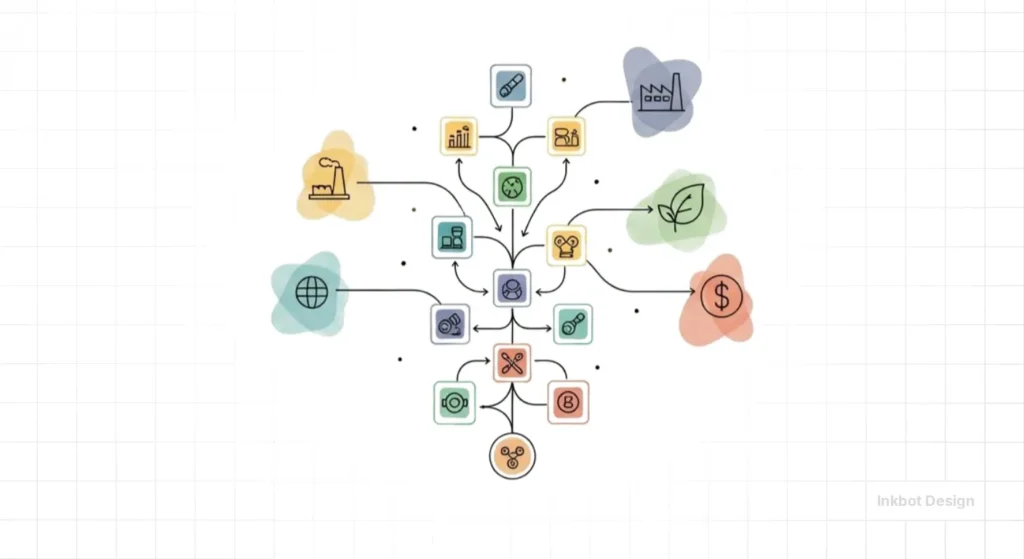
Don’t build a platform. Build a feature that solves one painful problem.
16. Grant Writing AI for Non-Profits
Grant writing is tedious, formulaic, and high-stakes.
The Business: A SaaS tool specifically trained on successful grant applications. It helps non-profits format their data into the specific language required by government bodies.
The Niche: Focus on a specific sector (e.g., Arts Funding in the UK) to reduce competition.
17. The “Estate Agent” Description Generator (That Isn’t Cringe)
Most automated property descriptions sound robotic.
The Business: A tool that takes floor plans and photos and generates descriptions that sound like a human wrote them, specifically tuned to local dialects and market trends (e.g., highlighting “school catchment areas” in the UK).
18. Medical Scribe for Private Practices
Doctors spend 40% of their time typing notes.
The Business: A secure, HIPAA/GDPR-compliant audio tool that listens to the consultation and formats it into the specific fields of the Electronic Health Record (EHR) system.
The Key: Seamless Integration with Existing Hospital Software.
19. Procurement & Supply Chain Predictor
Small manufacturers struggle with inventory.
The Business: A tool that connects to their sales data and global news feeds to predict supply chain shocks (e.g., “The Red Sea is blocked, order more steel now”).
The Value: Saving cash flow by preventing overstocking.
20. Automated RFP (Request for Proposal) Responder
Agencies spend days filling out boring RFP documents.
The Business: A secure vault where an agency uploads all its past case studies and technical data. The AI then automatically fills in new RFPs based on that knowledge base.
Part 5: The Physical World (Blue Collar Tech)
AI cannot fix a leaking pipe or install a solar panel.
21. Smart Home Integration Specialist
People are buying “smart” devices that don’t talk to each other.
The Business: You are the IT guy for the physical home. You make the solar panels talk to the EV charger and the heat pump. You don’t just install; you optimise the system logic.
22. Robot Fleet Maintenance
As warehouses adopt more robots (like Amazon’s Kiva systems), who fixes them?
The Business: A roving mechanic service specifically trained to repair and service autonomous warehouse robots and delivery drones.
23. Vertical Farming Controller
Food security is a massive issue.
The Business: You set up and manage the AI systems that control humidity, light, and nutrients for urban vertical farms. The “farmer” is now a data analyst.
24. 3D Printing / Additive Manufacturing Bureau
Supply chains are shortening.
The Business: A local manufacturing hub. When a part breaks on a vintage car or a washing machine, you scan the broken part, use AI to repair the 3D model, and print a replacement in metal or plastic.
25. Energy Efficiency Auditor
Energy prices are volatile.
The Business: You use drones with thermal cameras and AI analysis to scan large commercial buildings. The AI identifies exactly where heat is leaking and calculates the ROI of fixing specific windows or insulation.
The Reality Check
I once audited a client who wanted to “replace their design team with Midjourney.” They thought they would save £100k a year.
Six months later, they hired the team back at a higher rate. Why? because the AI-generated images that looked cool but violated their own brand guidelines, confused their customers, and in one case, accidentally used a competitor’s distinct colour palette.
The lesson: AI is a generator, not a strategist.
If you launch a business today, your role is not to generate more “stuff.” We have enough stuff. Your role is to provide Context, Curated Quality, and Liability Protection.
The Wrong Way vs. The Right Way (2026 Model)
| Feature | The Old Way (Obsolete) | The New Way (AI-Leveraged) |
| Copywriting | “I write blog posts for £50.” | I build Brand Voice databases that ensure your AI sounds like you. |
| Coding | “I build WordPress sites.” | “I refactor legacy code and integrate AI agents into your CRM.” |
| Design | “I make logos.” | “I create brand identity systems that work across spatial computing and AI interfaces.” |
| Consulting | “I give general advice.” | “I implement specific LLM workflows to reduce your overhead by 30%.” |
The State of Business in 2026: The “Integration” Shift
As we move toward 2026, the initial hype of “ChatGPT can write a poem” has faded. According to McKinsey & Company, the real economic value—trillions of dollars—lies in integration.
The businesses that succeeded in 2024/25 weren’t the ones building new models; they were the ones integrating existing models into boring, unsexy workflows.
For example, a law firm doesn’t need a “Robot Lawyer.” They need a secure plugin that reads a PDF and highlights clauses that contradict the UK Companies Act 2006. That is boring. That is specific. And that is incredibly profitable.
The “New Business Ideas” listed above all share this trait: they solve a specific friction point created by the adoption of AI, or they address a human problem that AI has exacerbated (such as trust).
The Verdict
The market is currently bifurcating.
On one side, you have the “Race to the Bottom”—cheap content, cheap code, cheap services, all driven by automation. You do not want to be here. The margins are zero.
On the other side, you have the “Trust & Expertise” economy. This is where you leverage AI to handle the grunt work, allowing you to focus on high-value problem-solving, strategy, and human connection.
Don’t start a business that performs a task. Start a business that owns an outcome.
Your Next Step:
If you are building a brand in this new landscape, you cannot afford to look like a generic template. You need a visual identity that cuts through the synthetic noise.
Request a Quote for your Brand Identity today, and let’s build something that lasts.
Frequently Asked Questions
What are the best AI business ideas for beginners with no coding skills?
Focus on “Service-based” roles that require human oversight, such as AI Compliance Auditing, Niche Prompt Engineering for non-tech industries (like legal or real estate), or Digital Detox Tourism. These rely on soft skills and strategy rather than Python development.
Is dropshipping still a viable business model in 2026?
Traditional AliExpress dropshipping is largely dead due to market saturation and AI-driven ad costs. The new model is “Branded Dropshipping” or “Print on Demand 2.0,” where you use AI to create unique, hyper-niche designs that cannot be found elsewhere, backed by a strong brand story.
How can I use AI to validate my business idea?
Use tools like ChatGPT or Claude to act as a “Sceptical Investor.” Feed it your business plan and ask it to identify 10 reasons why the business will fail. Use it to analyse competitor reviews to find gaps in the market, rather than just asking it to “generate an idea.”
Will AI replace creative agencies?
No, but it will replace agencies that only offer execution (making the thing). Strategic agencies that offer “thinking” (i.e., why we are creating the thing) will thrive. Brands need guidance on positioning more than ever. See our thoughts on Brand Strategy.
What is the difference between a “Wrapper” startup and a defensible AI business?
A “Wrapper” is just a thin interface over ChatGPT (e.g., “AI for Dog Names”). These are easily copied. A defensible business adds proprietary data, unique workflows, or complex integrations that a competitor cannot replicate simply by plugging into an API.
How do I price my services if AI does half the work?
Stop billing by the hour. AI reduces the time it takes to complete work, which can negatively impact your revenue through hourly billing. Switch to “Value-Based Pricing” or “Productised Services” where you charge for the completed outcome or the asset delivered, regardless of how long it took.
What industries are most at risk from AI disruption?
Sectors that rely on repetitive cognitive tasks are most exposed, including entry-level coding, translation, basic copywriting, and tier-1 customer support. However, these sectors also offer the highest opportunity for “Consultants” who can help companies automate these processes.
Can I copyright content or products created by AI?
In most jurisdictions (including the UK and US), you cannot copyright purely AI-generated work. However, if there is significant human input, modification, and arrangement, you may be able to protect the human-created elements. This is why the “Human-Made” Certification business model is rising.
What is “Prompt Engineering”, and can I build a business around it?
Prompt Engineering is the skill of structuring inputs to get optimal outputs from LLMs. While valuable, selling it as a standalone service is becoming difficult as models get smarter. It is better to sell the result of the prompting (e.g., “I build automated sales funnels”) rather than the prompting itself.
How important is branding for an AI business?
Crucial. As technical barriers lower, technology becomes a commodity. Trust becomes the only differentiator. A professional Brand Identity signals longevity and security in a market full of fly-by-night AI wrappers.