Lead Generation Website Design: How To Build Friction That Qualifies
Most lead generation website design advice tells you to remove friction. For professional services firms billing partner hours, that advice fills the diary with unqualified calls. Qualification belongs on the page, before the form — not in a sales call afterwards. Six stages, built around intentional friction that filters buyers early.
 By Stuart Crawford
 Reviewed by Tabitha Ayers
Updated 17 min read
On this page17 min left
- How Qualified Lead Generation Is Achieved
- What You Need In Place Before You Start
- The Judgement Layer: Where Rules Stop Working
- “Yes, But”: Two Objections Worth Answering
- Where This Stands Now: Friction Is The Last Remaining Variable
- The Step Everyone Does Last: Qualification Belongs On The Page
- The Verdict
- Frequently asked questions
Your website converts at 2.3%, your web agency wants to get it to 4%, and the partners are complaining they're wasting afternoons on people who were never going to instruct.
Both things are true at once.
HubSpot's State of Marketing Report (February 2025) puts the median B2B visitor-to-lead conversion rate at 2.3%, with top-quartile programmes at 4.7% or higher, and 42% of businesses cite low-quality leads as a significant challenge (Reach Marketing, 2025). Doubling the first number without touching the second doubles the problem.
The reason most rebuilds fail is that the brief was wrong before the wireframes started. “Increase enquiries” is a volume brief.
For a 90-partner firm where an hour of partner time carries a real opportunity cost of several hundred pounds, volume is not the constraint. Fit is.
Every serious gain in lead-generation website design comes from decisions made about qualification, which sits upstream of layout and is usually handled downstream, in a sales call, by the most expensive person in the building.
Get it right, and the site becomes an instrument of conversion rate optimisation that measures the right rate.
This is one facet of the broader discipline covered in Inkbot Design's web design services.
How Qualified Lead Generation Is Achieved

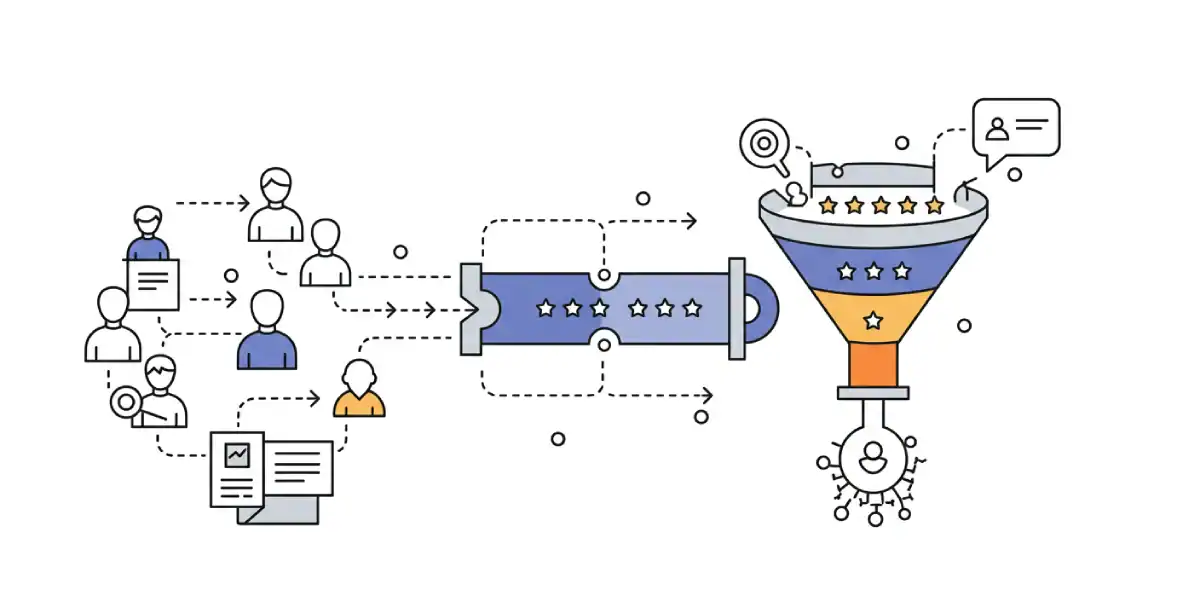
Qualified lead generation is achieved in six stages: define the qualified lead in commercial terms, map the disqualifying signals, install a price anchor, design the form as a qualification instrument, match capture volume to response capacity, and measure MQL-to-SQL rather than visitor-to-lead. Each stage removes friction that the buyer should never feel and adds friction that only the wrong buyer trips over.
- Stage sequence is load-bearing: designing the form before defining the qualified lead guarantees the presence of the wrong fields.
- The median B2B MQL-to-SQL conversion rate is 13% (industry demand generation benchmark survey, Q4 2024) — the diagnostic that reveals whether capture is filtering or flooding.
- Contacting a web lead within five minutes makes qualification 21× more likely (MIT/InsideSales Lead Response Management Study, 2007), which makes response capacity a design input rather than an afterthought.
Lead generation website design is the practice of structuring pages so qualified prospects self-select into contact, and unqualified visitors filter themselves out before submitting a form.
What You Need In Place Before You Start
Three entry conditions, and most firms have none of them.
You need a written definition of a qualified lead that a partner and a marketing manager would both sign. Not “interested in our services.”
Something like: an in-house counsel at a UK business turning over £20m+, with a live matter, a budget above £15,000, and authority to instruct. If two partners write different definitions, stop — that disagreement will surface as inconsistent copy across the site, and the prospect will notice before you do.
You need six months of enquiry data, sorted by outcome. Which enquiries became instructions, which became wasted hours. Without it, you are designing filters against a hypothesis.
You need an honest number for response capacity. If enquiries arrive at 11 am and a partner replies at 6 pm, no amount of design fixes that.
Harvard Business Review reports that the odds of qualifying a lead drop by 80% after the first five minutes. Capacity is a constraint on the design, not a problem for operations to solve later.

Stage 1: Define The Qualified Lead In Commercial Terms
The qualified lead must be defined by revenue outcome, not interest signal. A firm that defines it as “requested a callback” will design a site that maximises callbacks. A firm that defines it as “an instruction worth £15,000+ from a decision-maker with a live matter” designs an entirely different site — and the two sites share almost no components.
Write the definition as a sentence with four clauses: who, what problem, what budget, and what authority. Test it against last year's actual instructions. If your definition excludes 30% of the work you actually won, it is too narrow. If it includes enquiries that consumed partner time and produced nothing, it is too loose.
How to know it's done right: a partner can look at any enquiry in the inbox and classify it in under ten seconds.
Failure mode at this stage: defining the lead by channel behaviour (“downloaded the guide”) rather than commercial fit. Content Marketing Institute (2024) found that companies with documented content strategies see 13× higher content marketing ROI — documentation is the mechanism, and it starts with the definition, not the editorial calendar.
Stage 2: Map The Disqualifying Signals
Disqualifying signals are the specific attributes that make a prospect unwinnable, and they must be named before any page is designed. For most UK professional services firms, the list is short and unglamorous: a budget below the minimum engagement, a matter outside the practice's scope, a timeline that cannot be resourced, a prospect shopping three firms on price alone.
Pull them from the enquiry data, not from a workshop. The signals that recur across your worst-fitting enquiries are the ones the site must surface early. Each disqualifying signal maps to a downstream design decision: a budget floor becomes a price anchor, a scope boundary becomes a “who we don't work with” passage, a timeline constraint becomes a stated lead time on the contact page.
The most expensive line on a professional services website is the one that doesn't exist: the sentence that would have told the wrong prospect to leave. Every enquiry that reaches a partner having already read that sentence and stayed is worth more than three that didn't. Omitting it does not increase your pipeline. It relocates your filtering costs to the people you pay most.”
How to know it's done right: you can point to a specific sentence on the site that addresses each disqualifying signal.
Failure mode at this stage: softening the signals into euphemism. “We work with ambitious businesses” doesn't disqualify anyone.
Stage 3: Install The Price Anchor
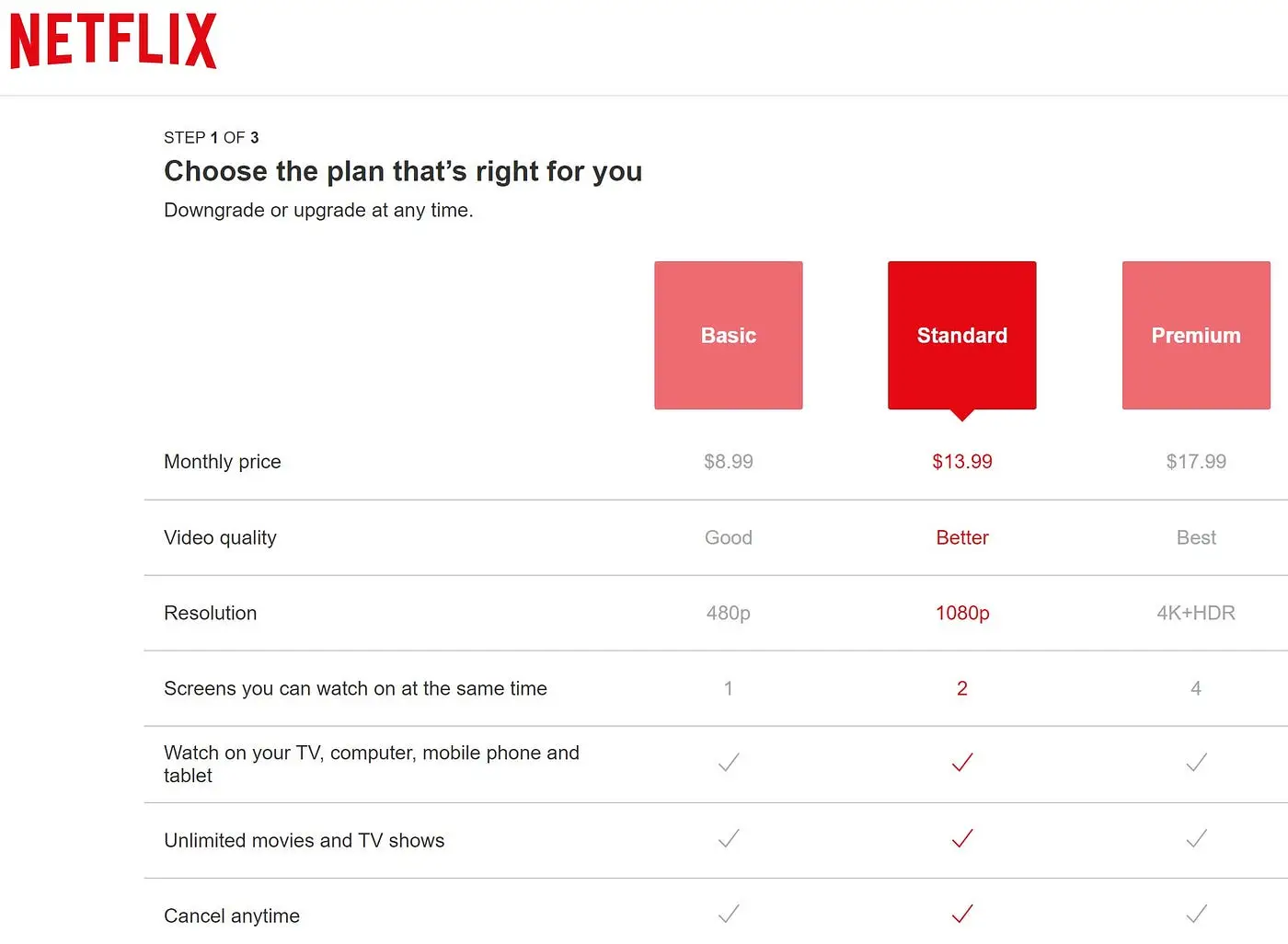
A price anchor is a stated minimum engagement value placed before the form. It is the highest-leverage element in professional services lead-generation website design. Firms resist it for one reason: they believe it costs enquiries. It does. That is the mechanism working.
The anchor does not need to be a price list. “Our typical engagements start at £15,000” does the entire job. It gives a prospect below the threshold a reason to leave without ever contacting you. It gives a prospect above the threshold a signal that they are in the right place, reducing their perceived risk of a wasted call and increasing their likelihood of enquiring.
The mechanism matters here because it is counterintuitive. A senior buyer's dominant fear is not price. It is a wasted hour with a firm that turns out to be too junior, too generalist, or too expensive. A number on the page resolves that uncertainty for free, before the buyer has spent anything. Removing the number does not remove the question — it defers it to a call, where answering it costs partner time.
How to know it's done right: total enquiries fall; enquiries that reach proposal stage rise.
Failure mode at this stage: burying the anchor on a pricing page nobody visits, rather than placing it on the page adjacent to the form.
Stage 4: Design The Form As A Qualification Instrument
Every form field must either qualify or be deleted — there is no third category. The standard advice treats field count as a dial between volume and quality. That framing is wrong. Field count is not the variable. Field function is.
Sort every field into one of two piles. Fields that produce information a partner would use to decide whether to take the call: budget band, matter type, timeline, and role. Fields that produce administrative data: company size, how did you hear about us, job title free-text, phone number you will never ring. Keep the first pile in full. Delete the second entirely.
Sonarlitix (2025) reports that B2B lead-generation forms lose 60%–80% of qualified prospects due to friction in the request flow. That figure is used across the industry to justify wholesale field removal. Read it precisely: the loss is of qualified prospects. Administrative fields cost you qualified prospects and return nothing. Qualification fields cost you unqualified prospects and return the single thing a partner needs. Deleting both because they are both “friction” is how a firm ends up with a 4.7% conversion rate and a 13% MQL-to-SQL ratio.
A budget-band dropdown with four options adds four seconds for a serious buyer. For a buyer with no budget, the moment they close the tab is the end. That asymmetry is the entire design.
How to know it's done right: every field on the form appears in the partner's first-pass decision.
Failure mode at this stage: replacing qualification fields with an AI chatbot that asks the same questions conversationally and calls it frictionless. Reach Marketing (2025) reports companies using AI-powered lead generation tools see a 35% increase in conversion rates versus traditional methods — an increase in conversion, which is precisely the metric that does not tell you whether the pipeline improved.
Stage 5: Match Capture Volume To Response Capacity
Capture volume must be designed against the firm's actual response capacity. For most professional services firms, that capacity is measured in hours, not minutes.
The MIT/InsideSales Lead Response Management Study (2007) established that contacting a web lead within five minutes makes qualification 21× more likely. Kixie (2025) reports that responding within 60 seconds can boost conversions by 391%.
Neither of those findings is achievable for a firm whose partners are in client meetings from 9 am. Rather than pretending otherwise, design for it. If the realistic response window is four hours, then the form's job shifts: it must capture enough qualification data that the four-hour reply can be substantive rather than a scheduling request. The form is doing work that the speed cannot.
This inverts the standard prescription. The firms that can respond in five minutes should use short forms — speed does the qualifying. The firms that cannot must use longer forms, because the form is the only qualification that happens before the reply. Copying the short-form playbook without the response capacity to back it up is the most common error at this stage.
How to know it's done right: your stated response time on the contact page matches your median actual response time.
Failure mode at this stage: installing a chatbot to bridge the capacity gap, which collects volume nobody has time to process.
Stage 6: Measure MQL-To-SQL, Not Visitor-To-Lead
The visitor-to-lead rate is a vanity metric for professional services firms; the MQL-to-SQL rate is the diagnostic. The median B2B MQL-to-SQL conversion rate sits at 13% (industry demand generation benchmark survey, Q4 2024).
If your visitor-to-lead rate rises after a redesign and your MQL-to-SQL rate falls, the redesign made things worse even as it appeared to succeed. That is the specific failure this entire method exists to prevent.
Track four numbers monthly: enquiries received, enquiries a partner accepted, proposals issued, instructions won.
The ratio that matters is enquiries-to-proposals. Salesforce B2B Benchmarks (2024) reports top-performing B2B companies convert 3.2% of website traffic into qualified leads — note the word qualified, which is a different denominator to HubSpot's 2.3% median visitor-to-lead figure.
Firms routinely compare their number to the wrong benchmark and conclude they have a traffic problem.
How to know it's done right: you can state, without checking, what percentage of last quarter's web enquiries a partner would take again.
The Judgement Layer: Where Rules Stop Working
The six stages describe the mechanism. Three decisions inside them cannot be resolved by rule, and this is where most implementations quietly fail.
How hard is it to anchor? A stated £15,000 minimum will filter accurately. Stated with an apology (“engagements typically start from around £15,000, though we're flexible”), it filters nothing and signals uncertainty. The judgement is tonal and a brand decision, not a UX one — which is why web agencies get it wrong. In 17 years of brand work, the pattern I see most often is a firm that installs the right filter and then undermines it in the adjacent sentence.
When the filter is too tight, if proposal volume drops below the firm's capacity to deliver, the anchor is set above the market rather than above the noise. Loosen the number before loosening the language.
Which objection to answer on the page? A sceptical buyer arrives with two objections at once. Answer both, and the page reads defensively. Answer the wrong one, and they leave. That call requires knowing the sector's actual buying anxiety, and it is the reason social proof architecture beats testimonial volume: the right proof answers the specific objection at the specific moment.
“Yes, But”: Two Objections Worth Answering
“We can't afford to reduce enquiry volume. The partners want more leads, not fewer.”
Fair, and the maths is the answer. If 100 enquiries produce 13 that a partner takes seriously, and filtering reduces you to 45 enquiries producing 20 partner-worthy conversations, the pipeline improved while the dashboard got worse.
The uncomfortable part is that the dashboard is what gets reported to the board. Change the reported metric before you change the site, or the redesign will be judged a failure in month two and reversed in month three.
“Our market is relationship-led. Nobody buys legal services from a form.”
Correct, and irrelevant. The form's job is not to sell. It is to determine whether the relationship-building conversation is worth having.
Forbes Agency Council (April 2025) documents that C-suite buyers increasingly explore new solutions after exposure to thought leadership, and rely more on niche creators and trusted communities than on polished brand messaging. The relationship starts elsewhere. The form is where it becomes a diary entry — or doesn't.
Where This Stands Now: Friction Is The Last Remaining Variable
B2B lead generation is shifting from a numbers game toward intent-driven, AI-powered precision.
Buyers now expect personalised, timely, cross-channel engagement — mass cold email and generic forms underperform against targeted, data-rich approaches (Forbes Agency Council, April 2025).
Read that as a design brief rather than a trend report, and it says something specific: the generic form is dying because it asks nothing useful, not because it asks too much.
AI-driven personalisation using intent data is now table stakes, with platforms including Adobe Marketo Engage and HubSpot using real-time behavioural signals to adjust messaging (Forbes Agency Council, April 2025).
Table stakes means it confers no advantage. When every competitor's site can respond instantly and personalise dynamically, ease of contact stops anyone from differentiating. What differentiates is whether the contact was worth having.
Two further shifts sharpen this. Forbes Agency Council (April 2025) reports that prospects now need 12–15 touchpoints before responding. That multichannel retargeting across email, programmatic display, LinkedIn and social outperforms single-channel tactics.
A prospect arriving at your form on touchpoint 14 is not friction-averse — they have already invested more than any form will ever ask of them. Designing that form for a stranger's patience threshold misreads who is actually standing there.
Data quality has become a core bottleneck, with email lists decaying by roughly 28% per year and campaigns built on stale data depressing conversion rates; data precision is now more valuable than volume (Forbes Agency Council, April 2025).
The same logic applies inside the form. A form that collects three accurate qualifying facts is worth more than one that collects nine fields of decayed noise.
“Every competitor can now make contact effortlessly. That was the differentiator for fifteen years, and it is worth nothing in 2026, because it is universal. The remaining edge is qualification: knowing before the call whether the call is worth taking. Firms still competing on how few fields their form has are optimising the one variable the market has already commoditised.”
The Step Everyone Does Last: Qualification Belongs On The Page

The prevailing view is defensible, and intelligent practitioners hold it for good reasons. Every additional form field measurably increases abandonment. Baymard Institute's body of form-usability research has established this repeatedly across e-commerce. Nielsen Norman Group (NN/g), the UX research consultancy, has documented for two decades that cognitive load at the point of conversion suppresses completion. The advice to simplify is not stupid. It is correct for the context it came from.
That context is transactional e-commerce, where every completed purchase is a good purchase, and the only variable is completion rate. Professional services invert the economics. A completed form is a cost until proven otherwise, because it consumes the scarcest resource the firm has.
The sequence error is this: nearly every firm qualifies after capture, in a call. The website is designed to capture; the partner is left to filter. That order is backwards, and it is backwards because the website was briefed by someone measured on enquiry volume and staffed by an agency paid for conversion rate. Neither party is measured by what matters, so neither designs for it.
Move the qualification onto the page. The price anchor, the scope statement, the budget band, and the stated response time — each is a filter the prospect applies to themselves, at zero cost to the firm, before any partner time is spent. The 13% median MQL-to-SQL rate (Q4 2024 benchmark) exists because 87% of qualification is happening in the wrong place, paid for at partner rates.
For every disqualifying signal you named in Stage 2, place one sentence on the page that a prospect carrying that signal will read and act on. Then accept the drop in the conversion rate as evidence that the design is working.
The Verdict
Friction is not the enemy. Undirected friction is. The distinction determines whether your website costs the firm money or saves it, and it is invisible on every dashboard your web agency will show you.
The six stages hold together because they run in a specific order. Define the qualified lead in commercial terms. Name the disqualifying signals from real enquiry data. Install a price anchor before the form. Sort every field into qualifying or administrative and delete the second pile. Match capture volume to the response capacity you actually have, not the one the case studies assume. Measure MQL-to-SQL, because visitor-to-lead will lie to you in exactly the direction that feels like success.
The 2.3% median and the 4.7% top quartile (HubSpot, February 2025) indicate how many people complete the form. The 13% median MQL-to-SQL rate (Q4 2024) describes whether that mattered. Firms that optimise the first number and ignore the second build sites that generate more work for partners and less revenue for the firm — and they do it while the reports go green.
Today, do one thing: take the last twenty enquiries from your website and sort them into two piles — worth a partner's hour, and not. Count the second pile. Every item in it went through a design decision that failed to stop them, and each of those decisions is on a page you can change this week.
If the second pile is the bigger one, the problem is upstream of your website. Request a free Brand Equity Audit™ — a written diagnostic, delivered in 48 hours, identifying exactly where your brand is losing commercial ground and what to do about it—no sales call.
Frequently asked questions
What is lead generation website design?
Lead generation website design is the practice of structuring pages so qualified prospects self-select into contact. At the same time, unqualified visitors filter themselves out before submitting a form. For professional services firms, the objective is qualified conversations rather than enquiry volume, because partner time is the scarce resource being protected.
What is a good B2B website conversion rate?
The median B2B visitor-to-lead conversion rate is 2.3%, with top-quartile programmes reaching 4.7% or higher (HubSpot State of Marketing Report, February 2025). For professional services firms, the more useful benchmark is MQL-to-SQL conversion, which sits at a median of 13% (Q4 2024 demand generation benchmark survey).
Should professional services firms put prices on their website?
Yes — a stated minimum engagement value filters prospects below the threshold before they consume partner time, and signals fit to prospects above it. A single sentence suffices: “Our typical engagements start at £15,000.” A full price list is unnecessary and often counterproductive for bespoke mandates.
How long should a B2B contact form be?
Field count is the wrong variable. Every field should either produce information that a partner would use to decide whether to take the call or be deleted. Budget band, matter type and timeline qualify. Company size and “how did you hear about us” do not.
Is it true that shorter forms always generate more leads?
Shorter forms generate more submissions. Whether those submissions are leads depends on the definition. Sonarlitix (2025) reports that B2B lead generation forms lose 60%–80% of qualified prospects to friction, but administrative fields cost qualified prospects and return nothing, while qualification fields cost unqualified prospects and return decision-grade data.
Why are our website enquiries never a good fit?
Qualification is happening after capture rather than on the page. When no filter exists before the form, the partner becomes the filter, at partner rates. 42% of businesses cite low-quality leads as a significant challenge (Reach Marketing, 2025), which is a design symptom rather than a traffic problem.
When should I redesign my lead generation website?
Redesign when MQL-to-SQL conversion is falling or when partners are declining a majority of web enquiries. Rising traffic with static proposal volume is the clearest trigger. Redesigning because the site “looks dated” results in a cosmetic change without any commercial effect.
What's the difference between a lead and a qualified lead?
A lead has expressed interest. A qualified lead matches a written commercial definition covering who they are, what problem exists, what budget is available and whether they hold authority to instruct. The distinction determines every subsequent design decision on the site.
How fast should we respond to website enquiries?
Contacting a web lead within five minutes makes qualification 21× more likely (MIT/InsideSales Lead Response Management Study, 2007), and the odds of qualifying drop by 80% after that window (Harvard Business Review). Firms unable to meet the five-minute target should collect more qualification data in the form to compensate.
Do AI chatbots improve lead generation website design?
Companies using AI-powered lead generation tools see a 35% increase in conversion rates versus traditional methods (Reach Marketing, 2025). Conversion rate is not pipeline quality. A chatbot that collects volume the firm lacks the capacity to process relocates the bottleneck rather than removing it.
Why does our conversion rate rise while revenue stays flat?
Visitor-to-lead conversion measures form completions, not commercial fit. A redesign that removes qualification fields will raise conversion and lower MQL-to-SQL simultaneously. Track enquiries-to-proposals monthly; it is the only ratio that connects website performance to fee income.
Is thought leadership more effective than website lead capture?
They perform different jobs. Forbes Agency Council (April 2025) reports that C-suite buyers increasingly explore new solutions after exposure to thought leadership and rely on trusted communities over polished brand messaging. Thought leadership creates the relationship; the website determines whether the resulting conversation is worth a partner's diary.