30+ Innovative Signage Ideas: How to Make Your Business Stand Out
Signage plays a crucial role in business marketing and branding. From storefront signs to window graphics, signage conveys your brand identity and helps attract customers.
But with so many companies competing for attention, it’s not enough to just have signage – you need innovative signage ideas that make your business memorable.
This article explores creative ways to make your business signage pop.
We’ll look at examples of unique signage from innovative companies and examine different materials and technologies you can use.
We’ll also provide tips on designing and placing your signs to maximise visibility and impact. Your signage can become an invaluable marketing asset with the right innovative approach.
- Innovative materials and shapes: Use unexpected forms and substrates like neon, 3D printing, preserved moss, or living walls to reinforce brand identity.
- Digital and interactive tech: Employ LEDs, AR, AI-driven content, digital displays, and QR integration for dynamic, targeted messaging.
- Sustainability and provenance: Choose recyclable substrates, low-VOC inks, and signage that communicates product origins to match brand values.
- Legibility, accessibility and compliance: Prioritise clear typography, contrast, tactile/Braille elements, and follow UK planning and illumination regulations.
30+ Innovative Signage Ideas

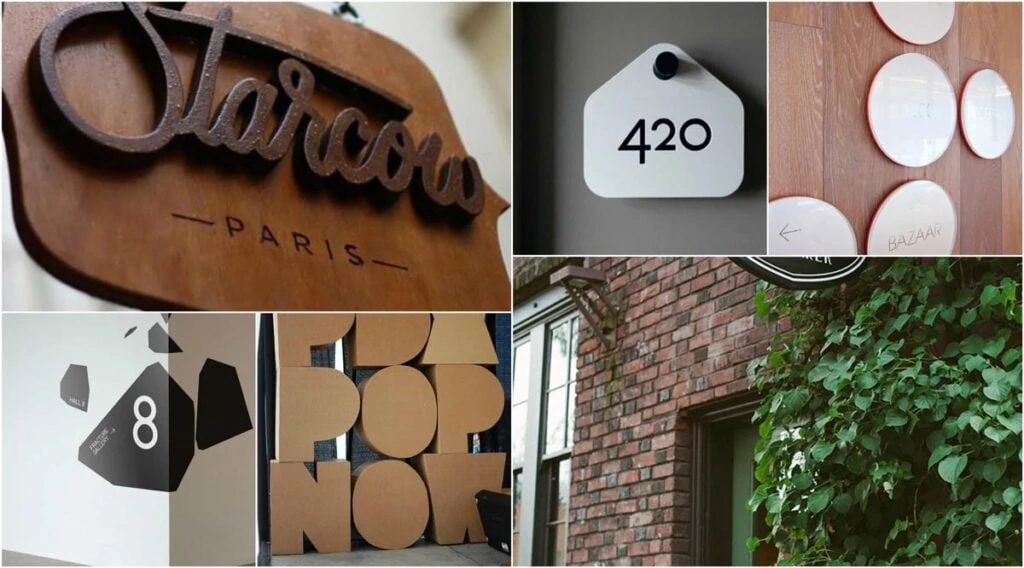
1 – Unique Sign Shapes and Materials
One of the simplest ways to make your signs stand out is to use an unexpected or distinctive shape. Consider other forms that align with your brand identity rather than sticking with a standard square or rectangular sign. For example, Starbucks is easily recognised by its circular logo on the signage above each store.
Likewise, you can use materials beyond the usual wood, plastic, or metal. Signs from unexpected materials like chalkboards, neon, or plants can capture attention. Some hair salons use old-fashioned scissors in their window displays.
A pizza shop could have a sign shaped like a slice of pizza. Get creative with shapes and materials that reinforce what makes your business unique.
2 – Lighting Effects
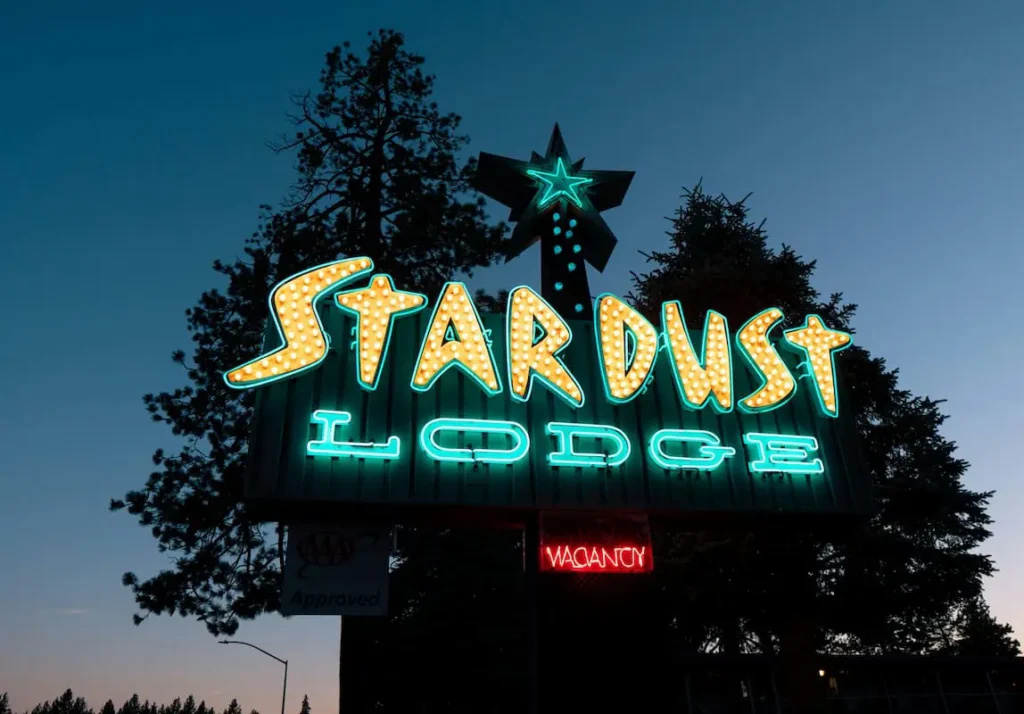
Illumination is another excellent way to make signage stand out, especially at night. From neon to LED, lighting can transform ordinary signs into eye-catching attractions. You can outline critical elements of your signage with lights or even make the entire sign glow.
Targeted spotlighting on signs creates dramatic effects. You can also program LED signs to flash or change colours, adding hard-to-ignore dynamism.
Just be sure lighting aligns with your brand identity and doesn’t create distractions. The goal is to emphasise your signage, not overwhelm it.
3 – Kinetic Signs
Making signage move takes innovation up another notch. Kinetic signs feature components that rotate, swing, or move to capture attention. Even simple movements like flipping letters can make your business more memorable.
Savvy companies are taking kinetics to new levels with digital displays and 3D elements. For example, Salata, a salad restaurant chain, has menu boards with a spinning salad bowl graphic.
Some car dealerships have kinetic logos with moving car shapes or spinning tyres. As technology advances, the possibilities for animated signage continue to grow.
4 – Chalkboard Paint
Here’s a straightforward DIY approach to innovative signage: chalkboard paint. Applying speciality chalkboard paint lets you turn any smooth surface into a chalkboard.
This could be your entire storefront window, door, or a partial accent wall. Chalkboard paint creates a fun, antiqued look, giving you a surface you can write on with chalk.
The great thing about chalkboard paint is its flexibility. You can use it for permanent signage or constantly changing menus, sales, announcements, etc.
It’s an inexpensive way to make your business more approachable while showcasing your offerings. Just remember to keep the handwritten content looking neat and professional.
5 – Show Window Graphics

An ideal place for innovative signage is in your show windows facing the street. You can turn your windows into “silent salespeople” with suitable graphics, luring customers inside. Window graphics can take virtually any shape and convey a variety of messages.
Many coffee shops use window graphics to showcase their logo and menu offerings. Boutiques may feature custom graphics with their brand name formed from fashionable shapes.
Or get creative, like Booksmith, a bookstore using literary window scenes with mannequins and real books to depict famous stories. The goal is to stop pedestrians in their tracks.
6 – Perforated Window Vinyl
Right, look. If you’ve got big storefront windows, you’re sitting on a goldmine of advertising space. Don’t just stick a little A4 poster in the corner.
You need to consider perforated window vinyl, also called one-way vision film. It’s a clever bit of kit.
It’s basically a sheet covered in thousands of tiny holes. From the outside, people see a massive, full-colour graphic of your choosing.
But the magic is, from the inside, you can still see out perfectly fine. You get to use the entire window for your advert without turning your shop into a dark cave.
You’ve definitely seen this stuff before. It’s what they use for those huge ads that cover the windows of city buses. The ad looks solid from the street, but the passengers inside can still see their stop coming up.
It’s a simple idea, but it’s massively effective for getting your message across without sacrificing daylight.
7 – Neon Signs
Neon signs may seem old school, but they stand out from other signage. The glow of neon commands attention, especially at night.
Neon signs have a vintage, artistic aesthetic that complements certain businesses, such as diners and bars. But modern companies can also use neon stylishly.
Shake Shack has neon signage above its ordering counter featuring its logo and menu items like shakes and fries.
Neon signage can be expensive due to the glass-bending and vacuum-sealing process. But it will ensure your business gets noticed. Neon signs also last for years if properly maintained.
8 – Interactive “Phygital” Signage: AR and AI Integration
The boundary between physical and digital—”Phygital”—is where the most innovative signage lives in 2026. Augmented Reality (AR) has moved from a gimmick to a conversion tool.
The AR Revolution. Instead of a static “Sale” sign, customers point their smartphone at your window and see a virtual 3D fashion show or a “try-on” filter. By using WebAR (which doesn’t require a separate app download), you remove the friction that previously killed AR adoption.
AI-Driven Dynamic Content Modern digital signs now use Computer Vision (anonymised AI sensors) to change content based on who is looking at them.
- The Scenario: It’s a rainy Tuesday morning. Your outdoor digital screen detects the weather and automatically switches from promoting “Iced Lattes” to “Hot Toasted Paninis.”
- The Result: Targeted messaging that increases the “attach rate” of high-margin items.
Entities to watch: Tools like Zappar and 8th Wall are industry leaders for creating browser-based AR experiences without a six-figure budget.
9 – Interactive QR Code Integration
Augmented reality is brilliant, no doubt. But let’s be honest, it’s not always cheap, and it can be a bit of a faff. The thing is, you can get most of the benefit for a fraction of the price with something much simpler: a QR code.
Don’t dismiss them. They’re not just for checking into places anymore. A modern QR code can do all sorts.
A customer scans it, and boom, they’re instantly connected to your guest Wi-Fi. Or it opens up your digital menu, or, and this is the clever part, it reveals a special discount code right there on their phone.
Think about a real estate agent’s “For Sale” sign. Stick a QR code on there that links straight to a video tour of the house.
You’ve just given a potential buyer instant information and made their life easier. It’s all about removing friction and making it dead simple for people to take that next step with you.
10 – Branded Sidewalk Stencils
Here’s a highly affordable innovation for signage: sidewalk stencils. Many businesses stencil their logo and address right on the sidewalk out front. It’s a clever way to catch pedestrians’ eyes and reinforce your location.
Sidewalk stencils work exceptionally well for restaurants and shops in urban areas with plenty of foot traffic.
The stencils can be created with letter/number templates and spray paint. Just use high-quality outdoor paint that won’t fade or smear too quickly. Periodic touch-ups keep your branded sidewalk stencils looking fresh.
11 – Gobo Projectors for Logos
Sidewalk stencils are a good, cheap option for daytime. But as soon as the sun goes down, they disappear. If you want to own the night, consider gobo projectors.
It sounds techy, but it’s dead simple. A “gobo” is just a small metal or glass disc with your logo cut into it.
You pop it into a special projector, and it shines a super-sharp, bright image of your logo onto the pavement, an exterior wall, or even an indoor floor. It looks incredibly professional and high-end.
Hotels are masters at this, projecting their crest onto the lobby floor to greet guests. The best part is that it’s not permanent.
You can turn it off, or swap the gobo out for a seasonal message. It’s flexible, eye-catching, and makes a much bigger statement than a bit of spray paint ever could.
12 – Digital Displays
Consider installing a digital display as part of your exterior signage for retail stores and restaurants. Digital displays allow you to showcase specials, promotions, new products, upcoming events, and any messages you want.
With built-in animation and video capabilities, digital displays are far more dynamic than static signs. They are continually changing, so passersby are more likely to take notice each time.
You can easily update the messaging from a central computer as needed. And digital displays are often cheaper than printing new traditional signage.
13 – Sign Toppers
An easy upgrade for standard signage is adding a decorative topper element. Sign toppers sit above a sign and often feature embellishments that relate to the business.
A bakery may have a plastic moulded cake or cupcake. A dog-grooming business could use a 3D dog statue on its sign.
Different architectural flourishes can spruce up plain square signage, even without a themed topper.
Arches, diagonal corners, ornamental scrollwork, a logo cutout, or a branded prop can transform boxy signs into distinctive landmarks. Sign toppers provide free advertising from above that catches the eye.
14 – Living Walls

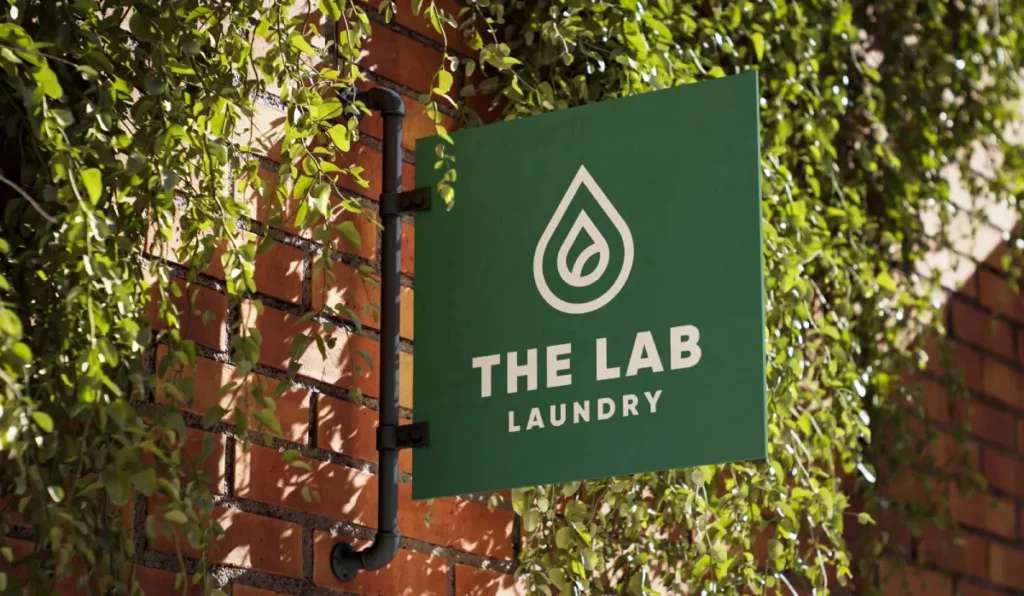
Here’s an innovative signage idea that benefits the environment – living walls. Living walls are vertical gardens attached to building exteriors. They can contain a mix of plants, herbs, or vegetables planted in felt layers on a supporting structure.
Living walls provide natural beauty while also filtering air pollution. Signage can be incorporated right into the living wall or positioned in front.
The plants form a lush, eye-catching backdrop and instantly convey a sense of freshness and health. Just be sure the plants are placed for optimal sun exposure so they thrive.
15 – Digital Window Displays
Consider installing a digital window display facing outward from your business, like digital signage. Digital displays can show anything from product visuals and promotions to branded content and helpful tips.
The significant advantage of window displays is that pedestrians don’t have to stop walking to see your messages and imagery. The screens are suitable at eye level.
Digital displays also work well in low-light conditions compared to printed signs. Just keep the imagery and information short and captivating.
16 – Invisible Ultraviolet Signs
Here’s one innovative technology that reveals signage under ultraviolet light. Unique UV ink print designs, logos, or text that appear utterly invisible under standard lighting.
But when illuminated with UV light, also called blacklight, the signage suddenly becomes visible, glowing brilliantly.
UV signage is ideal for bars, nightclubs, and other nightlife spots. The trippy glowing signs attract attention and create intrigue. Patrons will be amazed when portions of your establishment seem to transform before their eyes. Just be sure to have traditional signage for daytime visibility.
17 – Hanging Signs
Hanging signs above doorways or into pedestrian areas makes excellent visual landmarks for businesses. The suspended signs attract passersby’s eyes from a distance. Hanging signs tend to be smaller than fixed signage on buildings, making them more intimate.
Materials like wood, metal, or glass work well for hanging signs. You can incorporate lighting effects for extra drama. Just be sure hanging signs don’t impede foot traffic.
The ideal height clearance is around eight feet. Take precautions to secure your hanging signs properly against wind and weather.
18 – Creative Use of Typography

With standard rectangular signage, creative typography is one way to improve the visual impact.
Avoid bland fonts and play with different weights, styles, sizes, and positions of the type. Use stylised fonts, all caps, small caps, underlining, italics, varying letter spacing, etc.
You can form logos using a customised display type. Or try stacking words vertically or at angles—overlay type on imagery or textures.
Incorporate stylistic elements such as character repeats or abstract backgrounds. With online tools, designing innovative typography is easier than ever. Just keep it legible.
19 – Window Clings
For digital-free window signage, consider using semi-permanent vinyl clings. These thin vinyl decals stick to glass surfaces using static electricity – no adhesive is required. They can display logos, hours, phone numbers, coupons, etc. Clings are easy to remove and change as needed.
Compared to paper window signs, clings look more polished and professional. They help brand the business and highlight vital information for passersby.
Window clings work exceptionally well for restaurants, cafes, boutiques, salons, and other retail establishments. Just switch them out to keep the messaging fresh.
20 – Sculptural Signs
Most business signage sits flat against buildings.
However, you can create more intrigue with 3D sculptural signs that add artistic flair. Even relatively simple moulded signs catch the eye better than flat ones. Or go all out with large kinetic sculptures doubling as signs.
Some options for sculptural signs include:
- Carved wood shapes and symbols
- Metalwork silhouettes of logos or products
- Objects like bikes or cars holding signage
- Digital clocks or tickers built into artistic structures
- Branded shapes protruding from buildings
Sculptural signs work best for experience-focused businesses like hotels, wineries, galleries, and entertainment venues. However, any company can benefit from signage, which can evolve into creative 3D art.
21 – 3D Printed Signage
Proper sculptural signs are fantastic, but getting them custom-made can cost an absolute fortune, can’t it? Well, not so much anymore. 3D printing has completely changed the game for creating custom shapes and letters.
You can now make these designs full of fine detail and complex shapes for a fraction of what a traditional carpenter or metalworker would charge.
The materials, such as durable plastics, are lightweight yet strong enough for outdoor use. Imagine your logo with real depth and texture, something people actually want to reach out and touch.
A tech company could have its complex logo printed for its reception area, or a boutique could use custom-designed 3D letters for a one-of-a-kind storefront sign. It immediately shows people that you’re modern and not just doing things the old, boring way.
The Sustainability Revolution: Eco-Friendly Signage in 2026
The signage industry has undergone a radical shift toward the circular economy. Business owners are no longer just looking for “green-looking” signs; they are demanding verifiable eco-credentials.
In 2026, using recycled ocean plastic or biodegradable PVC-free vinyl from brands like 3M or Avery Dennison is a standard expectation for B-Corp-certified businesses.
When should you switch? If your brand values are rooted in wellness, sustainability, or social responsibility, your signage must reflect this physically. A plastic-heavy sign for a vegan cafe creates a “values gap” that modern customers notice immediately.
- Substrate Choice: Swap traditional foam board for Aluminium Composite Material (ACM), which is 100% recyclable, or Re-board, a high-strength paper-based board.
- Low-VOC Inks: Ensure your printer uses Latex inks or UV-LED inks, which do not release harmful Volatile Organic Compounds into your shop environment.
- Case Example: A London-based boutique, The Green Thread, replaced all its interior acrylic displays with mushroom-based mycelium packaging that was moulded into 3D letters. Not only was it compostable, but it also became a social media talking point, driving organic foot traffic.
22 – Signage Incorporating Nature
Combining live plants or natural elements with signage is an innovative trend. Real planted moss words grab attention. Beloved Coffee in Austin has its logo framed in an imported ficus tree. Or signs can be nestled in planted areas or vertical gardens.
Natural components surrounding signage help create an oasis effect. Signage emerges organically from its environment. The mix of fixed signage with changing natural features keeps the imagery fresh and appealing. Just be sure the landscaping is maintained correctly.
23 – Moss Art & Preserved Plant Signage
Living walls are beautiful, but they can be a real headache to maintain. You’ve got watering schedules, sunlight requirements… It’s basically a massive, high-maintenance plant stuck to your wall. There’s a much smarter way to get that green look: preserved moss.
This is real moss that has been specially treated to stay soft, green, and lush forever, and it requires zero maintenance. No water, no light, nothing.
You just install it, and it looks incredible from day one. You can have your entire logo or brand name crafted from it, bringing that natural, calming vibe indoors without any of the hassle.
It’s become very popular with wellness brands and modern offices trying to create a better atmosphere. Google famously has a huge preserved moss wall with its logo in its Dublin office. If it works for them, it’s definitely worth considering.
24 – Car Wrap Signage

One prominent place for signage is directly on your company vehicles.
Complete vehicle wraps let you transform vans, trucks, or cars into mobile billboards that display your branding everywhere they go. Today’s printing technologies allow for full-colour, photo-realistic vehicle wraps.
The key is keeping the vehicle wraps tasteful with your logo and concise messaging, not bombarding the design. Nicely branded company cars or delivery vehicles subtly market your business around town all day long as they drive. Its signage is always on the move.
25 – Digital Sign Toppers
Earlier, we discussed decorative physical toppers to enhance standard signs. Another option is digital sign toppers, also called blade signs. These narrow digital screens mount to the top or side of the main sign.
The ancillary digital screens can display rotating specials, advertisements, or promotions. They work well for theatres, hotels, gas stations, and other places with frequently changing information.
The slender digital blade signs add high-tech dynamism while the main sign stays consistently branded.
26 – Illustrated Window Murals
Large, custom illustrations painted directly on storefront windows create fun artwork that entices customers inside. Whimsical window murals might depict products, characters, or scenes from your business. The hand-painted quality makes a refreshing change from vinyl decals.
Just hire a talented artist who can render imaginative window murals smoothly.
Avoid anything too intricate or complex—bold, simple illustrations with your branding work best. Window murals are also brilliant for seasonal changes — switch to new holiday-themed art.
27 – Branded Umbrellas and Awnings
Pay attention to the shading elements outside your business as prime real estate for signage. Umbrellas and awnings provide excellent visibility from a distance. The repetition of your branded awnings along a shopping district multiplies impressions.
Logos and messaging can be digitally printed on awning fabrics for a crisp, clean look. For umbrellas, high-visibility colours that complement your branding make them walk billboards. Consider placing branded umbrellas and seating in front of your business to draw pedestrian eyes.
28 – Mirrored Signage
Here’s an innovative approach to attention-grabbing signage using reflections. Mirrored surfaces contain your logos and graphics while duplicating views of passersby and surroundings. The reflections amplify your signage while making it highly interactive.
Mirrored signs work incredibly well in places with heavy foot traffic – visual interest increases as more people pass. Extra lighting directed at mirrored signs casts reflections farther, extending the effect.
Just beware of potential glare if positioned toward traffic. Mirrored graphic panels are also popular at trade show booths.
29 – Inspiring Quote Signage
Some innovative businesses forego overly salesy messages and instead opt for inspiring quotes on signage. Short, poignant sayings catch the eye and communicate the company’s values and priorities beyond profit.
For example, Patagonia displays thought-provoking environmental quotes on its store bags and signs. Apple highlighted the phrase “Think Different” in its marketing.
Quote signage works best when the sentiments align with your brand story and ideals. Refresh the inspirational sayings seasonally for renewed impact.
30 – Laser Projection Signage

One high-tech innovation in signage is the use of laser projectors to display logos and messaging. Laser-projected signs can produce crisp, high-contrast images unsuitable for standard projection lights. The imaging works even in daylight outdoors.
Projecting directly on buildings eliminates the need to install permanent signage. Messaging and graphics can be changed instantly.
Some restaurants use laser projections on sidewalks to help lead patrons to entrances down alleyways. Wherever projected, laser signs magically appear and then vanish like ghosts.
31 – Projection Mapping on Buildings
Laser projections are cool, but if you have a massive product launch or a big event and you genuinely want to stop traffic, you need to look at projection mapping. This is not just pointing a projector at a flat wall. This is a whole different league.
The technology uses software to map the entire surface of a building, including every window, ledge, and architectural detail. It then turns the whole building into a custom-fit video screen.
You can create stunning animations that make it look like the building is transforming, crumbling, or being covered in your branding in real-time.
You’ve seen this in action. Disney uses projection mapping on its Cinderella Castle for its nightly shows, and luxury brands like Cartier project incredible animations onto their flagship stores during the holidays.
Look, it’s not a cheap option; it’s a serious investment. But for pure, jaw-dropping spectacle that people will film and share online, absolutely nothing else comes close.
32 – Signage Incorporating Local Elements
Including hyperlocal touches is an innovative way to make signage connect more deeply with the community. Work elements of local significance into the design. This could be landmarks, historical references, foliage/crops, nostalgic architectural details, etc.
Signage with familiar local ties helps businesses feel more approachable and ingrained versus outsider chains. Customers also appreciate signs that reflect regional or neighbourhood pride and character. Just ensure the local elements subtly enhance signage rather than overwhelm brand identities.
33 – Purposeful Handmade Imperfections
Signage conveys that a business is established and professional. But surprisingly, slight intentional imperfections can also boost likability. Minor flaws make signs appear handcrafted with love versus mass-produced.
Subtle ideas like faux drips or smears, uneven text kerning, paint globs, patched distressing, or faded edges build character. Just keep the imperfections looking intentional, not sloppy. Imperfections are especially effective for businesses promoting craftsmanship and personalisation. Each “flaw” becomes a charming mark of humanity.
34 – Digital Menu Boards
For restaurants and food businesses, digital menu boards present an opportunity for innovative signage. Digital menus allow you to display mouthwatering photos and videos of dishes rather than just text descriptions. You can also easily update menus and pricing.
Many fast-casual restaurants now have exterior digital menu boards and interior screens highlighting their offerings. Digital menus help attract more passing traffic. And order accuracy improves when customers can see exactly how each item looks. The versatility of digital also allows for testing menu layouts.
35 – Concrete Signage

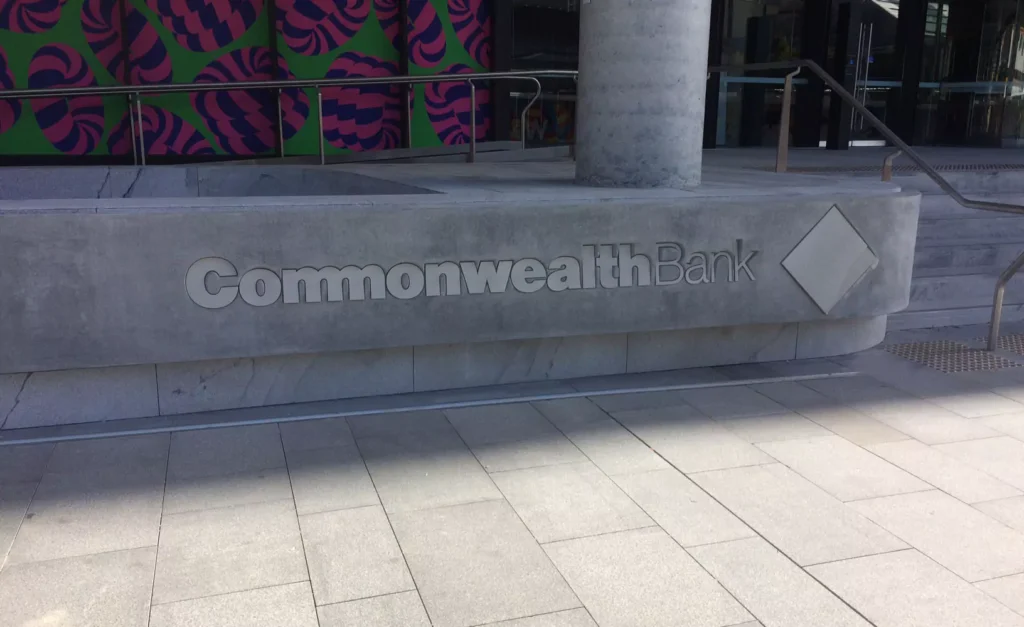
Signs crafted from textured, stained, or creatively shaped concrete are modern and artful. The hefty material provides a sense of substance and permanence when you order lawn signs.
Concrete’s grey tones also pair well with other natural materials in contemporary designs.
Possibilities for concrete signage include etched logos, sleek raised lettering, and even dramatic cantilevered forms. Concrete can also be cast into custom, artistic, branded shapes.
If going for a weathered look, use techniques such as exposing aggregate or sandblasting. Sealing is required to prevent cracks and fading.
36 – Signage Showing Product Provenance
Customers today care deeply about product origins and responsible sourcing. Innovative signage provides transparency by showcasing where ingredients, components, or materials are sourced. Diagrams can map supply chains. Images and stories about artisans bring provenance to life.
Provenance signage is compelling in food establishments. However, any business, like clothing stores, can benefit from identifying fabric origins. Telling the story behind products through signage boosts trust while making things feel more substantive. Just keep explanatory signage focused and easy to digest for passersby.
37 – Directional Signage
Make sure to consider interior directional signage when seeking innovative ideas. Chances are, you still use elemental clip art, arrows, and typed text to direct customers. However, branded environmental graphics can make navigating more intuitive while enhancing aesthetics.
Some best practices for innovative directional signage:
- Use original icons and illustrations rather than cliché clip art
- Incorporate branded colours, fonts, and stylistic flourishes
- Group sign types (directories, department IDs, arrows) for visual coherence
- Use a modular system allowing signs to be changed/moved as needed
- Add accent lighting or illumination for aesthetic and accessibility
The goal is to make directionals less institutional and more intriguing. Signage that tells an immersive story feels welcoming while still effectively guiding visitors.
Accessible Signage: Beyond the Equality Act
In 2026, accessibility is not just a legal box-ticking exercise under the Equality Act 2010; it is a hallmark of a premium customer experience. Signage that is “hidden” to visually impaired or neurodivergent customers is a lost revenue opportunity.
How-to: Design for Inclusivity
- Contrast Ratios: Use a minimum contrast ratio of 70:1 between the text and the background. For example, white text on a dark navy background is significantly more legible for those with low vision than yellow on white.
- Tactile Elements: Incorporate Grade 2 Braille and embossed (raised) lettering on all directional signs at eye level (roughly 1200mm to 1500mm from the floor).
- Matte Finishes: Avoid glossy materials for informational signs. Glare from overhead lighting can make text invisible to those with certain visual sensitivities.
Scenario: A regional hospital upgraded its wayfinding by using colour-coded floor paths combined with tactile wall markers. This reduced “reception fatigue” (where staff are constantly asked for directions) by 40% in the first quarter of 2026.
Navigating UK Planning Permission and Regulations
Your innovative signage idea is only as good as its legality.
In the UK, the Town and Country Planning (Control of Advertisements) (England) Regulations dictate what you can and cannot display. Ignoring these can lead to “Discontinuance Notices” and hefty fines.
What should you know?
- Deemed Consent: Many signs, like small window graphics or non-illuminated signs under 0.3 square metres, fall under “deemed consent,” meaning you don’t need formal permission.
- Illumination Limits: In 2026, local councils are stricter about light pollution. If you are in a residential area, your sign’s brightness (measured in Candelas per square metre) must often drop after 11:00 PM.
- Listed Buildings: If your business is in a Grade I or II listed building, neon or digital displays are almost certainly prohibited. You will likely be required to use traditional hand-painted timber or cast metal signs.
| Sign Type | Permission Usually Required? | Key Constraint |
| Projecting Signs | Yes (if over a certain size) | Minimum 2.1m clearance from pavement |
| Digital Screens | Yes | Refresh rate and brightness levels |
| A-Boards | Varies by Council | Must not obstruct pedestrian “desire lines” |
| Banners | Yes (if temporary for >28 days) | Durability and safety fixings |
ROI and the “Cost per Impression” of Signage
Business owners often view signage as a “cost,” but in 2026, it is tracked as a high-performing customer acquisition channel. To calculate the value of your sign, you need to look at the Cost per Impression (CPI).
Comparing the ROI
- Vehicle Wraps: A high-quality wrap on a transit van costs roughly £2,500 and lasts 5 years. In a busy city like Manchester or London, that vehicle can generate 30,000–70,000 impressions per day. The CPI is measured in fractions of a penny, far lower than for Google Ads or Instagram sponsored posts.
- Digital Menu Boards: While the initial outlay is higher than for print, the ability to “day-part” (change menus for breakfast, lunch, and dinner) typically results in a 15% increase in average transaction value.
Note: A 2025 study by the International Sign Association found that 54% of shoppers have failed to find a business because the signage was too small or unclear. Don’t let your “innovative” design sacrifice basic legibility.
Wrapping Up
Signage is an art and a science. It’s about grabbing attention, conveying information quickly, and making connections. The signage ideas in this article are innovative ways to make your business stand out.
But more importantly, they represent a mindset – a willingness to do something different and take risks.
Great signage doesn’t just happen. It takes imagination, iteration, and guts. You have to try new things and be willing to fail. Every great sign has ten failed drafts behind it. Treat signage as an ongoing experiment. Track what works and double down on it. Let your signs evolve.
And understand that signage is just one part of experience design. Focus on crafting a remarkable customer experience across all touchpoints.
Signage sets the stage, but your people and processes must deliver. Surprise and delight customers at every turn. Make signage weird and welcoming.
The only absolute failure is letting your business blend into the background. With the ideas in this article, you have no excuse. Take a chance and set your business apart. The bolder, the better.
FAQs
How much does a digital storefront sign cost in 2026?
For a high-quality, outdoor-rated LED screen (P3.9 pixel pitch), expect to pay between £3,000 and £8,000 depending on size. This usually includes the media player but excludes the monthly subscription for CMS software like ScreenCloud or Enplug.
Do I need planning permission for a projecting ‘A-board’ on the pavement?
Generally, yes. Most UK councils require a licence for anything that sits on the public highway. In 2026, many “clean air zones” have banned them entirely to improve pedestrian flow, so always check with your local authority first.
What is the best font for signage visibility from a distance?
How long does a preserved moss sign actually last?
If kept indoors and away from direct sunlight, a preserved moss sign can last 7–10 years. It doesn’t need water, but it does require a humidity level above 35% to prevent the moss from becoming brittle.
Can I use a QR code on a moving vehicle wrap?
It’s generally discouraged. It’s a safety hazard for other drivers to try and scan it, and it’s physically difficult to capture while moving. Use a short, memorable URL, or a “Search for [Brand Name]” call to action instead.