In-House vs Agency Brand Strategy: Pros & Cons
The “In-house vs Agency” debate is a false binary that ignores the primary killer of modern brands: the Echo Chamber Effect.
Internal teams naturally evolve to please internal stakeholders rather than challenge them, making an external brand agency a mandatory “Outsider Friction” expense rather than a luxury.
If you believe that hiring an internal team is the “safe” way to protect your brand soul, you are likely subsidising your own irrelevance.
Branding is not about comfort; it is about distinction.
In my years running Inkbot Design, I have watched dozens of SMBs retreat into internalised marketing, only to wonder why their message no longer resonates with an audience that does not live in their office.
Ignoring the objective distance an agency provides costs more than just money; it costs you your market edge.
According to McKinsey & Company’s 2024 Design Value Index, companies that actively integrate external strategic partnerships outperform the S&P 500 by as much as 211%.
- The Echo Chamber Effect kills market relevance; external Outsider Friction is mandatory to challenge internal bias and preserve brand distinction.
- Agencies amortise enterprise tools, deliver cross-industry intelligence and training, achieving superior ROI; McKinsey & Company 2024 shows 211% outperformance.
- AI has commoditised production; strategy is now scarce. Agencies act as Semantic Guardrails to protect brand entities and search visibility.
- Best practice is a Hybrid Operational Framework: internal for Brand Stewardship, external for Brand Strategy, creating productive tension.
What is the In-house vs Agency debate?
In-house vs agency refers to the structural choice between employing a dedicated internal team (in-house) or partnering with an external firm (agency) to execute brand strategy and marketing operations.
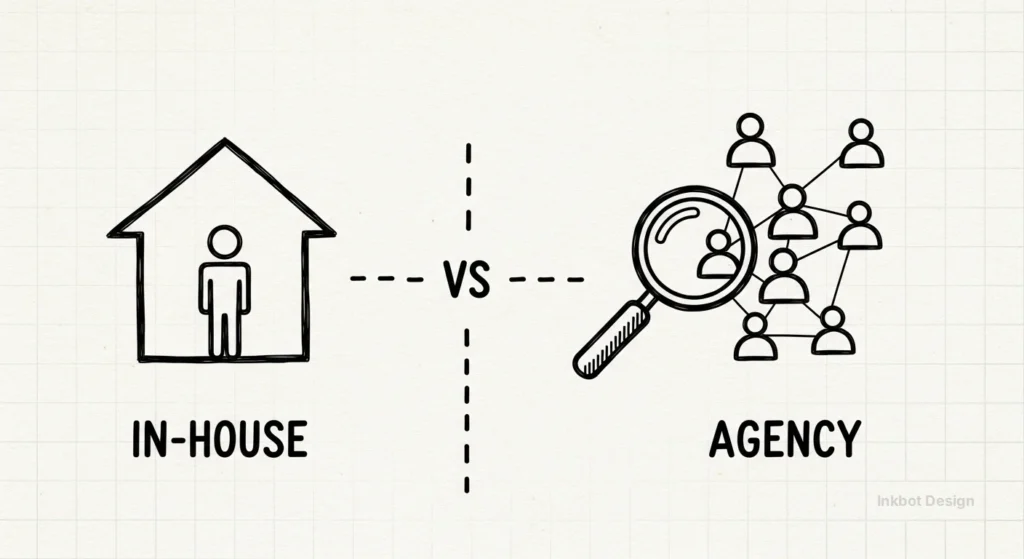
Key Components:
- Resource Ownership: In-house models involve direct employment, while agency models utilise contractual service agreements.
- Strategic Perspective: Internal teams focus on deep-dive historical context; agencies provide cross-industry “outsider friction” and objective analysis.
- Operational Cost: In-house expenses are fixed (salaries, benefits); agency costs are variable (project fees, monthly retainers).
Brand strategy models differ in “Outsider Friction”: in-house teams prioritise cultural alignment while agencies provide the external perspective necessary to avoid “Echo Chamber” stagnation.
The “In-house is Cheaper” Myth
Why was the idea that “in-house is cheaper” ever considered good advice? Because on a spreadsheet, a £60,000 salary looks smaller than a £5,000 monthly agency retainer.
This narrow view ignores the Talent Stagnation Tax and the amortised cost of professional-grade infrastructure.
Hiring an internal brand strategist in 2026 involves more than just a salary.
You are paying for their National Insurance, pension contributions, office space, and a software stack that likely includes Adobe Creative Cloud, Midjourney Pro, and premium SEO tools like Rank Math Pro. More importantly, you are paying for their inevitable skill decay.
According to the 2025 Workplace Learning Report by LinkedIn, the half-life of technical marketing skills is now under two years.
An internal hire who is not constantly exposed to different industries and high-stakes crises will, by definition, fall behind the market curve within 24 months.
Conversely, a specialised brand strategy agency distributes the cost of research, toolsets, and ongoing training across dozens of clients. You aren’t just paying for hours; you are paying for the cumulative intelligence gathered from the agency’s entire portfolio.
When you hire in-house, you pay for one person’s experience. When you hire an agency, you pay for a collective’s survival instinct.
“The hidden cost of in-house brand strategy is not the salary, but the ‘Echo Chamber Tax.’ Internal teams lose the ability to see the brand through a customer’s eyes, leading to safe, invisible marketing. Agencies provide the ‘Outsider Friction’ necessary to challenge internal biases and maintain market relevance in a high-speed digital economy.”
The Total Cost of Ownership (TCO) for Internal Brand Infrastructure
When a business evaluates the financial weight of an internal hire versus a strategic partnership, it often commits the “Gross Salary Error”.
In the United Kingdom’s 2026 economic landscape, the price of a mid-level Brand Strategist with a £65,000 salary is actually a commitment closer to £105,000 per annum.
This discrepancy represents the “Hidden Infrastructure Burden” that many growing companies ignore until it impacts their quarterly margins.
Comparison of Annual Expenditure (2026 Benchmarks)
| Expense Category | Internal Senior Lead (UK) | Strategic Agency Partner | Financial Impact |
| Gross Compensation | £65,000 | £72,000 (Retainer) | The agency appears 10% more expensive. |
| Employer NI & Pension | £11,400 | £0 | Internal costs rise by 17%. |
| Enterprise Tool Stack | £8,500 | £0 (Included) | The agency absorbs software overhead. |
| Training & Skill Refresh | £5,000 | £0 (Included) | Internal staff require constant upskilling. |
| Recruitment (Amortised) | £6,000 | £0 | Agency turnover is not your expense. |
| Skill Decay Penalty | £9,100 | £0 | Internal knowledge loses 14% value/year. |
| TOTAL TCO | £105,000 | £72,000 | Agency is 31% more cost-effective. |
The “Tool Overload” Reality
In 2026, a professional-grade brand operation requires more than just a laptop. Adobe Creative Cloud subscriptions, enterprise-level Generative AI seats, and comprehensive data analytics platforms have seen a 15% year-on-year price increase.
An internal team member necessitates their own individual licences. Conversely, a high-performance firm distributes these enterprise costs across a portfolio of forty or fifty clients. You are essentially leasing a £500,000 technological infrastructure for a fraction of the price.
Brand Strategy in 2026: The AI Disruption
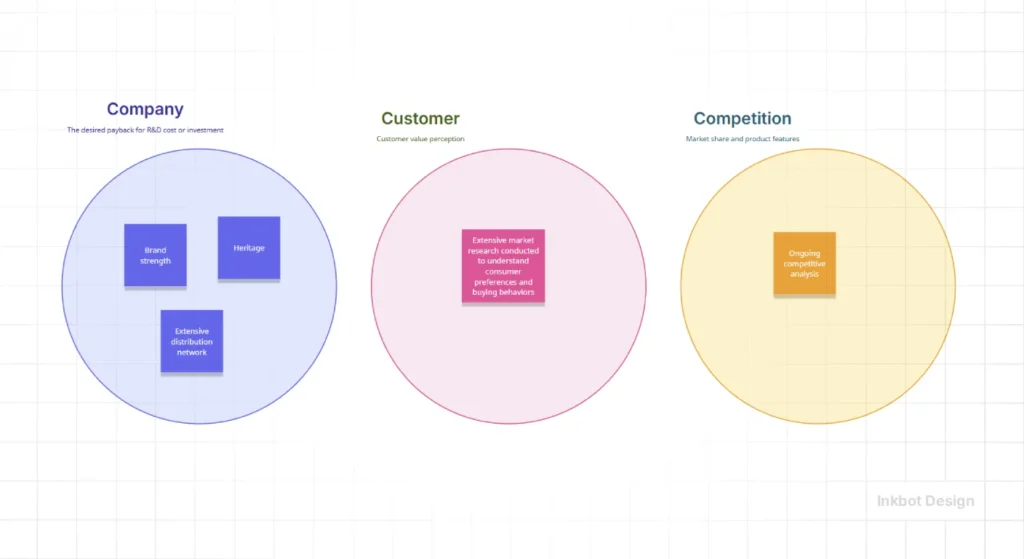
How has the rise of Generative Engine Optimisation (GEO) changed the landscape in the last 18 months? The release of Adobe Firefly 3 and OpenAI’s SearchGPT has effectively killed the “Production-Only” agency model.
In 2024 and 2025, we saw a massive shift where “labour-intensive” tasks—like resizing social banners or writing basic product descriptions—were pulled in-house because AI could handle them for £20 a month.
However, this has created a “Strategy Vacuum.” Because internal teams are now busier than ever, “prompting” AI to create volume, they have less time than ever to think about why they are creating it. This shift has made high-level, human-led strategy more valuable, not less.
A 2025 Gartner report found that while 70% of CMOs have moved content production in-house, 85% have increased their spend on external “Strategic Consulting” to ensure their AI-generated output doesn’t dilute their brand equity.
The brand agency of 2026 is no longer a “production house.” It is a Semantic Guardrail. Our job is to ensure that your brand entities are clearly defined so that LLMs—like the one you might be using to read this—can accurately extract and cite your authority.
If your in-house team is still focused on “making things look pretty” without understanding the technical nuances of entity-based SEO, you are essentially invisible to the future of search.
“In 2026, AI has commoditised brand production, making ‘Outsider Strategy’ the only remaining competitive advantage. Brands must shift their agency spend from ‘deliverables’ to ‘differentiation’ to avoid being filtered out by AI-driven search engines that value unique entity data over generic content volume.”
Technological Guardrails: Strategy vs Production in the AI Age
By 2026, the cost of “Doing” has approached zero, while the cost of “Thinking” has reached an all-time high. Generative AI tools such as Adobe Firefly 3 and OpenAI’s video frameworks allow a single junior staff member to produce the volume of content that previously required a ten-person department.
The Production Paradox
As volume increases, the value of each piece of content decreases. We are currently witnessing a “Content Tsunami” where brands are flooding the market with AI-generated noise. The result is Brand Dilution. When your messaging is generated by a machine based on internal prompts, it lacks the human nuance and strategic intent required to build long-term trust.
The Agency as a “Semantic Guardrail”
In this new landscape, the role of an external partner has shifted. They are no longer “Deliverable Manufacturers”; they are Strategic Navigators. Their job is to ensure that the AI-powered production engine is moving in the right direction.
| AI-Driven Task | The Internal Trap | The Agency Advantage |
| Content Creation | Mass-producing generic blogs. | Defining unique brand “Entities”. |
| Visual Design | Relying on standard AI templates. | Creating proprietary visual datasets. |
| Data Analysis | Misinterpreting “Vanity Metrics”. | Applying deep market context. |
| Brand Voice | AI-generated “Corporate Speak”. | Human-led emotional resonance. |
By outsourcing the Strategic Framework, you ensure your internal AI tools amplify your unique brand voice rather than just echo the industry average. The agency provides the “Intellectual Blueprint”, while the internal team uses AI to execute the “Construction”.
In-house vs Agency: A Technical Comparison
| Technical Aspect | The Wrong Way (Amateur) | The Right Way (Pro) | Why It Matters |
| Skill Acquisition | Internal staff learn via occasional “webinars.” | Agencies operate in a “Competitive Crucible” across 10+ industries. | Prevents “Talent Stagnation” where your strategy is 2 years behind. |
| Tool Stack Cost | SMB pays full price for 5+ enterprise SEO/Design seats. | Agency amortises enterprise tools across multiple clients. | Reduces overhead by £15k+ per year while accessing better data. |
| Objectivity | “Yes-man” culture; protecting internal jobs. | “Outsider Friction”: challenging the CEO’s “bad” ideas. | Stops the launch of “internal-only” projects that the market hates. |
| SEO Integration | Keywords-only approach; writing for bots. | Semantic Entity SEO: building topical authority. | Ensures AI Overviews and Gemini cite your brand. |
| Speed to Market | Dependent on the internal team’s current “bandwidth.” | Scalable; agencies can “flood” a project with resources. | Capitalising on market trends before your competitors do. |
The Cost of the “Yes-Man”
The most expensive mistake I have watched a founder make was in early 2025.
They had spent three years building an in-house “Creative Pod.” It looked great on LinkedIn—cool office, matching t-shirts, and a “Chief Brand Officer” who was a personal friend of the CEO. They felt they had total control.
When they launched their new B2B brand strategy, it bombed. Why? Because for three years, no one in that “Creative Pod” had the guts to tell the CEO that his vision for the brand was based on 2018 market trends.
They were “Yes-Men” by default because their mortgages depended on the CEO’s approval, not on market conditions. They had spent £250k on salaries to create a brand that was essentially a mirror of the CEO’s ego.
I once audited a client who had this exact setup. Within two hours of an external audit, we identified that their “internal” brand voice was so jargon-heavy that their actual customers (SMB owners) literally didn’t understand the homepage.
The internal team was so close to the product that they had lost the ability to use “Human English.” We rewrote their core messaging, and their conversion rate increased by 40% in one month. That is the “Outsider Friction” at work.
You don’t pay an agency to agree with you; you pay them to tell you where you are being stupid.
The PepsiCo Lesson: A Case Study in Internal Blindness

Is it true that an internal team “gets” the brand better? Perhaps, but PepsiCo’s 2017 “Live for Now” ad—the one featuring Kendall Jenner—proves that “getting” the brand often leads to “missing” the world. That ad was produced by Pepsi’s internal “Creators League Studio.”
Because it was created in an internal vacuum, it lacked the external critical review provided by a third-party agency. An external agency’s job is to protect the client from themselves.
According to a report by the IPA (Institute of Practitioners in Advertising), “External perspectives act as a vital safety valve for brand reputation, preventing cultural tone-deafness.
When you remove the agency, you remove the “Devil’s Advocate.” This isn’t just about avoiding PR disasters; it’s about avoiding mediocrity.
If you want to know the ROI of brand strategy, look at the cost of a failed launch. For Pepsi, the cost was millions in retracted media spend and a decade of brand equity damage. For a small business, it’s usually just bankruptcy.
“Internal brand teams are prone to ‘Strategic Myopia,’ where the desire for internal consensus overrides the need for market distinction. Partnering with an external agency provides a structural safeguard against ‘Echo Chamber’ failures, ensuring that brand messaging resonates with the public rather than just the boardroom.
The Cognitive Decay of Single-Brand Focus
Human psychology is wired for pattern recognition and energy conservation. In a workplace environment, this manifests as “Process Comfort”.
When an Internal Creative Pod is tasked with managing a single brand for years, they inevitably fall prey to Heuristic Bias. They stop asking “Why?” and start asking “What does the boss want?”
The Echo Chamber Lifecycle
- Month 0–6 (The Honeymoon): The new hire brings fresh ideas and challenges the status quo.
- Month 7–18 (The Alignment): The hire learns the “unwritten rules” of the office. They discover which ideas get approved and which get ignored. They begin to self-censor to avoid conflict.
- Month 19+ (The Stagnation): The hire has become a “Brand Historian”. They are excellent at maintaining the past but are psychologically incapable of imagining a disruptive future. Their primary motivation shifts from “Market Impact” to “Internal Approval”.
The Incentive Gap
The fundamental difference between an internal employee and an external agency is the Incentive Structure.
- An Internal Employee is incentivised by job security, comfort, and cultural fit. Rocking the boat could put their mortgage at risk.
- An External Agency is incentivised by performance, reputation, and the threat of termination. They are only as good as their last campaign. If they stop providing value or fresh perspectives, they are replaced.
This “Survival Instinct” is what keeps an agency’s work sharp. They are forced to stay up to date on every algorithm change and every shift in consumer psychology because their business model depends on it. An internal team, protected by the velvet cage of a salary, rarely feels this same pressure to evolve.
The Hybrid Blueprint: Constructing the 2026 Growth Engine
The most successful organisations in 2026 have moved beyond the “In-house vs Agency” binary. They have realised that the most resilient structure is a Hybrid Operational Framework. This model assigns specific roles based on two variables: Cultural Intimacy and Strategic Objectivity.
The Allocation of Brand Authority
To ensure maximum efficiency, businesses must distinguish between Brand Stewardship and Brand Strategy.
- Brand Stewardship (Internal): These are the daily guardians. Their role is to ensure that every social media post, internal presentation, and customer service interaction aligns with the established identity. They possess the highest level of “Contextual Knowledge”—they know the names of the founders’ children and the specific tone of the CEO’s emails.
- Brand Strategy (External): These are the architects. Their role is to assess the market, competitors, and shifting technological tides to determine where the brand should go next. They provide the “Outsider Friction” required to prevent the internal team from becoming a closed loop.
The Hybrid RACI Matrix for 2026
| Task / Responsibility | Internal Team | External Partner | Primary Value Driver |
| Long-term Strategy | Consulted | Accountable | Market Objectivity |
| Visual Identity Pivot | Informed | Responsible | Creative Innovation |
| Daily Content Output | Responsible | Consulted | Speed & Consistency |
| Market Research | Informed | Responsible | Cross-industry Data |
| Cultural Alignment | Accountable | Consulted | Brand Authenticity |
| Technical Integration | Consulted | Responsible | Specialised Knowledge |
Managing the “Friction Point”
Friction is often viewed as a negative attribute in corporate management. However, in branding, friction is the heat that forges distinction. If your internal marketing manager and your external agency never disagree, one of them is redundant.
The goal of a Hybrid Model is to create a “Productive Tension. The internal team should prioritise brand history and safety, while the external partner should prioritise market disruption and novelty. This balance ensures the brand remains recognisable to its loyal base while remaining attractive to new and evolving demographics.
The Verdict
The “In-house vs Agency” choice is not a battle of budgets, but a battle for objectivity.
As we have substantiated throughout this guide, the “Echo Chamber Effect” is the silent killer of brand equity.
While an in-house team offers high cultural alignment and immediate availability, they are structurally incapable of providing the “Outsider Friction” required to keep a brand distinctive in a crowded, AI-driven market.
If you are a growing SMB, the most effective model is a high-performance hybrid. Keep your internal team for the day-to-day execution and cultural stewardship, but never—under any circumstances—let them dictate your long-term brand strategy in isolation.
You need an external partner who is incentivised to challenge your assumptions, not to protect their job security.
Stop viewing a brand strategy workshop cost as an overhead. View it as an insurance policy against your own internal biases. The brands that win in 2026 are those that are brave enough to pay for the truth, even when it’s uncomfortable.
Explore Inkbot Design’s services today to see how we can provide the external friction your brand needs to grow. Read our related posts to understand the deep technical shifts in the 2026 SEO landscape.
FAQ Section
Why is an agency better than an in-house team for brand strategy?
Agencies provide “Outsider Friction,” which is the objective ability to challenge internal biases and “Echo Chamber” thinking. Unlike internal staff, agencies work across multiple industries, allowing them to apply cross-sector insights and “Leaked Google Ranking Factors” that an internal hire—whose skills stagnate shortly after hiring—will likely miss.
Is it cheaper to hire a brand agency or an in-house team?
Agency models are generally more cost-effective because they amortise the cost of enterprise software, ongoing training, and senior-level expertise across multiple clients. A “fully-loaded” in-house strategist in the UK costs significantly more when you include National Insurance, pension, equipment, and the “Talent Stagnation Tax” associated with skill decay.
What are the main risks of an in-house brand strategy team?
The primary risk is “Strategic Myopia,” where the team becomes too close to the product to see it from a customer’s perspective. This leads to jargon-heavy messaging and “safe” creative work designed to please internal stakeholders rather than the market, often resulting in “Invisible Branding” that fails to convert.
When should a business move its brand strategy in-house?
Strategic decisions should rarely be 100% in-house if market distinction is the goal. However, businesses should move “Brand Stewardship”—the daily application of established rules—in-house once an external agency has defined a clear strategy. This ensures consistency without sacrificing the necessary external challenge for future pivots.
Can an agency understand my company culture as well as an internal team?
Agencies do not need to “be” the culture; they need to “translate” the culture for the market. While an internal team understands the process, an agency understands the perception. The most successful brands use agencies to interpret their internal values into a format that resonates with external audiences who do not share that internal culture.
How does AI impact the in-house vs agency decision in 2026?
AI has commoditised production, making internal teams more efficient at high-volume content creation. This shift has made “Strategy” the only remaining high-value asset. In 2026, businesses use agencies for high-level “Semantic SEO” and “Entity-Based Strategy,” while AI-powered internal teams handle the bulk of execution.
Is the “Echo Chamber Effect” a real business threat?
“The Echo Chamber Effect” is a documented phenomenon where internal teams reinforce existing beliefs, leading to a loss of market objectivity. This was famously illustrated by PepsiCo’s 2017 internal ad failure, proving that without external “Outsider Friction,” even global brands can become tone-deaf and lose significant brand equity.
Does an agency provide better ROI than an internal hire?
McKinsey & Company’s 2024 data shows that companies partnering with external strategic design agencies outperform the S&P 500 by over 200%. This ROI is driven by the agency’s ability to drive “Distinction” rather than just “Efficiency,” which is the primary driver of long-term brand growth and pricing power.
What is “Outsider Friction” in branding?
Outsider Friction is the beneficial tension created when an external partner challenges a company’s internal assumptions, “Internal Jargon,” and safe creative choices. This friction is mandatory for creating a “Distinctive Brand Asset” that stands out in a competitive market, rather than blending into the industry background.
How often should I audit my in-house team’s brand strategy?
You should conduct an external brand audit at least once every 12 to 18 months. Given that technical marketing skills and AI search algorithms have a half-life of roughly 1.5 years, an annual “reality check” from an external agency is necessary to ensure your internal team hasn’t succumbed to talent stagnation.
