Content Repurposing Framework: Turn 1 Post into 10
There is a pervasive lie in the marketing industry that “content is king.” It is not. Content is merely an asset. If that asset sits in a vault where nobody sees it, it is worthless.
I frequently audit businesses that spend thousands of pounds on high-quality, long-form journalism for their company blog. They hit ‘publish’, share the link once on LinkedIn with a caption that says “New post, check it out,” and then… nothing. They move on to the next topic.
This is the digital equivalent of building a Formula 1 car, driving it to the supermarket once, and then parking it in a garage forever. It is an appalling waste of capital.
The problem is not a lack of ideas; it is a lack of extraction.
You do not need to write more; you need to extract more from what you already have. This is where content repurposing separates the amateurs from the media companies.
Real content marketing is not about volume; it is about density. It is about taking one core idea and hammering it home across every channel until your audience associates that authority with your brand.
If you are tired of the content treadmill—running faster only to stay in the same place—this guide is for you. We are going to dismantle the “publish and pray” method and replace it with a rigorous, industrial-grade framework for asset management.
- Treat long-form content as the Core Pillar: create exhaustive, data-rich source material to feed all downstream assets.
- Deconstruct the pillar into platform-native child assets: H2s become LinkedIn posts, carousels, threads, or short videos.
- Prioritise platform context and zero-click value: tailor hooks, formats and links to each channel for maximum reach.
- Use AI for structure, not final copy; add human anecdotes and batch repurposing to scale efficiently and protect quality.
What is Content Repurposing?
Content repurposing (also known as content recycling) is the strategic practice of adapting a single source piece of content into multiple formats for distribution across different channels.
It is not simply copying and pasting a blog post into a Facebook caption. It is the process of deconstructing a heavy “parent” asset (like a white paper or video) into smaller, platform-native “child” assets to maximise reach and reinforce the message.
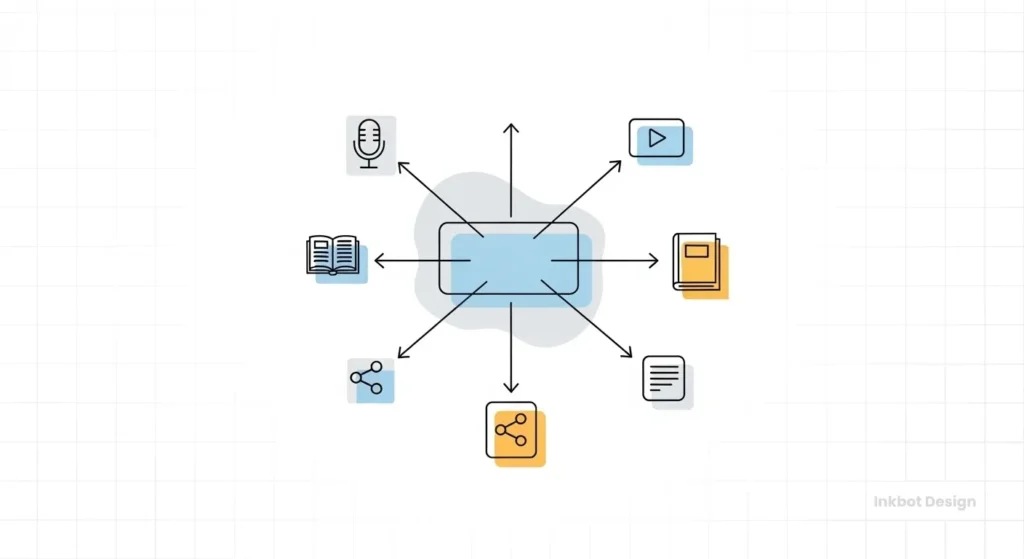
The 3 Pillars of Effective Repurposing
- Adaptation: Changing the format (e.g., text to audio) to suit the consumer’s context.
- Distribution: Placing the message where the audience actually lives, rather than forcing them to visit your site.
- Reinforcement: Using repetition to create the psychological “Frequency Illusion,” making your brand appear ubiquitous.
The Economics of Repurposing: Why You Cannot Afford to Skip This
Before we get into the how, we must address the why. This is not just about saving time. It is about unit economics.
The Cost of Acquisition vs. The Cost of Distribution
Creating a high-quality, 3,000-word, authoritative article takes time. Let’s conservatively say it costs you £500 in billable hours (research, writing, editing, graphic design).
If that post generates 100 views, your Cost Per View (CPV) is £5.00. That is expensive.
If you repurpose that post into 10 pieces of social content, 2 videos, and a newsletter, and you generate 10,000 impressions across channels, your cost per impression plummets.
The “Duplicate Content” Myth
One of the most stubborn myths I hear from clients is: “If I post the same thing everywhere, won’t Google punish me?”
No.
Google’s “duplicate content” penalty applies to on-site duplication (e.g., having 10 identical pages on your own website, which can trick the algorithm). It does not apply to you sharing the insights from your blog on LinkedIn, Medium, or YouTube.
Furthermore, you are overestimating the amount of attention people pay to you. Marketing data consistently shows that organic reach on platforms like Facebook and LinkedIn is often below 5%. That means 95% of your audience did not see the first post. Repurposing is not “spamming”; it is ensuring your audience actually sees the message.
Consultant’s Note: I once worked with a SaaS founder who was terrified of “repeating himself.” He thought that if he tweeted about a feature on Monday, he couldn’t mention it on Thursday. We looked at his analytics. The overlap in audience between the two posts was less than 2%. By “protecting” his audience from repetition, he was actually ensuring they remained ignorant of his product.
The “1-to-10” Framework: Step-by-Step Execution
This is the core methodology we use at Inkbot Design. We refer to it as the “Waterfall Method.” It starts with one high-effort asset at the top and cascades down into lighter, faster formats.

Step 1: The Core Pillar (The Source)
Everything starts with the Core Pillar. This is typically a lengthy piece of content that necessitates in-depth research. It serves as the “Source of Truth” for all downstream assets.
Format Examples:
- A 2,500-word Ultimate Guide.
- A 45-minute Podcast Episode.
- A 20-minute YouTube Tutorial.
- A Webinar recording.
The Rule: The Core Pillar must be exhaustive. It must contain data, unique opinions, and structural hierarchy (H2s and H3s). If the source is weak, the repurposed content will be of little value.
Step 2: The Deconstruction (The Chop Shop)
Once the Pillar is live, do not just share the link. You must deconstruct it.
Take your 2,000-word article. It likely has 4 or 5 main subheadings (H2s). Treat each H2 as a standalone topic.
- Action: Copy the text of one H2 section.
- Refinement: Strip out the transitional phrases (“As mentioned above…”).
- Result: You now have the rough draft for 5 separate LinkedIn posts or newsletter segments.
Step 3: Visualisation (The Scroll Stoppers)
Text is hard to digest on mobile feeds. You need to convert your data into visuals.
The Carousel (LinkedIn/Instagram):
Take the 5 main points from your article and turn them into a slide deck (PDF for LinkedIn, Images for Instagram).
- Slide 1: The Hook (The Title of your Blog).
- Slides 2-6: One key point per slide (summarised).
- Slide 7: The Verdict/Summary.
- Slide 8: CTA (Link to the full article in the comments/bio).
The Infographic:
If your article contains data (e.g., “75% of users abandon carts”), turn that stat into a standalone graphic.
- Tool: Canva or Adobe Illustrator.
- Usage: These are high-performance assets for Twitter/X and Pinterest.
Step 4: Audio & Video (The High-Value Spin-off)

You have already written the script; it is your blog post. Now, perform it.
The “Talking Head” Video:
Set up a camera (or a decent smartphone). Read your article, but ad-lib slightly to make it sound natural.
- Short Form: Record a 60-second summary for TikTok/Reels/Shorts. “Here are the top 3 reasons your logo is failing…”
- Long Form: Record a 10-minute deep dive for YouTube.
The Podcast Micro-sode:
Not every podcast needs to be an hour-long interview. Record yourself reading the blog post. Release it as an “Audio Article” for people who prefer listening during their commute.
Step 5: The Newsletter (Direct Injection)
Do not simply send a link with the message “New Post.”
Copy the most controversial or valuable section of the post and paste it directly into the email body. Give the value inside the inbox.
- Subject Line: The Hook from the article.
- Body: 300 words of pure value.
- Footer: “Read the full breakdown here.”
Technical Deep Dive: Platform-Specific Nuances
Repurposing fails when you overlook the platform’s context. A LinkedIn audience is in a “career growth” mindset; an Instagram audience is in a “visual discovery” mindset.
LinkedIn: The Professional’s Tavern
LinkedIn penalises posts that link out of the platform. The algorithm wants to keep users on the site.
- The Wrong Way: Posting the title and a link to your website. Reach will be near zero.
- The Right Way: Write a “Zero-Click” post. Put the lesson in the post itself. Post the PDF carousel. Put the link to your website in the comments or your bio.
Twitter / X: The Thread
A 2,000-word blog post is a 12-tweet thread waiting to happen.
- Tweet 1: The Hook + “A thread 🧵”
- Tweets 2-11: Your key points.
- Tweet 12: “If you enjoyed this, read the full deep dive here: [Link]”
YouTube Shorts / TikTok: The Visual Hook
You cannot just read the text monotonously. You must use the “Green Screen” effect.
- Visual: Put a screenshot of your article or a relevant chart behind you.
- Audio: Point to the data. “Everyone thinks X, but this chart shows Y.”
The State of Content Repurposing in 2026: The AI Factor

We must address the elephant in the room: Artificial Intelligence.
Since the explosion of LLMs (Large Language Models), the internet has been flooded with “AI Slop”—generic, auto-generated summaries. Tools now promise to “Turn one URL into 50 tweets automatically.”
Do not use them blindly.
The algorithm updates from Google and social platforms in late 2025 heavily penalised low-effort, synthetic content. Platforms are detecting generic AI structures (e.g., excessive use of emojis, words like “delve” and “landscape”).
The Hybrid Approach:
Use AI to structure the repurposing, not to write the final copy.
- Good Prompt: “Extract the 4 contrarian arguments from this text and outline them as bullet points.”
- Bad Prompt: “Write me a LinkedIn post based on this.”
The brands winning in 2026 are those that add Human Experience to the repurposed content. When you repurpose a blog into a LinkedIn post, add a personal anecdote: “I saw this happen with a client last week…” AI cannot convincingly simulate a genuine experience to fool a cynical B2B buyer.
Real-World Examples: Success Stories
1. The GaryVee “Reverse Pyramid” Model
Gary Vaynerchuk is often credited as the godfather of this concept. His team films a 1-hour keynote (Pillar Content).
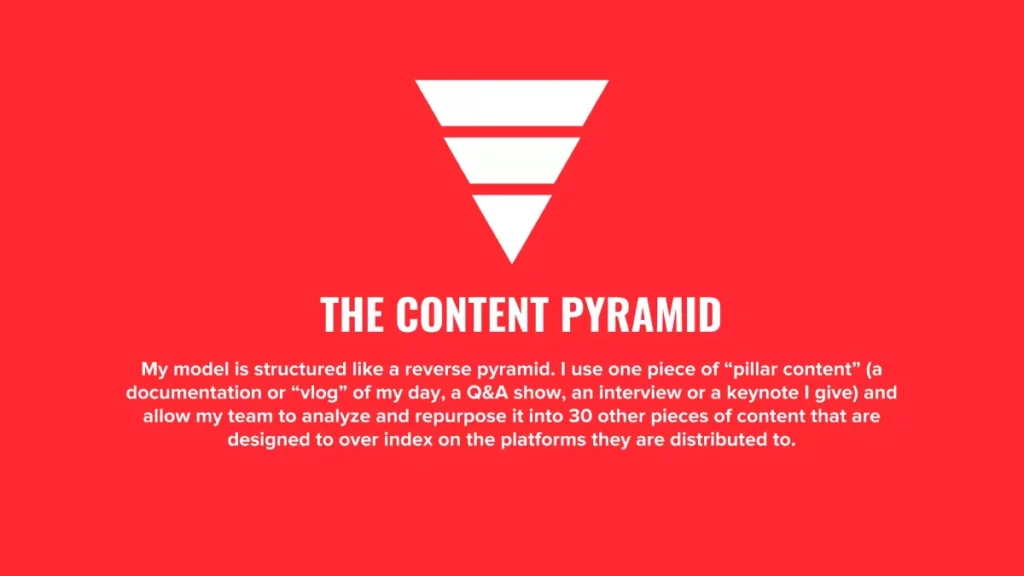
From that 1 hour, they produce:
- 3 YouTube clips.
- 5 Instagram Reels.
- 10 Image Quotes.
- 1 LinkedIn Article.
- Countless Tweets.
- The Result: He produces 100+ pieces of content a day. While you may not have his budget, the principle remains valid. Capture once, edit many times.
2. Moz: Whiteboard Friday
Rand Fishkin’s “Whiteboard Friday” was a masterclass in B2B repurposing.
- Format: A video of Rand explaining an SEO concept on a whiteboard.
- Repurpose: They transcribed the video into a comprehensive blog post, incorporating screenshots of the whiteboard as diagrams.
- Impact: They captured the video audience (YouTube) and the reading audience (Google SEO) with a single recording session.
3. Foundation Inc (Ross Simmonds)
Ross Simmonds builds his entire agency reputation on the concept of “Distribution.” He frequently takes old slide decks, updates the year, adds new data, and re-uploads them to LinkedIn, generating hundreds of thousands of impressions on “old” ideas.
The Repurposing Matrix: Amateur vs. Professional
To clarify the difference between lazy copying and strategic repurposing, review the table below.
| Feature | The Amateur (Lazy) | The Professional (Strategic) |
| Strategy | Copy-paste the same text to all platforms. | Rewrites the “Hook” for each platform’s culture. |
| Linking | Puts the URL in the main post text (killing reach). | Uses “Link in Bio” or “First Comment” strategy. |
| Visuals | Uses the same stock photo for everything. | Resizes images (9:16 for Stories, 4:5 for Feed) and adds overlay text. |
| Timing | Post everything at once. | Staggers posts over weeks to extend the “Long Tail” life of the topic. |
| Goal | “Get clicks to the website.” | “Deliver value on the platform (Zero-Click Content).” |
| Effort | 5 Minutes (Automated). | 1 Hour (Curated & Edited). |
How to Build Your Repurposing Engine
You do not need a team of ten to do this. You need a checklist. Here is a practical workflow you can implement today if you are using digital marketing services or doing it in-house.
- Audit Your Archives: Go to your Google Analytics. Identify the top 10 best-performing blog posts from the last 2 years. These are your “Unpolished Gems.”
- Update the Data: If the post is from 2023, update the stats for 2026.
- Create Templates: Build a Canva template for quotes, a carousel template, and a thumbnail template. This reduces design time by 80%.
- Batch Creation: Do not repurpose one post at a time. Take one day a month to repurpose 4 blog posts. Schedule them out using tools like Buffer or Hootsuite.
- Monitor & Reply: Repurposing fails if you ignore the comments. When you post a question on LinkedIn based on your blog, you must engage with the answers.
Pro Tip: Look for the “Golden Sentence.” In every article, there is one sentence that encapsulates the entire value proposition. Find it. Put it on a plain background. That is your Instagram post.
The Verdict
Content repurposing is not about being lazy. It is about being respectful of the effort you put into the original work.
If you spend 10 hours writing an article, it is disrespectful to your own business to let it die after 24 hours. You owe it to your bottom line to ensure that the asset works for you for months or even years to come.
Stop looking for new ideas until you have exhausted the ones you already have. Your next customer is not waiting for a new post; they are waiting for you to show them the answer you wrote six months ago, in a format they can actually consume.
Do you need help building a content strategy that actually drives revenue? Request a quote today, and let’s stop wasting your expertise.
Frequently Asked Questions (FAQ)
What is the difference between content repurposing and content syndication?
Content repurposing involves transforming the format of the content (e.g., converting a blog post to a video). Content syndication involves republishing the same content on a third-party site (such as Medium or LinkedIn Articles) to tap into their audience. Both are valuable but serve different functions.
Will repurposing content hurt my SEO?
No. As long as you are not publishing identical text on multiple pages of your own domain, Google will not penalise you. Repurposing on social media creates “social signals” and backlinks that can actually improve your SEO authority.
How much time should I wait before repurposing a post?
You can start immediately. The “Waterfall Method” suggests releasing the micro-content (tweets, clips) in the days following the main launch to drive traffic back to the source. However, you can also repurpose “Evergreen” content years later.
What are the best tools for content repurposing?
For visuals, Canva is the standard. For video editing, Descript allows you to edit video by editing text. For scheduling, Buffer or Hootsuite. For turning text into carousels, tools like Contentdrips are useful.
Can I use AI to repurpose my content?
Yes, but with caution. Use AI (like ChatGPT or Claude) to summarise key points or extract quotes, but always edit the output to ensure it matches your brand voice. Never copy and paste AI output directly to social media.
Which social media platform is best for repurposing?
It depends on your business model. For B2B, LinkedIn is the undisputed king for text and document repurposing. For B2C or visual brands, Instagram and TikTok offer the highest viral potential for video repurposing.
How do I repurpose a video into a blog post?
Use a transcription service (like Otter.ai or Rev) to get the text. Then, edit the transcript to add headers, remove filler words, and insert screenshots from the video. Embed the original video at the top of the post.
What is “Zero-Click” content?
Zero-Click content offers standalone value within the platform (e.g., a LinkedIn post that teaches you something without forcing you to click a link). This fosters high trust and brand affinity, which ultimately leads to increased sales, even if it doesn’t drive immediate traffic.
How do I track the success of repurposed content?
Do not just look at website traffic. Look at “Platform Metrics” (Impressions, Likes, Shares) for brand awareness. Use “UTM Parameters” on your links to see exactly which piece of repurposed content drove a visitor to your site.
Is repurposing content worth the effort?
Absolutely. Repurposing typically delivers a higher ROI than creating new content because the “R&D” phase (research and development) is already complete. You are simply maximising the distribution, which is where the value is captured.