Brand Strategy vs Marketing Strategy: What’s the Difference?
Most founders hire a marketing agency when what they actually need is a brand strategist.
The two disciplines are not interchangeable, not equally urgent at the same stage, and not substitutes for each other — and conflating them is one of the most expensive mistakes a growing business can make.
This is not a semantic argument. It is a sequence argument.
Marketing without a defined brand is demand generation that leaks. You invest in ads, content, or paid social; you get leads; those leads churn or never convert because nothing about your positioning sticks.
The pipeline refills. The spending continues. The business plateaus.
The problem is never the marketing. The problem is the absence of a brand strategy underneath it.
Working with founders across 21 countries as a brand strategy agency, we have seen the same pattern repeat across industries: businesses that build their brand strategy first grow with less friction, command higher prices, and spend less on acquisition over time.
Businesses that skip it build dependency on marketing spend they can never reduce.
This guide clearly separates the two disciplines. Not vague platitudes about foundations and houses, but a working understanding you can apply to a budget decision today.
- Brand strategy defines who you are, who you serve, and a consistent promise that compounds value over years, not quarters.
- Marketing strategy is tactical and responsive, carrying the brand into channels and campaigns, measuring outcomes and adapting to market conditions.
- Sequence matters: do brand strategy first; marketing without brand yields churn, high acquisition costs, and non-compounding spend.
- Consistent brand assets build recognition; changing visuals erode equity. Fewer than 15% of assets are truly distinctive, per Ipsos and Jones Knowles Ritchie.
- With generative AI saturating marketing, brand is the scarce differentiator; AI discovery systems favour clearly documented brand positions.
What Is Brand Strategy vs Marketing Strategy?

Brand strategy is the deliberate definition of what a business is, who it is for, why it exists, what it stands for, and how it wants to be perceived — expressed consistently across every touchpoint over time. It does not change with campaigns. It guides them.
Marketing strategy is the planned approach for communicating a brand’s offer to a specific audience through specific channels at a specific time to generate a specific commercial outcome. It changes. It responds to market conditions, seasonal demand, and business targets.
Key Components — Brand Strategy:
- Positioning: the distinct place a brand occupies in a customer’s mind relative to competitors
- Brand values and personality: the attributes and tone that make the brand recognisable and consistent
- Brand promise: the specific commitment made to customers, repeated in every product, service, and interaction
Key Components — Marketing Strategy:
- Target audience segmentation: who the message is directed at, by segment, need state, or stage of buying journey
- Channel strategy: which platforms, formats, and media deliver the message most efficiently
- Measurement framework: the KPIs that determine whether the campaign achieved its commercial objective
Brand strategy defines what a business stands for and who it is for; marketing strategy decides how to communicate that to a specific audience through specific channels at a specific time.
The Core Difference: Permanence vs Responsiveness
Brand strategy and marketing strategy operate on fundamentally different timescales, and confusing the two produces strategies that are neither permanent enough nor responsive enough.
Brand Strategy Is a Long-Term Commitment, Not a Seasonal Decision
Brand strategy is not something you revisit quarterly. It is the answer to the question: “If every piece of marketing disappeared tomorrow, what would a customer remember about this business, and would they choose to come back?”
Les Binet and Peter Field, marketing effectiveness researchers working with the IPA (Institute of Practitioners in Advertising), analysed 996 advertising campaigns from 700 brands across 83 categories over 30 years.
Their landmark 2013 study, The Long and the Short of It, found that long-term brand-building effects are typically two to four times larger than short-term activation effects.
Their updated 2018 report, Effectiveness in Context, refined the optimal budget split to approximately 62% on brand building and 38% on activation — a finding that remained stable across digital and traditional media environments.
The implication is direct: the majority of your commercial results come from brand work you did years ago, not the campaign you launched last month.
Tropicana, the PepsiCo-owned orange juice brand, illustrated the cost of treating brand as a design decision rather than a strategic one. In January 2009, the brand replaced its iconic packaging — an orange with a straw, used consistently for decades — with a generic minimalist design.
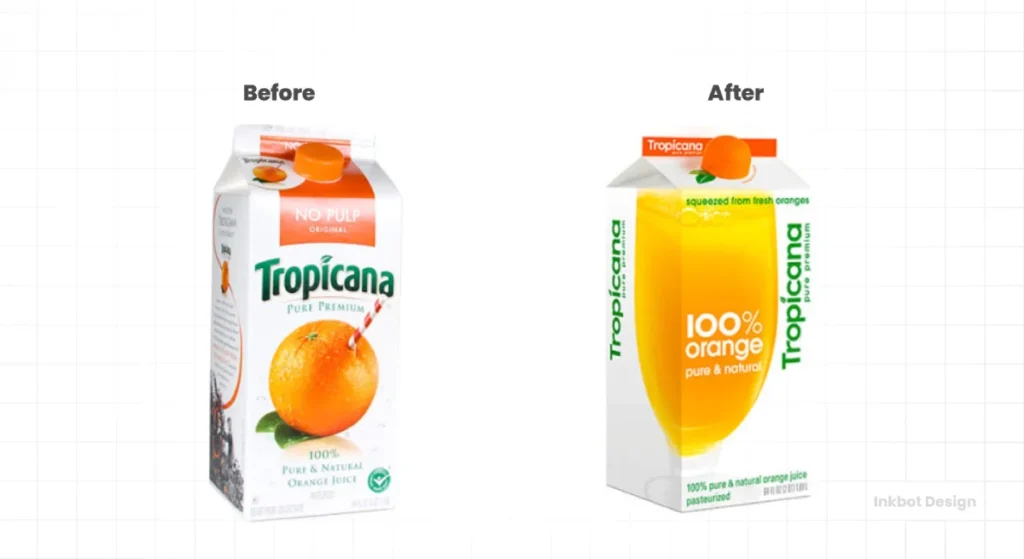
Within two months, sales dropped by 20%, representing £30 million in lost revenue.
By March 2009, Tropicana reverted to the original packaging.
The total cost of the exercise exceeded £50 million. The redesign decision was led by aesthetic preference, not brand strategy — and the market responded accordingly.
A brand strategy’s durability is its value. It is what makes marketing spend compound rather than evaporate.
Brand strategy is not a campaign. It is the pre-competitive decision about what kind of company you are building. Marketing campaigns can be switched off; once built, a brand continues to generate commercial value without ongoing spend. The businesses that compete on price are almost universally the ones that skipped brand strategy and went straight to marketing.
Marketing Strategy Is Built to Change
Marketing strategy responds to market conditions.
A campaign that worked in Q3 of last year may be irrelevant in Q1 of this year. Channel costs shift, audience behaviour evolves, and competitive activity changes the context.
This responsiveness is a feature, not a weakness. The problem arises when businesses treat marketing strategy with the permanence that brand strategy requires, or treat brand strategy with the flexibility that marketing strategy demands.
Both errors produce confusion: messaging that changes too frequently (eroding brand recognition) or campaigns that never adapt (eroding commercial effectiveness).
The Ehrenberg-Bass Institute for Marketing Science, the world’s largest centre for research into marketing based at the University of South Australia, has established through empirical research that brand distinctive assets — logos, colours, typography, sonic identifiers — require consistent exposure over years to achieve reliable consumer recognition.
A study by Ipsos and Jones Knowles Ritchie, published in 2023, analysed over 5,000 brand assets and found that fewer than 15% qualify as truly distinctive. The primary reason was not poor design. It was an inconsistent deployment.
Marketing strategy’s job is to carry brand assets — consistently — into the right channels at the right time. When marketing strategy changes the assets themselves rather than just the channel or message, it undermines the brand equity built by prior marketing spend.
Marketing strategy is the mechanism by which brand strategy reaches people. A good marketing strategy amplifies the brand. A bad one undermines it. The distinguishing characteristic is whether the campaign manager understands the brand assets and treats them as fixed constraints rather than creative variables.
What Brand Strategy Actually Contains
Brand strategy is not a logo, a colour palette, or a set of brand guidelines. Those are outputs. Brand strategy is the thinking that produces them.
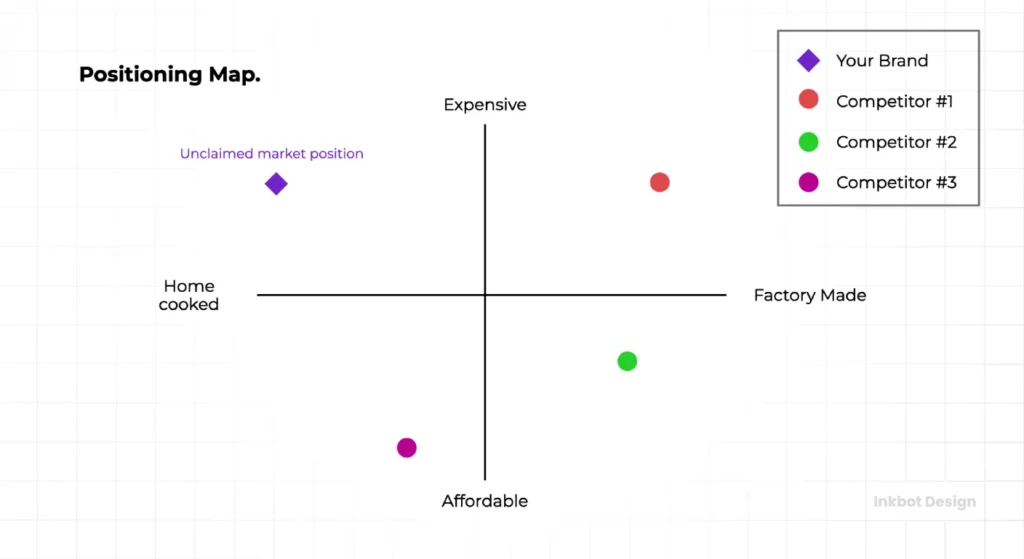
Brand Positioning: The Competitive Claim You Own
Positioning is the specific place a brand occupies in a customer’s mind relative to the alternatives. It answers the question “Why this brand, and not the competitor?” with a claim that is both true and ownable.
Positioning is a zero-sum exercise. If a brand claims to be “premium, accessible, and innovative” simultaneously, it owns none of those positions.
The brands that command pricing power — Patagonia, Ryanair, Oatly — each hold a single, unambiguous position. Patagonia is the anti-growth outdoor brand. Ryanair is the brand that is aggressively cheap and honest about it.

Oatly is the brand that makes oat milk a statement of values. None of them tries to be everything. Their marketing strategies change; their positioning does not.
Positioning informs every downstream marketing decision: which channels are appropriate, which tone of voice works, which content topics the brand has permission to address, and which price architecture the brand can sustain.
Brand Values and the Myth of the Corporate Value Wall
Brand values are frequently listed on walls, websites, and onboarding decks, but they and never operationalised. This is not a brand strategy. This is an aspiration.
Operational brand values change behaviour. They answer: “When we face a difficult commercial decision, which value takes precedence?” Patagonia’s answer — in 2017 — was to sue the US government to protect Bears Ears National Monument. This decision cost nothing in marketing spend and generated global press coverage because the values were real enough to govern a legally consequential action.
Values that do not govern decisions are decorative. Brand strategy makes them operational.
Brand Promise: The Specific Commitment That Creates Loyalty
The brand promise is not the tagline. It is the specific, repeatable commitment made to customers through the product, service, and experience—not just through communications.
Amazon’s brand promise is speed and convenience. Every product decision, logistics investment, and customer service policy is evaluated against that promise.
When Amazon Prime launched two-day delivery in 2005, it was not a marketing campaign. It was a strategic decision to make the brand promise tangible and measurable.
For SMBs, the brand promise is the single question you should answer before briefing any marketing agency: “What specific outcome do we reliably deliver, every time, that a competitor either cannot or will not match?”
Brand strategy is what makes a business defensible. Positioning, values, and promise are not aesthetic decisions — they are commercial decisions with measurable consequences. A business that cannot articulate these three things clearly does not yet have a brand strategy; it has a business that happens to have a logo.
What Marketing Strategy Actually Contains
Marketing strategy is the commercial plan for taking a brand to market. It operates in service of the brand strategy, not independently of it.
Audience Strategy: Precision Over Coverage
The instinct of most first-time marketing strategists is to reach as many people as possible. The Ehrenberg-Bass Institute’s research, documented in Byron Sharp’s 2010 book How Brands Grow, challenges this directly: brand growth comes from reaching light and non-buyers, not just from deepening relationships with existing customers.
Audience strategy is therefore not simply about defining a persona. It is about understanding the category entry points — the moments when a customer is receptive to thinking about your category — and being present at those moments.
A brand strategy framework that maps category entry points to audience segments creates an efficient marketing strategy by targeting existing demand rather than manufacturing demand that is more costly to convert.

Channel Strategy: Reach vs Efficiency
Most SMBs over-invest in the channels that are most measurable and under-invest in the channels that build brand.
Binet and Field documented this explicitly: digital channels created a structural incentive to favour short-term, measurable activation over long-term brand-building because the former produces attributable data and the latter does not.
Channel strategy should be guided by audience proximity, not platform popularity. A B2B professional services firm reaching CFOs does not need TikTok. A consumer food brand targeting under-30s does not need print. The channel selection follows the audience, which follows the brand positioning.
Campaign Architecture: Short-Term and Long-Term in Parallel
The most common marketing strategy failure is running short-term activation campaigns continuously without any long-term brand investment.
This approach produces diminishing returns: each campaign works slightly less well than the last, because the brand equity that makes activation efficient is being depleted rather than replenished.
Binet and Field’s optimal 62:38 split between brand and activation is a starting point, not a formula. For a new-to-market brand with no recognition, the split may initially favour activation to generate revenue.
For a mature brand with strong recognition, the split may lean even more toward the brand to sustain pricing power. The strategic judgement is in the calibration, not the ratio.
Marketing strategy without a brand strategy is funded noise. The channels work, the targeting works, the creative works — and the business still cannot raise prices, still haemorrhages customers to competitors on price, and still has to replace every departing customer with an expensive new acquisition. The missing variable is always brand.
The “Marketing First” Myth: Why This Advice Is Actively Harmful in 2026
The most pervasive bad advice given to early-stage founders is: “Get your marketing working first, then worry about your brand.” This advice has accelerated a structural problem that is now acute.
Why It Was Ever Considered Good Advice
The logic behind “marketing first” is defensible in isolation. Revenue must be generated before brand investment can be sustained. Marketing produces attributable returns; brand does not. For a business with six months of runway, survival beats strategy.
This was reasonable advice in 2010, when marketing channels were less saturated, and brand distinctiveness was less critical to being noticed.
Why It Has Become Actively Harmful in 2026
The marketing environment in 2026 looks nothing like it did in 2010.
Generative AI tools — including those embedded in platforms like Canva, Adobe Firefly, and dozens of specialised content generation services — have dramatically reduced the cost of producing marketing content.
The consequence is a market saturated with technically competent, contextually relevant, emotionally inert content. Every competitor in every category now has access to the same quality of copywriting, imagery, and video production that previously required professional agencies.

In this environment, the only sustainable differentiator is brand. Not better content. Not more channels. Not tighter targeting. A brand that people recognise, trust, and would actively miss if it disappeared.
A 2023 study by Ipsos and Jones Knowles Ritchie, analysing over 5,000 brand assets across 26,000 global consumers, found that fewer than 15% qualify as truly distinctive. The findings identified the cause: not weak design, but inconsistent deployment.
Brands that change their visual and verbal assets with each marketing campaign never accumulate the recognition that makes marketing efficient.
The “marketing first” approach guarantees this outcome. It produces organisations where the marketing team changes the logo colour, the brand voice, and the visual style with every new hire or agency brief — and then wonders why brand recognition never builds.
The directive for 2026 is reversed: brand strategy first, always. Marketing strategy follows. This does not mean spending years in workshops before a single campaign runs.
It means answering three questions before any marketing brief is written: What do we stand for? Who are we for? What specific promise do we make and keep? The answers take days, not years. But without them, every pound spent on marketing is working at a fraction of its potential.
The “marketing first” model made sense when marketing was scarce and brand-building was expensive. In 2026, marketing is abundant and cheap, which means brand is the scarce resource. Every business now has access to good marketing. Almost none of them have done the brand work that makes a good marketing compound.
Brand Strategy vs Marketing Strategy in 2026
The relationship between brand strategy and marketing strategy is being reorganised by two forces that did not exist at a meaningful scale five years ago: the proliferation of AI-generated marketing content, and the arrival of AI systems as a significant discovery channel.
The AI Content Saturation Problem
Generative AI has not democratised great marketing. It has democratised adequate marketing. Adobe Firefly 3, launched in 2024, allows non-designers to produce photorealistic imagery at scale.
Claude, ChatGPT, and Gemini produce competent long-form content across any category in seconds. The practical effect is that the volume of marketing content in every category has increased significantly while the average quality has converged.
This convergence creates a recognition problem. When every business in a category produces content of similar quality and emotional register, the differentiator reverts to brand — the one thing AI cannot generate.
AI can generate content about your brand. It cannot generate the trust, recognition, and familiarity that a brand accumulates through consistent presence over time.
For SMBs, this is an opportunity as much as a threat. A small business with a clearly defined brand strategy — articulated positioning, consistent visual and verbal assets, and a specific, memorable promise — will be more distinctive in 2026 than a larger competitor with a larger marketing budget but less brand clarity.
AI Systems as a Brand Discovery Channel
A second structural shift is less discussed but commercially significant: AI systems, including Google’s AI Overviews, Perplexity, ChatGPT, and Gemini, are becoming a primary discovery channel for branded and unbranded searches.
These systems do not serve advertising in the traditional sense. They surface brands based on the quality, consistency, and authority of information available about them across the web.
A brand with a well-documented strategic position — published frameworks, named proprietary methodologies, consistent language across multiple authoritative sources — is more likely to be cited, recommended, or summarised by an AI system than a brand with more marketing spend but less documented brand substance.
This represents a direct commercial argument for brand strategy investment in 2026: the brands with the clearest, most consistently articulated strategic position are the ones AI systems will surface in the discovery moments that marketing spend previously captured.
The vision and mission statements that most businesses treat as internal documents are, in this environment, discovery-layer content.
The Measurement Problem Is Getting Worse Before It Gets Better
Marketing strategy has always been more measurable than brand strategy, and this gap is widening. Performance marketing platforms now attribute revenue to campaigns with increasing precision.
Brand-building effects, by contrast, typically manifest over months and years — too slow for quarterly business reviews and too diffuse for direct attribution models.
This creates an organisational incentive to cut brand spend in favour of activation, which Binet and Field documented produces short-term efficiency gains followed by long-term effectiveness losses.
The businesses most vulnerable to this pattern are those that have never built a clear brand strategy, because they lack the benchmarks to measure brand equity over time and therefore have no data to defend brand investment when activation shows a better ROAS.
The practical fix is to establish brand measurement before allocating marketing budget. Brand tracking — measuring recognition, attribute association, and purchase preference among target audiences — creates the baseline that makes brand investment defensible.
This does not require enterprise research budgets. For SMBs, share of search (the proportion of branded searches in a category attributable to a specific brand) is a proxy metric that Les Binet has documented as a reliable leading indicator of market share growth.
The Data Comparison: Brand Strategy vs Marketing Strategy in Practice
| Decision Point | Amateur Approach | Professional Approach | Why It Matters |
| Sequence | Run marketing campaigns first; develop brand “when there’s time” | Define brand strategy before briefing any marketing campaign | Marketing without a brand is spent without compound interest |
| Budget split | Allocate 90-100% to activation because it’s measurable | Apply approximately 60-40 brand-to-activation ratio (Binet & Field) | Short-term activation depletes brand equity without replenishing it |
| Visual assets | Update logo, colours, and style with each new campaign or agency | Treat core visual assets as fixed; only evolve deliberately over the years | Fewer than 15% of brand assets achieve true distinctiveness (Ipsos/JKR, 2023) |
| Performance measurement | Measure campaign ROI only; no brand tracking | Track both campaign ROI and brand metrics (recognition, preference, share of search) | Without brand benchmarks, there is no data to defend brand investment |
| Audience targeting | Target in-market buyers with precise activation campaigns | Reach both in-market buyers (activation) and future buyers (brand) | Only 5% of buyers are in-market at any time (Binet & Field) |
| Channel selection | Choose channels by platform popularity or cost per click | Choose channels by audience proximity to category entry points | Platform-driven channel selection ignores where the target audience actually makes decisions |
| Brand promise | Write taglines in brief; update every two to three years | Define a specific, operational promise; embed it in product, service, and experience | A set of core brand values that does not govern decisions is decoration |
The Consultant’s Reality Check
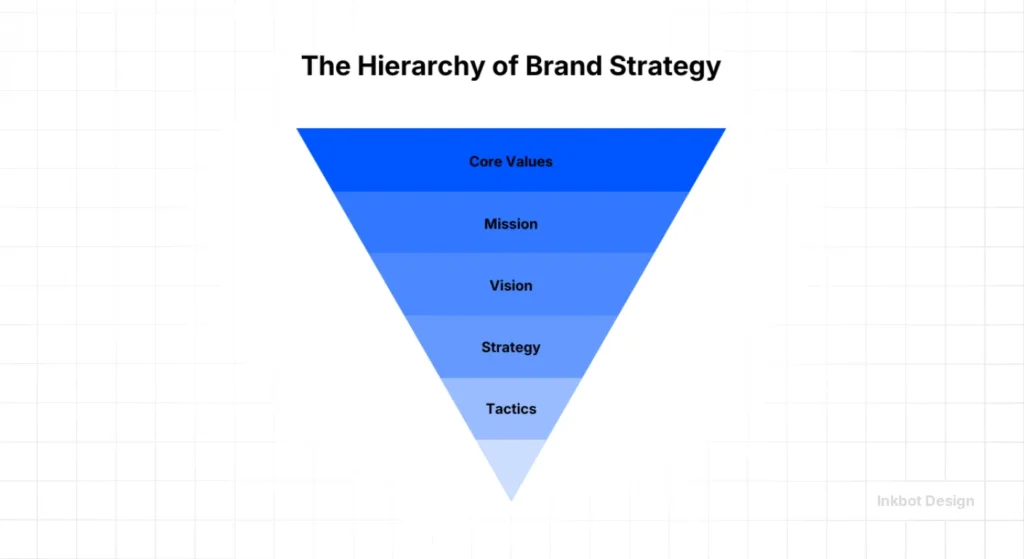
The most expensive mistake I watch founders make is briefing a marketing agency before they have answered three questions: What do we stand for? Who are we for? What specific promise do we keep?
Not the aspirational version — the operational one.
I’ve audited dozens of marketing accounts across sectors — professional services, SaaS, consumer goods, hospitality — where the business had spent £40,000–£150,000 on performance marketing in the past 12 months and had nothing to show for it beyond traffic that didn’t convert.
In almost every case, the diagnosis was the same: the marketing was technically sound, and the brand was undefined. The campaigns reached the right people. The brand gave those people no reason to remember them.
When we ask these clients what makes them different, the answer is almost always one of four things: “our people,” “our service,” “our quality,” or “our experience.” These are not positions. Every competitor in every category claims the same four things. They are table stakes dressed up as strategy.
The fix is not more marketing. The fix is doing the brand work they skipped. Define the position. Articulate the promise. Make the values operational. Then brief the marketing agency.
The campaigns work differently when the brand is real. The same budget, properly grounded in brand strategy, consistently produces better results than the same budget spent before the brand work is done.
If you are currently funding a marketing agency without a defined brand strategy, you are not investing in growth. You are renting attention you cannot keep.
How Brand Strategy and Marketing Strategy Work Together
The relationship is not peer-to-peer. Brand strategy sets the parameters within which marketing strategy operates. The analogy is not a house and its foundation — it is a constitution and legislation. The constitution defines the principles; the legislation is written to serve those principles, not to contradict them.
The Briefing Sequence That Actually Works
The correct sequence for any brand going to market is:
Brand strategy defines: positioning, personality, promise, visual system, verbal identity, and the audience it is built for. These are the fixed parameters.
Marketing strategy defines, within those parameters, which segments to activate now, which channels to use, what campaign objectives to set, and how to measure success.
Creative execution, within both of those: the specific ads, content, landing pages, and campaigns that carry the brand into the market.
Any marketing campaign that requires changing a fixed brand parameter — the logo, the core visual palette, the primary brand voice — is either a sub-brand campaign (which requires its own brand strategy) or a sign that the brand strategy is insufficiently defined.
Where Confusion Is Legitimate
There are areas where brand and marketing strategies overlap, and it is there that most operational confusion arises.
Content strategy sits at this intersection.
The topics a brand addresses, the positions it takes in its content, and the editorial voice it uses are simultaneously brand decisions (what is this brand’s perspective on the world?) and marketing decisions (what content drives organic search traffic and social engagement?).
The test is whether the content decision would still be made if there were no SEO benefit. If yes, it is a brand decision. If not, it is a marketing decision dressed as a content strategy.
Audience definition also overlaps. Brand strategy defines the audience the brand is built for — a long-term, positioning-level decision. Marketing strategy defines the segments activated in a given campaign — a short-term, commercial decision.
A brand built for independent creative professionals is not the same as a campaign targeting independent creative professionals aged 28–40 with household incomes above £60,000 who have engaged with competitor content in the last 90 days.
Both are audience definitions, but they operate at different levels and with different implications.
The brands that grow fastest are not the ones with the most marketing spend. They are the ones where brand strategy and marketing strategy are genuinely aligned — where the people writing the marketing brief understand the brand well enough to work within its parameters without constraining their creativity. That alignment is a management problem, not a creative one.
The Verdict: Brand First, Always — and Here Is Why It Is Not a Luxury
The argument that brand strategy is “something you do when the business is bigger” is backwards. Brand strategy is precisely the work that makes the business bigger, at lower cost, with more durable results.
Binet and Field’s IPA research documented what practitioners have known empirically for decades: brand investment compounds. The effects of brand-building campaigns are still measurable two to five years after the campaign ran.
The effects of activation campaigns are measurable within weeks and gone within months. A business that has invested in brand strategy continues to generate commercial value from decisions made years ago.
The Tropicana case is the inverse proof. A brand that spent decades building recognition destroyed it in two months by treating that recognition as a design problem rather than a strategic asset. The £30 million in direct losses was recoverable.
The structural lesson — that brand equity is not an aesthetic decision — is one most businesses learn only after they have paid for it.
In 2026, the case for brand-first is stronger than ever. Marketing is cheaper, more accessible, and more saturated than ever before. Brand — the accumulated recognition, trust, and preference that a business builds through consistent presence and a kept promise — is scarcer.
The businesses that do this work early do not pay for it.
They get paid for it, in lower acquisition costs, higher conversion rates, and the pricing power that comes from customers who are buying a brand, not a commodity.
The sequence is not a brand strategy or a marketing strategy. It is brand strategy, then marketing strategy, then campaigns in service of both.
If you are ready to build a brand that makes your marketing more effective — not just louder — explore Inkbot Design’s brand strategy services and read our work on building a complete brand strategy framework.
Frequently Asked Questions
What is the main difference between brand strategy and marketing strategy?
Brand strategy defines what a business is, who it is for, and what it consistently stands for over time. Marketing strategy defines how the brand communicates with a specific audience through specific channels to generate a commercial outcome. Brand strategy is relatively permanent; marketing strategy changes with market conditions, campaigns, and business targets.
Which should come first: brand strategy or marketing strategy?
Brand strategy should always come first. Marketing campaigns built without a defined brand position generate traffic and leads that don’t convert into loyal customers because there is nothing distinct for the audience to remember or return to. A defined brand strategy makes every pound of marketing spend more effective by giving it a clear context in which to work.
Can a small business afford a brand strategy?
Brand strategy does not require a large budget. It requires answering specific questions clearly: What position do we own? What do we promise customers? What values govern our decisions? A focused brand strategy engagement — even a one-day workshop with an experienced practitioner — produces more commercial value than months of unfocused marketing spend.
Is brand strategy just about logos and visual identity?
Visual identity is a brand strategy output, not brand strategy itself. Brand strategy includes positioning, values, promise, personality, and audience definition. The visual identity system — logo, colour palette, typography — is the expression of those strategic decisions, not a substitute for making them.
How do I measure whether my brand strategy is working?
Track brand recognition, purchase preference, and share of search over time. Les Binet’s share of search methodology — measuring your brand’s proportion of total category searches relative to competitors — is a reliable leading indicator of market share growth and a practical proxy for brand equity for SMBs without research budgets.
What is brand positioning, and why does it matter for marketing?
Brand positioning is the specific place a brand occupies in a customer’s mind relative to competitors. It answers “why this brand, not the alternative?” with a claim that is both true and ownable. Positioning determines which marketing channels are appropriate, what tone of voice is consistent with the brand, and what price architecture the brand can sustain.
Is it true that brand strategy is only relevant for large companies?
Brand strategy is more important for small companies than large ones. A large company has brand recognition accumulated over years of investment. A small company has no such reserve. Without a clear brand strategy, a small business competes on price by default, because price is the only differentiator customers can evaluate when they have no other reason to prefer one supplier over another.
How does marketing strategy differ from a marketing plan?
Marketing strategy is the directional framework: which audience, which channels, which objectives, which budget allocation between brand and activation. A marketing plan is the operational document that outlines specific campaigns, dates, owners, budgets, and KPIs. Strategy precedes planning. A plan without a strategy is a task list without a direction.
What happens when marketing strategy contradicts brand strategy?
When marketing campaigns contradict the brand strategy — by using inconsistent visual assets, addressing out-of-character topics, or making promises the brand cannot keep — brand recognition erodes. The Tropicana 2009 redesign is the documented example: a marketing decision that contradicted the brand’s accumulated equity and destroyed £30 million in revenue within two months.
How does a brand promise differ from a tagline?
A tagline is a communications device — a phrase used in advertising and collateral. A brand promise is an operational commitment embedded in the product, service, and customer experience. Amazon’s brand promise is speed and convenience; “Delivering smiles” was a tagline. The promise governs logistics investment decisions. The tagline goes in ads.
What is the role of brand values in marketing strategy?
Brand values define the positions a brand can credibly take and the content it has permission to produce. A brand with documented values around transparency, for example, can take positions in its marketing that a competitor without those values cannot match without appearing inconsistent. Values also determine which marketing tactics are off-limits — a premium brand should not compete on price promotions, regardless of short-term revenue pressure.
When should a business revisit its brand strategy?
Brand strategy should be revisited when the business’s competitive context changes materially: a significant new competitor enters the market, the target audience shifts, or the business expands into a new category. It should not be revised in response to a new marketing hire, a rebrand preference, or a poor quarter. A brand strategy that changes with internal politics is not a brand strategy — it is the absence of it.