Brand Positioning Strategies: 5 Frameworks to Dominate Your Niche
If you try to be everything to everyone, you end up being nothing to anyone.
It is the oldest cliché in marketing because it happens to be true.
Most small business owners treat branding and positioning as an afterthought—a logo here, a witty tagline there. They assume that if their product is “good,” the market will naturally notice. This is a dangerous fallacy. The market does not care about your product; the market cares about context.
Positioning is that context. It is the deliberate act of designing your company’s offering and image to occupy a distinct place in the mind of the target market.
Without it, you are just another commodity fighting a war on price—a war you will eventually lose to someone with deeper pockets or lower overheads.
This guide strips away the academic fluff. We are examining the mechanics of brand positioning strategies that effectively work for small to medium-sized businesses (SMBs) in the real economy.
- Positioning creates context in the customer's mind; without it you compete on price and become a commodity.
- Choose one clear strategy—price, quality, competitor, convenience, or values—and avoid mixing contradictory claims.
- Specialisation beats generic claims; target a narrow niche and define technical measures of quality.
- Perceptual mapping and a single Point of Difference reveal white space and guide a surgical positioning statement.
- Positioning requires sacrifice: lose wrong customers to attract right ones; authenticity and topical authority matter in 2026.
What are Brand Positioning Strategies?
Brand positioning strategies are the tactical frameworks businesses use to differentiate themselves from competitors in the minds of consumers. It is not about changing the product itself, but rather how it is perceived.
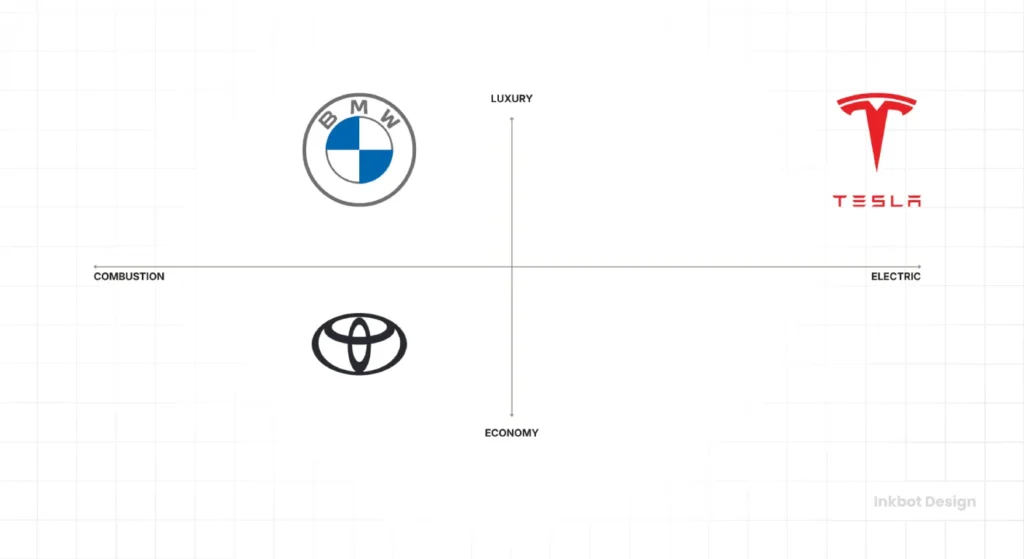
At its core, a robust positioning strategy answers three specific questions:
- Who is this for? (Target Audience)
- What value does it provide that others do not? (Differentiation)
- Why should they believe you? (Reason to Believe)
If you cannot answer these clearly, you do not have a brand; you have a business card.
The “Stuck in the Middle” Trap
Michael Porter, the godfather of modern strategy, warned against getting “stuck in the middle.” This occurs when a brand attempts to be both high-quality and low-priced, or exclusive and mass-market, simultaneously.
Consultant’s Note: In our audits at Inkbot Design, we frequently see SMBs claiming to offer “luxury service at affordable prices.” This breeds distrust. Consumers know that luxury is expensive. By claiming both, you achieve neither. You must pick a lane.
5 Brand Positioning Strategies for Small Businesses
There is no single “best” way to position a brand, but there are proven paths. The goal is to identify which attribute your competitors are ignoring and claim it for yourself.
1. Price-Based Positioning Strategy
This is the most dangerous game, yet it is also the most common entry point. You position your brand based on the economic value exchange.
- Economy (Low Price): You offer the most affordable option. This requires massive scale to remain profitable (e.g., Ryanair, Walmart). For an SMB, this is usually a suicide mission unless you have a proprietary manufacturing advantage.
- Premium (High Price): You use price as a signal of quality. A higher price point creates an implicit assumption of superiority.
The SMB Angle:
Avoid the “race to the bottom.” Instead, use Premium Pricing to signal expertise. If you are a consultant, charging double the market rate instantly positions you as a specialist rather than a generalist. It filters out bad clients and attracts those who value results over savings.
Real-World Example:
Apple never competes on price. They price their hardware significantly higher than functional equivalents (like Dell or HP). This pricing strategy reinforces their position as a lifestyle luxury brand, not just a tech manufacturer.

2. Quality-Based Positioning (The “Specialist” Approach)
Beware: “Quality” is subjective. Everyone claims to have high quality. To make this work, you must define what quality means technically.
Does quality mean “durability” (it lasts 50 years)? Does it mean “precision” (accurate to 0.001mm)? Or does it mean “ingredients” (organic, non-GMO)?
For small businesses, Specialisation is the most effective form of quality positioning. Do not be a “Digital Marketing Agency.” Be a “PPC Agency for SaaS Companies.” Deep expertise is the ultimate proxy for quality.
- The Wrong Way: “We offer high-quality dental services.” (Generic).
- The Right Way: “We are the only clinic in London specialising exclusively in nervous patients.” (Specific).
3. Competitor-Based Positioning (The Challenger)
This strategy involves defining your brand directly in relation to a dominant competitor. You acknowledge the market leader and explain why you are the better alternative for a specific segment.
This is often called “De-positioning.” You frame the competitor’s strength as a weakness.
The “David vs. Goliath” Tactic:
If your competitor is huge, position them as slow, impersonal, and bureaucratic. Position yourself as agile, personal, and caring.
- Classic Example: Avis vs. Hertz.
In the 1960s, Hertz was the market leader. Avis couldn’t claim to be #1. So they positioned themselves as #2. Their famous tagline: “We’re number two. We try harder.” It turned their smaller size into a benefit (better service). - Modern Example: Liquid Death.
They positioned themselves against traditional “boring” water brands and sugary energy drinks. They used death metal aesthetics to sell… water. They positioned themselves against the culture of the category.

4. Convenience-Based Positioning
In 2026, friction is the enemy. If you can save the customer time or effort, that is a defensible position.
This is not just about location; it is about platform, speed, and ease of use.
- Implementation: Can you offer same-day delivery when competitors take three days? Can you offer a one-click checkout? Can you automate a manual process?
- The SMB Reality: You cannot out-logistics Amazon. However, you can offer mental convenience. For example, a “Done-For-You” service package positions you as the convenient solution compared to a competitor’s “Do-It-Yourself” tool.
5. Values-Based Positioning (Differentiation)
This is increasingly vital for Gen Z and Millennial consumers. It involves aligning your brand with a social, environmental, or ethical cause.
However, this carries risk. It must be authentic, or you will be accused of “Greenwashing” or “Woke-washing.”
The “Tribe” Concept:
You are not just selling a product; you are building a tribe of people who share your beliefs.
- Example: Patagonia.
Their position is environmental activism. When they ran the “Don’t Buy This Jacket” ad, it reinforced their position against consumerism, which ironically drove sales. - Example: Ben & Jerry’s.
They do not just sell ice cream; they sell social justice. Their positioning is so strong that it often overshadows the product itself.

The Strategic Framework: How to Build Your Position
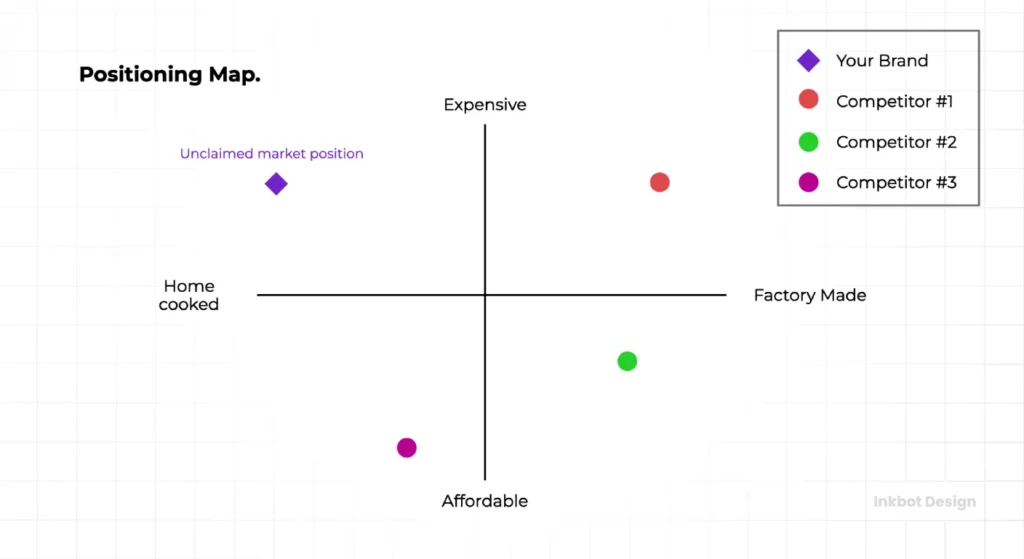
Understanding the strategies is one thing; executing them is another. At Inkbot Design, we use a variation of the Perceptual Mapping technique to find gaps for our clients.
Step 1: Analysing the Competitive Landscape
You must know who you are fighting. Conduct a competitive analysis to identify your rivals’ market positions.
Create a graph with X and Y axes. Label the axes with opposing attributes relevant to your industry (e.g., Price vs. Performance, Traditional vs. Modern). Plot your competitors. Look for the white space.
Step 2: The “Points of Difference” (POD)
What is the one thing you can claim that no one else can?
- Is it a proprietary technology?
- Is it a unique founder story?
- Is it a specific process?
Warning: Do not rely on “Customer Service” as your POD. Good service is an operational requirement, not a strategic differentiator. Your competitor can hire better staff tomorrow and nullify your advantage.
Step 3: Crafting the Positioning Statement
This is an internal document, not a tagline. It guides your marketing decisions.
The Formula:
For [Target Audience], [Brand Name] is the [Frame of Reference] that delivers [Benefit/Point of Difference] because [Reason to Believe].
Example for a B2B Software Company:
“For remote-first creative agencies, FlowChart Pro is the project management tool that eliminates email chains entirely, because it integrates natively with Slack and Zoom.“
See the difference? It is not “the best software for business.” It is surgical.
The “Anti-Positioning” Trap: What to Avoid
In our work developing brand identities, we often have to “un-learn” bad habits that clients have picked up from generic business advice.
1. The “Better” Trap
Stop trying to be “better.” “Better” is a comparison; “Different” is a position. If you say you have “better coffee,” you invite the customer to critique you. If you say you have “the strongest coffee in the world” (Death Wish Coffee), you have created a category.
2. The Focus Group Fallacy
Do not ask your customers where you should position yourself. They do not know. As Henry Ford (allegedly) said, “If I had asked people what they wanted, they would have said faster horses.” Positioning requires leadership, not consensus.
3. Ignoring the “Cost of Retrieval”
If your positioning is complex, you lose.
- Bad: “We are a synergy-driven solutions provider for enterprise architecture optimisation.”
- Good: “We fix broken IT infrastructure.”
The lower the cognitive load (or Cost of Retrieval) for your audience to understand what you do, the higher your conversion rate.
The State of Brand Positioning in 2026
The landscape has shifted. The strategies that worked in 2020 are starting to show signs of strain.
The Death of “Aspirational” Branding
For decades, brands positioned themselves as “aspirational”—showing consumers the perfect life they could have. In 2026, amidst economic volatility and digital fatigue, consumers are cynical. They crave Authenticity and Transparency.
Brands that position themselves as “flawed but real” are winning. The “Building in Public” movement, where founders share their revenue, failures, and struggles, is a powerful positioning tool for SMBs. It creates a human connection that faceless corporations cannot mimic.
The Rise of “Algorithmic Branding”
We are now positioning for algorithms as much as for humans. Large Language Models (LLMs) and search engines favour entities with high “Topical Authority.”
If you position yourself as a generalist, the AI overlooks you. If you position yourself as the semantic authority on a narrow topic (e.g., “Sustainable Bamboo Packaging for Cosmetics”), you become the primary answer in the new search landscape.
Consultant’s Reality Check
I once audited a client—a mid-sized law firm—that wanted to “modernise” their brand. Their website was full of stock photos of people shaking hands and copy that read: “Dedicated to excellence. Committed to you.”
I asked them, “If I cover your logo and swap it with your biggest competitor, would anyone notice?”
Silence.
They were terrified of offending potential clients by being too specific. They wanted to appeal to corporate law, family law, and criminal defence equally.
We forced them to make a sacrifice. We repositioned them purely as “The Litigation Specialists for Tech Startups.”
They lost 40% of their leads overnight. The partners panicked.
But the 60% that remained? They were the right leads. Their conversion rate tripled. Their fees doubled because they were no longer “lawyers”—they were “startup protectors.”
The Lesson: Positioning is about sacrifice. You must be willing to lose the wrong customers to get the right ones.
Comparing Positioning Approaches
Here is a quick reference to illustrate how a generic approach falls short compared to a strategic one.
| Feature | The Amateur (Generic) | The Pro (Strategic) |
| Focus | Trying to appeal to everyone. | obsessively appealing to a niche. |
| Pricing | Based on costs + margin. | Based on value perception. |
| Message | “We offer high-quality service.” | “We solve [Specific Problem] for [Specific Person].” |
| Competitors | Ignores them or copies them. | De-position them actively. |
| Visuals | Follows current design trends. | Brand differentiation strategy based on psychology. |
The Verdict
Brand positioning strategies are not a marketing exercise; they are a business strategy.
If you are a small business, you do not have the budget to shout your way to market share. You must whisper the right words to the right people.
- Stop being generic. “Quality” and “Service” are not strategies.
- Make a sacrifice. Decide who you are not for.
- Check your ego. Your brand is a tool to help customers solve a problem, not a monument to your own ego.
If you are struggling to define your position or feel that your visual identity is undermining your strategy, we can help. At Inkbot Design, we specialise in translating complex business goals into clear, profitable brand identities.
Next Step:
Are you ready to stop competing on price? Request a Quote today, and let’s define exactly where you stand.
Frequently Asked Questions (FAQ)
What is the difference between branding and positioning?
Branding is the emotional and visual expression of your company (logo, voice, design). Positioning is the strategic logic behind it—defining where you sit in the market relative to competitors. Positioning comes first; branding brings it to life.
Can a small business use multiple positioning strategies?
It is risky. Blending strategies (such as “lowest price” and “highest quality”) often lead to confusion. It is safer to choose one primary “Master Strategy” (e.g., Convenience) and use others as supporting pillars, provided they do not contradict the main promise.
How often should I review my brand positioning?
You should audit your positioning every 12 to 18 months. Markets change, competitors adapt, and consumer behaviours shift. If your conversion rates are dropping or you are constantly haggling over price, it is a sign your positioning has slipped.
What is a “Unique Selling Proposition” (USP) vs. Positioning?
A USP is a specific feature or benefit (e.g., “The only toothpaste with micro-beads”). Positioning is the broader perception of the brand (e.g., “The toothpaste for people who care about whitening”). Your USP supports your positioning.
Is “Customer Service” a valid positioning strategy?
Rarely. In 2026, customers expect excellent service as a baseline. Unless your service model is radically different (e.g., Zappos in the 2000s), claiming “great service” is often seen as a platitude, rather than a differentiator.
How do I know if my positioning is working?
You know it is working when:
You stop competing on price.
Your ideal clients find you, rather than you having to chase them.
You can easily explain what you do in one sentence.
Your competitors try to copy you.
What is “Repositioning”?
Repositioning is the process of changing the market’s perception of an existing brand. This is necessary when a brand becomes outdated or sales decline. Examples include Old Spice (from grandpa’s aftershave to a cool/viral sensation) or Burberry (from a gang wear association back to luxury).
Can I position my brand based on my founder’s personality?
Yes, this is referred to as a “Founder-led Brand” or “Personal Branding.” It is highly effective for SMBs and consultants because it is unique and hard to copy. However, it makes the business harder to sell later since the value is tied to an individual.
What is a Perceptual Map?
A brand positioning map is a visual chart used to plot brands against two axes (e.g., Price and Innovation). It helps identify “white space”—areas where no competitors are currently operating, offering an opportunity for you to enter.
Why is niche positioning better for small businesses?
Niches allow you to focus limited resources. It is cheaper to market to “Left-handed golfers in the UK” than “Golfers.” You can charge a premium for specialisation, and word-of-mouth spreads faster within tight-knit communities.