Brand Mission Statements: 30 Examples & Expert Tips
Summing up your entire business in a single sentence is one of the hardest tasks a founder faces.
It’s easy to dismiss a mission statement as a “fluffy” marketing exercise, but in reality, it’s the strategic heartbeat of your brand.
Get it right, and it becomes a focus for every decision you make and every connection you build. Get it wrong, and you’re just adding to the junk.
After years of refining brand identities, I’ve cracked the code on what separates a “corporate slogan” from a mission that moves the needle.
Today, we’re breaking down 30 real-world examples that actually pack a punch—analysing why they work and how you can apply those same principles to find your brand’s true voice.
Let’s dive in.
- Mission must state your company’s clear purpose, guiding decisions and inspiring employees and customers.
- Craft missions that are concise, action‑oriented and memorable—aim for eight to fifteen words.
- Use the Purpose‑Mission‑Vision framework to keep roles distinct and ensure strategic alignment.
- Activate and measure: embed the mission in hiring, OKRs and a quarterly Mission Alignment Score.
What Exactly Is a Brand Mission Statement?
Before diving into the examples, let’s clarify what we discuss here.
A brand mission statement is:
- A concise declaration of your company’s purpose
- The reason your business exists is beyond making money
- A guide for decision-making at all levels of the organisation
- An inspiration for employees and customers alike
It’s not:
- A lengthy essay about your company’s history
- A list of products or services
- A description of your target market
- A slogan or tagline (though it can inspire these)
Think of it as the focus of your brand. Every decision, from product development to customer service, should align with this mission.
Beyond the Basics: Why Brand Mission Matters in 2026
A brand mission is no longer just a decorative sentence on an “About Us” page. It has evolved into a strategic operational tool.
With the rise of the B-Corp movement and heightened consumer scrutiny, your mission is the primary filter through which your company’s ethics, sustainability, and values are judged.
According to recent benchmarks, purpose-driven brands see higher Customer Lifetime Value (CLV) and lower employee turnover.
In 2026, the mission is the foundation of your Environmental, Social, and Governance (ESG) reporting.
It tells your stakeholders—from investors to entry-level hires—exactly what you stand for when the market gets volatile.
The Shift from “What” to “Why”

Following the principles of Simon Sinek’s Golden Circle, the most successful organisations communicate from the inside out.
While most companies can describe what they do, the mission statement is your opportunity to articulate the why. This emotional core is what builds Brand Advocacy.
When a customer buys from Patagonia, they aren’t just buying a jacket; they are participating in a mission to save the planet.
Mission vs Vision vs Values vs Purpose
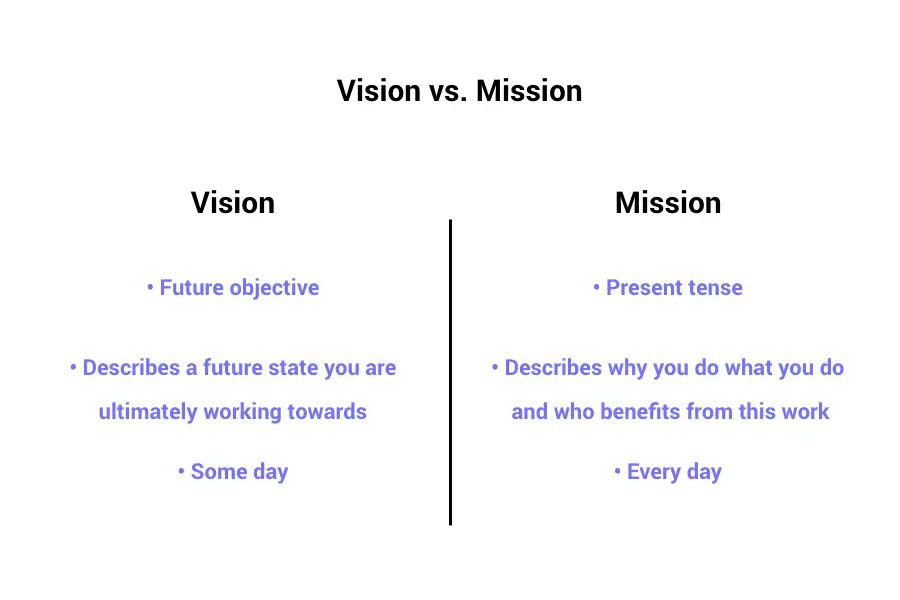
- Mission is what you do today to create impact.
- Vision is the future state you aim to build.
- Values are the non‑negotiable behaviours you uphold.
- Purpose is the broader why that links profit to positive outcomes.
- Taglines are hooks, not missions.
Quick distinctions:
- Mission, present tense, scope and impact.
- Vision, future tense, destination and direction.
- Values, principles that shape choices.
- Purpose, reason to exist beyond money.
Keep the order tight: purpose, mission, vision, values.
- Use purpose as the focus.
- Use the mission to steer today.
- Use vision to frame tomorrow.
- Use values to police behaviour.
Review all four in one workshop.
The Purpose-Mission-Vision Framework
To avoid confusion, use this comparison table to ensure your brand architecture is sound:
| Concept | Focus | Time Horizon | Key Question |
| Brand Purpose | Philosophical | Permanent | Why do we exist? |
| Mission Statement | Operational | Present | What do we do every day? |
| Vision Statement | Aspirational | Future (5-10 years) | Where are we going? |
| Core Values | Behavioural | Permanent | How do we behave? |
Mission Statements by Industry: Tailoring Your Purpose
One size does not fit all. A mission statement for a local bakery will look drastically different from a global SaaS platform. Here is how different sectors approach their focus:
Tech & SaaS
In the technology sector, missions often focus on “empowerment” and “efficiency.” The goal is to show how the software removes friction from a specific process.
- Example (Fintech): “To democratise financial literacy for every household in the UK.”
- Key Elements: User Experience (UX), Digital Transformation, Financial Inclusion.
Healthcare & Life Sciences
These missions are rooted in “outcomes” and “patient-centricity.” They must balance innovation with trust.
- Example: “To accelerate the discovery of life-saving therapies through collaborative genomic data.”
- Key Elements: Patient Outcomes, Biotechnology, Ethics Committees.
Professional Services (Law, Consulting)
For service-based firms, the mission usually revolves around “integrity,” “expertise,” and “client success.”
Key Elements: Fiduciary Duty, Client Relations, Thought Leadership.
Example: “To provide clarity in complex legal landscapes through unwavering integrity.”
30 Brand Mission Statements That Hit the Mark
1. Tesla
“To accelerate the world’s transition to sustainable energy.”
Why it works:
- Clear and ambitious goal
- Focuses on global impact
- Implies innovation without explicitly stating it
2. Nike
“To bring inspiration and innovation to every athlete in the world. (If you have a body, you are an athlete.)”
Why it works:
- An inclusive definition of ‘athlete.’
- Emphasises both emotional (inspiration) and practical (innovation) aspects
- Asterisk adds a memorable twist
3. Google
“To organise the world’s information and make it universally accessible and useful.”
Why it works:
- Broad yet specific
- Addresses both the ‘what’ (organise information) and the ‘why’ (make it accessible and useful)
- Implies ongoing progress and improvement
4. Patagonia
“We’re in business to save our home planet.”
Why it works:
- Bold and unapologetic
- Puts environmental mission front and centre
- Implies that business success is tied to environmental impact

5. Airbnb
“To help create a world where you can belong anywhere and where people can live in a place, instead of just travelling to it.”
Why it works:
- Evokes emotional connection (belonging)
- Challenges traditional concepts of travel and home
- Implies a transformative experience
6. Spotify
“To unlock the potential of human creativity—by giving a million creative artists the opportunity to live off their art and billions of fans the opportunity to enjoy and be inspired by it.”
Why it works:
- Balances artist and listener perspectives
- Implies scale (millions and billions)
- Focuses on enabling creativity and its appreciation
7. Amazon
“To be Earth’s most customer-centric company, where customers can find and discover anything they want to buy online.”
Why it works:
- Sets an ambitious goal (Earth’s most customer-centric)
- A clear focus on customer needs
- Implies a vast selection and convenience
8. TED
“Spread ideas.”
Why it works:
- Incredibly concise
- Open-ended (allows for various types of ideas)
- Implies action and impact
9. Whole Foods
“To nourish people and the planet.”
Why it works:
- Double meaning of ‘nourish’ (food and sustainability)
- Connects individual well-being with global impact
- Simple and memorable

10. Disney
“To entertain, inform and inspire people around the globe through the power of unparalleled storytelling.”
Why it works:
- Covers multiple aspects of impact (entertain, inform, inspire)
- Global focus
- Emphasises their core strength (storytelling)
11. LinkedIn
“To connect the world’s professionals to make them more productive and successful.”
Why it works:
- Clear target audience (professionals)
- Specifies both the ‘how’ (connect) and the ‘why’ (productivity and success)
- Implies ongoing value beyond just networking
12. Starbucks
“To inspire and nurture the human spirit – one person, one cup and one neighbourhood at a time.”
Why it works:
- Emotional appeal (inspire and nurture)
- Balances individual impact with a broader reach
- Implies personalised experience
13. IKEA
“To create a better everyday life for the many people.”
Why it works:
- Focus on improving daily life
- Implies affordability and accessibility (“the many people”)
- Simple and straightforward
14. Uber
“We ignite opportunity by setting the world in motion.”
Why it works:
- Dynamic language (ignite, motion)
- Implies broader impact beyond just transportation
- Focuses on creating opportunities

15. Microsoft
“To empower every person and every organisation on the planet to achieve more.”
Why it works:
- Inclusive (every person and organisation)
- Global scale
- Focuses on enabling others’ success
16. Coca-Cola
“To refresh the world in mind, body and spirit. To inspire moments of optimism and happiness through our brands and actions.”
Why it works:
- Emotional appeal (refresh, inspire, optimism, happiness)
- Connects product (refreshment) with broader impact
- Implies responsibility through ‘actions’
17. Mastercard
“To connect and power an inclusive digital economy that benefits everyone, everywhere by making transactions safe, simple, smart and accessible.”
Why it works:
- Addresses current trends (digital economy)
- Emphasises inclusivity and global reach
- Specifies how they achieve their mission (safe, simple, smart, accessible transactions)
18. Zoom
“To make video communications frictionless and secure.”
Why it works:
- A clear focus on the core product
- Addresses key user concerns (ease of use and security)
- Concise and straightforward
19. Adidas
“Through sport, we have the power to change lives.”
Why it works:
- Emotional impact
- Positions sport as a transformative force
- Implies broader social responsibility

20. Virgin Group
“To change business for good.”
Why it works:
- Double meaning (for the better and permanently)
- Implies innovation and disruption
- Broad enough to cover diverse business interests
21. Southwest Airlines
“To connect people to what’s important in their lives through friendly, reliable, and low-cost air travel.”
Why it works:
- Focuses on customer benefits
- Specifies how they deliver (friendly, reliable, low-cost)
- Emphasises emotional connections
22. Etsy
“Keep commerce human.”
Why it works:
- Incredibly concise
- Implies uniqueness in a digital world
- Focuses on personal connections in commerce
23. Twitter
“To give everyone the power to create and share ideas and information instantly without barriers.”
(“Twitter” rebranded to X in 2023, mission wording shown reflects the Twitter era.)
(You will now see the X name and logo across products and policies.)
Why it works:
- Emphasises democratisation of information
- Implies the real-time nature of the platform
- Focuses on removing obstacles to communication
24. Slack
“To make work life simpler, more pleasant and more productive.”
Why it works:
- A clear focus on improving work experience
- Balances efficiency (more straightforward, more productive) with enjoyment (more pleasant)
- Implies ongoing improvement
25. Shopify
“To make commerce better for everyone.”
Why it works:
- Inclusive (‘everyone’)
- Implies continuous improvement
- Broad enough to cover various aspects of commerce
26. Netflix
“To entertain the world.”
Why it works:
- Incredibly concise
- Global ambition
- Focuses on core offering (entertainment)
27. LinkedIn
“To connect the world’s professionals to make them more productive and successful.”
Why it works:
- Clear target audience (professionals)
- Specifies both the ‘how’ (connect) and the ‘why’ (productivity and success)
- Implies ongoing value beyond just networking
28. Lyft
“To improve people’s lives with the world’s best transportation.”
Why it works:
- Ambitious goal (world’s best)
- Focuses on positive impact (improve lives)
- Implies continuous innovation
29. Walmart
“To save people money so they can live better.”
Why it works:
- Clear value proposition (save money)
- Links savings to improved quality of life
- Simple and straightforward
30. Impossible Foods
“To save Earth by making delicious meat, fish, and dairy products using plants.”
Why it works:
- Bold environmental mission
- Specifies how they achieve it (plant-based products)
- Emphasises taste (delicious) to appeal to consumers
Breaking It Down: What Makes These Mission Statements Work?

Now that we’ve seen some stellar examples, let’s dissect what makes them tick:
- Clarity: They’re easy to understand at a glance.
- Concise: Most are under 20 words.
- Inspiration: They paint a picture of a better future.
- Action-oriented: They use strong verbs to convey purpose.
- Memorable: They often use unique phrasing or structure.
- Broad yet specific: They give direction without limiting potential.
- Customer-focused: They emphasise benefits to users or society.
- Authentic: They align with the brand’s values and offerings.
Quick self‑audit:
- Can someone grasp it in 10 seconds?
- Does it answer who, what, and why?
- Under 30 words, or close.
- Uses active verbs, no fluff.
- Can a colleague recall it after one read?
- Could a competitor claim it? If yes, sharpen it.
- Aligned with current products and values.
- Read it aloud. Does it scan clean?
- Translate once, does the meaning hold?
- Strip adjectives, does the core still work?
Timebox edits: decide within 48 hours.
How to Craft a Mission Statement That Moves the Needle
A mission statement isn’t a creative writing project; it’s a strategic alignment tool.
It should act as a filter for every business decision you make. If a project or a partnership doesn’t fit the mission, it doesn’t happen.
Follow this four-stage framework to move from “corporate fluff” to “brand clarity.”
1. The Core Discovery
Before you write, you need to audit. You cannot define where you are going until you are honest about why you exist. Ask yourself:
- The Utility: What is the specific, high-stakes problem we solve?
- The Audience: Who are the people we refuse to let down?
- The Differentiator: Why should they choose us over a cheaper or closer alternative?
- The Legacy: If our business disappeared tomorrow, what would the world actually miss?
2. The Golden Circle Framework
We utilise Simon Sinek’s Golden Circle to ensure your mission is rooted in purpose, not just profit.
- Why: The belief. (e.g., “We believe every small business deserves a global stage.”)
- How: The process. (e.g., “By democratising high-end e-commerce tools.”)
- What: The product. (e.g., “We build intuitive selling platforms.”)
The Formula: Combine these into one punchy sentence: “We [What] for [Who] by [How] to ensure [Why].”
3. Refine and Distil
Now, we trim the fat. A mission statement you can’t remember is a mission statement you can’t follow.
The Inkbot Rule: Use strong, active verbs. If a word doesn’t add value, it’s noise.
| The Wrong Way (Generic) | The Right Way (Strategic) |
| “To be the best company in our industry.” | “To simplify small business finance so owners can focus on growth.” |
| “To provide innovative solutions to customers.” | “To protect families with simple, fair insurance they can trust.” |
| “To deliver world-class services globally.” | “To connect local makers with global buyers through ethical commerce.” |
Power Verbs to Consider: Empower, Accelerate, Connect, Simplify, Protect, Inspire, and Advance.
4. Activation and Measurement
A mission statement on a wall is a cliché. A mission statement in your workflow is a competitive advantage.
The Rollout Checklist:
- Internal Alignment: Use the mission to vet new hires. If they don’t buy into the Why, they won’t deliver the What.
- Decision Filtering: Reference the mission in your quarterly OKRs. Does this new product feature actually serve the mission?
- The Memory Test: If you ask a junior staff member what the company’s mission is, can they give you the gist of it without looking at a handbook?
How to Measure Impact:
Don’t just set it and forget it. Track your Mission Alignment Score. Every quarter, audit five major decisions. If the mission didn’t play a role in the “Yes” or “No,” you’re experiencing Mission Drift.
Common Pitfalls to Avoid
I’ve seen plenty of mission statements that made me want to gouge my eyes out with a rusty spoon. Don’t be that company. Here are some landmines to sidestep:
- Vagueness: “To be the best” doesn’t cut it. Best at what? For whom?
- Jargon overload: If your gran can’t understand it, it’s too complex.
- Focusing solely on profit: You’re in business to make money. But that’s not inspiring.
- Being too narrow: Leave room for growth and evolution.
- Copying competitors: Your mission should be uniquely yours.
- Ignoring your actual capabilities: Dream big, but stay grounded in reality.
- Writing by committee: Too many cooks spoil the broth. Get input, but have a single vision.
- Exclusionary or inaccessible language: avoid jargon and ableist or culture‑bound phrasing; use plain English and inclusive checks so it reads well across markets.
Evolving Your Mission: It’s Not Set in Stone
Here’s something many people get wrong: Your mission statement isn’t meant to be carved in granite for all eternity.
As your business grows and evolves, your mission might need to shift, too. And that’s okay.
Take Netflix, for example. Their original mission was “To become the world’s best Internet entertainment distribution company.” Pretty specific? But as they expanded into content creation and global markets, they updated it to the broader “To entertain the world.”
The key is to stay true to your core values while adapting to new realities and opportunities.
Frequently Asked Questions about Brand Missions
How long should a brand mission statement be in 2026?
The trend is moving toward extreme brevity. Aim for 8 to 15 words. This ensures it is “sticky” enough for employees to memorise and fits cleanly on social media profiles or mobile app splash screens.
Can a mission statement be a list?
Generally, no. A mission should be a singular, cohesive declaration. If you have a list of items, those are likely your Core Values or strategic pillars, not your mission.
What is the difference between a mission and a tagline?
A mission is internal-facing and strategic; a tagline (like Nike’s “Just Do It”) is external-facing and emotional. Your mission informs your tagline, but they are rarely the same sentence.
How do you write a mission statement for a personal brand?
Focus on the transformation you provide for your audience. Instead of “I am a consultant,” try “To empower creative entrepreneurs to scale their business without burnout.”
Is it okay to change your mission during a rebrand?
Yes. As companies pivot—for example, shifting from hardware to SaaS—the mission must evolve to reflect the new business reality.