The 7-Step Brand Audit: A Strategic 2026 Guide for SMBs
There’s a quiet killer in most marketing budgets: Brand Drift.
It happens slowly—a logo from five years ago here, a disjointed message there—until suddenly, it all collapses. I talk to founders constantly who are baffled why their premium service is being treated like a commodity.
They think they have a traffic problem. In reality, they have a “Trust Tax” problem.
If your brand doesn’t command attention and project authority, you’re working twice as hard for half the results. To move forward, you have to look back.
Here is how we use the Inkbot Design 7-Step Approach to strip away the noise and rebuild your brand’s competitive edge.
- Identify and eliminate Brand Debt by aligning internal culture, visual assets, and IP to restore trust and pricing power.
- Measure Brand-Market Fit using organic search share and sentiment to reduce CAC and increase premium pricing.
- Ensure data cleanliness and technical entity authority (NAP, Schema, accessibility) for visibility in AI-driven search.
What is a Brand Audit?
A brand audit is a comprehensive examination of a brand’s current market position relative to its competitors and its effectiveness.
It is a diagnostic process that identifies where the brand is succeeding, where it is failing, and where the “Brand-Market Fit” has diverged.
The process involves three core elements:
- Internal Branding: Analysis of your values, mission, and company culture.
- External Branding: Evaluation of your visual identity, content marketing, and advertising.
- Technical Performance: Audit of SEO entity health, website UX, and digital accessibility.
Quantifying the Brand-Market Fit (BMF)
In 2026, audit success is measured by its impact on Customer Acquisition Cost (CAC) and Pricing Power.
If your audit doesn’t lead to a reduction in marketing spend or the ability to charge a premium, it has failed.
The BMF Formula:
BMF = (Organic Brand Search Volume ÷ Total Category Search Volume) × Sentiment Score
Why this matters:
- High BMF: Customers seek you out by name. Your dependence on paid advertising drops.
- Low BMF: You are a commodity. You only win on price, and your margins are constantly under pressure.
To calculate your debt, evaluate your Brand-Market Fit against three variables:
- Visual Friction: The percentage of assets not compliant with WCAG 2.2 standards.
- Verbal Entropy: The degree to which your messaging deviates from your core USP across channels.
- Technical Lag: The impact of poor Core Web Vitals on user perception.
The Inkbot Design Brand Audit in 7 Steps

Step 1: The Internal Audit (The Culture Check)
Before you look at your logo, you have to look at your people. A brand is a promise kept. If your internal team doesn’t know what that promise is, you’ve already lost.
Data from McKinsey & Company proves that companies with a strong internal design and brand culture outperform the S&P 500 by as much as 219%. Most SMBs fail here because they view “Brand” as a marketing department problem.
Deep-Dive: The Internal Brand Sentiment Audit
A brand is only as strong as its least-convinced employee. If your internal team doesn’t buy into the mission, your external marketing will always feel hollow.
The “Glassdoor Analysis”: An audit must include an anonymised review of your presence on Glassdoor and Indeed. Search for recurring keywords in negative reviews. Are employees complaining about “lack of direction” or “inconsistent leadership”? These are brand problems, not just HR problems.
Questions for your Employee Survey:
- “If our brand were a person, who would it be and why?”
- “What is the one promise we make to customers that we most often fail to keep?”
- “On a scale of 1-10, how confident are you in explaining our USP to a stranger?”
Strategic Fix: If the average confidence score is below 7, your first post-audit action is an Internal Brand Relaunch, not a new ad campaign. Use platforms like Slack or Microsoft Teams to create “Brand Hubs” where assets and values are easily accessible.
Step 2: The Visual Asset Audit (Killing “Brand Debt”)
Visual Brand Debt is the accumulated clutter of old templates, inconsistent font usage, and varying logo versions across the web.
I once audited a client who was using four different shades of blue across their LinkedIn, website, and PDF proposals.
To a human, it looks “messy.” To a machine—like Google’s Vision AI, it seems like a lack of authority.

Checklist for Visual Assets:
- Logo Versatility: Does your logo work as a 16px favicon and a 10ft billboard?
- Typography Compliance: Are you paying for your font licences? Using “cracked” or unlicensed fonts is a legal ticking time bomb.
- Colour Accessibility: Do your brand colours meet WCAG 2.2 contrast requirements?
A study by Nielsen Norman Group indicates that poor accessibility doesn’t just alienate users; it also signals poor technical quality to search engines.
If you haven’t updated your visual guidelines since 2022, you are likely failing modern accessibility standards.
| Feature | Amateur Brand | Professional Brand |
| Logo | Multiple “tweaked” versions | Single, master SVG library |
| Fonts | Whatever is on the designer’s PC | Licensed, brand-specific web fonts |
| Colours | “Looks good” (subjective) | HEX/RGB/CMYK/Pantone + WCAG Pass |
| Imagery | Generic stock photos | Bespoke, art-directed photography |
The Legal and Intellectual Property Audit
While a visual audit focuses on aesthetics, a legal audit focuses on ownership. You do not truly own your brand if your Intellectual Property (IP) is not secured.
In 2026, with the proliferation of AI-generated content, protecting your “Human-Authored” assets is critical.
Key Checklist for IP Health:
- Trademark Status: Are your brand name and logo registered with the Intellectual Property Office (IPO) in the UK, or the USPTO in the US?
- Font Licensing: Using “free for personal use” fonts in a commercial setting is a significant source of brand debt. Ensure you have a commercial licence for every weight of every typeface in your brand book.
- Image Rights: Audit your stock photo library. If you cannot produce a licence for a hero image on your homepage, it is a liability.
- Domain Portfolio: Does your brand own the .com, .co.uk, and relevant social handles? Discrepancies here create “Navigational Friction.”
Example: A mid-sized UK tech firm recently rebranded to “Nexus Growth.” Six months later, they received a Cease and Desist from an established European firm with a prior trademark. The audit would have cost £5,000; the forced rebrand, £85,000.
Step 3: The Verbal Audit (Voice and Tone)
If I stripped your logo off your website, would I still know it was you? Most brand voices are “professional yet friendly.” That is a platitude. It means nothing.
In 2026, the verbal audit must account for AI-generated content. If your brand sounds like a generic LLM, you are commoditising yourself. You need a distinct brand identity that uses a personal tone of voice to its advantage.
Entity Density and Messaging:
Your brand needs to be semantically linked to your core services. If you are a branding agency, your copy should naturally include terms such as “graphic design,” “typography,” and “market positioning.” This isn’t “keyword stuffing”; it’s establishing your place in the Knowledge Graph.
Step 4: Competitive Strategy & Market “White Space”
You are not auditing in a vacuum. Your brand health is relative to your competitors’ decay. A 2026 competitive audit uses a Positioning Matrix to identify where the market is “over-served” and where gaps exist.
The “Shelf Competition” Analysis
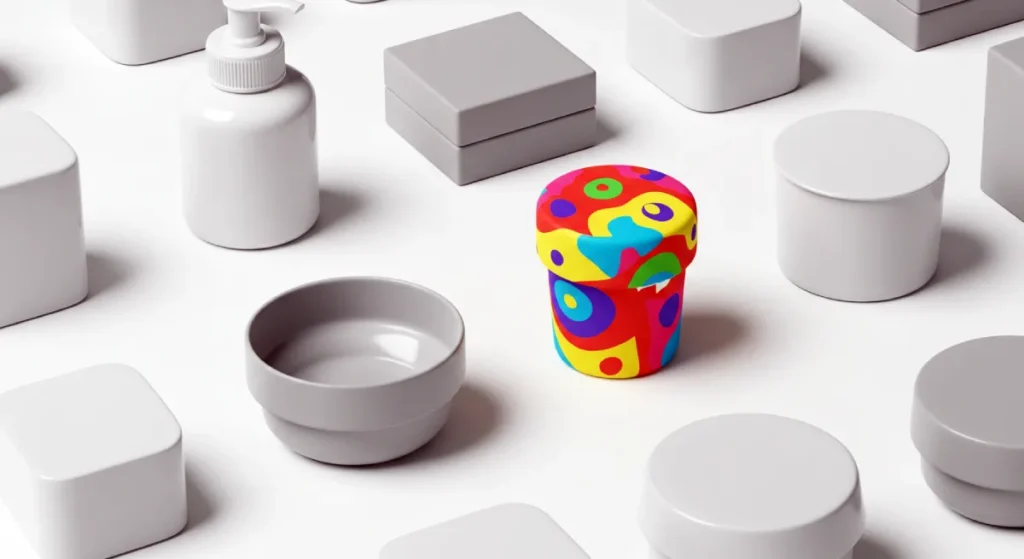
Just as Tropicana lost $30 million by failing to audit their physical shelf presence, digital brands lose market share by blending into the SERP.
- Visual Differentiation: Do your search snippets look like everyone else’s?
- Messaging Overlap: Are you all claiming to be “Innovative” or “Customer-Centric”?
- Authority Gap: Does the competition have a Knowledge Panel, while you only have a standard blue link?
Using Synthetic Audiences
Advanced audits now utilise Synthetic Data—AI-generated personas derived from real consumer datasets—to test new brand positioning before launch.
This allows you to simulate how a “Cost-conscious SMB owner” or a “Tech-savvy Gen Z buyer” would react to your updated visual identity.
Step 5: Customer Perception Audit (The Hard Truths)
What people say about you when you aren’t in the room is your brand.
Use social listening to find the gaps between what you think you are and what the market knows you are. We use tools to aggregate sentiment across Reddit, X, and industry forums.
The “Authenticity” Myth Debunked:
Industry “gurus” tell you to be “authentic.” I’m telling you to be valuable.
Data from the Edelman Trust Barometer suggests that consumers value “competence” and “ethical behaviour” over “personality.” An audit should find where you are failing to demonstrate competence.
Quantifying Perception: Sentiment Analysis Tools
“Authenticity” is no longer a buzzword; it’s a measurable metric. In 2026, we use Emotion AI to quantify how audiences feel about your brand.
This replaces the guesswork of traditional focus groups with real-time data.
Key Tools for your 2026 Audit:
- Brand24: Best for all-in-one sentiment monitoring and protecting your reputation in real-time.
- Chattermill: Ideal for medium-to-large brands looking to centralise feedback across multiple languages and channels.
- Unwrap AI: Uses AI to categorise thousands of unstructured customer reviews into clear “frustration signals” or “trust drivers.”
- Hume AI: For auditing the emotional resonance of your video content and voice search assets.
The Empathy Index. Your audit should result in an Emotional Resonance Score (ERS). This measures the intensity of positive emotion per brand asset. If your imagery is art-directed but yields a low ERS, your visual strategy is failing to connect. In the era of “Treatonomics”—where consumers seek small, optimistic pleasures—brands that evoke joy or competence outperform those relying on fear or urgency.
Step 6: Technical Auditing: Preparing for the Agentic Web
In 2026, your “Digital Twin”—the way AI models perceive you—is your most valuable asset. An audit must ensure that your data is machine-readable and consistent across the entire web.

Entity Matching Checklist:
- NAP Consistency: Ensure your Name, Address, and Phone Number are identical on Google Business Profile, Bing Places, Yelp, and your website. Even a difference between “Street” and “St.” can cause a minor drop in entity trust.
- Schema.org Implementation: You must use Organisation Schema and ProfessionalService Schema. This tells AI agents exactly what you do, who you serve, and where you are located.
- Citation Audit: Use tools like Semrush or BrightLocal to find “Zombie Mentions”—old addresses or outdated logos on third-party directories.
The “Hallucination Test”: Prompt a private instance of Claude or GPT with: “Provide a detailed summary of [Your Brand Name], including its primary competitors and core values.” If the AI mentions services you no longer offer or lists the wrong founder, your Data Cleanliness is failing.
Auditing for “Values-Alignment” and ESG
By 2026, Environmental, Social, and Governance (ESG) factors will no longer be “extras”—they will be core brand identifiers. A brand audit must evaluate if your public statements align with your operational reality.
The Greenwashing Audit: If your brand claims to be “sustainable” but your packaging uses non-recyclable plastics, you are accruing “Reputational Debt.” Use the B Corp framework as a benchmark, even if you aren’t seeking certification.
Key Metric: The Authenticity Gap
This is the distance between your “Marketed Purpose” and your “Operational Truth.” A large gap leads to “Brand Fragility,” where a single social media post can cause a total collapse in consumer trust.
Step 7: The Strategy Gap Audit (The Roadmap)
The final step is the bridge between where you are and where you want to be.
Most audits end with a “report” that sits in a Dropbox folder. A real audit ends with a realignment strategy.
The 2026 Shift:
Over the last 18 months, we have seen a massive shift in how brands are priced and perceived. With the rise of “Cheap AI Design,” the value of “Craft” has skyrocketed. A brand audit in 2026 must focus on “Human Signals.”
The State of Brand Audits in 2026
We are currently in the era of Generative Engine Optimisation (GEO).
When a user asks an AI, “Who is the best branding agency in the UK?”, the AI doesn’t look at your logo. It looks at your citations, your entity relationships, and the consistency of your across-web mentions.
A brand audit today is as much about “Data Cleanliness” as it is about “Design Excellence.” If your address is different on Google Maps than it is on your website, your “Entity Trust Score” drops.
This is a technical failure that a traditional graphic designer will never fix.
Brand Audit Tools for 2026
| Tool | Focus Area | Best For | 2026 Standout Feature |
| Brandwatch | Consumer Intelligence | Enterprise | AI-driven trend prediction |
| Ahrefs | Market Visibility | SMB / SEOs | Share of Voice (SoV) tracking |
| Figma | Visual Consistency | Design Teams | Multi-platform design system syncing |
| Hotjar | UX & Friction | E-commerce | “Rage click” mapping vs brand sentiment |
| SurveyMonkey | Customer Feedback | All | AI-assisted survey bias detection |
| Sprout Social | Social Voice | Marketing Agencies | Cross-channel tone of voice auditing |
2026 Brand Debt Calculator
Measure your brand’s risk based on the 7-Step Audit Framework.
What Does a Professional Brand Audit Cost in the UK?
The cost of an audit varies depending on the depth and size of your organisation.
In 2026, the market will be split between “automated technical checks” and “strategic deep-dives.”
| Audit Type | Best For | Typical UK Investment (2026) |
| The “Health Check” | Small businesses/Startups | £1,500 – £3,000 |
| The Strategic Audit | Scaling SMBs | £4,500 – £8,500 |
| Enterprise Governance | Corporate/Global Brands | £15,000 – £35,000+ |
Why the variation?
A low-end audit (under £1,000) is usually a “copy-paste” job from a generic template. A strategic audit from an agency like Inkbot Design involves qualitative interviews, competitive benchmarking, and a technical entity overhaul that provides a clear ROI roadmap.
The Verdict
Your brand is either an asset or a liability. There is no middle ground.
A strategic brand audit is the only way to identify the “Brand Debt” that is currently dragging down your ROI. In 2026, this means auditing for visual consistency, verbal distinctiveness, and technical entity authority.
Don’t wait for your sales to tank before you check your brand’s health.
If you want to stop guessing and start growing, it’s time to look at the data. Visit Inkbot Design to see how we transform fragmented identities into market leaders.
Ready to fix your brand? Request a quote today.
Frequently Asked Questions
What is a brand audit?
A brand audit is a thorough analysis of a business’s current market position, visual identity, messaging, and technical performance. It identifies inconsistencies and “Brand Debt” that prevent growth and reduce marketing effectiveness.
How often should I perform a brand audit?
You should conduct a complete brand audit every 18 to 24 months. However, smaller “health checks” of digital assets and technical SEO entity alignment should be performed annually to keep up with algorithm changes.
How long does a brand audit take?
A professional brand audit typically takes between 4 to 8 weeks. This depends on the company’s size and the number of digital and physical touchpoints that need to be evaluated.
What is the difference between a Brand Audit and a Brand Refresh?
The audit is the diagnosis (identifying what is broken); the refresh is the treatment (fixing it). You should never start a refresh—or a complete rebrand—without audit data to guide your decisions.
Can I use AI to perform my own brand audit?
You can use tools like ChatGPT or Claude to analyse your copy, but they lack the “Out-of-Bottle” perspective. AI cannot feel the emotional friction of your user experience or understand the nuance of your internal culture. A human-led audit provides the objective “allergic to fluff” insights needed for growth.
What are the signs that I need a brand audit?
Signs include declining lead quality, inconsistent visual usage across platforms, a dated logo, or your team’s inability to consistently describe your “Unique Selling Proposition” (USP).
How does WCAG 2.2 compliance affect my brand?
Accessibility is no longer optional. Poor colour contrast or non-navigable menus signal poor quality to both users and search engines. Auditing for WCAG 2.2 ensures you don’t alienate the 20% of the population with accessibility needs and protects you from legal risks.
How do I audit my brand if I have a £0 budget?
You can perform a “manual audit” by conducting five customer interviews, performing a Google search for your brand to check for consistency, and using the free version of Wave to check your website’s accessibility. Focus on the “Internal Audit” first, as this costs only time.
How much does a professional brand audit cost?
Costs vary based on scope, but for an SMB, a strategic audit usually ranges from £2,500 to £7,500. This is an investment that saves thousands in wasted marketing spend.
What is a “Verbal Audit”?
A verbal audit examines your brand’s tone of voice, messaging hierarchy, and copy. It ensures you don’t sound like a generic AI and that your message resonates with your specific target audience.
Why is accessibility important in a brand audit?
Accessibility (WCAG compliance) is a legal requirement and a search ranking signal. Auditing your brand colours and web design for accessibility ensures you don’t alienate 20% of your potential market.
How does a brand audit improve my visibility in AI Overviews?
AI search systems like Google Gemini and Perplexity rely on topical authority and entity consistency. A brand audit ensures your website uses the correct Schema.org and that your citations are consistent across the web, making it easier for AI to verify your expertise and surface you in answers.
Can an audit help me if my industry is “boring” (e.g., B2B manufacturing)?
Yes. In “boring” industries, a brand audit often reveals a massive “White Space” for differentiation. If all your competitors look the same, even minor improvements in verbal distinctiveness can make you the “default” choice.
Should I audit my personal brand alongside my business brand?
In 2026, the two are inextricably linked. Founders often act as the primary “Entity” that grants trust to the organisation. Audit your LinkedIn profile and public speaking history to ensure they align with the company’s core values.

