STP Marketing: Segmentation, Targeting & Positioning
In auditing SMBs, the biggest drain on capital isn’t high CPCs or bad creative—it’s a fundamental failure in STP.
Companies try to be everything to everyone, resulting in a brand that is nothing to no one.
If you can’t define exactly who you are excluding from your marketing, you haven’t performed STP; you’ve performed “Spray and Pray.”
Ignoring these concepts costs more than just missed sales; it destroys your branding and positioning.
When your positioning is vague, your customer acquisition cost (CAC) skyrockets because you’re bidding on broad keywords against giants with deeper pockets.
- STP prevents wasting budget by defining who you exclude, forcing focused marketing instead of "spray and pray".
- Modern segmentation must use behavioural, psychographic and zero-party data for micro-segmentation and higher relevance.
- Targeting is a financial choice: pick the best segments, aim for LTV:CAC ≥ 3:1, and be willing to say no.
- Positioning claims clear mental real estate; find white space, optimise for AI/entity extraction and maintain consistent proof.
What is STP Marketing?
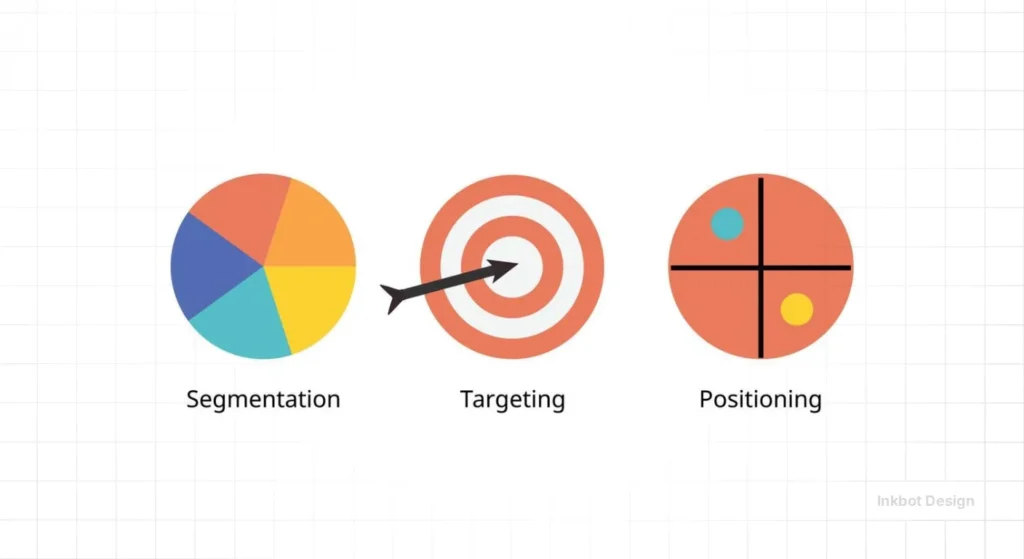
STP Marketing (Segmentation, Targeting, and Positioning) is a three-step strategic framework designed to identify the most valuable market segments and develop a tailored marketing mix for each.
It shifts the focus from the product to the customer, ensuring resources are allocated to audiences with the highest conversion potential.
The three core elements are:
- Segmentation: Slicing the total market into distinct groups based on shared characteristics.
- Targeting: Evaluating the attractiveness of each segment and choosing which ones to enter.
- Positioning: Occupying a distinct, valued place in the target customer’s mind relative to competitors.
Segmentation: Moving Beyond Basic Demographics
If you are still segmenting your audience solely by “Age: 25-34” and “Location: London,” you are failing.
Demographics reveal who a person is, but they don’t reveal why they make a purchase. In 2026, behavioural and psychographic data are the only metrics that matter for a high-performance brand differentiation strategy.
The Four Pillars of Modern Segmentation
- Geographic: Not just countries, but climate, urban density, and regional cultural nuances.
- Demographic: The basics—age, gender, income, education. Useful for filtering, but insufficient for winning.
- Psychographic: Social status, lifestyle, and personality traits. This is where the “Why” lives.
- Behavioural: Purchasing habits, brand loyalty, and product usage rates.
The Evidence: Consider Tesco and its Clubcard data, managed by Dunnhumby. They don’t just see that you bought milk; they see that you bought organic almond milk on a Tuesday evening every fortnight.
They segment you as a “Health-Conscious Suburbanite” and adjust their targeting accordingly. This level of granularity boosted their sales significantly by reducing irrelevant offers.
The Rise of Zero-Party Data
Privacy regulations have made third-party tracking a nightmare. Successful brands in 2026 are using “Zero-Party Data”—information that a customer intentionally and proactively shares with a brand.
This includes preference centre data, purchase intentions, and personal context. This allows for “Micro-segmentation,” where the segment size is effectively one.
Targeting: The Art of Saying “No”
Targeting is the stage where most entrepreneurs lose their nerve. They see five potential segments and decide to target all of them “just in case.” This is a fast track to mediocrity.
Effective targeting requires ignoring 80% of the market to win the 20% that actually matters.
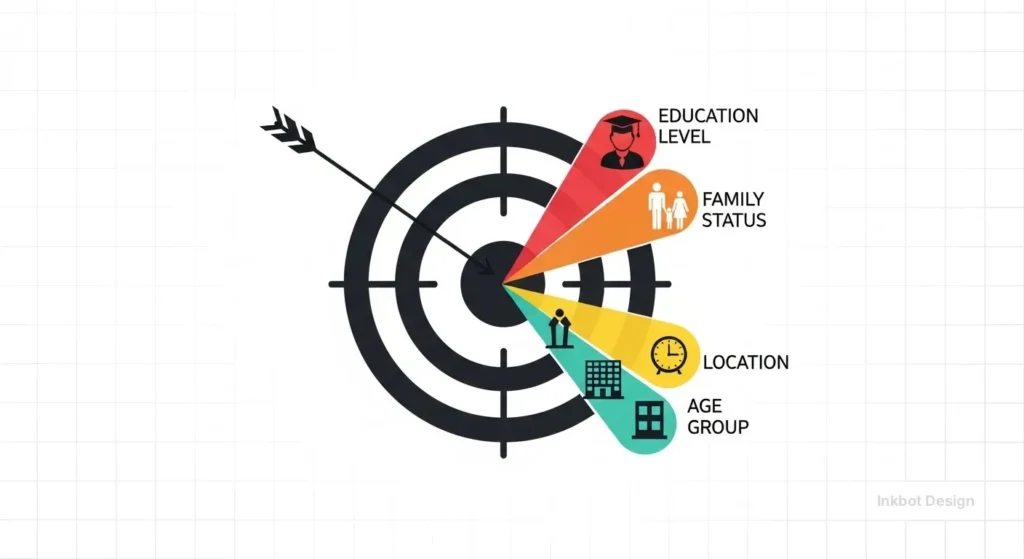
Evaluating Segment Attractiveness
To avoid wasting resources, evaluate your segments against these criteria:
- Size: Is the segment large enough to justify the effort?
- Profitability: Do these customers have a lifetime value (LTV) that offsets the acquisition cost?
- Reachability: Can you actually get your message in front of them without spending a fortune?
- Competition: Is the segment already saturated by a dominant player?
Targeting is a financial calculation, not just a creative one. In 2026, the most successful Market Segments are those that satisfy the LTV:CAC Ratio of at least 3:1.
If your Customer Acquisition Cost (CAC) in a highly competitive “Psychographic Segment” is £500, but the Lifetime Value (LTV) is only £1,200, your STP Marketing is mathematically flawed.
You are effectively paying for a “Targeting” strategy that yields a diminishing return.
Use Predictive Analytics to forecast the Churn Rate of a segment before committing your 2026 ad budget.
The Evidence: Netflix is the master of targeting. They don’t target “people who like movies.” They target specific “taste communities.” Their algorithm identifies thousands of micro-segments, enabling them to market a niche Korean horror film to a specific group in Leeds based on their viewing history, rather than their age.
According to research from McKinsey, companies that excel at this type of precision targeting generate 40% more revenue from those activities than average players.
The PESTLE Influence in 2026
In 2026, targeting must account for the PESTLE factors—Political, Economic, Social, Technological, Legal, and Environmental —when considering the impact of external factors.
For instance, the UK’s focus on sustainability means segments prioritising “Eco-conscious consumption” are growing faster than traditional “Value” segments.
If you aren’t adjusting your targeting to reflect these shifts, your brand visibility will suffer.
Positioning: Claiming Real Estate in the Mind
Positioning is not a slogan. It is the mental map your customer uses to categorise you.
If I say “Volvo,” you think “Safety.” If I say “Ferrari,” you think “Speed.” If I say your brand name and the customer thinks, “I’m not sure, they do stuff with logos,” you have a positioning crisis.
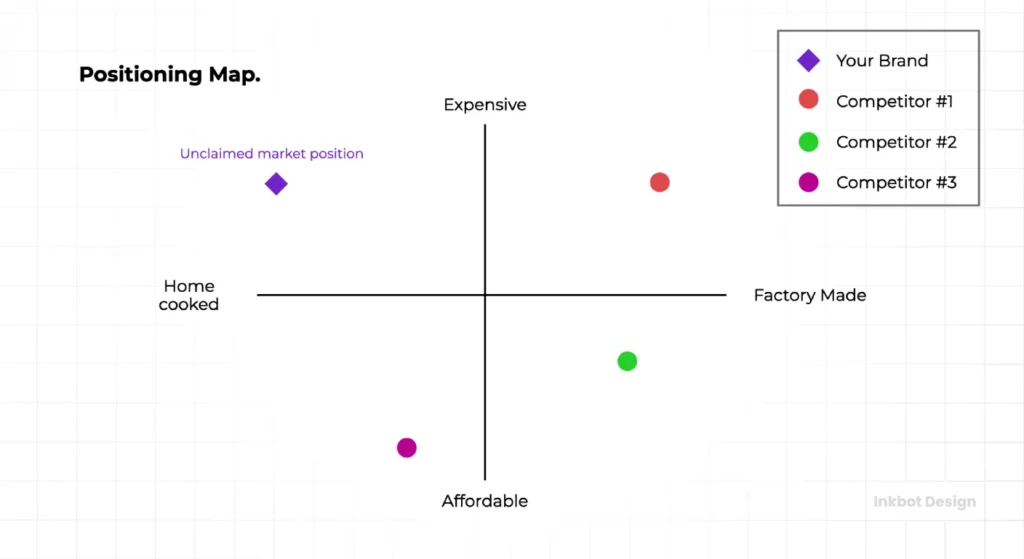
The Positioning Map
You need to identify the two most important variables in your industry—usually Price and Quality, or Innovation and Reliability—and plot your competitors on a quadrant.
Your goal is to find the “White Space.” This is often referred to as a blue ocean strategy, where you compete in an uncontested market space.
| Feature | Amateur Positioning | Pro Positioning (Inkbot Style) |
| Focus | Product Features | Emotional & Functional Benefits |
| Messaging | “We are the best” | “We are the only ones who…” |
| Validation | Self-proclaimed excellence | Third-party proof & data |
| Longevity | Changes with every trend | Consistent for years |
| Price | Race to the bottom | Value-based premium |
Debunking the “Hyper-Segmentation” Myth
There is a dangerous belief that the more you segment, the better you perform. The Ehrenberg-Bass Institute has debunked this.
Their research in “How Brands Grow” shows that most brand growth comes from increasing “Mental Availability” (being thought of in buying situations) and “Physical Availability” (being easily accessible). If you segment too narrowly, you limit your growth potential.
The pro move is Sophisticated Mass Marketing: reaching everyone in the category but using positioning to ensure you are the preferred choice for the most profitable subgroups. If you’ve drifted too far into a tiny niche, you might need brand repositioning to survive.
STP Strategy Validator
Is your branding 2026-ready or stuck in “Spray and Pray”?
Ready for a Clinical STP Overhaul?
Don’t let your marketing budget evaporate in 2026. Let’s sharpen your focus and dominate your niche.
Request a Strategy AuditThe State of STP Marketing in 2026
We are currently in the era of Generative Positioning. It’s no longer just about what humans think; it’s about how LLMs (like the one you’re reading now) categorise your brand.
When a user asks an AI, “Who is the best branding agency for a tech startup in London?”, the AI performs a lightning-fast competitive analysis of the entire web. It looks for “Entity Density”—how often your brand is associated with specific keywords, expert opinions, and trusted sources.
The 2026 Shift: From Funnels to Flywheels
The linear STP model is being replaced by a feedback loop.
- AI Analysis: Using LLMs to cluster customer reviews and social sentiment into segments.
- Dynamic Targeting: Adjusting ad spend in real-time based on live economic data (e.g., inflation spikes in the UK).
- Algorithmic Positioning: Ensuring your site’s schema and content are optimised for “Entity Extraction” by search engines.
To dominate AI Overviews in 2026, your STP strategy must be machine-readable.
Google’s Knowledge Graph doesn’t just read your text; it maps the relationship between your Brand Entity and the Target Segment.
The Technical SEO of Positioning
To ensure Generative Engine Optimisation (GEO), you must implement Product Schema and Organization Schema that explicitly define your “White Space.”
For example, if your Positioning is “The Sustainable Choice for Enterprise SaaS,” your JSON-LD should include knowsAbout and mentions properties that link to Sustainability Standards and Enterprise Software entities.
| STP Stage | Technical Signal for AI | 2026 Impact |
| Segmentation | ItemList Schema for user personas | Helps LLMs categorise your “Helpful Content” for specific users. |
| Targeting | Geo-coordinates & areaServed Schema | Increases visibility in Local GEO results. |
| Positioning | sameAs links to Wikipedia & industry bodies | Establishes E-E-A-T by association with high-authority entities. |
Consultant’s Reality Check: I Once Audited a Client…
I recently audited a B2B SaaS firm that insisted its target audience was “All UK businesses.” They were spending £5,000 a month on LinkedIn ads and getting zero conversions.
After two hours of digging, we realised their product was actually only viable for firms with 50-100 employees using legacy ERP systems. We performed a clinical STP overhaul.
We segmented by “Tech Debt,” targeted the IT Directors of mid-sized manufacturing firms, and positioned the software as “The ERP Bridge” rather than “General Management Software.”
Their CAC dropped by 65% in three weeks. They didn’t need more traffic; they needed to stop talking to the wrong people. If you’re in a similar situation, it’s time to request a quote and get your strategy in place before your competitors do.
The Verdict
STP Marketing isn’t a “nice-to-have” part of your slide deck; it is the fundamental architecture of your business. Without clear segmentation, your targeting is expensive guesswork. Without precise targeting, your positioning is a shout into a hurricane.
In 2026, the winners aren’t the ones with the biggest budgets—they are the ones with the sharpest focus. They understand that niche branding isn’t about being small; it’s about being the only logical choice for a specific group of people.
If your current marketing feels like you’re shouting at a brick wall, your STP is broken. Fix it, or watch your digital marketing services budget evaporate.
Are you ready to stop the fluff and start the growth?
Explore how Inkbot Design can overhaul your brand strategy and positioning today.
Frequently Asked Questions (FAQ)
What is the primary benefit of STP Marketing?
STP Marketing allows businesses to prioritise their resources by focusing on the most profitable market segments. Instead of a “one-size-fits-all” approach, it enables personalised messaging that increases conversion rates and reduces customer acquisition costs by speaking directly to the specific needs and pain points of a defined audience.
How does segmentation differ from targeting?
Segmentation is the analytical process of dividing the broad market into smaller groups based on characteristics like geography or behaviour. Targeting is the strategic decision-making process of selecting which of those identified segments are most attractive and worth pursuing with specific marketing campaigns and resources.
Can a small business use STP Marketing effectively?
Yes, STP is actually more critical for SMBs than for large corporations. With limited budgets, small businesses cannot afford to waste money on broad, untargeted advertising. By using STP to identify a specific niche branding opportunity, they can compete effectively against larger rivals with greater efficiency.
What is psychographic segmentation?
Psychographic segmentation categorises consumers based on their psychological attributes, such as values, beliefs, interests, and lifestyle. Unlike demographics, which describe “who” the buyer is, psychographics explain “why” they buy, allowing for much more resonant and emotional brand positioning.
What is a positioning map?
A positioning map (or perceptual map) is a visual tool used to compare brands based on two or more key attributes, such as price and quality. It helps marketers identify gaps in the market—known as “white space”—where they can position their brand to avoid direct competition.
How often should a company update its STP strategy?
An STP strategy should be reviewed at least annually, or whenever there is a significant market shift, such as the entry of a new competitor or a change in consumer technology. In the 2026 environment, regular competitive analysis is essential to ensure your positioning remains relevant.
What is the difference between USPs and positioning?
A Unique Selling Proposition (USP) is a specific feature or benefit that makes your product different from others. Positioning is the broader perception of your brand in the customer’s mind. Your USP is a tool used to achieve your desired positioning.
How does AI affect STP Marketing in 2026?
AI enables “Hyper-personalisation” by processing vast amounts of behavioural data in real-time to create dynamic segments. It also changes positioning, as brands must now ensure they are “understandable” by AI search engines and LLMs, which synthesise brand information for users in the form of GEO results.
What is the biggest mistake in STP Marketing?
The most common mistake is failing to exclude segments. Effective targeting requires focus. Trying to appeal to every segment dilutes your brand message and weakens your positioning, leading to higher marketing costs and lower brand loyalty.
Is demographic segmentation becoming obsolete?
While demographics are still useful for basic filtering, they are becoming less predictive of buying behaviour. In 2026, “Intent” and “Behaviour” are much stronger signals. Knowing someone is 30 years old is less valuable than knowing they have recently searched for “how to start a sustainable business.”
What is brand repositioning?
Brand repositioning is the process of changing the target market’s perception of a brand. This is often necessary when the original positioning has become outdated, sales are declining, or the brand wants to move into a more premium or mass-market space to fuel growth.
How do I measure the success of my positioning?
Success can be measured through brand tracking studies, Net Promoter Scores (NPS), and share-of-mind metrics. Additionally, technical SEO metrics like “branded search volume” and how LLMs describe your brand provide a modern insight into your current market positioning.