Top 10 Business Name Generators: An Honest Review (Pros & Cons)
Naming a business is agony. You sit in a room, staring at a whiteboard, throwing words like “Synergy” and “Solutions” around until they lose all meaning.
You eventually find a name you love, type it into a registrar, and realise a squatter in Florida bought the .com in 1998 and wants £50,000 for it.
This is why entrepreneurs turn to business name generators. The promise is seductive: type in a keyword, press a button, and receive a perfect, available brand identity.
The reality is often disappointing. Most generators are simply random word combiners that append “ify” or “ly” to your keyword and check GoDaddy. They don’t care about phonetics, memorability, or brand strategy.
But there are exceptions. Artificial Intelligence has begun to fix the broken naming process. Some tools now understand context, metaphors, and industry nuance.
In this guide, I’m stripping away the marketing fluff. We have tested the most popular tools on the market to give you a forensic breakdown of the top 10 business name generators.
We will look at which ones actually help you build a brand naming strategy, and which ones are just trying to sell you a domain name.
- Generators are ideation tools, not legal clearance; always perform trademark searches (IPO/USPTO) before committing to a name.
- Use AI-driven tools like Namelix for creative, semantic suggestions; use marketplaces (BrandRoot, Atom) for premium, pre-vetted domains.
- Treat generators as a starting point: combine divergent idea generation with human validation for phonetics, brand strategy, and future-proofing.
What Actually Is a Business Name Generator?
Before we tear into the list, we need to define the tool. A business name generator is a software application that utilises algorithms—ranging from simple concatenation (combining words) to complex Large Language Models (LLMs)—to generate a list of potential company names based on user input.
However, from a professional perspective, you must understand the three distinct categories of these tools:
- The Keyword Mashers: These take your word (e.g., “Cloud”) and add suffixes (e.g., “Cloudster”, “Cloudify”). They are crude but effective for functional names.
- The AI Creative Engines: These use vector analysis to understand the concept of your business. If you type “fast”, they might suggest names related to “velocity”, “hawks”, or “arrows”, rather than just the word “fast”.
- The Premium Marketplaces: These are essentially catalogues of pre-registered domains (e.g., BrandBucket). The generator is just a search bar for their inventory.
The “Availability Trap” (Read This First)
The biggest mistake I see startups make is confusing Domain Availability with Legal Availability.
Just because a generator tells you BlueRocket.com is available for £10 does not mean you can legally trade as “Blue Rocket”. A similar company might hold a trademark in your specific class (e.g., Class 35 for Advertising or Class 42 for Technology).
Consultant’s Note: A business name generator is an ideation tool, not a lawyer. Always perform a clearance search with the UK Intellectual Property Office (IPO) or USPTO before printing your business cards.
The Top 10 Business Name Generators (Ranked & Reviewed)
We evaluated these tools based on Relevance (does the name make sense?), UX (is it annoying to use?), Creativity (is it unique?), and Domain Integration (does it handle .com availability well?).
1. Namelix (The Best AI All-Rounder)
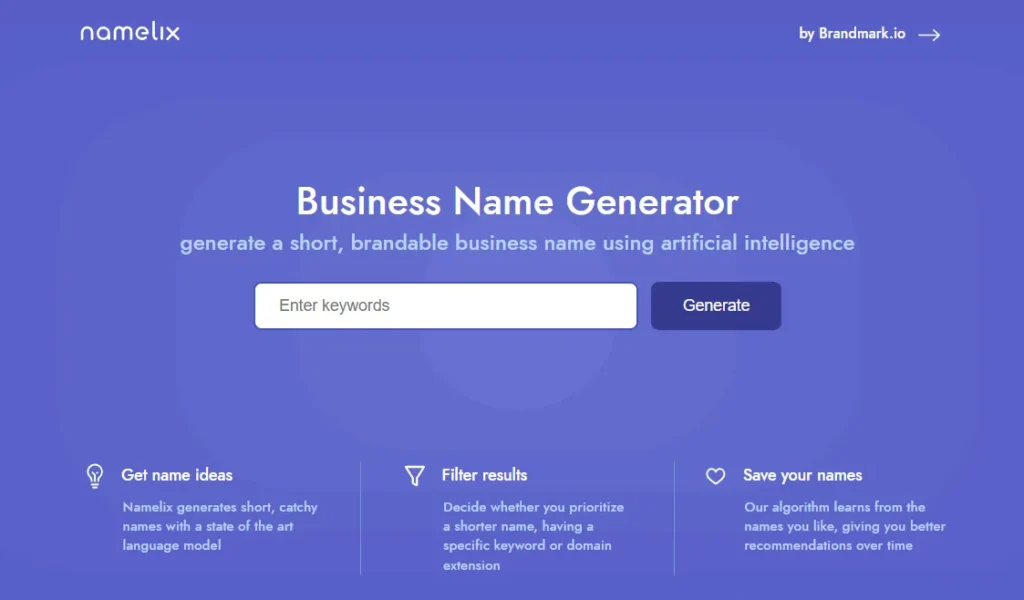
Namelix is currently the gold standard for automated naming because it doesn’t just shuffle keywords; it uses a generative language model to understand ideas. It was one of the first to move away from direct keyword inclusion.
How it Works:
You enter keywords, but you also select a “Style” (e.g., Brandable names, Alternate spelling, Compound words, Real words). You can also set a “Randomness” level. If you want a name like “Uber” or “Apple” that has no connection to the product, Namelix can help you achieve that.
- Pros:
- High “Brandability”: Creates short, punchy, logo-ready names.
- Granular Control: Filtering by length and naming style is superior to that of competitors.
- Learning Algorithm: You can save names you like, and the algorithm refines subsequent suggestions based on your taste.
- Cons:
- Premium Upsell: Many of the best results are achieved with premium domains, which can cost thousands.
- Abstract Overload: Sometimes the “High Randomness” setting produces absolute gibberish that sounds like an alien language.
The Verdict: If you’re looking for a modern, tech-startup style name (like those of generic SaaS companies), start here.
2. Shopify Business Name Generator (The Functional Standard)
Shopify’s tool is legendary, not because it’s the most creative, but because it is brutally efficient. It is designed for e-commerce. It assumes you want to start selling today.
How it Works:
You enter a keyword. It returns hundreds of results immediately. It is heavily biased towards available .com domains because Shopify wants you to sign up for a store immediately.
- Pros:
- Speed: It is incredibly fast.
- Instant Availability: It only displays names where the domain is technically available for purchase.
- Simplicity: No complex settings or confusing parameters.
- Cons:
- Lack of Creativity: It relies heavily on adding generic nouns and verbs to your keyword (e.g., “Shop [Keyword]”, “The [Keyword] Hub”).
- The “Lock-in”: The CTA is designed to funnel you into a Shopify subscription.
The Verdict: Perfect for dropshippers or functional e-commerce stores. Bad for agencies or high-end brands.
3. Looka (The Visual Thinker)
Looka is primarily an AI logo maker, but its name generator is surprisingly robust. The unique angle here is the immediate visualisation. Seeing a name in a font changes how you perceive it.
How it Works:
It generates names (mostly abstract or compound) and immediately renders them inside potential logo designs.
- Pros:
- Context: You see the name as a brand, not just text on a screen.
- Abstract Ideas: Good at generating “invented” words.
- Integration: Seamlessly moves you into brand identity design (colours, typography).
- Cons:
- Distraction: Sometimes, a great logo can make a bad name look good. You might choose a weak name because the font was nice.
- Upsell Heavy: The goal is to sell you the brand kit.
The Verdict: Use Looka if you are a visual person who struggles to judge a name without seeing it “in ink”.
4. Atom (The Human-AI Hybrid)
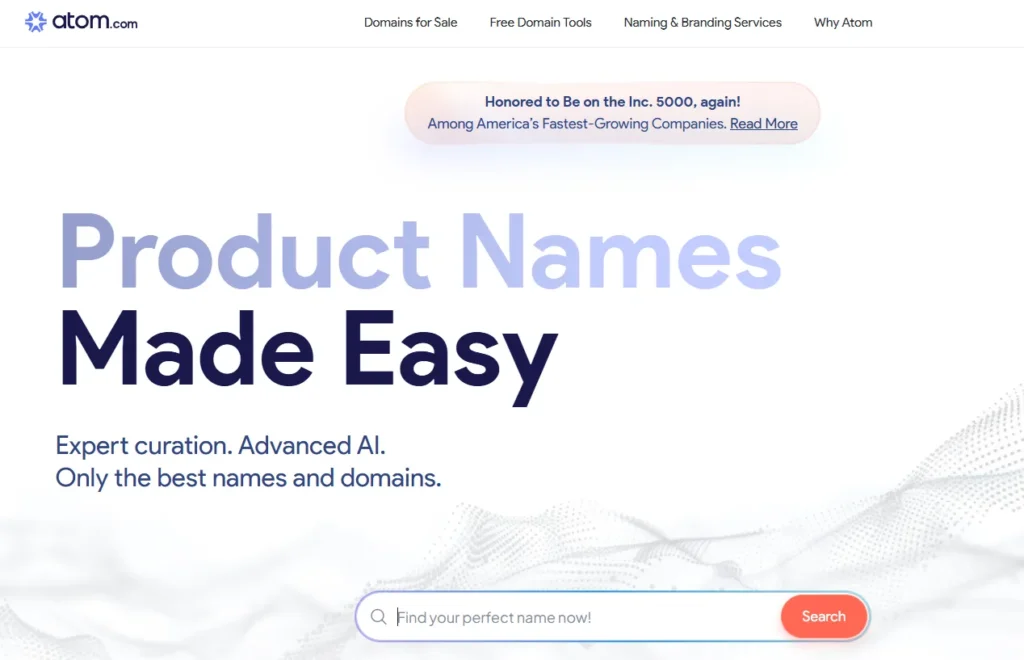
Atom (was SquadHelp) is different. It is a platform where real humans compete to name your business (crowdsourcing), but they also offer a free AI-powered generator.
How it Works:
The generator uses data from their successful naming contests. Because they have data on which names real humans actually paid for, their AI is trained on “winning” names rather than random dictionary words.
- Pros:
- Market-Tested Data: The suggestions feel more “commercial” and less robotic.
- Categorisation: Excellent filtering by industry and emotion (e.g., “Trust”, “Playful”).
- Crowd Option: If the AI fails, you can opt to launch a contest at your expense.
- Cons:
- Pricey Domains: Like Namelix, they aggressively promote their premium marketplace.
- Navigation: The interface can be cluttered with upsells for contests.
The Verdict: The best choice if you have a budget and are willing to pay for a premium, pre-vetted domain name.
5. Panabee (The Domain Hacker)
Panabee is an older tool, but it excels at “domain hacking”—finding ways to get a domain when your primary choice is taken.
How it Works:
If you want “DesignCorp” and it’s taken, Panabee suggests “DesignCorpApp”, “GetDesignCorp”, or phonetically similar spellings like “DezynCorp”.
- Pros:
- Transparent Logic: It explicitly tells you how it modified the name (e.g., “We dropped the last vowel”).
- Social Check: It checks social media handles (Facebook and X) alongside domains.
- Playful: It’s less corporate and more suited for apps and playful brands.
- Cons:
- Dated UI: It feels like a tool from 2015.
- Extension Heavy: It often suggests obscure domain extensions (.io, .ly), which may not be suitable for a local plumber.
The Verdict: Essential for tech startups seeking a clever way to bypass a blocked .com domain.
6. BrandRoot (The Premium Boutique)
BrandRoot isn’t a generator in the sense of “creating from scratch.” It is a search engine for premium, brandable domain names that are listed for sale.
- Pros:
- Quality Control: Every name on the site has been vetted by a human branding expert. No garbage.
- Asset Value: You are purchasing a digital asset that is likely to retain its value.
- Logo Included: Most names come with a logo concept.
- Cons:
- Cost: You can expect to spend between $1,000 and $5,000.
- Limited Choice: You are restricted to what is in their inventory.
The Verdict: If you have funding and zero time, buy a name here. If you are bootstrapping, look elsewhere.
7. Novanym (The Corporate Choice)
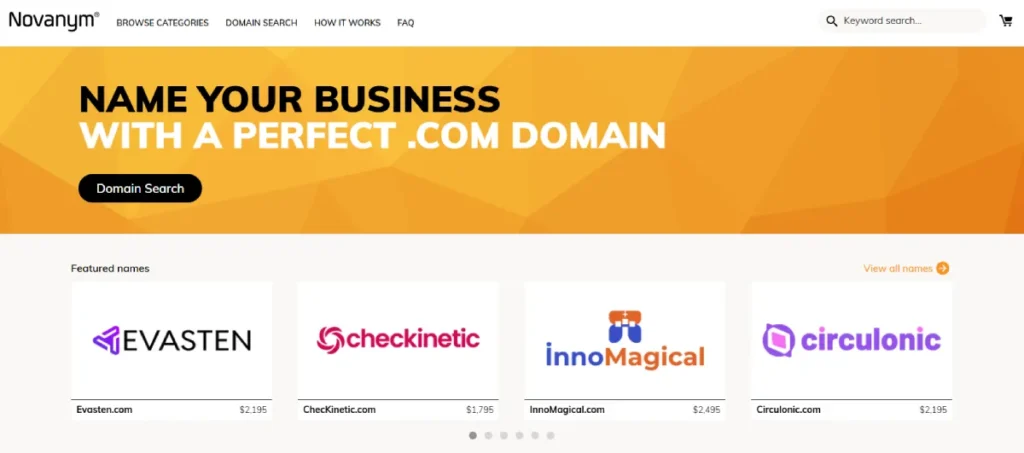
Novanym focuses on corporate, “sounding” names. They specialise in names that sound like pharmaceutical companies, consultancy firms, or logistics groups.
- Pros:
- Authority: The names sound established and trustworthy.
- Exact Match: They focus on names where the .com is the exact brand name (no “Get” or “App” prefixes).
- Business Focus: Less “whimsical” than Namelix, more “Boardroom”.
- Cons:
- Dryness: The names can feel a bit sterile or generic.
- Inventory-Based: Similar to BrandRoot, it is a marketplace rather than a pure generator.
The Verdict: Ideal for B2B service providers who need to convey a serious tone immediately.
8. Zyro (The AI Writer’s Assistant)
Zyro (by Hostinger) offers a generator that is integrated into a wider suite of AI tools (slogan generator, content writer).
- Pros:
- Ecosystem: If you need a website builder, this integrates seamlessly.
- Simplicity: Very clean interface, no ads cluttering the view.
- Wildcards: It often throws in completely unrelated words that surprisingly work well for “lifestyle” brands.
- Cons:
- Depth: It lacks the granular controls of Namelix.
- Generic Outputs: You will see a lot of “Best[Keyword]” or “Pro[Keyword]” results.
The Verdict: A solid, user-friendly option for beginners building their first website.
9. Business Name Generator (BNG) (The Volume King)
This tool (located at businessnamegenerator.com) is the heavyweight of the industry. It uses extensive keyword matching and industry filters.
- Pros:
- Volume: It generates thousands of options.
- Filters: You can filter by character count and number of words (e.g., “One word only”).
- Rhyming: It has a setting to find rhyming names, which aids memorability.
- Cons:
- Ad-Heavy: The page is cluttered with GoDaddy ads.
- Quality Control: You have to sift through a lot of junk to find a gem.
The Verdict: Good for brute-force brainstorming when you are completely stuck and just need to read 500 words to spark an idea.
10. NameSnack (The “Unique” Finder)
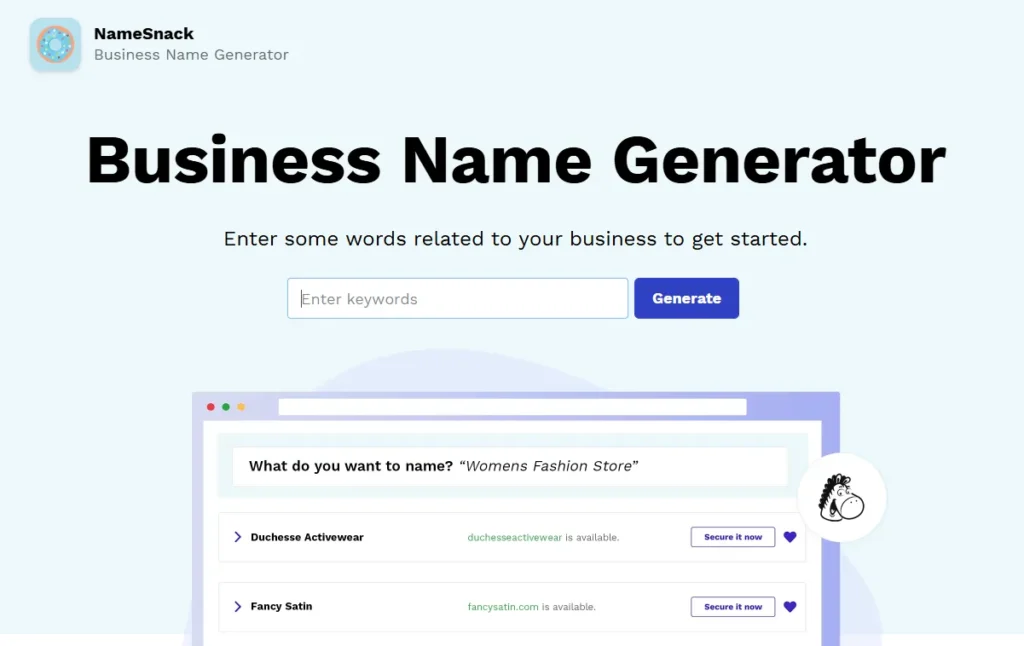
NameSnack claims to combine machine learning with keyword techniques. It markets itself as the “Business Name Generator” that creates unique names for free.
- Pros:
- Free Logos: It creates a simple logo instantly for every name generated.
- Concise: It tends to favour shorter names, which is a significant plus in mobile-first markets.
- Visual Interface: Clean and modern.
- Cons:
- Availability Issues: Sometimes reports a domain as available when it is actually a premium domain.
The Verdict: A strong middle-ground contender that balances volume with AI relevance.
The Wrong Way vs. The Right Way to Use Generators
Many entrepreneurs use these tools, but few use them correctly. The amateur accepts the first available name; the professional uses the tool as a springboard.
| Feature | The Amateur Approach | The Pro Approach (Strategic) |
| Input Strategy | Type “Coffee Shop” and hit enter. | Uses lateral concepts like “Bean”, “Roast”, “Morning”, “Awake”, “Fuel”. |
| Selection Criteria | Picks the first name that sounds “cool”. | Evaluates based on brand identity, scalability, and phonetics. |
| Due Diligence | Checks if GoDaddy indicates that the domain is available. | Checks the IPO/USPTO trademark database and social handles. |
| Refinement | Accepts “CoffeeShopify.com”. | Takes “Shopify” output and refines it manually to “The Roast Lab”. |
| Future Proofing | Picks a name tied to a specific location (e.g., “London Coffee”). | Picks a name that allows expansion (e.g., “Urban Brew”). |
The State of Business Naming in 2026
The landscape of naming has undergone a dramatic shift in the last 18 months. We have moved past the era of “misspelt words” (think Flickr, Tumblr) and the “noun-verb” era.
1. The Rise of “Real” Words
In 2026, there is a premium on legibility. Consumers are tired of brands they cannot pronounce or spell. The trend is moving back towards dictionary words, even if it requires a .io, .co, or .ai extension. Companies prefer GetPilot.com (using a verb prefix) over Pylot.com (misspelling).
2. Semantic AI over Keyword Stuffing
Generators have evolved from simple “Keyword + Suffix” scripts to semantic understanding. The best tools now understand that if you are opening a security firm, names related to “Shields”, “Fortresses”, and “Guardians” are relevant, even if you didn’t type those words. This reduces the cognitive load on the founder.
3. The “.Com” is No Longer King
While the .com is still the gold standard for trust, it is no longer the only option. With the explosion of TLDs (Top-Level Domains) and the normalisation of .ai for tech companies and .store for retail, the pressure to find a 5-letter .com has eased. This gives generators more freedom to suggest relevant names with alternative extensions.
Consultant’s Reality Check
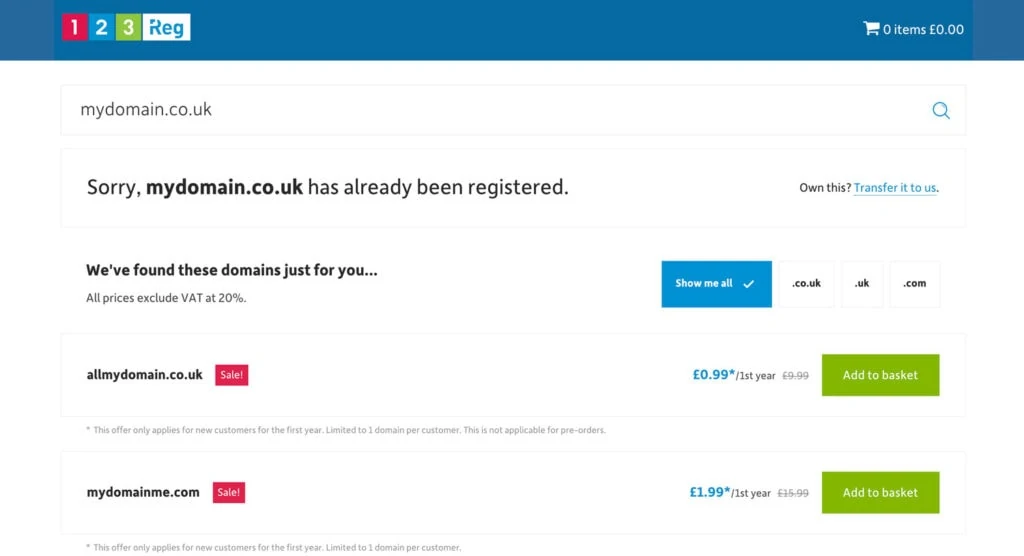
I once audited a client who had spent £15,000 on signage and branding for a company name they found on a free generator. The name was “BlueLeaf”. It was available as a domain. They loved it.
Three months later, they received a Cease and Desist letter. “BlueLeaf” was a registered trademark in their sector held by a company that didn’t own the .com but did own the legal rights to the name. My client had to burn everything—signage, stationery, website—and start again.
The lesson? A generator is a robot. It does not know the law. It does not know your competitors. It does not know that “BlueLeaf” sounds too much like “BlueBeard” in a noisy room.
Use generators for divergent thinking (creating options).
Use human experts for convergent thinking (selecting and validating the safe choice).
If you are serious about building a brand that lasts, you cannot rely solely on an algorithm. You need to understand the psychology of names. Check out our guide on how to name your business for the strategic framework that should precede any software usage.
The Verdict
If you are looking for a quick answer, here is the breakdown:
- For pure creativity and AI power: Use Namelix.
- For e-commerce speed: Use Shopify.
- For visualising the brand: Use Looka.
- For premium, safe assets: Use BrandRoot or Atom.
However, remember that a name is just the beginning. It is the empty vessel into which you pour your reputation. A great name helps, but it won’t save a bad business. A mediocre name can be elevated by great design and service (just look at “Google”—a typo of a math term).
If you are struggling to find a name that carries the weight of your ambition, or if you are terrified of the legal pitfalls of doing it yourself, it might be time to bring in the professionals.
Ready to turn that new name into a dominant brand?
Request a Brand Identity Quote from Inkbot Design today.
Frequently Asked Questions (FAQ)
Can I legally use a name from a business name generator?
Not automatically. Generators only check if the website domain is available. They do not check government trademark databases (like the IPO in the UK or USPTO in the US). You must conduct a legal clearance search before engaging in any trading activities.
Why are the best names on generators always premium domains?
Domain investors (“squatters”) buy thousands of brandable domains hoping to sell them for a profit. Generators often partner with these marketplaces. It can be frustrating, but buying a premium domain is often more cost-effective than rebranding later.
Does my business name have to match my domain name exactly?
Ideally, yes, for SEO and user trust. However, it is common to use prefixes or suffixes (e.g., “https://www.google.com/search?q=TeslaMotors.com” before they bought “Tesla.com”). As long as the brand name is clear, the domain can vary slightly.
What is the best AI for business names?
Namelix is widely regarded as the best AI-driven tool because it utilises Large Language Models to comprehend concepts and metaphors, rather than merely combining keywords.
Should I use a made-up word for my business name?
Invented words (neologisms) like “Kodak” or “Spotify” are easier to trademark and own because they have no prior meaning. However, they require more marketing budget to educate customers on what the business actually does.
Is it better to have a descriptive name or an abstract name?
Descriptive names (e.g., “WeBuyAnyCar”) are great for quick SEO and clarity, but they can be difficult to trademark. Abstract names (e.g., “Apple”) are strong brands but require explanation. For small businesses, a descriptive or suggestive name is usually safer.
How do I know if a generated name is offensive in another language?
Most free generators do not check this. You must manually verify your shortlist using tools like Google Translate or by consulting native speakers. This is a crucial step for global brands.
What if the .com is taken, but the .co.uk is free?
If you are strictly a local UK business, .co.uk is fine. However, if you plan to expand globally, not owning the .com is a risk, as customers might default to the .com version and land on a competitor’s site.
How many syllables should a business name have?
Data suggests that 2-3 syllables are the sweet spot for memorability (e.g., Face-book, Ap-ple, Am-a-zon). Anything over 4 syllables usually gets abbreviated by customers anyway.
Can I just ask ChatGPT to name my business?
Yes, ChatGPT is excellent for generating ideas and brainstorming. However, like other generators, it cannot verify real-time domain availability or trademark status. Use it for ideas, then manually validate them.