Social Commerce: Designing for TikTok Shop & Instagram Stores
Most brands look at social commerce and see a gold rush.
They see the user numbers—billions of eyes glued to screens—and assume that simply syncing a Shopify catalogue to Instagram or TikTok will result in immediate revenue.
It won’t.
The reality is that social commerce is littered with the corpses of lazy execution. We see it constantly at Inkbot Design: a business uploads its boring, white-background Amazon product photos to TikTok Shop and wonders why nobody is buying. Or they treat an Instagram Store like a chaotic flea market rather than a curated boutique.
The stakes are massive. Accenture predicts that social commerce will grow three times faster than traditional e-commerce, reaching $1.2 trillion by 2025. But that money isn’t going to the brands that “dabble.” It is going to the brands that understand the fundamental shift in user behaviour.
Traditional e-commerce is intentional; you search for a kettle because you actually need one. Social commerce is emotional; you buy a kettle because a 15-second video made you feel like that kettle would solve all your life’s problems.
If you ignore the specific design constraints, UI “safe zones,” and psychological triggers of these platforms, you are just burning ad spend. Here is how to stop messing about and start selling.
- Social commerce demands in-app checkout and shoppable media to remove friction and keep buyers within the platform.
- TikTok requires raw, UGC-style content and central safe-zone design; imperfection signals authenticity and drives impulse purchases.
- Instagram needs curated, high-fidelity grids, consistent visual identity, and smart product tagging to build trust and perceived value.
- Technical reliability—inventory sync, correct aspect ratios, and platform-specific assets—prevents oversells and preserves conversion rates.
- Measure revenue-focused metrics (ROAS, conversion, CAC) and prioritise quality content over posting frequency or vanity likes.
What is Social Commerce? (The Direct Answer)
Social commerce is the process of selling products directly through social media platforms. Unlike social media marketing, which drives traffic to an external website, social commerce allows the entire transaction—from discovery to checkout—to happen within the app (e.g., Instagram, TikTok, Facebook).
This removes the “friction of the click.” Every time you force a user to leave the app to visit your website, you lose a percentage of them. Social commerce keeps them where they are comfortable.

The Three Key Components:
- Native Checkout: The ability to pay without opening a web browser.
- Shoppable Media: Images or videos with embedded product tags that link directly to the inventory.
- Social Proof Integration: Reviews, comments, and influencer endorsements are visible immediately alongside the “Buy” button.
The Platform Divide: Chaos vs. Curation
Before designing a single asset, it’s essential to understand that TikTok and Instagram are distinct platforms. Treating them as identical distribution channels is a rookie error.
Instagram: The Digital Catalogue (Aspiration)
Instagram is your high-street flagship store. It is polished, curated, and quiet. Users here are looking for inspiration. They want to see the “best version” of themselves. The design language here must be high-fidelity, consistent, and aesthetically pleasing. A messy feed destroys trust on Instagram.
TikTok: The Digital Bazaar (Authenticity)
TikTok is a chaotic, noisy street market. It is raw, loud, and unpolished. Users here are looking for entertainment and authenticity. If your content resembles a polished TV commercial, users will likely swipe past it instantly. The design language here relies on “UGC” (User-Generated Content) aesthetics—shaky cameras, poor lighting, and genuine reactions often outsell studio-quality productions.
The Strategic Implication
You cannot use the same creative assets for both. Your social media marketing strategy must account for this bifurcation. You need a folder of “polished assets” for Meta (Instagram/Facebook) and a folder of “raw assets” for ByteDance (TikTok).
Designing for TikTok Shop: The “Ugly” Truth
TikTok Shop is arguably the most disruptive force in e-commerce right now. But designing for it requires you to unlearn almost everything you know about traditional branding.
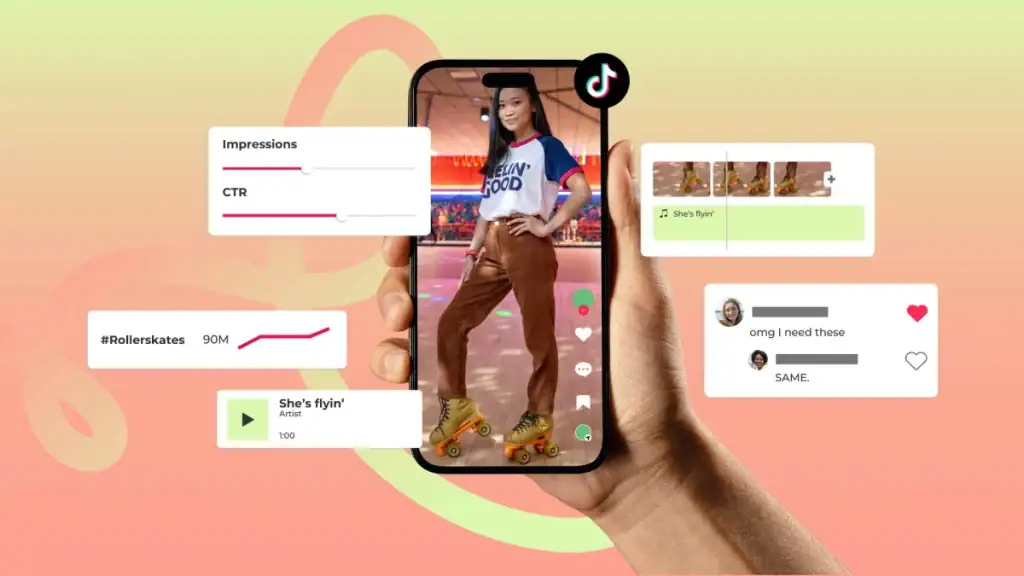
The “Lo-Fi” Trust Signal
On TikTok, high production value signals “advert.” Low production value signals “content.”
We have analysed client campaigns where spending £5,000 on a glossy product video resulted in lower sales than a video shot on an iPhone 11 by a staff member in the warehouse. Why? Because the iPhone video felt real.
The Design Rule: Imperfection is a feature, not a bug. Ensure your product demonstrations look achievable by a normal person, not a model.
UI Safe Zones: The Invisible Killer
This is where most designers fail. TikTok overlays a tremendous amount of UI elements over the video:
- The caption and hashtags (bottom left).
- The “Like,” “Comment,” and “Share” buttons (right side).
- The Music disc (bottom right).
- The “Shop” link anchor (bottom left, above captions).
If you place your product text, logo, or key visual in these areas, they will be covered.
Technical Constraint: You are designing for a 9:16 aspect ratio (1080 x 1920px). However, the “Safe Zone” is essentially a central column. Keep all critical text and visuals within the middle 1080x1400px area, leaving at least 150px of clear space at the top and 350px of clear space at the bottom.
The “Hook” Visual
You do not have 3 seconds. You have 0.5 seconds. The first frame of your TikTok Shop video must be visually arresting.
- Do: Start with the product in action or a bizarre visual outcome.
- Don’t: Start with a logo fade-in or a slow pan.
Real-World Example: The “Pink Stuff” Phenomenon
Consider the cleaning paste “The Pink Stuff.” They didn’t explode on TikTok through corporate branding. They exploded because users posted videos of dirty ovens becoming clean. The “design” was the combination of grime and shine. It was visceral. If they had used a white background studio shot of the tub, they would have been unknown.
Designing for Instagram Stores: The Trust Architecture
If TikTok is about the impulse, Instagram is about the aesthetic validation.
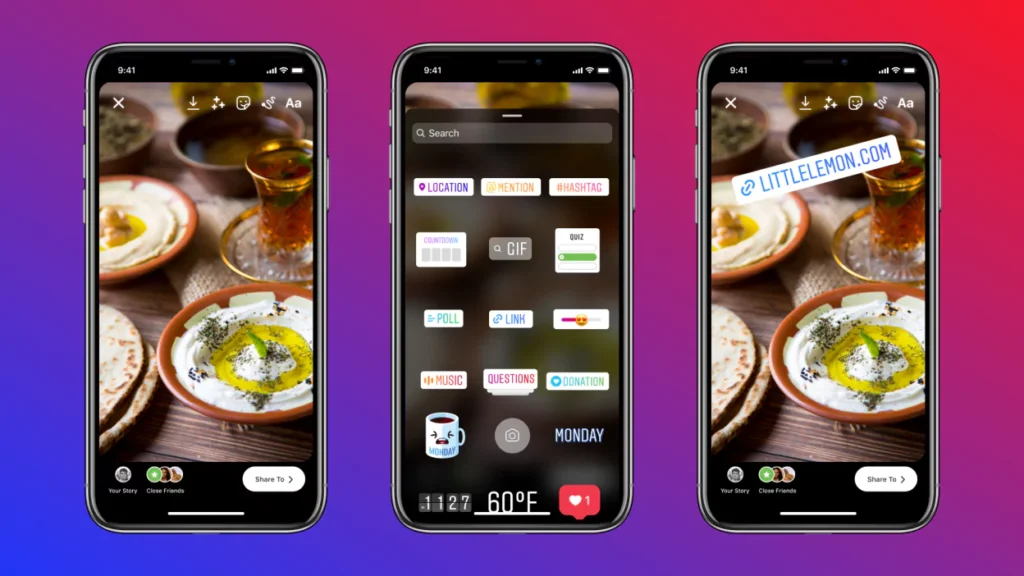
The Grid Consistency
Your Instagram Shop connects directly to your profile. If a user clicks through from a product tag, they will likely check your main grid. If the visual identity is disjointed—different fonts, clashing colour palettes, inconsistent lighting—you lose the sale.
Consistency creates perceived value. A cohesive grid tells the user, “We are a professional operation.”
High-Fidelity Tagging
Instagram allows for “Product Tags” on images. The placement of these tags matters.
- Crowding: Do not tag 5 products in a small cluster. It creates a “fat finger” error for the user, which is annoying.
- Context: Tag the product where it is most visible in the photo.
The “Collections” Feature
Instagram allows you to group products into “Collections” (e.g., “Summer Essentials,” “Office Gear”). This is a UX superpower.
- Bad Design: A flat list of “All Products.”
- Good Design: Curated Collections with custom cover images that match your brand identity. This serves as a navigation menu, enabling users to find what they want without needing to search.
The Trust Signals
Since Instagram users are often more sceptical of scams than TikTok impulse buyers, you need to leverage design to build trust.
- UGC Reposting: Create a “highlight” reel on your profile specifically for customer reviews/photos. Design a branded frame for these, so they look official yet authentic.
- Bio Clarity: Your bio must clearly state shipping policies or return guarantees. “Free Shipping UK-Wide” is a powerful conversion driver to place above the fold.
The Technical Foundation: It’s Not Just Pictures
You can have the best social media graphic design in the world, but if the backend is broken, the shop fails.
Inventory Syncing Latency
This is a boring but critical detail. If you use Shopify, you will likely use an app to sync your catalogue to Meta (Instagram) and TikTok.
- The Trap: Changes in Shopify are not instant. There is often a sync delay (sometimes 15-60 minutes).
- The Risk: If you run a “flash sale” and sell out on Shopify, the product might still look available on Instagram for an hour. A user buys it, and you have to cancel the order; you also destroy that customer relationship.
- The Fix: Use inventory buffers. If you have 5 units left, mark it as “sold out” on social channels to prevent overselling.
Image Formatting Protocols
Do not rely on auto-cropping.
- Shopify/Web: Usually Square (1:1) or Portrait (4:5).
- Instagram Stories: 9:16.
- Instagram Feed: 4:5 (recommended to take up more screen real estate than square).
- TikTok Carousel: 9:16.
If you push a landscape (16:9) image from your website to an Instagram Store, it will look small, weak, and unprofessional. You need to upload platform-specific assets to your catalogue manager.
Amateur vs. Pro Social Commerce
| Feature | The Amateur Approach (Fails) | The Pro Approach (Converts) |
| Visuals | Uses generic white-background Amazon photos. | Uses lifestyle shots and platform-native UGC. |
| Aspect Ratio | Forces landscape (16:9) images into vertical feeds. | Creates bespoke 9:16 assets for Stories/Reels. |
| Copywriting | “Buy our high-quality product.” (Generic) | “Fixes [Problem] in 30 seconds.” (Benefit-driven) |
| Checkout | Links to website homepage (high friction). | Uses native in-app checkout (zero friction). |
| Community | Ignores comments. | Replies to comments with video responses. |
| Catalogue | Syncs everything, including out-of-stock items. | Curates specific “Social Collections” based on stock. |
The Consultant’s Reality Check
I once audited a client—a mid-sized fashion brand based in Manchester—whose sales on TikTok were baffling. They had a beautiful digital marketing service package, great studio photos, and a massive ad budget.
I opened their TikTok profile. It looked like a brochure for a funeral home. Everything was slow, serious, and perfectly lit.
Then I looked at their “Tagged” photos. A customer had posted a video of herself dancing in their dress, spilling a drink, and laughing. It had 50,000 views. The brand’s official video had 200.
The brand was trying to dictate the aesthetic. The customers were dictating the reality.
We switched their strategy. We stopped the studio shoots. We sent free clothes to 20 micro-influencers and told them, “Do whatever you want, just tag the product.” We then ran the best-performing user videos as Spark Ads (ads that boost organic posts).
Sales increased by 400% in the first month.
The Lesson: On social commerce, you are not the Creative Director. The algorithm is. Your job is to feed the algorithm what it wants, not what you think looks “premium.”
The State of Social Commerce in 2026

Looking ahead, we are witnessing a significant shift toward live shopping and AI-driven personalisation.
In the last 12 months, TikTok has aggressively pushed “Live Shopping” in the UK and US markets, mirroring the Douyin model in China. This is QVC for Gen Z. Brands that set up a camera and have a charismatic host answering questions in real-time are seeing conversion rates that far surpass those of static stores.
Furthermore, AI is changing the backend. Meta’s “Advantage+” campaigns now use AI to automatically remix your creative assets—testing different music, text overlays, and formats to find the winning combination. By 2026, manual A/B testing will likely be obsolete; the algorithm will generate the “perfect” ad for each individual user on the fly.
If you aren’t experimenting with Live Shopping or AI-ad delivery now, you are already behind.
Common Mistakes to Avoid (Debunking Best Practices)
Myth: “Post Every Day”
This is outdated advice. Posting garbage every day hurts your account standing.
Reality: Post when you have something that adds value. Quality (defined as engagement potential) beats frequency. On TikTok, one viral hit is worth 100 mediocre posts.
Myth: “Use Trending Audio Only”
Brands obsess over using the latest trending sound.
Reality: For business accounts, copyright law can be a complex matter. Using a trending pop song can result in your video being muted or your shop being banned. Stick to the “Commercial Music Library” or create original audio. A muted video sells nothing.
Myth: “The Product Must Be The Hero”
In traditional advertising, yes. In social commerce, the reaction to the product is the hero.
Reality: Show the face of the person using it. Humans evolved to look at faces. Eye contact stops the scroll. The product is just the prop.
Measuring Success: Beyond Vanity Metrics
Do not come to me with “Likes.” You cannot pay your mortgage with Likes.
In social commerce, you need to track:
- ROAS (Return on Ad Spend): If you spend £1, how much do you get back?
- Conversion Rate: What percentage of people who view the product card actually make a purchase? (Average is 1-2%; good is 3%+).
- Cart Abandonment Rate: High cart abandonment rates typically indicate that your shipping costs are too high or your checkout process is confusing.
- CAC (Customer Acquisition Cost): Is it cheaper to acquire a customer on TikTok or Instagram? Typically, TikTok is more cost-effective for awareness, but Instagram is more effective for LTV (Lifetime Value).
For a deeper dive on metrics, read our guide on how to increase social media engagement, which actually translates to revenue.
Conclusion: The Verdict
Social commerce is not a “feature” you turn on. It is a fundamental shift in how you do business. It requires you to be faster, looser with your brand guidelines, and more attentive to technical details than ever before.
TikTok Shop and Instagram Stores are powerful tools, but they are also unforgiving. They demand that you respect their unique cultures—the raw energy of TikTok and the curated aspiration of Instagram.
If you try to force a traditional e-commerce square peg into a social media round hole, you will fail. But if you design for the medium, respect the UI safe zones, and prioritise authenticity over perfection, the scale is limitless.
Stop scrolling. Start selling.
Would you like Inkbot Design to audit your current social commerce setup and identify the specific UX flaws costing you revenue? Request a quote today.
Frequently Asked Questions (FAQ)
What is the main difference between TikTok Shop and Instagram Shopping?
TikTok Shop focuses on discovery through short-form video entertainment and impulse buying (“Shoppertainment”). Instagram Shopping leans towards curated, aspirational browsing and serves as a digital catalogue for established brand followers.
Do I need a website if I have a TikTok Shop?
Yes. While you can sell directly on TikTok, owning your own website (via Shopify or WooCommerce) protects you from platform bans and algorithm changes. Think of social shops as outposts, not your HQ.
Why are my products not being approved on the Instagram Shop?
Common reasons include selling prohibited items (such as digital goods, services, or supplements), domain verification issues, or a lack of consistency between your website and your catalogue data.
How do I fix the “inventory sync delay” between Shopify and Meta?
Use a third-party connector app if the native integration is too slow, or set “buffer stock” rules where a product shows as out-of-stock on social media when inventory dips below 5 units.
What is the best image size for social commerce product tags?
For catalogues, use 1080x1080px (Square). For content driving the sale (Stories/Reels/TikToks), use 1080x1920px (9:16 Vertical). Never use landscape images in a vertical feed.
Are “Live Shopping” events worth the effort for small businesses?
Yes. Live streams offer the highest conversion rates in social commerce because they enable real-time Q&A, thereby overcoming the “uncertainty” barrier that prevents users from making a purchase.
What are the fees for TikTok Shop?
As of late 2025, TikTok Shop commission fees in the UK/US vary but generally hover around 5-6% per transaction, plus payment processing fees. This is competitive compared to Amazon but higher than a direct website sale.
Can I use copyrighted music in my TikTok Shop videos?
Generally, no. Business accounts must use the Commercial Music Library to avoid copyright strikes. Using unlicensed trending audio can result in your video being muted or your shop suspended.
What is a “Spark Ad” on TikTok?
A Spark Ad allows you to boost an existing organic post (either yours or a creator’s) as an ad. These perform better than standard ads because they retain the social proof (likes, comments) of the original post.
How can I improve my Instagram Shop conversion rate?
Ensure your product images are high-quality. Use “Collections” to organise products by theme, write clear descriptions that include shipping times, and utilise user-generated content in your Stories to build trust.

