Print Design: Everything You Need to Know
With almost everything going digital these days, print design can be your secret weapon.
While your competitors fight for pixels, a physical, high-quality printed piece is a powerful way to command attention and build tangible brand authority.
This isn’t a history lesson.
It’s a strategic breakdown of how to use the tactile nature of print—from premium paper stocks to unique finishes—to create a memorable experience that justifies a higher price and makes you unforgettable.
- Print's tactile quality builds brand authority and memorability, triggering the Endowment Effect and stronger retention.
- Choose appropriate stocks, finishes, and processes—paper weight, grain, and spot vs process inks shape perception and production.
- Follow prepress standards: correct bleeds, colour management (ICC/PDF/X‑4), embedded fonts, and proofing to avoid costly errors.
- Integrate print with digital (QR, NFC, AR) and prioritise sustainability and personalisation to stay relevant in 2026.
The Relevance of Print Design Today
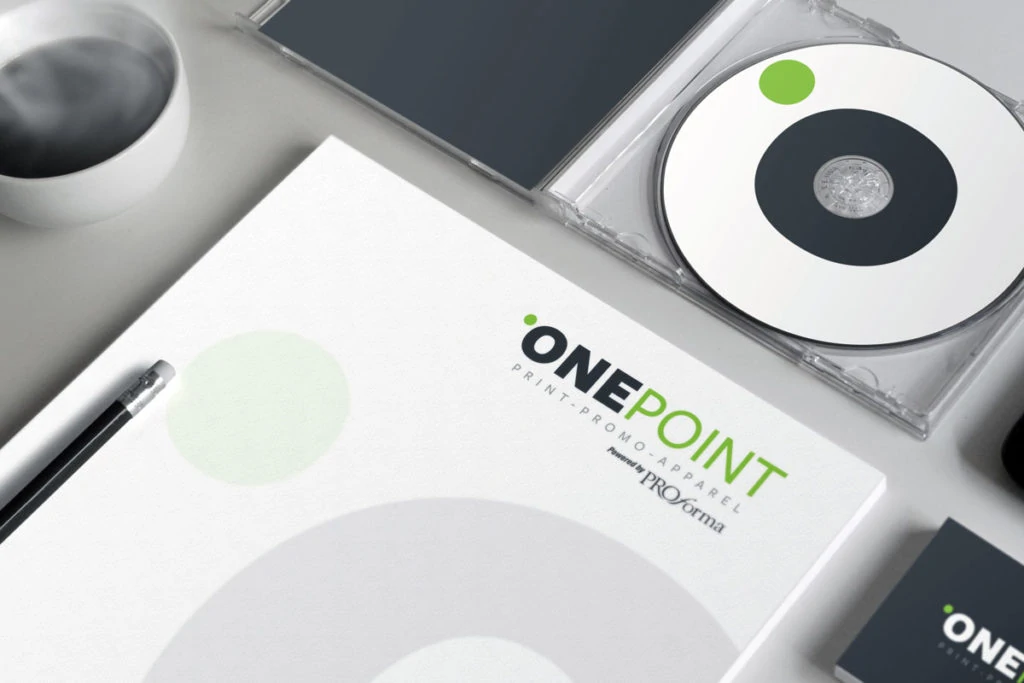
It is important not to see print design as something that belongs only in museums, because there are still many ways it can be used today.
Nothing beats physicality when it comes to providing an experience that digital platforms struggle to reproduce; my observations on trends have led to this realisation.
Businesses and advertisers realise that their campaigns will benefit from including printed materials in their strategy. They tend to add depth while being perceived as more credible in an instant-gratification age, where everything changes quickly.
Understanding the relevance of current printed designs requires appreciating their ability to create lasting impressions.
Although comprehensive coverage may necessitate using these types over other forms, such as electronic media, engaging physically through leaflets or beautifully crafted business cards elicits different reactions among consumers who come into contact with them.
Therefore, people should know this so that whenever they want someone to remember their brand for quite some time, even after the initial meeting, they give out brochures instead of relying on email alone.
The Science of Touch: Sensory Marketing in 2026
In an era dominated by haptic-feedback screens and digital fatigue, the physical weight of a printed piece does more than deliver information; it triggers a cognitive response known as the Endowment Effect. When a potential client holds a high-quality brochure, their brain begins to internalise ownership of the brand.
The Psychology of Paper Weight
Research in sensory marketing suggests that “heavy” equals “important”. A 400 GSM business card isn’t just a choice of stock; it is a non-verbal cue of stability and premium positioning.
- Tactile Retention: Studies show that physical material is more “real” to the brain. It has a meaning and a place. It engages spatial memory networks, meaning a customer is more likely to remember where they left your catalogue than where they saved your PDF.
- The Haptic Bond: Using finishes like Soft Touch Laminate or Uncoated Fedrigoni Paper creates a sensory “pause”. In a world of frictionless scrolling, the friction of high-quality paper demands attention.
Scenario: A luxury real estate firm in London shifted from digital lookbooks to a 120-page “coffee table” book bound in a case. Despite the higher cost per unit, their lead-to-close ratio increased by 22% because the physical object stayed in the client’s home as a permanent visual reminder of the brand’s prestige.
Types of Print Design
If you are entering the print design world, knowing about all the different types is essential. They are all important because they help businesses communicate with and attract customers. Here are some main categories for print design:
| Business and Corporate Materials | Brochures, business cards, letterheads, and more |
| Marketing Collateral | Flyers, posters, banners, and promotional materials |
| Publications | Books, magazines, newsletters, and editorial designs |
| Packaging Design | Design for product packaging: boxes, labels, and bags |
| Large-Scale Prints | Billboards, signage, and trade show displays |
Standard Print Sizes and Paper Systems
ISO A‑series vs North American sizes
ISO 216 defines the A‑series used across Europe and much of the world; A4 is 210 × 297 mm, A3 is 297 × 420 mm, and A5 is 148 × 210 mm.
North American standards differ. Letter is 8.5 × 11 in, Legal is 8.5 × 14 in, Tabloid is 11 × 17 in, so templates should match the market.
Bleed conventions vary by region; 3 mm is common in ISO markets, and 0.125 in is common in North America, so set artwork accordingly.
Business and Corporate Materials
Material such as pamphlets, business cards, and letterhead establishes your company’s professional image. These tools don’t just provide essential information but also reflect what your brand stands for.
Effective design in corporate materials conveys trustworthiness and professionalism, helping you create a lasting impression on potential clients.
Marketing Collateral
Marketing collateral includes flyers, posters, and banners used to promote a product or service.
The main aim is to capture the target market’s attention and engage them. You want people to be informed and persuaded so that they can take action.
Another thing about marketing collateral is its ability to create brand uniformity.
Every piece should reflect your brand’s message and visual identity, ensuring consistency across all promotional campaigns.
This makes you more recognisable and builds confidence with readers, thereby making your communication more assertive.
Publications
Books, magazines, newsletters, etc., fall under the business publications category as they provide valuable resources for audiences who need them most.
Such outlets allow for deeper engagement with content, which can sway opinions one way or another.
When designed well, these publications can showcase expertise while boosting industry credibility.
Print media remains strong when disseminating information that people can touch and feel through publications.
It is often seen as more reliable than digital because there’s something about holding paper which many find trustworthy.
This allows deeper storytelling, coupled with broader insights only possible in print – capturing the minds of those tired of screens doing the same thing.
Print offers different ways to engage audiences; understanding publication design will help craft narratives using thoughtfully designed content across various media.
Common Binding Methods for Publications
Choose a binding to match the page count and use
Saddle-stitch staples sheets through the fold and suits lower page counts, typically up to 64 pages, depending on stock thickness.
Perfect binding glues stacked pages into a square spine and suits magazines and catalogues, spine width depends on paper calliper and page count.
Case binding creates hardbacks with a board case and is durable. Wire‑O or spiral works well for manuals and calendars that must lie flat.
Packaging Print Processes and Dielines
Match process to volume and substrate
Flexography suits high-volume labels and films; offset suits folding cartons; gravure serves very high-volume runs; and digital suits short runs and prototyping.
Dielines define cut, crease, and glue areas; keep bleed beyond cuts; avoid artwork on glue flaps; and use spot colours for keylines and varnish plates.
I keep dieline layers non‑printing in exported PDFs while maintaining spot plates for foil or UV so prepress can separate them cleanly.
Print Design Fundamentals
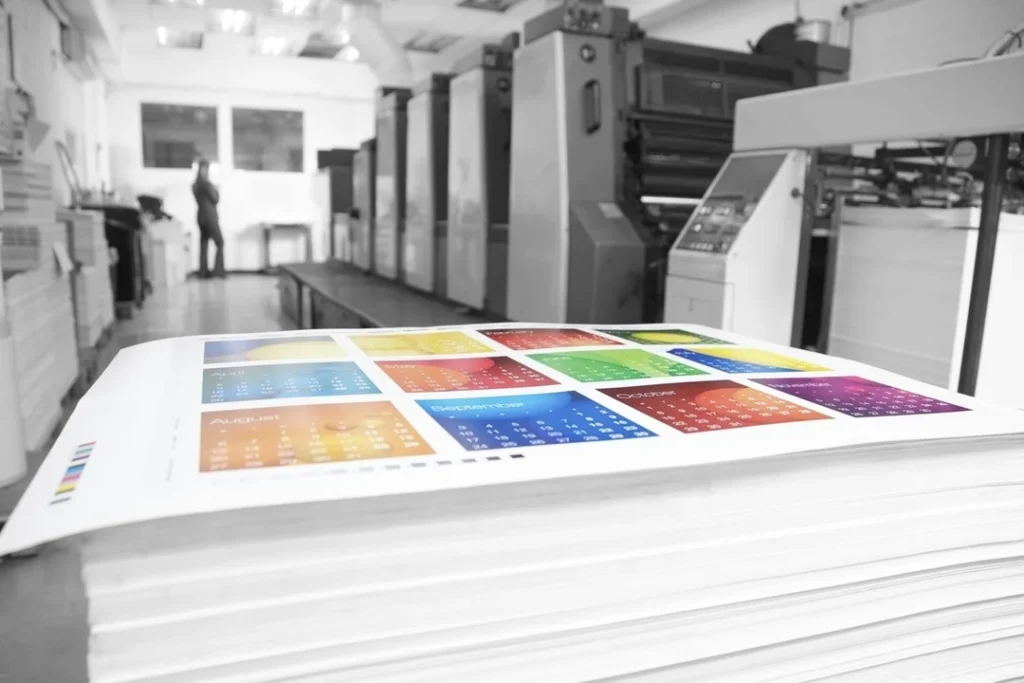
Recently, print design took a backseat in the digital world that never stops moving.
However, its comeback reminds us that specific rules must be followed to make an impact with your printed materials.
Essential Design Principles
Balance, alignment, contrast, repetition and proximity are five basic principles on which every design relies. They serve as a foundation for good communication – without them, the clarity and attractiveness of any message transmitted using print would be impossible.
Typography: The Art Of Choosing Fonts
For most designers, typography is one of the most critical elements of their print work. Appropriate font selection improves readability and triggers certain emotions or associations among readers.
Knowing how to apply typographic techniques correctly can improve your skills in this area.
To achieve excellent typography, consider font pairing, hierarchy and spacing.
Inclusive and Accessible Print
Modern print design must be “accessible by default”. This involves more than just large text; it’s about considering how light reflects off a surface and how different brains process layout.
- Colour Contrast and Dyslexia: Avoid stark black text on brilliant white paper, which can cause “blurring” for dyslexic readers. Instead, opt for off-white or cream stocks with a matte finish to reduce glare.
- Tactile Navigation: Incorporate Embossing or raised Spot UV to help visually impaired users identify key sections or contact information.
- Simplified Visual Hierarchy: For neurodivergent audiences, keep the Grid System predictable. Avoid “text wrap” around complex shapes, which disrupts the natural scanning path of the eye.
Expert Tip: When designing for the RNIB (Royal National Institute of Blind People) standards, ensure your minimum font size for “Clear Print” is 12pt, though 14pt is preferred for general accessibility.
Font Licensing and OpenType Features
Respect licensing and use features that improve reading
Commercial print needs licensed desktop fonts or clear embedding rights; embed or subset fonts in PDFs to avoid reflow or substitution at output.
OpenType features such as standard ligatures, oldstyle figures, small caps, and stylistic sets improve rhythm and tone in long‑form print.
I audit PDFs with a preflight to confirm fonts are embedded and that faux small caps or faux bold are not degrading letterforms.
Unusual typefaces can catch an eye, while well-thought-out combinations might add depth to what you’re trying to say through words printed on paper or other material surfaces around us all day!
Also, remember that, unlike digital formats, where small size usually means less weight (thickness), here sizes should vary much more for better legibility, because people need to see them clearly from some distance, sometimes even without glasses… yeah, right!
Colour Theory: Speaking Using Colours
The ability to communicate with colour is crucial for print design.
A suitable colour scheme can turn any piece into something extraordinary, shaping how different audiences perceive one’s brand.
It should always be remembered that this method can also trigger emotions.
Colour Management for Print
Colour management aligns screen, proof, and press using ICC profiles, correct colour spaces, and proofing protocols, thereby reducing shifts and reprints.
• Use ICC profiles that match the printing condition.
• Keep spot colours as spots when brand fidelity matters.
• Soft proof on a calibrated, profiled display with a viewing booth.
Process vs spot
CMYK process builds a mix to reproduce images; spot colours, such as Pantone, are pre‑mixed inks that improve brand colour accuracy or special hues.
Profiles and standards
FOGRA and GRACoL profiles align with ISO 12647 printing conditions, and PSO Coated v3 and GRACoL 2013 CRPC6 remain common in offset workflows.
Soft proofing and display calibration
Use a calibrated display and D50‑balanced viewing; a spectrophotometer-based routine reduces metamerism when assessing proofs, as Fogra advocates.
The State of Colour Management in 2026
The 2023 and 2024 Ghent Workgroup specifications endorse PDF/X‑4 with live transparency and ICC‑based colour for offset and digital presses, moving teams away from flatten‑first habits.
Printers adopting expanded gamut on digital presses now supply custom profiles. Idealliance G7 methodologies remain widely used for grey balance targeting in 2025 and 2026.
Pantone distribution now runs through Pantone Connect licensing in creative apps, and brand teams increasingly hold spot libraries centrally to avoid unmanaged conversions.
Debunked practice
“Always convert all artwork to CMYK before export” is outdated; Ghent Workgroup specifications support PDF/X‑4 with ICC‑managed colour, so conversions happen to the target profile at rip, improving gamut and black builds.
Real‑world examples
Coca‑Cola Red has long been specified as a spot ink in packaging to maintain brand consistency across substrates and geographies.
London Underground posters historically used limited spot colours for impact and production efficiency, a model still referenced in transport advertising.
Penguin paperbacks adopted strict colour standards for covers across perfect-bound formats, reducing reprint variance over decades.
IKEA’s 2013 catalogue used print with augmented content triggers; the print files kept spot blacks and managed CMYK to maintain consistent visuals beside AR content.
The Print Design Process
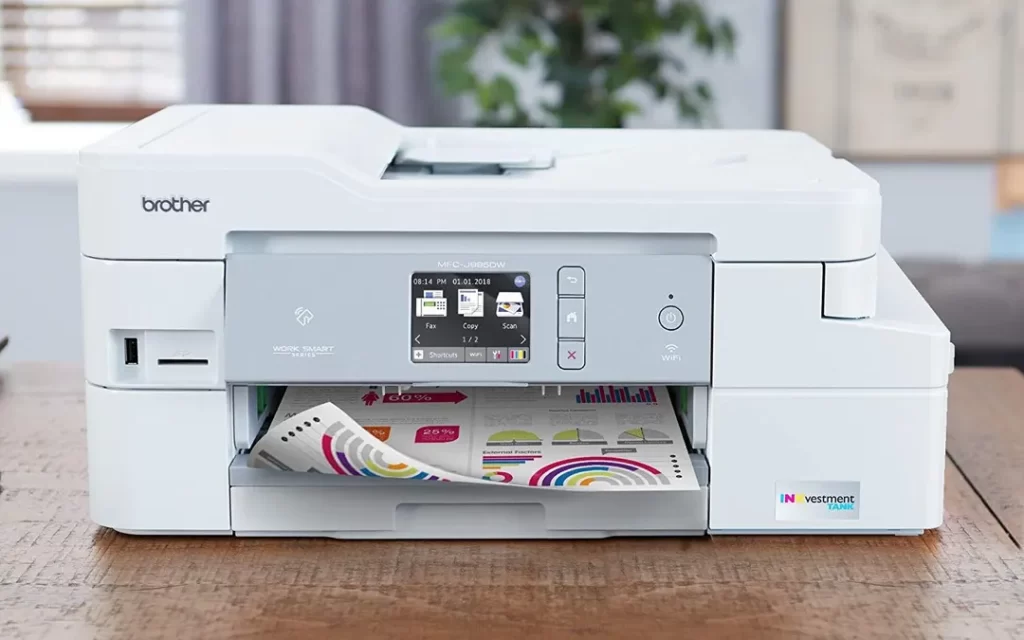
The print design process remains essential for creating impactful visual communications, even amid advancements in digital design.
Understanding how best to do this will enable you to develop designs that connect deeply with your target audience.
Every stage, from brainstorming to final preparations, is vital to achieving outstanding results in printing.
Idea Generation and Conceptualisation
Thinking up ideas and developing a concept mark the first step on the path to print design.
This is where you need to understand what your client wants and their goals – in other words, know them better than they do themselves!
Don’t hold back during brainstorming sessions; let all thoughts flow freely onto paper through sketches before considering different creative routes.
This imaginative thinking lays the foundation for success in any project.
Tools & Software for Print Design
Print design offers many powerful tools and software options that can significantly aid the creation process.
Programs such as Adobe InDesign or Illustrator offer industry-standard features tailored for projects intended for physical media representation.
These typesetting systems not only unleash one’s creativity but also save time by efficiently transforming ideas into something concrete.
The beauty of becoming skilled with these applications lies in their additional functionalities, such as layering, typography options, and colour management – often overlooked yet significant for enhancing visual appeal.
An example is Adobe InDesign’s layout capabilities, which help maintain grid systems while properly aligning elements, ensuring unity across the document’s elements.
Knowing what these programs can do transforms everything you thought you knew about designing into something greater!
Proofing & Revision Techniques
Regarding print design, proofreading and revising are the most vital skills needed from start to finish.
Doing mock-ups and test prints during the initial stages saves time and money that could’ve been wasted had errors gone unnoticed later on.
You must be very keen when evaluating your work – even the slightest mistake should not escape your eyes because you might regret it once everything has been printed.
Typically, this ideation stage focuses on areas where one would need to refine their designs to meet client needs.
Proofing usually involves sharing proofs with clients, which improves the final output and fosters collaboration between them and you, the designer.
It’s always good practice to make changes early enough so there is no room for misunderstandings and for something different from what was initially expected.
Prepress and File Delivery Standards
Preflight before you export
Update links, embed or subset fonts, set correct colour spaces, check overprint, traps, bleeds, and safe areas, then export to the printer’s PDF spec.
PDF/X‑1a flattens transparency and uses device-CMYK or spot colours; PDF/X‑4 retains live transparency and uses ICC‑based colour. The Ghent Workgroup promotes PDF/X‑4 for modern rips.
I request the printer’s job options and a sample proof, then match my export to their workflow so nothing surprises imposition or platesetting.
Layout and Composition Techniques
Entering print design, the most striking thing was realising how powerful layout and composition can be.
It’s not just about looks; the way you arrange things on a page affects what people understand from them.
Grid Systems and Their Significance
Effective print design relies on good composition, which can be achieved through grid systems that create order.
I like using grids because they help me maintain balance among different elements so that no part of my work appears more critical than the others.
They also make it easier for me to keep everything aligned at every stage of the design process since there is already a set pattern to follow.
Building Visual Hierarchy
Even the most beautiful designs will fall flat without a clear visual hierarchy.
Nothing is more important than guiding viewers where to look first, but this should not signal that they should stop there or ignore some parts altogether.
I use size, boldness and contrasting colours, among other techniques, to create focal points that attract attention and encourage reading through given content, especially when dealing with many competing components on one page.
Moreover, the visual hierarchy should be less governed by complex rules but somewhat influenced by understanding how people respond to your design choices.
When certain items are emphasised – such as headlines or calls to action – their significance is heightened, making them resonate well with audiences.
For instance, placing an image next to its caption would make it more noticeable than having the two texts separated, which may only result in aesthetic appeal without effectively conveying any message.
Best Practices for Effective Layouts
What does it take to come up with an engaging layout?
The first thing is ensuring that there is flow in your work. Allow some breathing space around elements by using white areas intelligently so none appear too squeezed together.
Equally important is maintaining uniformity across the various sections of your project, as this reinforces brand recognition and enhances readability across all platforms.
However, successful layouts are not created by following prescribed formats; they are discovered through trial and error, tailored to the unique needs of each assignment.
I return to simplicity whenever I feel overwhelmed because it brings out the best in any design.
This means eliminating unnecessary details to concentrate more on what matters most, producing powerful visual statements.
Nevertheless, don’t let beauty compromise clarity – both must go hand in hand for any printed material to communicate effectively.
Bleed, Trim, Safe Area, and Margins
Give the guillotine room to move
Set a 3 mm bleed for ISO work, or 0.125 in for North American work; keep text at least 3 to 6 mm inside the trim to avoid nicks.
Adjust panel widths on folded pieces so inner panels are undersized, roll folds and gatefolds need careful panel maths to prevent bulging when closed.
Working with Imagery
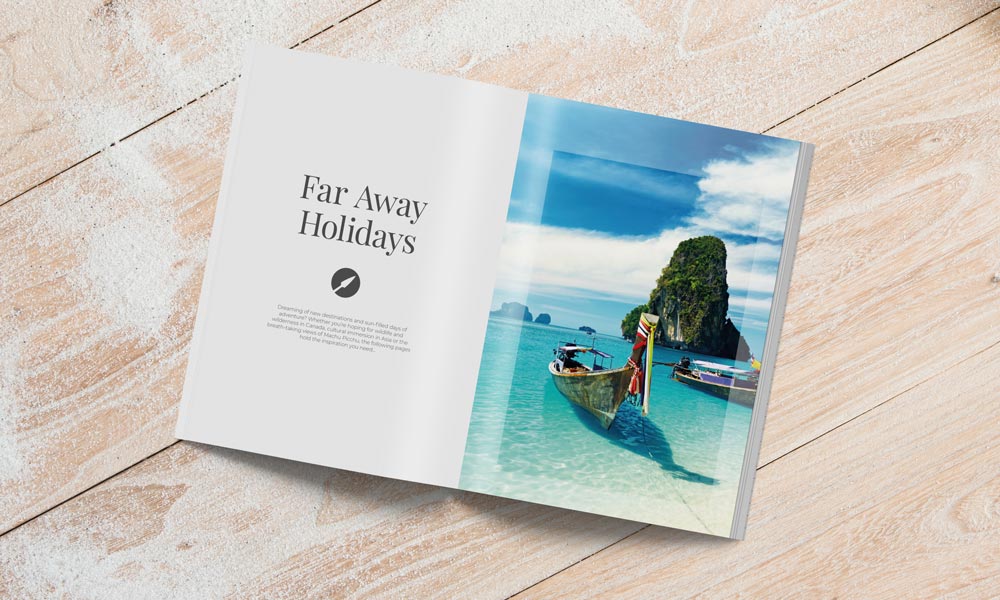
Digital design lets you change visuals with a click, but that’s not how it goes in print design.
You must carefully select images that resonate with your target audience and align with your brand message.
Pictures for print can instantly convey the message you want, which will catch people’s attention better than any text alone.
Choosing Images for Print — Aspects Often Overlooked
Picking the right images for print is often overlooked as one of the most crucial parts of design.
Each image should do something and connect viewers with it on a deeper level; this makes them impactful enough to be remembered long after they’ve flipped through whatever they were looking at.
For added versatility and engagement, consider complementing your design with dynamic elements like a video-to-flipbook, which can showcase your visuals in motion and enhance both print and multimedia strategies.
Every picture counts, whether about eye-catching covers or sleek business cards!
QR Codes for Print
Make them scan fast, first time
ISO/IEC 18004 specifies a quiet zone of four modules around a QR symbol, maintains strong contrast, and avoids reversing on dark backgrounds.
Error correction at level M or higher improves resilience, size codes relative to scan distance, and then tests on multiple devices before sign‑off.
I export vector codes or very high PPI rasters to avoid fuzzy edges that cause field scans to fail.
Vector vs Raster Graphics Explained
Knowing the difference between vectors and rasters in print design is essential because each has its own use case.
Vectors are made up of paths defined by mathematical expressions that allow for infinite scalability without any loss in quality. At the same time, rasters are comprised of pixels, which can lead to pixelation when resized.
Understanding this distinction will help you choose the right file type for what you’re trying to achieve.
Also, always consider whether your project involves logos, illustrations, or photographs, since these require different file types, given their varying levels of complexity and the vector/raster formats applicable to each situation.
For instance, logos and illustrations typically work best as vectors since they’ll likely be used across multiple platforms where sizes may vary considerably, necessitating scalability without sacrificing detail.
Resolution and Image Quality
Right resolution for the viewing distance
Target 300 PPI at final size for litho work; large-format work viewed from a distance can be 150 to 200 PPI or lower without visible softness.
Do not upsample poor originals as a fix; supply TIFF, PSD, EPS, or PDF for CMYK work rather than PNG, which lacks CMYK support and print metadata.
Line screen and dot gain vary with press and stock; printers aligned to ISO 12647 conditions will advise suitable resolution and sharpening strategies.
Print Production Workflow

Once again, we look at print production workflows, but this time, ensure your designs smoothly transition from concept to reality.
The procedure consists of several crucial steps that can significantly impact the final product.
Understanding these phases lets you make more informed decisions and improve your print design projects.
Choosing Printing Techniques: Offset, Digital, and More
The choice of printing technique can either make or break your project. For large runs, offset printing offers unbeatable quality, while digital printing provides greater versatility for short runs.
You can also use screen printing or letterpress, among other methods, to add unique textures and finishes to your work.
Evaluate your project’s scope and budget to determine which best suits it.
Picking Paper Stock and Finishes
At this point, selecting an appropriate paper stock becomes essential to achieve the desired aesthetic appeal and functionality.
The perceived quality of any print design may be influenced by characteristics such as the weight, texture, or finish of the paper used.
Depending on the project you’re working on, uncoated, glossy, or textured stock may be required. Be careful because different choices will significantly affect how things are presented.
But when thinking about stock, it’s not all about choosing papers themselves; think also about finishes that go hand in hand.
There are many options, including matte finish, which gives a soft, non-reflective appearance, while gloss finish makes colours pop more vibrantly; even satin finish adds a sheen without being too bright…
Thus, I would like everyone to remain conscious of the impact of their selections on audiences’ perceptions/feelings towards works under such circumstances.
Paper Weight, Coatings, and Grain Direction
Stock choice changes ink behaviour and durability
GSM indicates weight; common text stocks run 80 to 170 gsm, covers run 200 to 400 gsm, and coated stocks hold ink differently than uncoated due to surface sealing.
Grain direction affects folding and binding. Fold with the grain to reduce cracking, score heavier or coated stocks before folding to keep edges clean.
Fogra’s guidance on dot gain highlights how uncoated papers increase tone value, which designers should anticipate in colour builds.
Rich Black, Registration Black, and TAC
Build dense blacks without choking the sheet
Use 100 K for small text to stay sharp, use a rich black mix for large solids, avoid Registration colour for content, it is for marks only.
Total ink coverage should respect the printer’s spec; many coated workflows target around 300 per cent, newsprint runs far lower due to absorbency.
I ask for the press TAC limit and adjust profiles or black builds so solids dry properly and avoid setoff.
Trapping and Overprint Basics
Compensate for registration and keep fine text readable
Trapping creates slight overlaps between colours to hide misregistration on press, magnitudes depend on process and stock and are set in prepress.
Overprint keeps 100 K small text crisp over light backgrounds, avoiding overprinting light objects on dark backgrounds that would disappear in separation.
ISO 12647-based workflows and G7 calibration reduce variation, but I still check overprint previews before export to prevent vanishing elements.
Special Effects and Enhancements for Print
Embellishments on paper can jazz up a design, making it look exceptionally great.
Several techniques, such as foil stamping, embossing, and UV coating, can add an extra visual or tactile element to your printed material, making it more attractive to look at and touch.
Therefore, when you utilise them, you design and create something people would love to experience.
Finishes also play a part in highlighting specific areas within designs; for example, one might use spot UV to create a particular effect, while embossing could give the design a 3D feel that captures viewers’ attention even more.
While being creative is good during this process, ensure everything fits within what can be practically done during production, because you still need all these things within reach, budget-wise.
Folding Styles and Finishing Standards
Plan folds and finishes together
Common folds include tri‑fold, Z‑fold, gatefold, and roll fold. Adjust inner panels, choose lamination such as matte, gloss, or soft‑touch to add durability and a tactile feel.
Die‑cut tolerances require a buffer around fine details; highly detailed apertures can tear on softer stocks, and mailability rules may limit thickness and attachments.
I request a folded dummy on the chosen stock before artwork lock, so copy, creases, and panel maths are confirmed off-screen.
Variable Data Printing and Personalisation
Use data to change text, images, and codes per piece
Digital presses support VDP using CSV or CRM sources, swap names, offers, imagery, and barcodes while maintaining imposition and colour control.
Template discipline and data hygiene prevent broken fields. I run test records and rule checks before live runs to avoid waste on the press.
Idealliance and manufacturers document throughput limits and RIP behaviours, and check with the pressroom so creative choices do not exceed engine capacity.
Budgeting and Cost Factors
Don’t forget that effective print design isn’t just about being creative – it’s also about understanding how much things cost and budgeting accordingly.
Whether you’re a business owner, a marketer or a creative, controlling your budget can make or break your design project. Here are some things to consider:
Print Run Economics: Digital vs Offset
Find the break‑even point, then scale
Offset has a higher setup and lower unit cost at volume, digital has a low setup and stable unit cost at short runs, and quotes hinge on sheet size and imposition efficiency.
Ink colours, spot plates, finishing passes, and turnaround add cost; ganging multiple items on a sheet can lower the unit price when sizes align.
I ask for two quotes, one digital and one offset, then pick the method that fits quantity, colour needs, and speed without degrading quality.
Knowing production costs
One of the most critical steps in any print design journey is knowing what it will take to produce everything from start to finish.
That means looking at materials and labour, printing methods and delivery options, among other factors. Each of these elements impacts how much money you spend overall, so don’t skip this step if you don’t want to be hit with unexpected expenses.
Cutting costs without cutting quality
Consider which materials can be used and how processes might differ to maximise your budget.
For example, digital printing works best for small runs because it’s cheaper than traditional methods.
Also, make sure the layout is versatile enough so the typeface can easily be changed on a need-versus-want basis, where some things just look cool but don’t say anything useful at all, in which case they should probably be removed anyway.
This doesn’t mean settling for low quality; instead, it invites strategic thinking.
An excellent way to do this would be to use high-quality stock paper and ink, which still offers great visual appeal without costing too much.
In every design decision, ask yourself, “How does this affect perceived quality?”
Overcoming Common Challenges in Print Design

Once you’ve drilled down into the essentials of print design, addressing some common hurdles you might face is important.
Each stage of the process has its challenges, but armed with the proper knowledge and strategies, you can overcome them effectively.
Dealing with Colour Matching Issues
You’re not alone if you’ve ever designed something on your computer and found that the vibrant colours didn’t translate well to print.
This is because digital RGB colour is different from printed CMYK colour.
To resolve this problem, it’s essential to understand your colour profiles and use proofing techniques so that what you see on your screen matches what comes out of the printer.
Contract Proofs and Colour Verification
Lock colour before plates or clicks
Use contract proofs from the printer for colour‑sensitive jobs; these are produced to a known standard with measurement bars and are signed off by both parties.
Pantone spots can be run as true spots or simulated in CMYK. Device variance means a spectrophotometer verified proof is the safest way to compare expectations.
Evaluate proofs under D50 lighting, Fogra and ISO guidance exists for viewing conditions, which cuts arguments about cast and brightness.
Avoiding File Preparation Errors
Assuming you’ve created a beautiful design, file preparation is crucial.
Wrong setups can result in cut-off text or unexpected white borders, ruining an otherwise perfect piece of work.
Therefore, it’s vital to check bleeds, margins and resolution settings twice before sending your file off for printing.
Knowing how to prepare a file for print correctly is half the battle.
This means ensuring all images are high resolution (300 DPI), using the correct colour mode (CMYK), and including bleeds where necessary, among other things. Every little detail counts as a missed aspect that could compromise quality overall.
Not only will failures be reduced through meticulous adherence to these specifications, but success will be more satisfying during printing.
Communicating Effectively with Clients
Any designer worth their salt knows that good client communication skills are everything.
Misunderstandings can lead to disappointment and wasted resources, so a thorough briefing process can save time in the long run.
When clear communication serves as your foundation, creating a roadmap becomes easier, as it helps align both parties’ visions toward the same goals through collaboration.
Arrange regular check-ins and bridge understanding gaps using visual aids such as mock-ups or sample materials. Remember, involving clients at different design stages heightens satisfaction and increases the overall impact of printed materials.
Seek to maintain transparency with them during this period, as this will ensure that everyone remains informed about the printing process from start to finish.
The Print-to-Digital Bridge: AR and Smart Packaging
Print in 2026 is the “gateway” to the digital ecosystem. We no longer view print as a siloed medium but as a physical browser.
Augmented Reality (AR) Integration
By using tools like Zappar or Adobe Aero, designers can embed “invisible” triggers into printed posters. A user points their phone at a static movie poster, and the trailer begins to play within the physical frame of the paper.
- How-to: When preparing files for AR, ensure the “tracking image” has high contrast and no repeating patterns. This allows the software to lock onto the physical piece even in varying light conditions.
NFC and “Tap-to-Action”
NFC (Near Field Communication) tags are now thin enough to be embedded between layers of a 600 GSM business card or inside a luxury product box.
- The Benefit: Unlike QR codes, which require opening a camera app, NFC allows for a “frictionless” tap. A client taps their phone to your portfolio, and your contact details are instantly saved to their CRM.
Pros and Cons of Print vs. Digital Design
To grasp the effects of print and digital design, it is essential to consider what they are good at and where they fall short.
Every medium has its uses and resonates with different parts of human nature.
The following is an analysis of the positive and negative aspects of print versus digital design.
| Pros and Cons | Digital | |
| Tangibility | Provides a physical, tactile experience that enhances retention. | Accessible anywhere, anytime, through devices. |
| Attention Capture | Often stands out in a digital-saturated market. | High potential for interactive engagement through multimedia. |
| Longevity | It lasts longer and often retains its quality. | Content can be quickly updated or modified. |
| Cost | It can be expensive to produce in large quantities. | Generally lower costs with wide-reaching distribution. |
| Visual Aesthetic | Print offers unique design options such as textures and finishes. | Allows for dynamic animations and videos. |
| Market Reach | Effective in targeting specific local audiences. | Global reach with potential viral content. |
| Personalisation | Highly engaging when tailored for the recipient. | Can leverage data for intricate personalisation. |
| Sustainability | It is only sustainable if eco-friendly materials are used. | Digital formats reduce physical waste. |
| Storage and Distribution | Requires physical inventory and distribution logistics. | Stored effortlessly in cloud systems and shared instantly. |
| Interactivity | Limited interaction possibilities. | Incorporates interactive elements enhancing user experience. |
Pros of Print Design
Even in the digital age, print design still has many advantages.
When you get to touch and feel something, it’s more likely for you to remember it.
This haptic experience helps create an emotional bond with customers and build loyalty, making print media one of the most effective communication methods.
Cons of Print Design
One disadvantage is that (once printed) there is no way to change or update what has already been done without using even more resources to re-do everything from scratch.
The costs can be high and time-consuming, especially in environments where marketing needs constantly change.
In addition to cost and printability issues, another problem is its lack of dynamism compared with other forms, such as Internet advertising, which provides instantaneous feedback through user interaction.
Further, tracking engagement levels remains tricky because results cannot be viewed instantly, unlike in electronic campaigns.
Printing works in tandem with digital channels.
However much they differ, one thing impossible not to mention is how print works alongside digital platforms such as websites or social media pages.
These two methods should be used together to form a coherent plan that improves user experience while maximising coverage.
Print can drive people towards online areas, while internet campaigns can lure people into interacting with tangible hardcopy materials.
The marriage between these two worlds must be approached thoughtfully because print complements digital advertising when adequately combined, creating a synergy that amplifies brands’ recognition among potential users.
For instance, ads may include QR codes that enable individuals to access additional content via webpages without losing the richness of physical media.
This crossing over between formats creates an all-round marketing environment where every angle has its eye open for success, thus achieving maximum involvement coupled with efficiency, both at once
Current Trends in Print Design
Print design is changing as consumer behaviour changes and technology advances. Some significant trends are happening in the industry today — from sustainability to personalisation.
Sustainability 2.0: Environmental Ethics in the Print Room
In 2026, “recyclable” is the bare minimum. True leadership in print design involves a “Cradle-to-Cradle” approach, where every element—from the adhesive to the ink—is accounted for.
Specifying Green Entities
When briefing a printer, look for these specific certifications and materials to ensure your project meets 2026 environmental benchmarks:
- FSC Recycled: Ensures the paper is made from 100% post-consumer waste.
- Vegetable and Algae Inks: Traditional petroleum-based inks release VOCs (Volatile Organic Compounds). Modern Soy Inks or Algae-derived pigments are biodegradable and easier to remove during the de-inking process of recycling.
- Carbon Balanced Print: Work with providers who use the World Land Trust scheme to calculate the carbon footprint of your paper and offset it by protecting high-biodiversity forests.
The Problem with Luxury Finishes
Many designers unknowingly make their work unrecyclable by adding plastic-based laminates.
- The Solution: Use Cellulose-based Laminates or “Bio-glitter”. If you require a metallic look, specify Cold Foil, which uses significantly less material than traditional hot-stamping and is generally easier to recycle in standard UK municipal streams.
| Material/Process | Environmental Impact | 2026 Best Practice |
| PVC Banners | High (Non-biodegradable) | Switch to Kavalan or recycled polyester. |
| Traditional Gloss Laminate | Medium (Plastic film) | Use Aqueous Coating or bio-laminates. |
| Virgin Pulp Paper | Low-Medium | Ensure PEFC or FSC certification. |
Minimalist vs Maximalist Design Trends
In today’s print landscape, there is a place for both minimalism and maximalism – it depends on who you want to appeal to with your message!
Minimalistic designs often provide function over form by utilising negative space and clean lines while being very clear about what they are trying to say.
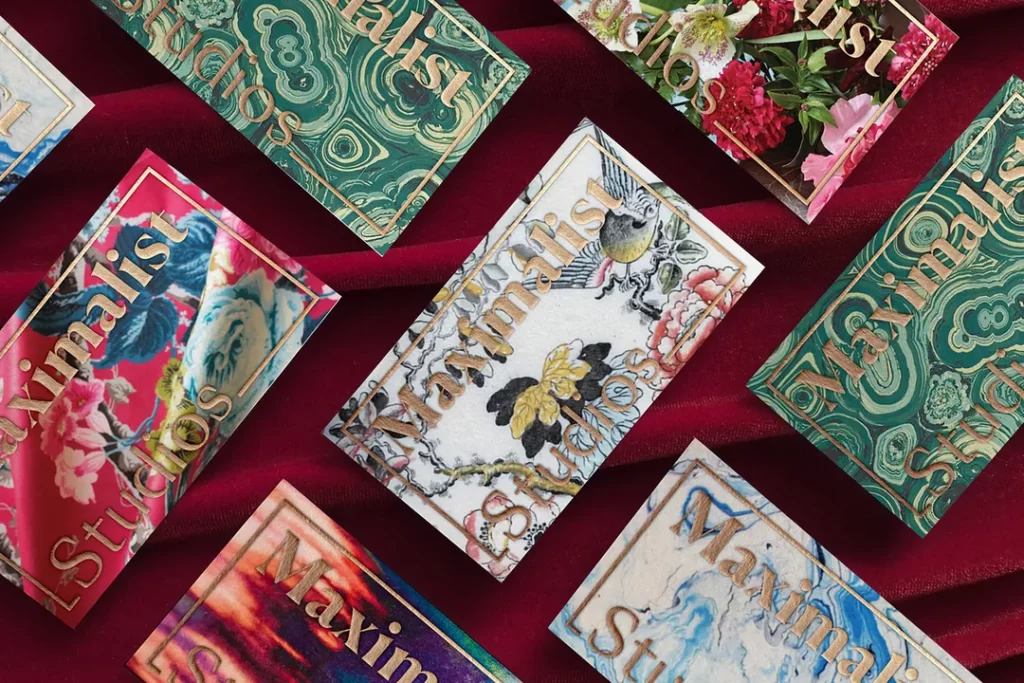
On the other hand, if being bold or loud is more up your alley, maybe try out some maximums, which use lots of vibrant colours layered with intricate details throughout each piece, until everything feels like one big explosion waiting to happen (in a good way).
When selecting materials, these two contrasting styles have their own merits.
Minimalists might use white space so essential items can shine through; maximal aesthetics could include multiple images stacked atop each other alongside bright hues guaranteed to grab attention at first glance.
Which path should be taken? It depends on how you want your message perceived – either method will result in better engagement rates!
Personalisation & Customer Engagement
Today’s key for many marketers is personalisation – making sure you speak directly TO people rather than AT them.
With advancements in printing technology, we can produce bespoke pieces that contain different words tailored to resonate with recipients on an individual level.
This increases relevance and improves the experience, fostering stronger brand and customer connections.
Recent studies have shown that personalised campaigns can generate up to 30% more responses than generic alternatives.
Using analytics data alongside unique creative designs allows me to talk about what matters most to you and ensure it resonates best with those who matter most – your audience!
This creates deeper involvement, leading to heightened loyalty, which is necessary within competitive environments.
Resources for Print Design
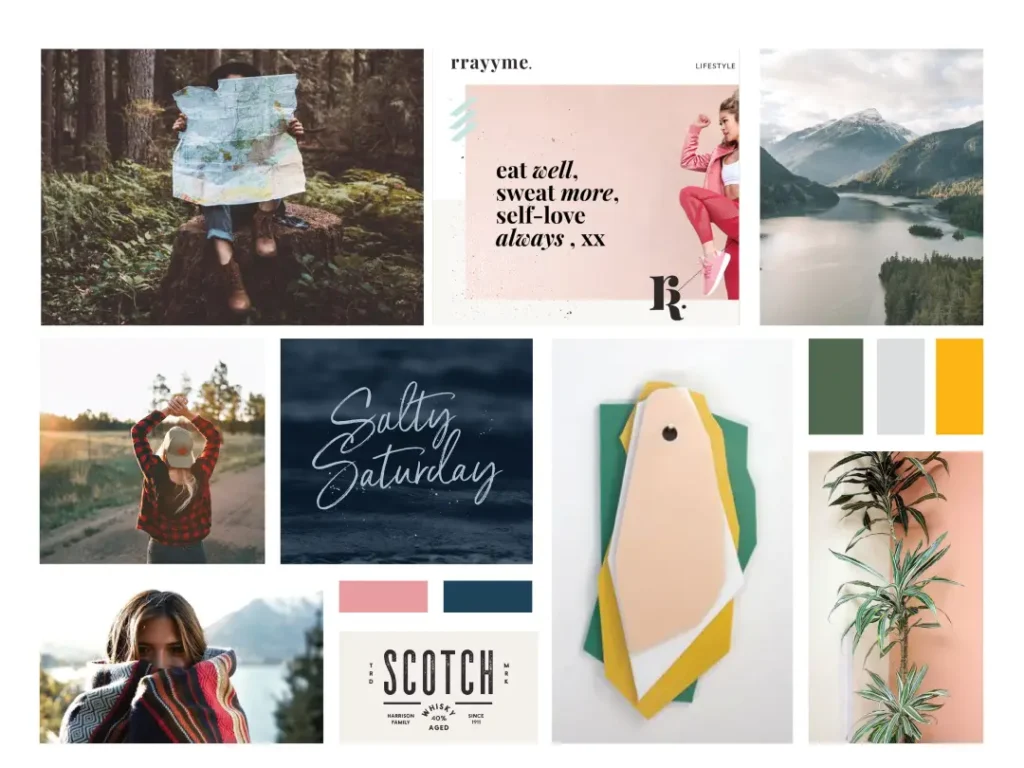
Several resources can help you improve your skills and creativity in print design.
These platforms and networks are helpful whether you are a beginner or an expert who wants to refine your skills.
Sources of Inspiration
Many designers must learn that inspiration for print design can be found anywhere. This is especially true today, with the internet.
Behance, Dribbble, Pinterest, and other websites offer a wealth of information about creative printing projects that have been done before.
They not only show the designs but also reveal trends and the people behind them.
Professional Development Opportunities
Continuous learning is paramount even for experts in any field, including print design.
Various workshops and online courses are available on Skillshare, LinkedIn Learning, and Coursera. These can help one better understand complex issues such as new technology, colour theory, typography, etc.
To remain competitive, it is vital to keep improving through these means, where professionals share their knowledge and develop new solutions.
Online Communities for Designers
The best place for a graphic designer to be is among other graphic designers.
Platforms like Reddit, Discord Servers or Facebook Groups offer spaces for designers to interact with each other, sharing ideas and challenges – such communities foster peer support among artists while also promoting collaboration towards successful project completion worldwide!
Tips for Effective Print Design
For beginners in print design, some basic principles can significantly improve the quality and impact of your work. Here are a few tips to get you started:
Typography and Colour Best Practices
Aim for a good balance between typography and colour in your prints.
Font choice can set your design’s mood, while colours may trigger feelings or indicate brand identity. Ensure you maintain consistency across all materials to help viewers understand the message conveyed by the brand name.
Effective Layout Strategies
The layout is crucial in guiding people’s eyes to where they should look when viewing an advertisement; hence, it should be done correctly.
You must consider how various parts relate to one another and achieve a balance between aesthetics and function.
Grid system adoption enables natural flow, thereby establishing content hierarchy and making it easier for readers.
Not only should the layout be attractive, but it should also serve its purpose of clearly communicating what you want others to know or do about your business idea/product/service, etc., when printed.
This fidelity to structure helps deliver neatness as part of design cleanliness, inherently suggesting a professional appearance and enhancing the perception associated with the brand.
Essential Tools for High-Quality Results
Several tools are required to produce good print designs, namely Adobe InDesign and Illustrator, which are industry standards.
These programs have many features that can boost creativity during the design stage while, at the same time, enhancing efficiency throughout the entire process, thus familiarising yourself with them.
The Future of Print Design
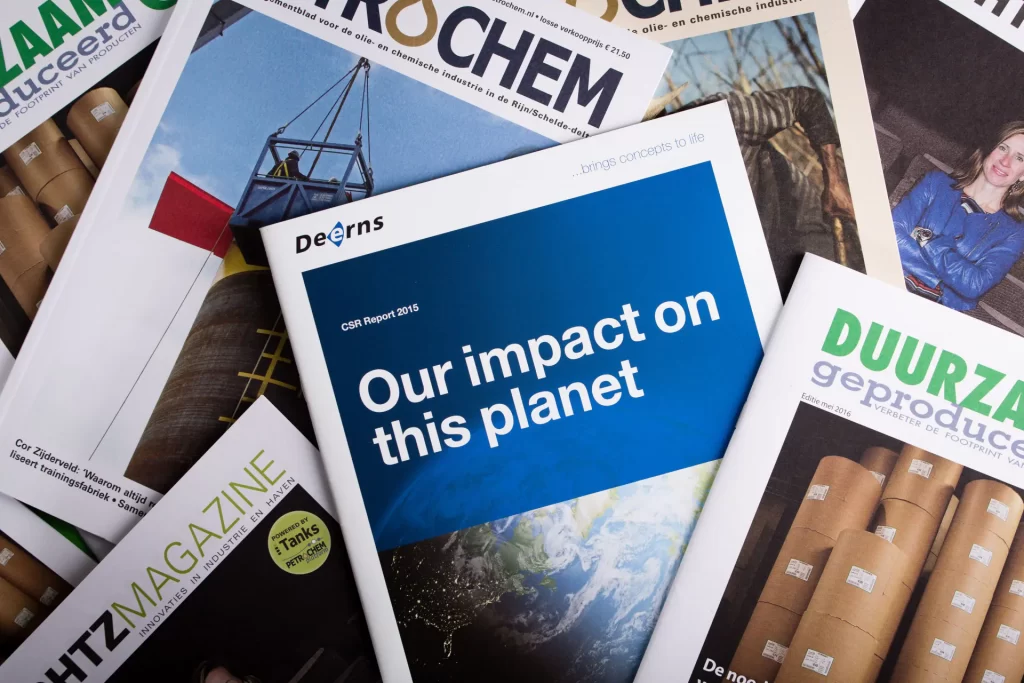
Many designers today face the question: How can we blend print and digital innovations for a better user experience?
This process is not just about mixing different means of information delivery; it’s about telling a holistic story that resonates with people across various channels.
For example, QR codes, augmented reality, and NFC technology enable printed materials to include interactive elements so users can touch or swipe to engage.
When used correctly, this symbiosis opens up a new world of possibilities for your brand.
Integration of Print and Digital Innovations
The connection between physical objects and digital environments has never been more critical in print design.
I’m amazed every day by some businesses’ ability to think outside the box: placing QR codes on brochures that lead customers straight to rich multimedia web pages filled with additional information about their products or services.
Such interactivity enhances the overall user experience and provides marketers with valuable insights into consumers’ interests.
Emerging Technologies and Practices
Even as we adopt new media technologies, traditional print still accounts for a significant share of marketing strategies.
One area where I think there’s been a lot of activity lately is sustainable printing – using 3D printers instead of traditional ones may expand creative options while reducing environmental impact.
The future seems bright, with AI taking over parts of design processes and greener printing methods becoming more popular!
The ability to produce personalised printed items efficiently and sustainably meets clients’ needs while setting us apart as forward-thinking experts; check out these advancements, which contribute to making print design an even more lively field than ever before.
Predictions Concerning the Future Course of Print Design
According to my gut feeling, what lies ahead is not just coexistence but an integration of print and digital media, where each enhances the other to better communicate with people, thereby creating lasting impressions.
There will be changes in how things are done, too – from now on, personalisation might take centre stage in the design of printed materials, as customers expect them to be tailored precisely to their needs.
Also, brands will have no option but to go green; the demand for biodegradable or recycled printing options might rise significantly.
The mix of these two factors should push us beyond current boundaries while establishing benchmarks that ensure we remain impactful players in this sector, even in an age dominated by screens.
FAQs
Can I use RGB images in my print files if I use PDF/X-4?
Yes. In a modern PDF/X-4 workflow, you can keep your images in their native RGB profile. The conversion to the specific printer’s CMYK profile (like Fogra 51) happens at the final output stage, which actually preserves a wider range of colours (gamut) for longer.
What is the best paper for a brand that wants to look “eco-friendly”?
Look for an Uncoated stock with visible “flecks” of recycled fibre. Brands like Gmund or Arjowiggins offer stocks made from alternative fibres, such as hemp, straw, or even recycled coffee cups, that visually communicate sustainability.
Why does my blue look purple when printed?
This is usually because the “Cyan” and “Magenta” values are too close. In CMYK, magenta is very strong. To keep a blue looking “true”, ensure your Cyan is at least 30% higher than your Magenta.
Is “DPI” the same as “PPI”?
Technically, no. PPI (Pixels Per Inch) refers to digital resolution on your screen, while DPI (Dots Per Inch) refers to the physical dots of ink a printer places on the paper. However, in common conversation, most people use them interchangeably to mean “high resolution”.
What is the “Safe Area” and why does it matter?
The safe area is a margin (usually 3-5mm) inside the trim line. It ensures that if the paper shifts slightly during the cutting process (the guillotine), your text or important logos don’t get chopped off or look uncomfortably close to the edge.