Content Governance: Who Owns Your Brand’s Voice?
I recently audited a mid-sized fintech company. They had a decent product, a solid budget, and a marketing team full of bright sparks. But their website read like it was written by five different people who had never met.
The homepage was formal and corporate. The blog was trying too hard to be “Gen-Z friendly.” The support documentation was overly technical and difficult to understand. And the sales deck? That was a wild west of promises; the product team knew nothing about it.
They did not have a writing problem. They had a content governance problem.
In the rush to “scale” and “publish,” businesses often overlook the fact that more content does not necessarily equate to better marketing. If you dump a gallon of water into a bucket with a hole in it, you don’t get a full bucket—you get wet shoes.
Content governance is the patch for that hole. It is the unsexy, rigorous, and absolutely necessary framework that determines who gets to speak for your brand, what they are allowed to say, and when they need to be silent.
If you are tired of your brand voice sounding like a chaotic committee argument, you are in the right place. We are going to strip away the fluff and look at how to build a governance model that actually works.
- Establish clear governance: define who owns content, approval rights, and a RACI-based Content Council to enforce tone and standards.
- Build the tripod—People, Process, Technology—to prevent inconsistent messaging, reduce content debt, and ensure findability via taxonomy.
- Adapt governance for AI: require human-in-the-loop verification, label AI-assisted content, and ban common AI‑style language.
What is Content Governance?
Let us cut through the jargon immediately.
Content Governance is the set of guidelines, processes, and tools that determine how an organisation creates, publishes, maintains, and archives content. It is not a content calendar. It is the law that dictates what goes on that calendar.
Think of your content strategy as the “Battle Plan” (what we want to achieve). Content governance is the “Rules of Engagement” (how we operate to achieve it).

The Three Core Pillars
A functional governance model relies on three non-negotiable pillars:
- People: Who owns the content? Who approves it? Who has the power to kill a piece of content that fails to meet standards?
- Process: How does an idea move from a sticky note to a published URL? This includes workflows, editorial guidelines, and taxonomy.
- Technology: What tools enforce these rules? This covers your CMS, Digital Asset Management (DAM) systems, and AI verification tools.
If you miss one, the tripod collapses. Technology without people is just expensive shelfware. People without process is anarchy.
The High Cost of Silence (And Noise)
Why should you care? Because bad governance is expensive.
We often see entrepreneurs treating content as a “free” resource. You write a blog post, you tweet, you send an email. It feels cheap. However, when you factor in salaries, tools, and opportunity costs, it becomes a significant line item.
The “Content Waste” Epidemic
According to data from SiriusDecisions (now Forrester), up to 60-70% of content created by B2B marketing organisations sits unused.
Let that sink in. You are likely paying your team to produce work that the sales team never uses, customers never see, or—worse—actively confuses your audience.

Without governance, you generate Content Debt. This is the accumulation of outdated, irrelevant, or off-brand content on your digital properties. Like technical debt, content debt accrues interest. Every outdated page on your site is a liability. It confuses Google’s crawlers, dilutes your content marketing authority, and frustrates users.
The Brand Consistency Tax
Consistency is not just an aesthetic choice; it is a revenue driver. Lucidpress (now Marq) reported that consistent brand presentation across all platforms increases revenue by up to 23%.
Conversely, inconsistent messaging erodes trust. If your LinkedIn posts sound like a chaotic teenager while your website sounds like a Victorian lawyer, the customer assumes your product is equally disjointed.
The Governance Model: People, Roles, and The “RACI” Reality
The biggest lie in marketing is that “everyone is a content creator.”
No, they are not.
If you let the sales team write their own case studies without oversight, you get hyperbole. If you let the product team write the landing page, you get technical manual jargon. If you let the CEO write the press release at 11 PM… well, we all know how that ends.
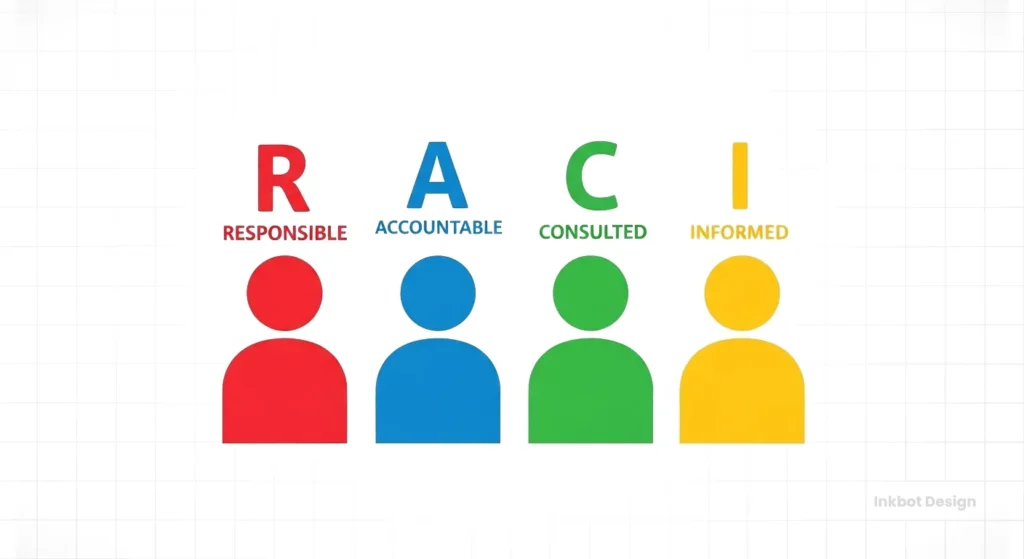
You need a strict RACI Model (Responsible, Accountable, Consulted, Informed). But let’s make it practical.
1. The Content Council (The Legislative Branch)
This is not a “brainstorming group.” This is the Supreme Court of your brand.
- Who: Head of Content, VP of Marketing, a Senior Product Lead, and a Legal/Compliance rep (if you are in a regulated industry).
- Role: They set the standards. They do not write; they legislate. They approve the Tone of Voice document and the Editorial Guidelines.
- Power: They have veto power. If a campaign violates the brand guidelines, it can be terminated, regardless of the time spent on it.
2. The Managing Editor (The Executive Branch)
- Who: Your Content Manager or Senior Editor.
- Role: Traffic control. They ensure that day-to-day operations comply with the laws set by the Council. They assign writers, manage deadlines, and perform the final “sanity check” before hitting publish.
- Power: They own the calendar. No “emergency blog posts” get published without their say-so.
3. The Subject Matter Experts (The Sources)
- Who: Engineers, Product Designers, Sales Leads.
- Role: They provide the facts, not the prose.
- Power: They verify accuracy. They do not get to dictate style. A common failure mode is allowing an SME to rewrite copy because they “don’t like the tone.” That is not their job. Their job is to say, “This technical spec is wrong.”
4. The Creators (The Hands)
- Who: Copywriters, Designers, Videographers.
- Role: Execution. They translate the raw data from SMEs into the brand voice defined by the Council.
The Strategic Conflict: Who Actually Owns the Voice?
This is where it gets uncomfortable. In theory, “the brand” owns the voice. In reality, ownership is often grabbed by whoever shouts the loudest.
The Sales vs. Marketing War
Sales teams are tactical. They want collateral now to close a deal today. They often view governance as a bottleneck. “Why do I need approval to change this slide deck? The client needs it in an hour!”
The Governance Fix: Create “Locked” and “Flexible” zones.
- Locked: Core value propositions, pricing tables, legal disclaimers. These cannot be edited by Sales.
- Flexible: Case study anecdotes, intro slides, personalised data.
Use tools like Canva for Enterprise or Seismic that allow you to lock specific pixels on a template while allowing text edits in designated boxes. This gives Sales the speed they want without the risk you fear.
The CEO Interference
We have all been there. The strategy is set, the content is written, and then the Founder swoops in at the 11th hour to “tweak” the headline because they showed it to their spouse, who didn’t get it.
The Governance Fix: Data.
You cannot argue with the HIPPO (Highest Paid Person’s Opinion) using feelings. You must use data. “We tested this headline, and it performed 14% better in A/B trials than the alternative.” Governance provides the framework to say “No” to the CEO by pointing to the agreed-upon strategy document they signed three months ago.
The “Direct Answer” Protocol: Structuring Your Guidelines
Your governance documents should not be a 50-page PDF that nobody reads. They need to be actionable tools.

1. The Tone of Voice (ToV) Matrix
Do not just say “We are friendly.” That means nothing.
Use a sliding scale:
- Funny but not silly.
- Confident but not arrogant.
- Smart but not academic.
- Urgent but not panic-inducing.
Provide examples of “This, Not That.”
Bad: “Our utilisation of best-in-class methodologies facilitates synergy.”
Good: “We use the best tools to help you work better together.”
2. The Editorial Style Guide
This is the nuts and bolts.
- Do we use the Oxford Comma? (The answer should be yes, but that is an argument for another day.)
- How do we format dates? (DD/MM/YYYY, please. We are not savages.)
- How do we refer to our own product? (Capitalised? Bolded?)
3. The Taxonomy & Metadata Schema
This is the “Rare Attribute” most businesses ignore. Governance is not just about words; it is about findability.
You must define a controlled vocabulary for your tags and categories.
- If one writer tags a post “Social Media” and another tags it “Social Media Marketing” and a third tags it “SMM,” you have broken your site structure.
- Rule: Tags must be selected from a pre-approved list. New tags require Editor approval.
The State of Content Governance in 2026: The AI Crisis
The release of generative AI tools has fundamentally changed the physics of content creation. In 2023, the bottleneck was creation. In 2026, the bottleneck is verification.
It is now possible to generate 500 blog posts in an hour. Without governance, this is a disaster. You will flood your site with mediocre, hallucinated, brand-diluting noise.
The New Governance Layer: “Human in the Loop” (HITL)
Your governance model must evolve to effectively address the impact of AI.
- Disclosure: Do you label AI-assisted content? (You should).
- Fact-Checking: AI lies with confidence. Every statistic generated by an LLM must be verified against a primary source.
- Tone Policing: AI defaults to a bland, American-corporate helpfulness. It uses words like “tapestry,” “landscape,” and “delve.” Your governance needs a specific “Anti-AI” style guide that explicitly bans these robotic markers.
The “Creation vs. Curation” Shift
Your writers are becoming editors. The governance role shifts from “approving the draft” to “auditing the prompt” and “verifying the output.”
Consultant’s Note: I recently observed a client utilising AI to create their “About Us” page. The AI invented a charity initiative they didn’t have. They published it. A customer asked how to donate. It was embarrassing. That is a governance failure.
Comparison: The Amateur vs. The Pro
Let’s examine the difference between a company that “wings it” and one that operates with governance.
| Feature | The Amateur Approach | The Pro (Governed) Approach |
| Strategy | “Post 3 times a week.” | “Publish content that answers specific user intent clusters.” |
| Workflow | Email attachments back and forth. | Centralised CMS/Project Management with forced approval stages. |
| Updates | Content is published and forgotten. | Quarterly “Content Audits” to refresh or delete decaying pages. |
| Voice | Depends on who is writing that day. | Consistent across all channels, enforced by style guides. |
| Access | Everyone has the password. | Role-based permissions (Author, Editor, Admin). |
| Archive | Old posts rot on the site. | Scheduled deprecation and 301 redirects for obsolete content. |
How to Conduct a Content Audit (The Cleanup)
You cannot govern what you do not know you have. Before implementing new rules, you must clean up the existing mess.

Step 1: The Inventory
Crawl your own site using a tool like Screaming Frog or Semrush. Get a list of every single URL.
Step 2: The ROT Analysis
Go through the URLs and tag them as ROT:
- Redundant: Do you have three articles about “How to choose a widget”? Merge them into one ultimate guide.
- Obsolete: That post about “Social Media Trends in 2018”? Kill it. It is dragging down your quality score.
- Trivial: Thin content (under 300 words) that offers no value. Delete or expand.
Step 3: The Action Plan
For every URL, assign an action:
- Keep: It is good. Leave it.
- Update: It has good bones but needs fresh data/examples.
- Merge: Combine with other similar posts to create a “skyscraper” asset.
- Delete (301): Remove it and redirect the URL to the most relevant category page.
Implementing the Model: A 90-Day Plan
You cannot fix this overnight. Here is a realistic timeline.
Month 1: The Audit & Standards
- Run the content inventory.
- Identify the top 10% of high-performing content (protect this at all costs).
- Identify the bottom 20% of content (mark for deletion).
- Draft the “Core Editorial Guidelines” (1-2 pages; keep it concise and straightforward).
Month 2: The Tech & Team
- Set up your permissions in WordPress/CMS. No more “Admin” access for interns.
- Establish the “Content Council.” Hold the first meeting to ratify the guidelines.
- Train the sales and product teams. “Here is where you find approved assets. Here is how you request new ones.”
Month 3: Execution & Review
- Begin the “Update/Merge/Delete” cycle for old content.
- Launch the new workflow for all new content.
- Review the first batch of content produced under the new rules. Adjust the guidelines if they are too restrictive.
I want to be clear about something: Governance is annoying.
Nobody likes being told they can’t publish their “great idea” right now. Nobody likes having their draft sent back with red pen marks because they used the wrong heading structure.
However, what is more annoying is that… Losing customers because they don’t understand what you do. Spending £50,000 on a marketing campaign that fails because the landing page contradicts the ad copy.
Governance feels like a brake, but it is actually a steering wheel. It allows you to drive fast without crashing.
When we work with clients on digital marketing services, the ones who succeed are not the ones with the most “creative” ideas. They are the ones with the discipline to execute those ideas consistently, over and over again, for years.
The Verdict
Who owns your brand’s voice? The answer should be: The Strategy, enforced by The Process.
It is not the CEO, it is not the intern, and it is certainly not the AI.
Content governance is the backbone of a mature brand. It turns a messy collection of blog posts into a cohesive media asset. It protects your reputation, saves your budget, and ensures that when your brand speaks, it speaks with one clear, undeniable voice.
If you are ready to stop the chaos and start treating your content like a business asset, it is time to stop writing and start governing.
Frequently Asked Questions
What is the difference between content strategy and content governance?
Content strategy defines what you say and why you say it (goals, audience, topics). Content governance defines how content is created and who is responsible (workflows, standards, approvals). Strategy is the map; governance is the vehicle and the rules of the road.
Who should be on a content governance council?
Ideally, include a cross-functional mix: a Content Lead (Chair), a Brand/Marketing Executive (Strategy), a Product/SME Representative (Accuracy), and a Legal/Compliance Officer (Risk). Avoid making the group too large; 4-5 decision-makers is optimal to prevent deadlock.
How often should we audit our content?
A full technical audit (checking for broken links, technical errors) should happen quarterly. A qualitative audit (reviewing content for relevance, accuracy, and performance) should happen at least annually. High-velocity publishers may need to audit “decaying” content every six months.
Does content governance kill creativity?
No, it focuses on it. By defining clear boundaries (voice, tone, format), governance removes the paralysis of “blank page syndrome.” Creatives can innovate within the framework without worrying about breaking brand rules. Constraints often breed better creativity.
What is “Content Debt”?
Content debt refers to the cost of maintaining, updating, or removing outdated content. Like financial debt, it accumulates over time. If ignored, it clogs search results, frustrates users with obsolete information, and requires significant resources to fix later.
How do I govern AI-generated content?
Implement a “Human-in-the-Loop” (HITL) policy. No AI content should be published without human review for fact-checking, bias detection, and tone alignment. Update your style guide to explicitly ban common AI-isms and require verification of all cited data.
What is a “taxonomy” in content governance?
Taxonomy is the classification system for your content (tags, categories, metadata). Governance ensures everyone uses the same terms (e.g., always using “Mobile App” instead of mixing “App,” “Application,” and “Mobile Tool”). This ensures that users and search engines can easily find related content.
How do we handle content requests from other departments?
Create a standardised “Creative Brief” form. Requests must include the target audience, the goal, the key message, and the distribution channel. If a request does not fit the strategic pillars defined by the Content Council, it should be rejected or revised.
What tools help with content governance?
Popular tools include Headless CMS platforms (such as Contentful and Sanity) for structured content, Digital Asset Management (DAM) systems (Bynder and Brandfolder) for visual assets, and project management tools (Asana and Monday.com) for workflow enforcement.
How do we start governance if we have none?
Start small. Do not try to govern everything at once. Begin by creating a basic “Tone of Voice” document and a simple approval workflow for your most high-risk channel (usually the main website or blog). Once that is stable, expand to social media and sales collateral.
Why is consistency so important for branding?
Consistency builds trust. When a brand looks and sounds the same across every touchpoint, it signals reliability and professionalism. Inconsistency signals disorganisation, which makes customers hesitant to buy.
Can a small business afford content governance?
A small business cannot afford not to have it. Governance for a small business doesn’t require expensive software; it can be as simple as a one-page checklist and a shared folder structure. The cost of repairing a damaged reputation due to poor content is far higher than the time spent preventing it.