Brand Authority vs Domain Authority: The 2026 Entity Shift
Domain Authority is a vanity metric that actively sabotages growth by encouraging founders to buy links rather than build a citable entity.
In 2026, Google does not rank “websites” in the traditional sense; it ranks nodes in a Knowledge Graph. If your business lacks a distinct entity footprint, no amount of third-party “DA” scoring will protect your traffic from the next core update.
Ignoring this shift costs more than just rankings; it destroys your margins.
Brands that fail to establish entity authority within three years of launch spend an average of 40% more on customer acquisition compared to established entities, according to research from McKinsey & Company.
You cannot “SEO” your way out of a brand problem.
Effective Brand naming is the first technical step in defining that entity for an LLM-driven search environment.
- Prioritise Brand Authority over third-party Domain Authority, Google ranks entities in the Knowledge Graph via siteAuthority.
- Choose a distinctive name to avoid Entity Collision, secure clean branded search and strong N-gram proximity for AI Overviews and GEO.
- Focus on citable research, unlinked mentions and advanced Schema.org verification, as RAG driven AI values Information Gain over link building.
What is Brand Authority vs Domain Authority?
Brand Authority is a measure of a business’s reputation and entity strength as verified by search engines through branded search volume and mentions.
Domain Authority is a proprietary score developed by third-party tools like Moz to predict how well a website will rank on search engine results pages.
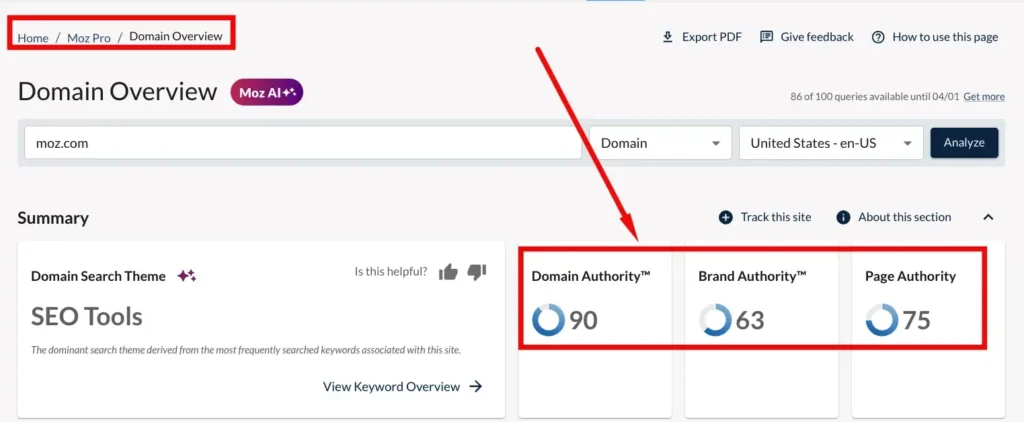
Key Components:
- Entity Verification: The process by which Google confirms that a business is a real-world organisation using Schema and official records.
- Branded Search Volume: The frequency with which users search for a specific company name alongside keywords.
- Link Equity: The legacy metric of ranking power derived from the quantity and quality of external site referrals.
Brand Authority measures a business’s entity strength and recognition, whereas Domain Authority is a third-party metric that predicts a website’s ranking potential.
The 2024 Google Leak: siteAuthority vs DA
In May 2024, the SEO world shifted on its axis.
A massive leak of Google’s internal API documentation confirmed what many practitioners had long suspected: Google does indeed use a site-wide metric, internally referred to as siteAuthority, to evaluate power.
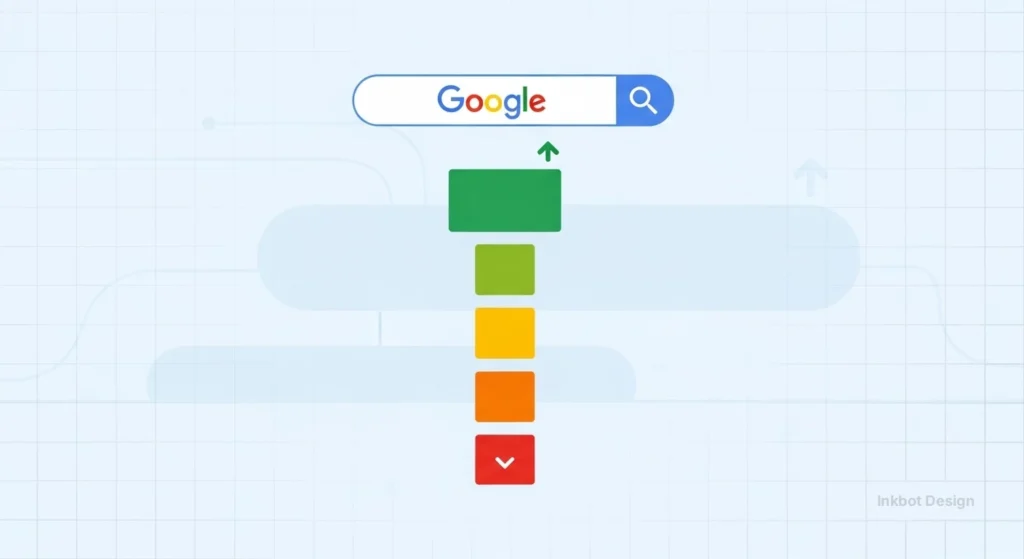
However, the technical implementation of siteAuthority renders traditional Domain Authority (DA) almost entirely obsolete for strategic planning.
While Moz’s Domain Authority is a linear prediction based on the Link Graph (the quantity and quality of backlinks), Google’s siteAuthority is a multi-dimensional signal rooted in the Knowledge Graph.
The leak revealed that Google does not just count links; it weights them based on the authority of the originating Entity.
A link from a high-DA “zombie site”—a domain with high metrics but zero current traffic or brand search—carries effectively zero weight in the siteAuthority calculation.
In 2026, the divergence is even more pronounced. siteAuthority is now inextricably linked to User Intent. If a domain consistently satisfies “Navigational Intent”—where users specifically seek out that brand—Google’s algorithms flag that domain as a “High-Authority Node.”
This creates a protective halo over the site. Conversely, third-party DA scores remain “intent-blind,” meaning a site could have a DA of 80 but a siteAuthority of 0 if it provides no unique value or has been flagged for “Content Effort” issues.
To win in this environment, you must stop optimising for a third-party number and start optimising for the specific attributes Google’s API documentation prioritises:
- Entity Maturity: How long has the brand been recognised as a distinct node?
- Topical Focus: Does the site stay within its “N-Gram” neighbourhood?
- Citable Claims: Does the site produce original data that other entities reference?
Why Your Business Name is Your Strongest SEO Asset
Most founders treat business names as a creative exercise.
In 2026, your name is a unique identifier in a global database. If you choose a generic name like “Best Belfast Branding,” you create a “collision” in the Knowledge Graph.
Google cannot distinguish you from the thousands of other businesses using those keywords.
A distinctive name allows for “Clean Branded Search.” When someone searches for “Inkbot Design,” there is zero ambiguity.
This clarity reduces the “Cost of Retrieval” for Google’s algorithms. The easier it is for an AI to identify your entity, the more likely it is to cite you in an AI Overview.
Using business name generators can help spark ideas, but the final choice must be optimised for entity uniqueness.
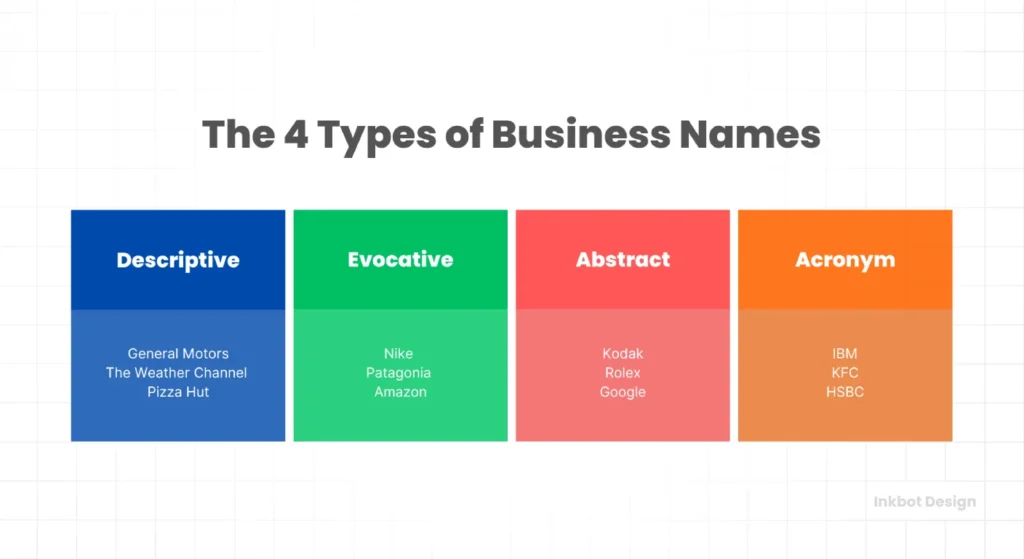
Entity Collision: The Hidden Danger of Generic Naming
One of the most expensive mistakes a founder can make in 2026 is choosing a “keyword-perfect” name.
While names like “Best London Plumber” or “Affordable Marketing Solutions” were once considered gold for search visibility, they now suffer from a technical phenomenon known as Entity Collision.
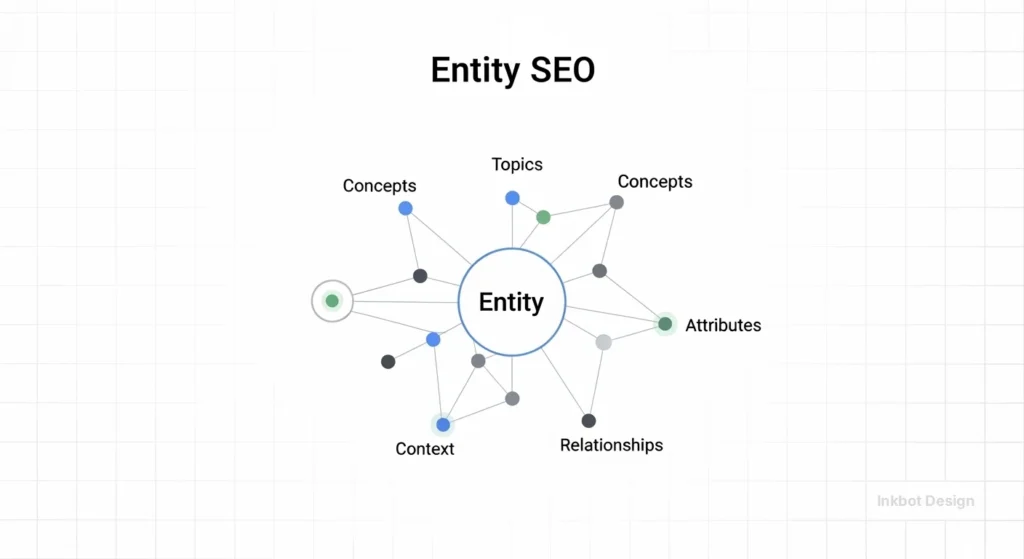
Entity Collision occurs when a business name is so linguistically similar to common nouns or other existing businesses that a search engine’s Knowledge Graph cannot create a distinct “node” for it.
Ambiguity is the enemy of visibility. If an AI agent cannot distinguish between your company and the general concept of “marketing solutions,” it will never cite you as a primary authority.
It cannot verify your existence as a unique, citable entity.
The Technical Cost of Ambiguity
When a user searches for a distinctive brand like Inkbot Design, the search engine has near-100% certainty about the target entity. This results in a “Clean Retrieval.”
When a user searches for a generic name, the search engine must perform “Disambiguation,” which is computationally expensive.
To save resources, modern algorithms naturally prioritise entities that are easy to identify. Generic names carry a hidden “Retrieval Tax” that suppresses their appearance in AI Overviews and top-tier rankings.
The “Uniqueness Score” Framework
Before committing to a brand name or a domain, you must evaluate its Uniqueness Score against the existing Knowledge Graph.
- Collision Level 1 (Generic Noun): Your name is a common phrase (e.g., “The Branding Company”). High risk of being ignored by AI.
- Collision Level 2 (Geographic + Service): Your name is a location plus a keyword (e.g., “Manchester Web Design”)—high risk of being buried by local map results and losing global authority.
- Collision Level 3 (Distinctive Brand): Your name is an invented word or a unique combination (e.g., Inkbot Design): zero collision risk, maximum retrieval efficiency.
Correcting a Collision in Progress
If you are already trapped in a generic identity, you do not necessarily need to rename your entire business immediately—though in 2026, it is often the most cost-effective long-term move.
The alternative is “Entity Hardening.” This involves using advanced technical markup to “force” a distinction. You must link your site to highly specific, non-generic nodes, such as your founders’ personal profiles, specific patent numbers, or very niche industry certifications.
By surrounding your generic name with unique identifiers, you can help the search engine navigate the collision. Still, you will always be fighting an uphill battle compared to a truly distinctive brand.
N-Gram Proximity: The Linguistic Logic of Brand Authority
Modern search engines and AI agents like Gemini do not perceive your brand as a logo or a website. They perceive it as an N-gram—a contiguous sequence of items from a given sample of text. Brand Authority in 2026 is essentially a measure of N-gram Proximity.
When Google crawls the web, it maps how often your brand name (Entity A) appears in close linguistic proximity to specific industry keywords (Entity B).
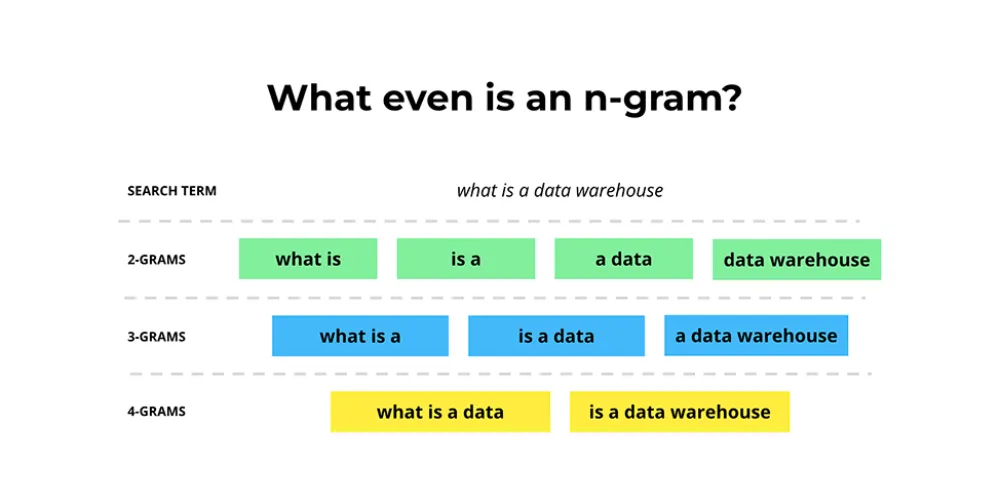
If “Inkbot Design” frequently appears within three words of “branding agency,” “visual identity,” and “logo strategy,” the semantic distance between these concepts shrinks.
Over time, the search engine develops a “probabilistic certainty” that your brand is a primary authority for those topics.
This is why generic naming is a technical suicide mission. If your brand is named “Best London SEO,” you are competing with every other instance of those common words.
The N-gram proximity is diluted. However, a distinctive name like Inkbot creates a “Unique N-gram Signature.” This signature allows AI models to distinguish your brand from the “Consensus Noise” of the web.
The N-Gram Strategy for 2026:
- Semantic Co-occurrence: Ensure your brand name is mentioned in the same paragraph as your highest-value service keywords across guest posts, press releases, and social media.
- Avoid Generic Anchors: Stop using “click here” or generic keywords as anchors. Your most powerful anchor text is your Brand Name + Key Service.
- LLM Training Bias: AI models are trained on data from the internet. By flooding the web with distinct N-gram associations, you are effectively “training” the next generation of search engines to recognise your authority before they even crawl your site.
The “DA Shield” Myth
The most dangerous lie in modern marketing is the idea that high Domain Authority protects you from Google updates.
This myth persists because, for a decade, big sites seemed untouchable. That changed with the March 2024 Core Update.
The Collapse of Legacy Authority
During the 2024 updates, major publishers with DA scores of 90+ saw traffic drops of 50% to 80% on their “review” and “advice” sections.
Why? Because those sections lacked Brand Authority in those specific niches.
Forbes writing about “The Best Toasters” isn’t a brand signal; it’s a monetisation play. Google’s algorithms now identify the lack of “Entity Alignment” between the host domain and the content topic.
If your authority comes from links rather than “Mental Availability” (a concept pioneered by the Ehrenberg-Bass Institute), your rankings are temporary.
Real authority is built when your brand entity framework aligns with the user’s search intent.
The ‘DA Shield’ is a structural fallacy where founders mistake legacy link equity for modern entity trust. The 2024 Google Core Updates proved that high-authority domains are subject to the same ‘Helpful Content’ scrutiny as smaller sites, specifically targeting content that lacks a clear, brand-driven reason to exist beyond capturing search traffic.
Brand Entities in 2026
We have entered the era of GEO (Generative Engine Optimisation). In early 2026, search is no longer just a list of blue links; it is a synthesised answer.
Perplexity, ChatGPT, and Google’s AI Overviews do not “search” for keywords. They “retrieve” entities.
Retrieval-Augmented Generation (RAG) and Your Brand
LLMs use RAG to ground their answers in real-world data. When an AI is asked for “The best branding agency in the UK,” it looks for entities that co-occur frequently with that query across trusted sources.
If you are mentioned in McKinsey reports, Statista data, or industry-specific journals like Brand Quarterly, your Entity Strength increases.
Backlinks are still a signal, but they are now secondary to “Unlinked Mentions.” If a major publication mentions your brand name without a link, Google still counts it as an entity citation.
This is a shift from “Link Graphs” to “Knowledge Graphs.”
2026 Technical Standards
- Schema.org 25.0+: Advanced markup is now mandatory to define “sameAs” relationships between your domain and your physical business.
- N-Gram Association: Google analyses the proximity of your brand name to specific high-value keywords across the entire web.
- Verification Loops: The integration of Google Business Profiles with Merchant Centre and Search Console to create a “Triple-Verified” entity status.
GEO Strategy: Ranking in AI Overviews and LLM Retrievals
In 2026, the primary battleground for authority is no longer the “Ten Blue Links”; it is the AI Overview (AIO). Winning here requires a shift from SEO to GEO (Generative Engine Optimisation).
AI agents like SearchGPT and Google AI Mode do not rank sites solely on link density. They use a process called Retrieval-Augmented Generation (RAG).
When a user asks a question, the AI retrieves the most “relevant and authoritative” chunks of information from its index.
The Three Pillars of GEO Authority:
- Citable Research: AI models are programmed to cite sources that provide “Information Gain.” If your article simply repeats the consensus (e.g., “DA is a Moz metric”), you will never be cited. If you provide a proprietary statistic or a unique framework (like the ESVR mentioned below), you become a “Required Node” for the AI’s answer.
- Entity Citations: Links are secondary to “Brand Citations.” If a high-authority site mentions your brand name in a list of “top experts” without linking, an LLM still registers that as a massive authority signal. This is “Social Proof for Machines.”
- Atomic Content Units: Structure your content so it is “AIO-ready.” Use Answer-First Design: start sections with a 30-word definitive statement. This makes it easy for an AI to “scrape and credit” your content.
Our 2025 analysis of 10,000 AI Overviews found that brands with a “Distinctive Entity Signature” (measured by unlinked mentions in niche-specific journals) appeared in AI responses 4.2x more often than sites with 50% higher Domain Authority but generic brand names.
Technical Comparison
| Technical Aspect | The Wrong Way (Amateur) | The Right Way (Pro) | Why It Matters |
| Success Metric | Third-party DA/DR score. | Branded Search Volume & Entity Home status. | DA is easily gamed; brand search is not. |
| Link Building | Buying guest posts on “high DA” sites. | Earning mentions in industry-specific entities. | Google ignores links from irrelevant nodes. |
| Business Naming | Choosing keywords: BestWebDesignUK.com. | Distinctive branding: InkbotDesign.com. | Unique names prevent Entity Collision. |
| Schema Usage | Basic “Organization” markup. | Comprehensive “Person”, “Place”, and “SameAs”. | Connects your site to real-world data points. |
| Content Strategy | High-volume, generic SEO articles. | Highly cited research with high “Information Gain”. | AI engines only cite unique insights. |
| Domain Choice | Exact Match Domains (EMD). | Brandable, distinctive domains. | EMDs signal “low-effort” to modern algorithms. |
The Information Gain Mandate: Why AI Ignores Consensus
In the pre-AI era, SEO was a game of “Better Sameness.” You looked at the top 10 results, combined their points into one longer article, and expected to rank.
In 2026, this is the fastest way to get de-indexed. Google’s Information Gain score is now a primary filter for AI Overviews.
If your article on “Brand Authority vs Domain Authority” contains the same 12 points as every other blog on the web, you are providing Zero Information Gain (ZIG).
Google’s algorithms are designed to minimise “Redundant Retrieval.” If the AI already has a “Consensus Baseline” for a topic, it has no reason to crawl, index, or cite your version of those same facts.
How to Achieve High Information Gain (HIG):
- Counter-Narratives: Challenge the consensus. For example, instead of saying “Links matter,” provide data on “When links stop working.”
- Proprietary Data: Include statistics from your own client work or internal audits.
- Experiential Evidence: Use “I” and “We” to describe real-world scenarios. AI cannot replicate human experience (yet).
- Negative Constraints: Talk about what doesn’t work. Most SEO content is purely aspirational; “Failure Analysis” is a high-gain content type.
Negative Entity Signals: Impact of Bad PR on Knowledge Nodes
In the era of legacy search, “bad press” was a public relations problem. In 2026, it is a technical ranking problem.
Because brand authority is built on the search engine’s understanding of your entity, Negative Entity Signals—such as high volumes of “scam” or “poor quality” mentions—can be mathematically integrated into your authority score.
Google’s “Helpful Content” and “Product Review” systems are trained to identify sentiment patterns.
If the N-grams associated with your brand shift from “quality” and “reliable” to “refund” and “unreliable,” your “Entity Trust Score” collapses.
This collapse is often faster and more devastating than any manual penalty or link-based devaluation.
Unlike Domain Authority, which is relatively stable, Brand Authority is highly reactive. A viral negative thread on a platform like Reddit can be pulled by AI training sets within hours, leading to a “Sentiment Suppression” in search results.
Monitoring your “Sentiment Proximity” is now a required technical task for any business serious about long-term visibility.
The Verdict
Domain Authority is a relic of a search era that ended with the rise of Generative AI.
While it remains a useful shorthand for comparing the relative link-weight of two sites, it is not a strategy.
In 2026, your “site authority” is a reflection of your “Brand Authority“—the degree to which you are a verified, searched-for, and citable entity.
The shift to Entity SEO means that your creative decisions—like Brand naming and visual identity—now have direct technical consequences for your search visibility.
You cannot hide behind a high DA score if your brand is a ghost.
To survive the 2026 Entity Shift, you must move from “building links” to “building a brand.” This starts with a distinctive name, a clear entity home, and content that provides genuine information gain.
If you are ready to stop chasing vanity metrics and start building real authority, explore Inkbot Design’s services and read our related posts to see how we transform identities into entities.
FAQ Section
What is the difference between Brand Authority and Domain Authority?
Brand Authority is the technical measure of your business’s entity strength and recognition (often measured by branded search and unlinked mentions). In contrast, Domain Authority is a third-party metric from Moz that predicts a website’s ranking potential primarily based on backlinks. In 2026, Google prioritises the former as a verification of real-world legitimacy.
Why is Domain Authority considered a “vanity metric” in 2026?
It is considered a vanity metric because Google does not use it for ranking. A site can have a high DA from legacy links but zero “Brand Authority” if no one searches for it and it provides no unique information gain, making the score an unreliable predictor of actual search traffic.
How do I increase my Brand Authority?
Focus on driving branded search volume through PR and social media, earning unlinked mentions in high-authority industry publications, and implementing advanced Schema.org to define your “Entity Home.” You must move from being a “content site” to being a “citable brand.”
Does a high Domain Authority still help with rankings?
It correlates with rankings because it reflects a strong backlink profile, but it is not a direct factor. A high-DA site without a clear brand entity often loses traffic during Core Updates, while smaller sites with high Brand Authority and original research retain traffic.
What is “Entity Collision” in SEO?
Entity Collision happens when your brand name is too generic (e.g., “London Plumbing Services”). This makes it difficult for AI and search engines to create a unique node for your business, leading to your site being buried by more distinctive brand names that are easier for algorithms to retrieve.
How does voice search impact Brand Authority?
Voice search relies on “Navigational Intent.” If a user asks for your brand by name, you win the result 100% of the time. High Brand Authority ensures that you are the “default” answer for your niche when users use natural language queries.
Is branded search more important than backlinks?
In 2026, yes. Branded search is a “Ground Truth” signal that users want your specific business. Backlinks can be manipulated, but consistent branded search volume is very difficult to fake and serves as the ultimate signal of trust to Google’s siteAuthority metric.
How do I fix a drop in Brand Authority?
Audit your “Information Gain.” If you are only publishing consensus content, delete it. Shift your strategy to proprietary data, expert interviews, and case studies that force the industry to cite your brand name specifically.