Blue Ocean Strategy: Creating New Market Space
If you are reading this, you are likely exhausted. You are tired of slashing prices to undercut a competitor who just slashed theirs.
You are tired of the “features arms race”—adding bells and whistles to your product just to maintain parity with the industry standard. You are swimming in a Red Ocean.
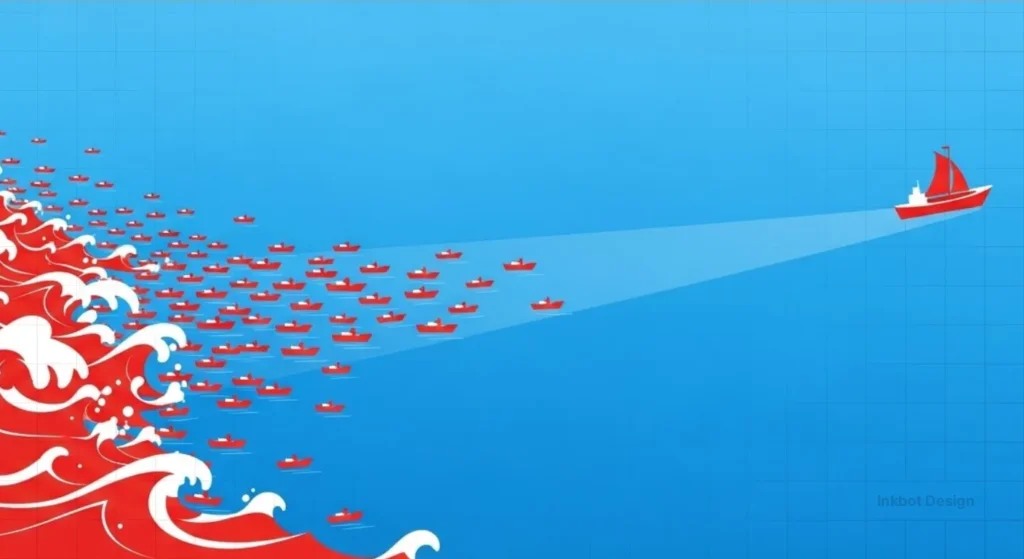
In a Red Ocean, industry boundaries are defined and accepted. The competitive rules are known. Companies strive to outperform their rivals to capture a larger share of existing demand.
As the market space gets crowded, prospects for profits and growth are reduced. Products turn into commodities, and cutthroat competition turns the ocean bloody.
Most entrepreneurs we speak to at Inkbot Design are obsessed with “beating the competition.” They bring us pitch decks filled with SWOT analyses, benchmarking themselves against the industry leader. They ask: “How do we look better than X?”
My answer is usually the same:
Stop trying to be better. Start being different.
This is the core of the Blue Ocean Strategy. It is not about fighting for a slice of the pie; it is about baking a new pie. It is about rendering the competition irrelevant.
This guide is not a summary of a business school textbook. It is a forensic breakdown of how you can escape the bloodbath of commoditisation and reconstruct market boundaries to create an uncontested market space.
- Escape Red Ocean competition by creating uncontested market space that makes rivals irrelevant through differentiation and low cost.
- Pursue Value Innovation: align utility, price, and cost to break the trade-off between differentiation and affordability.
- Use the Strategy Canvas and ERRC (Eliminate, Reduce, Raise, Create) to reconstruct buyer value and forge a distinct value curve.
- Seek non-customers across six paths and three tiers to unlock new demand instead of fighting over existing customers.
- Anticipate imitation and price corridor limits; continually revisit strategy and emphasise curation, human verification, and brand positioning.
What is Blue Ocean Strategy?
The Blue Ocean Strategy is a marketing theory and strategic framework developed by W. Chan Kim and Renée Mauborgne. At its heart, it challenges the traditional dogma that you must choose between differentiation (higher cost) and low cost.
Instead, it proposes Value Innovation.
Value Innovation is the simultaneous pursuit of differentiation and low cost. It occurs only when the whole system of the company’s utility, price, and cost activities is aligned.
In a Red Ocean, you trade value for cost. In a Blue Ocean, you break that trade-off.
Blue Ocean Strategy, Expanded Edition
Blue Ocean Strategy challenges you to stop battling competitors and start creating uncontested new market spaces ripe for growth. It’s based on a 100-year study of 150 strategic moves, offering systematic tools to pursue differentiation AND low cost simultaneously.
As an Amazon Partner, when you buy through our links, we may earn a commission.
The 3 Core Components
To execute this effectively, you must understand the trinity of the framework:
- Value Innovation: Instead of focusing on beating the competition, you focus on making the competition irrelevant by creating a leap in value for buyers and your company.
- The Strategy Canvas: A diagnostic and action framework for building a compelling Blue Ocean Strategy. It captures the current state of play in the known market space.
- The Four Actions Framework (ERRC): The tool used to reconstruct buyer value elements to craft a new value curve.
This methodology is essential for effective branding and positioning. If your brand looks, sounds, and acts like everyone else, you are deciding to compete on price. That is a race to the bottom where the only winner is the consumer, and the loser is your profit margin.
The Strategy Canvas: Visualising the Market
Before you can sail to a Blue Ocean, you must know where you are currently drowning. The Strategy Canvas is the central diagnostic tool.
The horizontal axis represents the range of factors on which the industry competes and invests. The vertical axis represents the level of offering that buyers receive across all these key competing factors.
How to Draw Your Canvas
- Identify the Factors: List 5-10 key factors your industry competes on (e.g., Price, Speed, Variety, Customer Service, Prestige).
- Plot Competitors: Rate the top competitors on a scale of 1-10 for each factor. Connect the dots. This is the industry’s “Value Curve”.
- Plot Yourself: Rate your business.
The Horror of Convergence:
When we audit clients, 95% of the time, their value curve aligns perfectly with that of their competitors. They might be a “7” on service while the competitor is a “6”, or a “5” on price while the competitor is a “4”. This is not a strategy; this is benchmarking.
If your curve looks like your competitor’s curve, you are in a Red Ocean. You are offering the same value, in the same way, at roughly the same price.
To create a Blue Ocean, your value curve must diverge. It needs a distinct focus and a compelling tagline.
The Four Actions Framework: The Engine of Innovation
This is where the work happens. To break the trade-off between differentiation and low cost, you must answer four questions to challenge the industry’s strategic logic and business model.
This is known as the ERRC Grid.
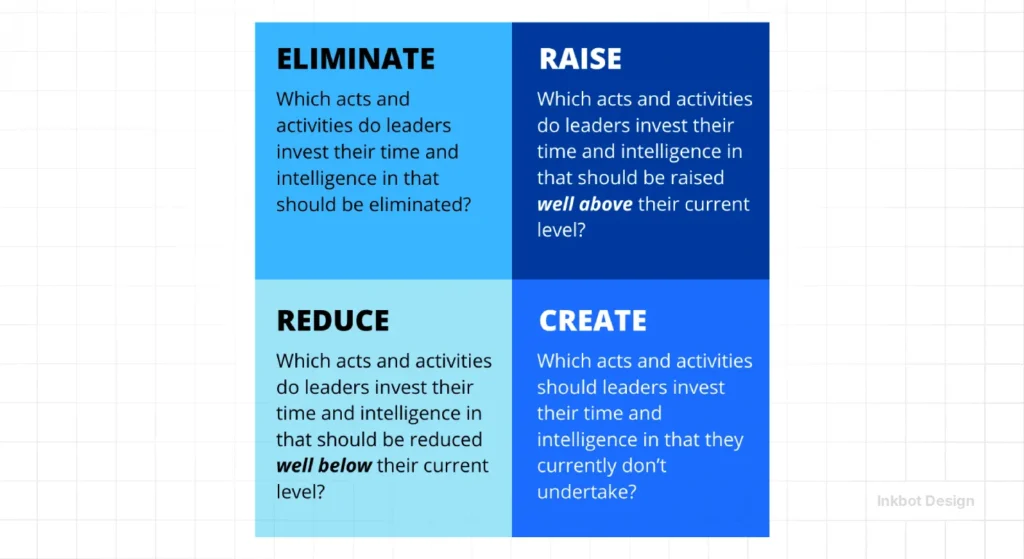
1. Eliminate (Cost Reduction)
Which factors that the industry takes for granted should be eliminated?
This is the hardest pill for business owners to swallow. You must ruthlessly eliminate factors that no longer provide value but still incur costs. These are often legacy features or services you offer simply because “that’s how it’s always been done.”
- Example: In the wine industry, brands are obsessed over “ageing quality” and complex terminology. Yellow Tail eliminated these. They stopped using confusing enological terms and focused on the casual drinker.
2. Reduce (Cost Reduction)
Which factors should be reduced well below the industry’s standard?
What are you over-serving the market with? Where are you spending money to be “great” when the customer only cares if you are “good enough”?
- Example: Cirque du Soleil reduced the reliance on expensive “Star Performers” and animal shows. These were huge cost centres for traditional circuses (Ringling Bros.) but added little value to the modern adult theatre-goer.
3. Raise (Value Creation)
Which factors should be raised well above the industry’s standard?
Where does the customer suffer? What compromises does the industry force them to make?
- Example: Southwest Airlines raised the frequency of departures. By flying point-to-point rather than hub-and-spoke, they offered the speed of air travel with the flexibility of a bus service.
4. Create (Value Creation)
Which factors should be created that the industry has never offered?
This is the source of new demand. What does the buyer need that they don’t even know to ask for?
- Example: Nintendo Wii created motion-controlled gaming. Before the Wii, consoles competed on graphics and processing power (Raise). Nintendo created a new factor: physical interactivity.
The Consultant’s Reality Check: The Fear of Elimination
I once audited a boutique law firm trying to scale. They were bleeding cash maintaining a prestigious, marble-floored office in the city centre because “that’s what law firms do.” It was an industry standard.
However, their clients were tech startups who hated travelling to the city and preferred Zoom calls. We used the ERRC grid:
- Eliminate: The physical office (huge rent savings).
- Create: A secure, 24/7 digital client portal (Value up).
They were terrified. “Will we look cheap?”
No. You look efficient. By redirecting that budget into better digital infrastructure, they moved from a Red Ocean (stuffy, expensive local lawyers) to a Blue Ocean (agile, digital-first legal partners for tech).
If you cannot identify what to eliminate, you are not doing Blue Ocean Strategy. You are just doing “More Strategy.”
The Six Paths Framework: Finding the Opportunity
You might be asking, “Where do I look for these new factors?” You don’t look at your competitors. You look across boundaries.
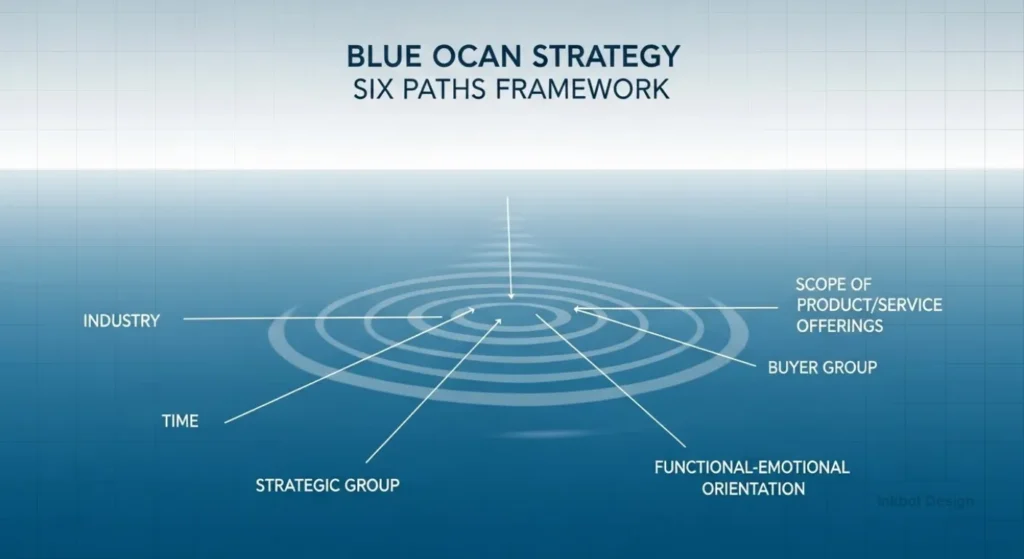
Path 1: Look Across Alternative Industries
Your competition is not just who makes the same product; it is whoever solves the same problem.
- The Insight: Southwest Airlines didn’t just look at other airlines. They looked at the car. The alternative to flying short-haul isn’t always another flight; it’s driving. They positioned themselves as fast as a plane, as cheap as a car.
Path 2: Look Across Strategic Groups
Strategic groups are companies within an industry that pursue a similar strategy (e.g., Luxury vs. Budget).
- The Insight: Toyota’s Lexus. They looked at the gap between the budget market (Toyota/Honda) and the luxury market (Mercedes/BMW). They offered Mercedes-quality at a price point much closer to the mass market, thereby bridging the gap between the two groups.
Path 3: Look Across the Chain of Buyers
Who pays for the product? Who uses it? Who influences it?
- The Insight: Novo Nordisk. Insulin was traditionally sold to doctors (influencers). Novo Nordisk shifted its focus to users (patients) by creating the NovoPen—an insulin device that resembled a fountain pen, thereby removing the stigma associated with public injections.
Path 4: Look Across Complementary Product and Service Offerings
What happens before, during, and after your product is used?
- The Insight: Dyson. James Dyson realised the “bag” was the pain point of the vacuum cleaner industry (a complementary product you had to keep buying). He eliminated the bag.
Path 5: Look Across Functional or Emotional Appeal
Some industries compete on utility (price/function), others on emotion (feelings). Flip it.
- The Insight: Swatch. Watches were a functional tool for telling time or a high-end luxury asset. Swatch turned them into a low-cost fashion accessory (Emotional). Conversely, The Body Shop transformed cosmetics (usually associated with emotions and glamour) into a functional and ethical choice.
Path 6: Look Across Time
Don’t just react to trends; anticipate how a trend will change value to the customer.
- The Insight: Apple (iTunes). As illegal music downloading exploded (Napster), Apple didn’t fight it. They observed the trend toward digital unbundling (buying tracks rather than albums) and created a legal, easy-to-use platform for it.
The 3 Tiers of Non-Customers
Red Ocean thinking focuses on existing customers. Blue Ocean thinking focuses on Non-Customers. This is where the scale lies.
There are three tiers of non-customers waiting to be unlocked.
Tier 1: “Soon-to-be” Non-Customers
These individuals utilise your industry’s offerings but are dissatisfied with them. They are waiting for a better option to jump ship.
- Example: Taxis. People used them because they had to, but hated the unclear pricing and waiting times. Uber captured this tier instantly.
Tier 2: “Refusing” Non-Customers
These people have considered your industry but rejected it because it is too expensive or complex.
- Example: JCDecaux (Outdoor Advertising). Before them, outdoor ads were billboards—expensive and for big brands. JCDecaux created “street furniture” (bus stops), allowing smaller budgets to access outdoor advertising and capturing the remaining tier.
Tier 3: “Unexplored” Non-Customers
These people have never considered your industry an option.
- Example: Teeth Whitening. Historically, a dentist-only procedure. Startups moved it to the home with strips and LED kits, unlocking millions of customers who never would have visited a dentist for cosmetic work.
By focusing on these tiers, you expand the size of the pie rather than fighting for the crumbs.
Real-World Failure & Success: A Forensic Analysis
It is easy to list the winners. However, let us examine the mechanics behind their success and the reasons why others fail.
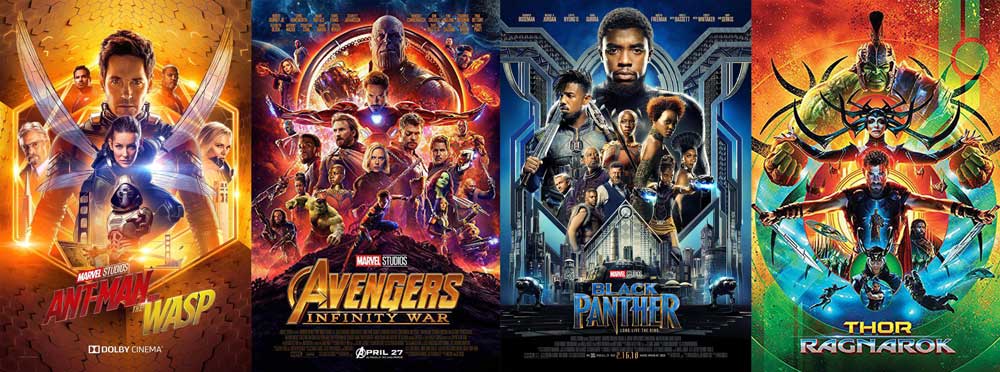
The Success: Marvel Studios
Before the MCU (Marvel Cinematic Universe), superhero movies were a niche genre or one-off blockbusters (Batman, Superman).
- The Red Ocean: Studios fought for “A-List” actors and known directors.
- The Blue Ocean Move: Marvel cast “B-List” actors (at the time—RDJ was a risk, Chris Hemsworth was unknown) to lower costs (Reduce). They eliminated the “stand-alone” movie format (Eliminate) and created the serialised, interconnected universe model (Create).
- The Result: They forced audiences to watch every movie to understand the whole, creating unprecedented recurring revenue.
The Failure: Tata Nano
Tata Motors attempted to create a Blue Ocean in India with the “World’s Cheapest Car” (₹ 1 Lakh).
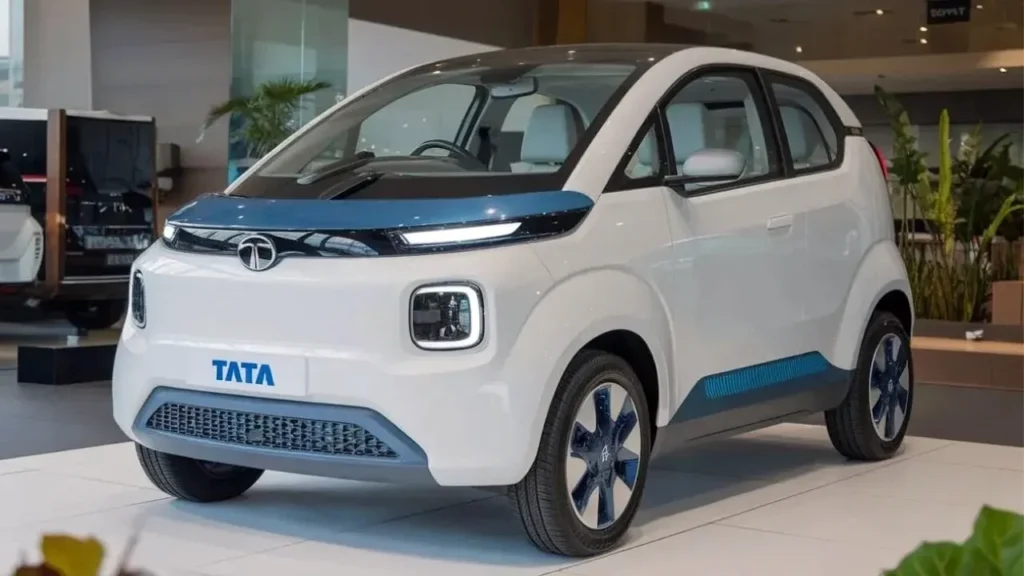
- The Logic: Target the “Refusing” non-customers—families riding scooters.
- The Execution Error: They focused so heavily on Price (Eliminating costs) that they neglected Brand Image. By marketing it explicitly as the “cheapest car,” they attached a social stigma to it. In aspirational India, nobody wanted to be seen driving the “poor man’s car.”
- The Lesson: Value Innovation requires Value, not just cheapness. If you eliminate the emotional appeal (prestige/safety), you do not have a Blue Ocean; you have a cheap product nobody wants.
This highlights why a brand differentiation strategy is critical. You cannot simply strip features; you must maintain the brand’s desirability.
The State of Blue Ocean Strategy in 2026
The landscape has shifted. The tools to “Create” are now cheaper than ever, thanks to AI and automation.
The “Creation” Trap
In 2026, adding features is easy. Coding an app is faster. Generating content is instant. This has led to a paradox where “Creation” is actually leading back to a Red Ocean of noise.
The new Blue Ocean is Curation and Verification.
As AI floods the web with mediocre content and designs, the value of human verification, high-touch consultancy, and tangible experiences creates a new curve.
- Trend: We are seeing a resurgence in “Analogue” experiences. Vinyl records, film photography, and in-person workshops are experiencing a resurgence because the digital space is saturated with AI-generated content.
- Strategic Move: If you are a service-based business, consider eliminating the automated, chatbot-first interactions that many others are adopting. Raise the access to human expertise. In a world of bots, a real human is a Blue Ocean.
Data from Gartner’s 2025 CMO Spend Survey suggests that while 70% of budgets are moving to MarTech, customer satisfaction with digital interfaces is at a 5-year low. This is the gap.
Technical Detail: The Pricing Corridor of the Mass
One technical nuance often missed is the Pricing Corridor of the Mass. You cannot just price “high” because you are unique.
You must identify the price bandwidth of the target market.
- Upper-Level Pricing: High degree of legal/resource protection (hard to copy).
- Mid-Level Pricing: Some protection.
- Lower-Level Pricing: No protection (easy to copy).
If your Blue Ocean idea is easy to copy (e.g., a service process), you must price low to capture market share quickly and discourage imitators from entering. If you price high, you invite the sharks in.
The Amateur vs. The Strategist
| Feature | The Red Ocean Thinker (Amateur) | The Blue Ocean Strategist (Pro) |
| Market Focus | Competes in existing market space. | Creates uncontested market space. |
| Competition | Obsessed with beating rivals. | Makes the competition irrelevant. |
| Demand | Exploits existing demand. | Creates and captures new demand. |
| Value/Cost | Makes the value-cost trade-off (Higher Value = Higher Cost). | Breaks the value-cost trade-off (Value Innovation). |
| Strategic Alignment | Aligns the system for either low cost or differentiation. | Aligns the system for both low cost and differentiation. |
| Execution | Adds features to match competitors. | Eliminates factors the industry takes for granted. |
Implementing the Strategy: Your Next Steps
You cannot read your way to a Blue Ocean. You have to build it. Here is the protocol for moving forward.
1. Visual Awakening
Compare your business to your competitors by drawing your “As-Is” Strategy Canvas. Be honest. If your line looks like theirs, admit it.
2. Visual Exploration
Go into the field. Talk to the Non-Customers (the refusal tier). Ask them why they don’t buy from your industry. Do not ask your current customers what they want (they will just ask for lower prices or faster service).
3. Visual Strategy Fair
Draft your “To-Be” Strategy Canvas using the ERRC grid. Create two or three versions. Present them to stakeholders. Which one is the most divergent? Which one has a compelling tagline?
4. Visual Communication
Once you have the strategy, you need to look the part. This is where brand identity services become non-negotiable. If you claim to be different but your logo, website, and tone of voice are generic, the market will not take you seriously.
Blue Ocean Strategy is not just an operational shift; it is a communication challenge. You have to teach the market how to judge you.
Consultant’s Note: The “Dip”
Be prepared for the dip. When you eliminate features, you will lose some existing customers.
- “Where is the feature I used to use?”
- “Why don’t you offer X anymore?”
Let them go. They are the Red Ocean customers. You are clearing space for the Blue Ocean tier. If you try to please everyone, you tend to revert to the mean.
The Verdict
The Blue Ocean Strategy is not safe. It is risky. It requires you to stop doing things that are currently making you money, in the hope of finding a much larger pot of gold.
But look at the alternative. The Red Ocean is a guarantee of shrinking margins, higher customer acquisition costs, and eventual irrelevance.
You have a choice: Continue to fight for scraps in a shark-infested pool, or set sail for open waters.
If you are ready to restructure your market position and need a brand identity that reflects this bold new direction, we should talk.
Request a Quote from Inkbot Design
Frequently Asked Questions (FAQ)
What is the main difference between Red Ocean and Blue Ocean strategies?
Red Ocean strategy focuses on competing within an existing market to beat rivals and capture a share of existing demand. The Blue Ocean strategy focuses on creating new market space (uncontested waters) where competition is irrelevant by generating new demand and breaking the value-cost trade-off.
Can small businesses effectively apply the Blue Ocean Strategy?
Yes. In fact, it is often easier for SMBs than for large corporations. SMBs are more agile and can execute the “Eliminate” and “Create” actions faster without the bureaucracy of legacy departments fighting to survive.
What is the ERRC Grid in Blue Ocean Strategy?
ERRC stands for Eliminate, Reduce, Raise, and Create. It is the analytic tool used to reconstruct buyer value. It forces companies to decide what to cut (to lower costs) and what to add (to increase value) simultaneously.
Why is the “Eliminate” step the most difficult?
Business owners fear that removing features will alienate customers. However, “Eliminate” is crucial for cost reduction. Without it, you are simply adding features (differentiation), which increases cost and fails to achieve true Value Innovation.
How do I identify non-customers?
Look for the three tiers: 1. “Soon-to-be” (using you but looking for an exit), 2. “Refusing” (consciously chose against your industry due to price/complexity), and 3. “Unexplored” (distant markets that have never considered your industry).
Is Blue Ocean Strategy just finding a niche?
No. Niche marketing involves segmenting an existing market further (smaller pie). Blue Ocean Strategy involves desegmenting markets to aggregate demand across different groups (bigger pie).
Does Blue Ocean Strategy require a lot of money?
Not necessarily. The goal is to lower costs while increasing value. By eliminating expensive, low-value factors (such as physical showrooms or complex packaging), you can often fund the new “Creation” elements without increasing the overall budget.
How often should I update my Strategy Canvas?
Market dynamics change. A Blue Ocean eventually turns Red as imitators enter. You should revisit your Strategy Canvas annually, or whenever you notice your value curve beginning to converge with that of your competitors’ competitive analysis.
Can a Blue Ocean Strategy fail?
Yes. Common failure points include misidentifying what buyers actually value, focusing solely on “Create” without “Eliminate” (leading to high costs), or poor execution of brand positioning, which confuses the market.
What is the Pioneer-Migrator-Settler (PMS) Map?
The PMS Map is a portfolio management tool. Settlers are “me-too” businesses (Red Ocean). Migrators offer some value improvement. Pioneers offer unprecedented value (Blue Ocean). A healthy company needs a balance, but must aim for Pioneers for future growth.