Apple Pencil vs Logitech Crayon: A Designer’s Verdict
As the founder of Inkbot Design, I’ve spent over a decade equipping and managing a remote graphic design team. This means I’m the one who signs off on the hardware. I’ve tested, bought, and ultimately seen what gets used and what gathers dust.
And let me tell you, the “which stylus?” debate is one I’ve had with myself—and my finance manager—many times. You have two main contenders: the Apple Pencil, the sleek, “default” creative tool, and the Logitech Crayon, the pragmatic, robust workhorse.
This isn’t another tech review. This is a business owner’s analysis. I don’t care about “magical” unboxings. I care about ROI, durability, and whether a tool actually makes my team’s workflow faster.
Before we dive in, let’s clear the air. I have a few pet peeves with this entire discussion:
- The “Pro” Hype: Stop assuming “Pro” on the box means it’s the right choice. Most business tasks—annotating, wireframing, signing contracts—don’t need a £129 stylus.
- The “Magic” Myth: A tool doesn’t make you a better designer. A world-class idea sketched with a Crayon will always beat a bad idea sketched with a Pencil Pro.
- Durability Snobbery: The Pencil is a beautiful, fragile, and expensive piece of white plastic that is prone to rolling off tables. The Crayon is a tool. It’s built to be tossed in a bag. I know which one I’d rather replace.
My core thesis is this: The Apple Pencil is a specialist’s instrument for digital illustrators. The Logitech Crayon is the workhorse for 90% of everyone else, including many designers.
Let’s get into it.
- Apple Pencil: essential for professional illustrators — pressure sensitivity enables variable line weight and advanced painting workflows.
- Logitech Crayon: pragmatic workhorse — durable, cheaper, instant-on, ideal for note-taking, wireframing, and team provisioning.
- Tilt vs pressure: both support tilt for shading, but only the Pencil offers pressure sensitivity — the decisive feature for heavy illustration.
- Business choice: Crayon wins ROI, compatibility (iPads 2018+), and practicality; Pencil is specialist kit worth the premium only for artists.
📈 The Quick Answer: Who Should Buy Which?
No time for 3,000 words? Here’s the executive summary.
Buy the Apple Pencil (2nd Gen or Pro) if…
- You are a professional digital illustrator, painter, or calligrapher.
- Your primary job is inside apps like Procreate or Affinity Photo.
- You absolutely, unequivocally need pressure sensitivity for variable line weight.
- You value the convenience of magnetic wireless charging above all else.
Apple Pencil Pro
You’re still tapping menus on your thousand-quid iPad, breaking your creative flow like an amateur. That’s a broken workflow. This isn’t a stylus; it’s a professional tool. It’s engineered with haptics and gestures like ‘squeeze’ and ‘roll’ so you can change tools without stopping. Stop fighting your tech.
As an Amazon Partner, when you buy through our links, we may earn a commission.
Buy the Logitech Crayon if…
- You are a business owner, entrepreneur, project manager, or student.
- Your main tasks are note-taking, marking up PDFs, and annotating client work.
- You are a UI/UX or logo designer whose work is 90% wireframes, vector shapes, and brainstorming (where pressure doesn’t matter).
- You are provisioning hardware for a team and care about durability, lower costs, and avoiding Bluetooth pairing.
Logitech Crayon
You want Apple Pencil precision, but you dislike the price and the complicated pairing process. This is the fix. It uses Apple’s own tech for pixel-perfect accuracy and palm rejection. It connects instantly, tilts for line weight, and won’t roll off the desk. Get the pro features without the “Apple tax.”
As an Amazon Partner, when you buy through our links, we may earn a commission.
The Head-to-Head: A Feature Breakdown
Technical specifications are often boring, but the differences here directly impact your wallet and workflow. I’m focusing on the Apple Pencil (2nd Gen) and the Logitech Crayon (USB-C), as they are the most common competitors.
| Feature | Apple Pencil (2nd Gen) | Logitech Crayon (USB-C) | The Business Owner’s Analysis |
| Price | £129 / $129 | £69 / $69 | Winner: Crayon. This isn’t a rounding error. I can buy almost two Crayons for the price of one Pencil. For a team, this represents a significant savings. |
| Pressure Sensitivity | Yes | No | This is the entire debate. The Pencil’s tip can tell how hard you’re pressing. This is non-negotiable for digital painting. The Crayon cannot. |
| Tilt Sensitivity | Yes | Yes | It’s a tie. Both styluses can create wider strokes when you tilt them, just like a real pencil. This is a key feature many think the Crayon lacks. It doesn’t. |
| Pairing | Bluetooth (Automatic) | Instant (No Pairing) | Winner: Crayon. The Pencil’s magnetic snap-to-pair is slick, but the Crayon just works. You turn it on, it works. On any compatible iPad. Instantly. This is a godsend for hot-desking or team environments. |
| Charging | Magnetic (Wireless) | USB-C Port | Tie (Personal Preference). The Pencil’s magnetic charging is elegant but drains the iPad and stops working if it’s in a case. The Crayon requires a cable, but it’s a universal USB-C, and it features an “off” button to conserve power. |
| Ergonomics | Round with one flat edge. | Flat, rectangular “carpenter” style. | Winner: Crayon. The Pencil is slick and minimal. It also rolls. The Crayon’s flat, anodised aluminium body feels like a tool, is more durable, and never rolls off the table. |
| Power Button | No (Always on) | Yes | Winner: Crayon. The “always on” Pencil often has a dead battery when I pick it up. The Crayon’s button means it’s off when it’s off. Simple. Reliable. |
| Latency | “Pixel Perfect” (Near Zero) | “Pixel Perfect” (Near Zero) | It’s a tie. Both use official Apple technology. You will not notice any lag on either device. Don’t believe anyone who says otherwise. |
The Feature Battle: What Actually Matters for Design Work
Let’s go beyond the spec sheet. Here’s what these features mean for my team’s day-to-day.
The Big One: Pressure Sensitivity (Pencil Only)
This is it. This is the entire decision.
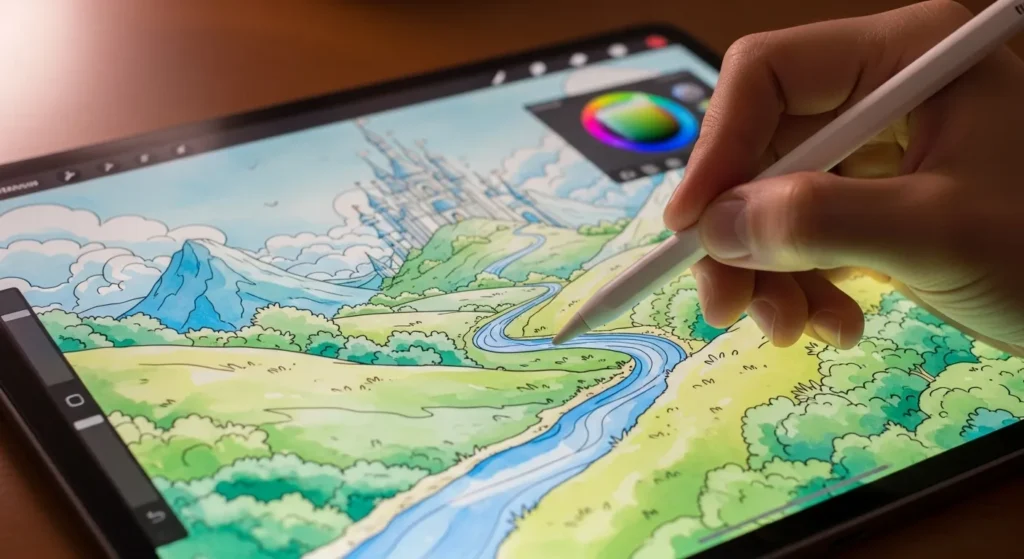
When you draw in an app like Procreate with an Apple Pencil, pressing harder makes the line thicker and more opaque. A light touch makes it thin and faint. This is essential for digital painting, blending colours, and creating the “tapered” look of inked line art.
The Logitech Crayon does not have this feature.
If your job is 80% in Procreate, stop reading and buy the Apple Pencil. You need it.
But for logo designers? It’s debatable. Most modern logo work is vector-based. You’re drawing clean lines, shapes, and curves. You are not “painting.” For brainstorming, sketching out concepts in an app like Concepts or FigJam, the Crayon is identical in function.
Tilt Sensitivity: The Crayon’s Secret Weapon
This is the most misunderstood feature. People confuse “pressure” with “tilt.”
Tilt is when you angle the stylus to shade, similar to how you would with the side of a pencil’s lead. Both the Crayon and the Pencil do this.
For a designer, this is arguably more important than pressure for quick sketching. You can lay down thick “marker” strokes to fill in a wireframe or shade a quick concept sketch. The Crayon does this flawlessly.
Charging & Pairing: Convenience vs. Annoyance
Apple’s solution is elegant. You snap the Pencil 2 to the side of the iPad. It pairs. It charges. It’s beautiful.
It’s also annoying.
If you have a protective case (which you should), it may not charge. If you throw the iPad in a bag, the Pencil gets knocked off and is dead when you need it. It’s always “on,” sipping battery.
The Crayon’s method is practical.
- Charging: It has a USB-C port. You use the same cable that charges your iPad, Mac, and phone.
- Pairing: It doesn’t “pair” via Bluetooth. It has a physical “on” button. You press it, a green light comes on, and it works. On any iPad.
- Power: It has an “off” button. When you’re done, you turn it off. The battery lasts for ages (7+ hours of writing time).
For a remote team, Crayon’s “it just works” simplicity is a massive operational win.
Ergonomics & Build: The Tool vs. The Jewel
The Apple Pencil is a piece of art. It’s weighted, seamless, and feels premium. It also feels like it will shatter if you drop it on tile. And it will roll under the one piece of furniture you can’t move.
The Logitech Crayon is a piece of kit. It’s made of aluminium, and its flat-sided design feels solid and purposeful. It reminds me of a carpenter’s pencil. It has never, not once, rolled off my desk.
It feels designed to be dropped, used, and tossed in a bag. As someone who has to buy replacements, my wallet prefers the Crayon.
The iPad Compatibility Minefield: A Clear Guide
This is where Apple creates its own logistical nightmare, and where the Crayon truly shines. The Pencil ecosystem is a mess.
- The Pencil 1 (with the nightmare Lightning cap) works with older iPads.
- The Pencil 2 (magnetic) works with most Pro, Air, and Mini models.
- The Pencil (USB-C) (a Crayon competitor) works with USB-C iPads but has no pressure sensitivity.
- The Pencil Pro (with squeeze) is compatible only with the latest M4/M2 iPads.
It’s a disaster.
The Logitech Crayon (current USB-C model) has a simple, yet beautiful, compatibility list: it works with all iPads released in 2018 and later.
That’s it.
For a business owner, this is the deciding factor. I don’t need to check serial numbers or models. If we buy a new iPad, the Crayon works. If a team member has an older iPad Air and another has a new iPad Pro, they can share the same stylus.
This simplicity is part of building a stack of the best remote work tools. You want interoperability and low-friction hardware. The Crayon provides that; the Pencil provides lock-in.
Real-World Design Scenarios: My Team’s Workflow
This is the “Human Effort” section. I asked my team and looked at my own workflow. Here’s what we actually use, and why.
Scenario 1: Initial Logo Brainstorming & Sketching
- Task: Scribbling 20-30 quick, rough concepts for a new brand identity. Getting ideas from brain to screen as fast as possible.
- App: FigJam, Miro, Apple Notes, or Concepts.
- Winner: Logitech Crayon.
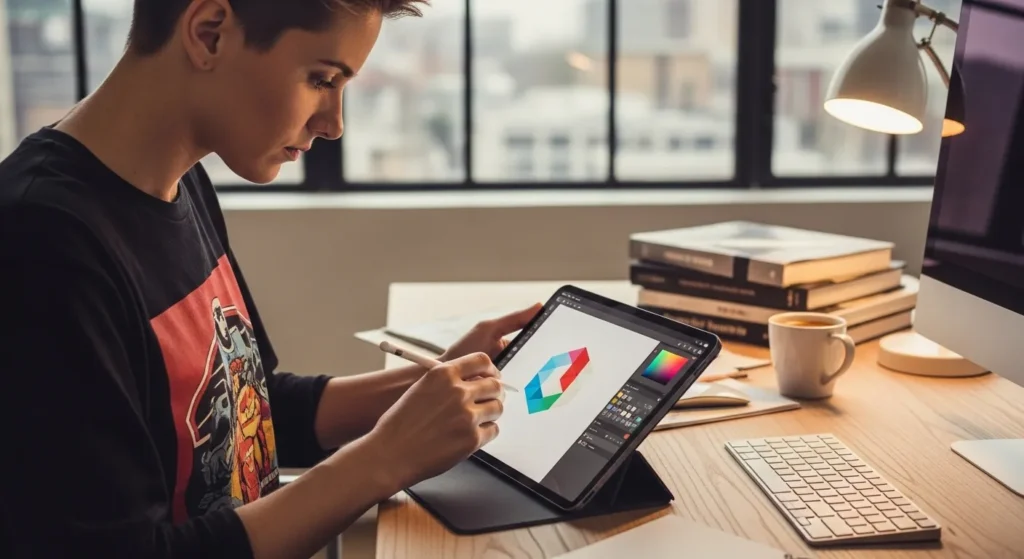
- Why: This is pure speed. We’re drawing simple vector shapes, arrows, and notes. Pressure sensitivity is not only irrelevant; it’s unwanted. We need consistent, clean lines. The Crayon’s shape and “on” button make it a faster tool to grab and use. This is the first step in our logo design process, and it’s all about volume, not fine art.
Scenario 2: Detailed Digital Illustration (Brand Mascots, Custom Icons)
- Task: Creating a complex, textured brand illustration or a detailed mascot with shading and varied line weight.
- App: Procreate or Affinity Designer 2.
- Winner: Apple Pencil (2nd Gen or Pro).
- Why: No contest. This is the 10% of the job where pressure sensitivity is everything. The illustrators on my team live in Procreate, and they need the ability to build up layers, blend, and create tapered strokes. This is what the Pencil was built for.
Scenario 3: Client Feedback & PDF Markups (The Business Owner’s Job)
- Task: My job. Reviewing a branding proposal, circling typos, annotating a web design, and signing a contract.
- App: GoodNotes, Notability, or just the iPadOS Markup tool.
- Winner: Logitech Crayon.
- Why: I’m using a digital red pen. I need a tool that allows me to write, circle, and highlight. The Crayon is 100% capable and half the price. It’s the ultimate executive markup tool. Spending £129 for this is financial malpractice.
Scenario 4: Wireframing & Team Whiteboarding (UI/UX)
- Task: Building out user flows, low-fidelity wireframes, and collaborating on a digital whiteboard.
- App: FigJam, Miro.
- Winner: Logitech Crayon.
- Why: This is identical to the brainstorming scenario. You’re using a digital sharpie to draw boxes and arrows. The Crayon’s flat-sided grip feels more natural for this “architectural” style of drawing. Again, pressure sensitivity is irrelevant.
Scenario 5: Provisioning a New Remote Designer
- Task: Sending a “welcome kit” to a new hire (a hybrid UI/Logo Designer).
- Winner: Logitech Crayon (default).
- Why: This is an ROI decision. I sent them a Crayon. It’s durable, it will 100% work with their iPad (or the one we send), and it covers 90% of their job. My instruction is simple: “Use this for everything. If you find you are constantly limited by the lack of pressure for illustrative work, we will approve the upgrade to a Pencil.”
Nine times out of ten, they never ask for the upgrade.
The Financial Case: Beyond the Sticker Price
Let’s talk Total Cost of Ownership (TCO). This is what small business owners live and die by.
| Cost Factor | Apple Pencil (2nd Gen) | Logitech Crayon (USB-C) | Analysis |
| Purchase Price | £129 | £69 | You save £60 instantly. |
| Replacement Tips | £19 (for 4) | £13.99 (for 10) | Crayon tips are not only cheaper, but you get more of them. |
| “Loss & Breakage” Risk | High | Low | This is the big one. The Pencil is small, round, and fragile. The Crayon is robust and stays put. I am far less concerned about a £69 Crayon getting lost in a co-working space than a £129 Pencil. |
| Total Cost (1 Year) | ~£148 (if you need new tips) | ~£83 | The value proposition is undeniable. The Pencil is nearly 78% more expensive in the first year. |
The “Apple Crayon”? What About the Pencil (USB-C)?
Apple recently released the Apple Pencil (USB-C) for £79. This is their direct competitor to the Crayon.
And guess what? It has no pressure sensitivity.
Apple Pencil (USB-C)
You want the Apple Pencil experience but aren’t paying the ridiculous ‘pro’ tax. This is the fix. It gives you the pixel-perfect precision, tilt sensitivity, and low latency that actually matter. It charges with a normal USB-C cable. Stop overpaying for features you don’t need.
As an Amazon Partner, when you buy through our links, we may earn a commission.
Apple has, in effect, acknowledged that a significant portion of its user base doesn’t require this “Pro” feature. This £79 Pencil is Apple’s version of the Crayon, but with two key disadvantages:
- It still needs Bluetooth pairing.
- It doesn’t have a simple on/off button.
At this point, the £69 Logitech Crayon, with its instant-on, no-pairing connection, remains the superior practical choice for the price.
My Recommendation as a Design Agency Owner
This choice is simpler than you think. It’s not about which is “better”; it’s about your job title.
- For Professional Illustrators: Get the Apple Pencil (2nd Gen or Pro). Your art demands pressure sensitivity. This is a non-negotiable tool of your trade.
- For Hybrid Designers (Logo, UI/UX): Get the Logitech Crayon. Start here. It will handle 90% of your workflow, from brainstorming to wireframing. You’ll be surprised how little you miss pressure sensitivity. If you find your work evolving into heavy illustration, then upgrade.
- For Business Owners, Entrepreneurs, and Project Managers: Get the Logitech Crayon. Do not waste your money. You need a reliable and durable tool for taking notes, making markups, and signing documents. This is it.
A stylus is a tool to capture an idea. The Crayon is the most efficient, reliable, and cost-effective tool for the job. Spend the £60 you save on something that actually grows your business.
Your Next Step
Choosing the right tool is the first step. The next step is applying it with skill and experience. If your business is ready for a professional brand identity that stands out, our logo design team puts these tools (both of them!) to work every day for clients around the world.
We’re a no-nonsense team focused on results. When you’re ready to see what we can build together, request a quote from our team.
Or, if you’re still in research mode, you can explore more of our practical business and design guides on the Inkbot Design blog.
❓ Apple Pencil vs Logitech Crayon (The TL;DR)
What is the one main difference between Apple Pencil and Logitech Crayon?
Pressure sensitivity. The Apple Pencil (2nd Gen/Pro) has it, which is vital for artists who need varied line weights. The Logitech Crayon does not.
Does the Logitech Crayon have tilt support for shading?
Yes. This is a common misconception. Both the Crayon and Pencil support tilt, allowing you to shade by angling the stylus.
Do I need to pair the Logitech Crayon with a Bluetooth device?
No. It connects instantly. You just turn it on and it works with any compatible iPad (2018 and later). This is a huge advantage over all Apple Pencil models.
Which is more durable, the Pencil or Crayon?
The Logitech Crayon, by a mile. Its flat, aluminium body is designed to be tough and not roll off a table. The Apple Pencil is more delicate.
Which is better for note-taking in meetings?
The Logitech Crayon. It’s more affordable, durable, and its core function (writing) is identical to the Pencil.
I’m a logo designer. Which should I get?
Start with the Crayon. Most logo design is vector-based sketching and wireframing, which doesn’t need pressure. You’ll save money and get a 95% solution.
Does the Crayon work with Procreate?
Yes, it works perfectly. You just won’t be able to use any brushes that rely on pressure sensitivity. All other features, including tilt, will work.
What’s the difference between the Crayon and the new Apple Pencil (USB-C)?
They are very similar (both lack pressure sensitivity). The Crayon is slightly cheaper, more durable, and doesn’t require Bluetooth pairing, making it (in my opinion) the better buy.
Does the Crayon charge magnetically?
No. It charges via a physical USB-C (or Lightning, on older models) port. The Apple Pencil 2/Pro charges magnetically.
Can I rest my palm on the screen with the Crayon?
Yes. Both the Crayon and Pencil support full palm rejection, so you can write and draw naturally.
