AI-Ready Brand Architecture: Structuring Your Brand Graph
The traditional way of looking at brand architecture—as a purely visual or organisational hierarchy—is dead. It has been replaced by the “Brand Graph.”
In an era where AI agents, LLMs, and Generative Engines are the primary gatekeepers of information, your brand’s structure must be more than just “pretty.” It must be machine-readable, semantically clear, and entity-dense.
Ignoring this shift isn’t just a technical oversight; it’s a financial drain. Research suggests that companies failing to align their digital entities with modern AI requirements face a significant “search tax,” paying up to 30% more in customer acquisition costs.
Why? Because if an AI agent cannot reliably verify your authority or link your sub-brands to your parent brand’s reputation, you are effectively starting from zero with every single search query.
“If the algorithm can’t map your expertise, your customers will never find it. We aren’t just building logos anymore; we are building digital ecosystems that AI can trust.”
- Brand Graph replaces visual hierarchy; needs to be machine-readable, semantically clear, and entity-dense for AI agents.
- Use Schema.org, JSON-LD, RDF triples to define parentOrganization and subOrganization relationships in source code.
- Implement sameAs links and Wikidata QIDs to create closed-loop verification and prevent Entity Hijacking.
- Adopt a Hybrid Semantic Architecture with semantic buffers to isolate risk and preserve authority across sub-brands.
- Prepare for agentic discovery with Verifiable Credentials, actionable nodes, and structured product feeds for autonomous agents.
What is AI-Ready Brand Architecture?
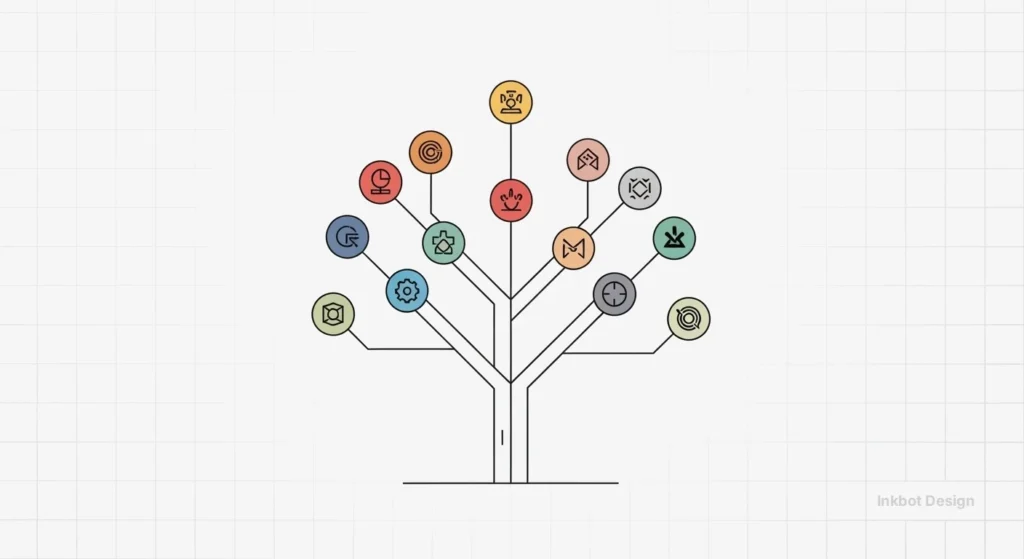
AI-Ready Brand Architecture is a strategic framework that organises a company’s portfolio of brands, products, and services into a semantically structured “Brand Graph.”
This system ensures that both human audiences and AI algorithms can instantly identify, categorise, and validate relationships among business entities.
The three core elements of this structure are:
- Entity Disambiguation: Using unique identifiers (like Schema.org and Wikidata) to ensure AI doesn’t confuse your brand with another.
- Semantic Hierarchy: Defining the relationship (e.g., parentOrganization, subOrganization) in the site’s code, not just on the “About” page.
- Authority Transference: Creating “linked data” paths that allow the reputation of a master brand to flow to its sub-brands through structured metadata.
Building the “Parent-Child” Semantic Bridge
To move from theory to reality, your technical team must implement a Parent-Child Semantic Bridge.
In 2026, AI agents don’t just “guess” relationships; they follow explicit pointers in your source code.
If your parent brand is Unilever and you launch a new sustainable soap brand, the agent needs to see the parentOrganization property in the JSON-LD script on the new brand’s homepage.
The Hierarchy Script
A professional brand graph uses nested Schema.org types. Instead of separate, disconnected blocks of data, you should use the following logic:
- Primary Entity: The Parent (e.g., Global Corp)
- Secondary Entity: The Sub-brand (e.g., Local Product)
- Relationship: subOrganization or parentOrganization
When an AI agent from OpenAI or Anthropic crawls your site, it builds a triple: [Sub-brand] -> [is a part of] -> [Parent Brand]. This ensures that the parent brand’s high “Trust Score” instantly validates the sub-brand.
Verification via sameAs
The sameAs property is your “digital passport.”
You should link your primary domain to authoritative external “truth sources” such as your LinkedIn Company Page, Crunchbase profile, and, ideally, your Wikidata entry.
This creates a closed-loop verification that prevents “Entity Hijacking”—a common 2026 threat where malicious actors create fake brand profiles to confuse AI models.
The Shift from Visual to Semantic Architecture
In the old world, we debated whether a branded house vs. a house of brands was better for consumer “trust.” Today, we must ask which one is better for AI “certainty.”
Unilever Brand Architecture
Click a Business Group to reveal key brands within the portfolio.
- Unilever
The Entity Problem
When a user asks an AI agent, “What is the best branding agency for a tech startup?”, the agent doesn’t look at your portfolio first.
It queries its training data and real-time indices for a specific entity.
If your brand architecture is a mess of conflicting names, disparate domains, and missing metadata, the agent experiences “low confidence.”
In 2026, low confidence equals no mention.
Why the “Brand Graph” Matters
A Brand Graph is the digital map of your business’s existence. It includes your brand identity, employees, physical locations, and intellectual property.
Gartner reports that as search volume shifts toward generative AI, the importance of “Entity Authority” has surpassed traditional keyword-based SEO.
You need to stop thinking about pages and start thinking about nodes.
The Components of a 2026 Brand Graph
To build a structure that survives the current technological shift, you must move beyond the surface. We use the “Root, Rare, and Unique” model to define these layers.
Root Attributes: The Foundation
These are the basics. You still need a clear hierarchy. Whether you are managing a sub-brand or a series of endorsed brands, the naming must be logical.
Real-World Example:
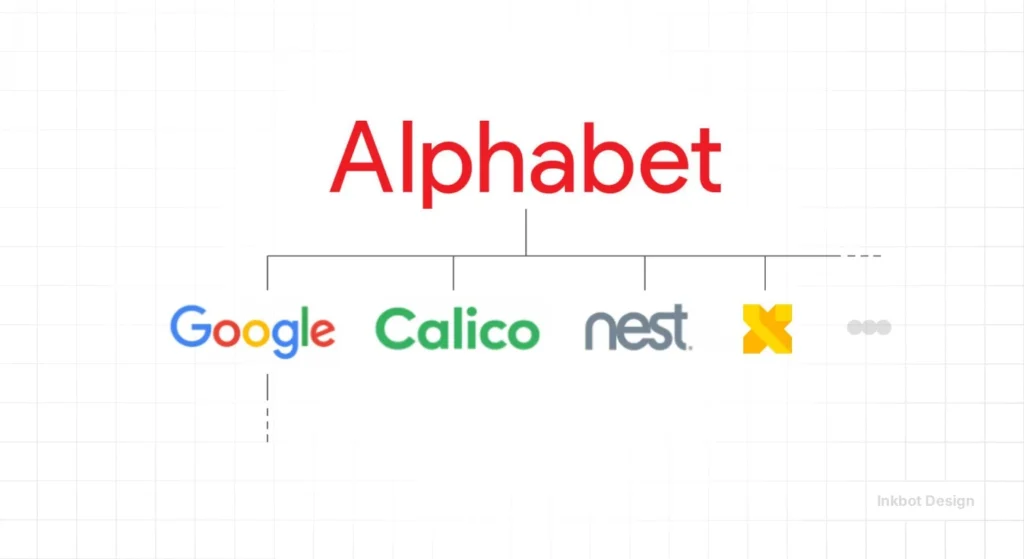
Look at Alphabet Inc. While it functions as a House of Brands, its technical architecture is meticulously mapped. Google, Waymo, and Verily are distinct entities, but their connection to Alphabet is clearly defined in their corporate filings and digital metadata, enabling “Entity Resolution” by financial and tech AI models.
Rare Attributes: The Technical Nuance
This is where most agencies fail. Rare attributes include the JSON-LD brand properties and the use of RDF (Resource Description Framework) to link entities.
- SameAs Properties: Your brand portfolio should use sameAs Schema to link your website to your social profiles, Wikipedia entries, and Crunchbase profiles. This “triangulates” your brand for the AI.
- Nested Organization Schema: Instead of having a flat Schema on every page, you must nest your sub-brands within the parent organisation’s code.
Unique Attributes: Context-Specific Connectivity
This is the psychological and technical “edge.” It is how your brand reacts to specific user intents.
For example, if you have a hybrid brand architecture, how does your data structure differ when a user has “buying” intent versus “research” intent?
The Myth of Visual Uniformity:
I’m going to attack a sacred cow here: Visual uniformity is often a distraction.
Amateur designers will tell you that every sub-brand must use the same font to “strengthen the brand.” This is nonsense.
In 2026, an AI agent doesn’t see your font. If you sacrifice semantic clarity (like using the same name for two different service tiers) just to make a logo look “balanced,” you are sabotaging your visibility.
Strategic differentiation in naming—which helps AI distinguish between entities—is far more valuable than a perfectly matched colour palette.
The State of Brand Architecture in 2026
We have entered the era of “Agentic Branding.”
In the last 12 months, the pricing for “Entity Management” tools has skyrocketed because businesses have realised that their Wikipedia entry is more important than their TV ad.
The most significant change in 2025-2026 is the Verifiable Credential. AI agents now look for cryptographically signed data to verify that a brand is who it claims to be.
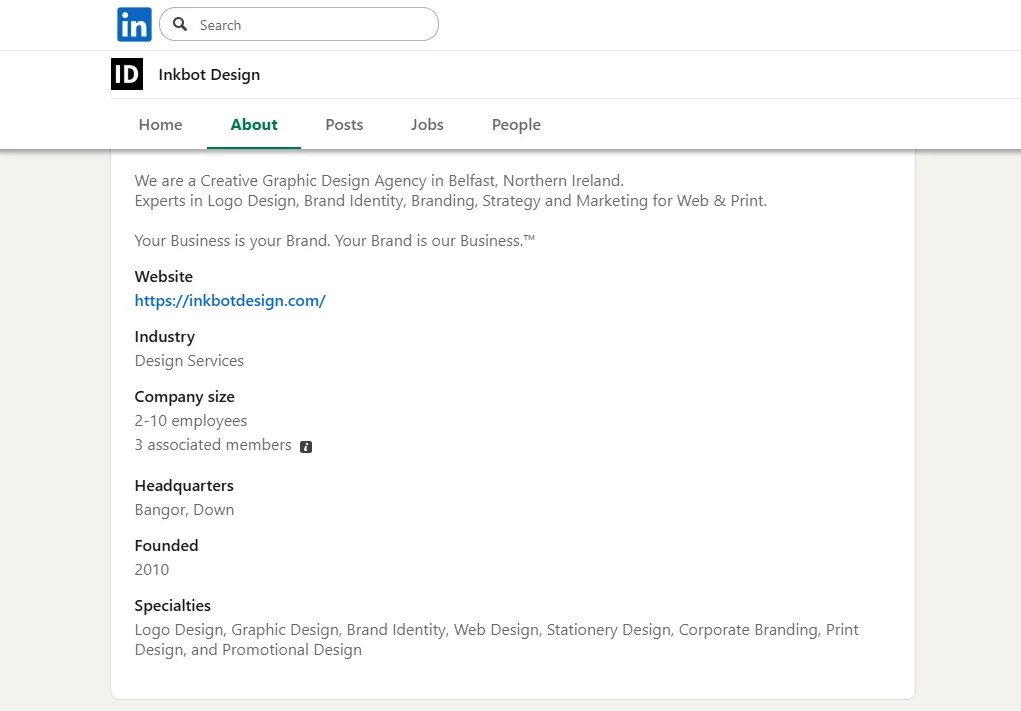
If your architecture doesn’t include a “Trust Layer” (like a verified LinkedIn Company Page linked to a verified Domain), AI will treat your brand as “Unverified Content,” often suppressing it in favour of older, established entities.
| Feature | The Wrong Way (Amateur) | The Right Way (Pro) |
| Hierarchy | Defined only in a PDF Brand Guide. | Defined in JSON-LD and RDF Triples. |
| Sub-brands | Use distinct, unrelated domains. | Use a sub-directory or a sameAs link. |
| Linking | Standard “Follow” links only. | Semantic links using rel=”me” or about. |
| Keywords | “Logo design”, “Branding”. | Entity: Inkbot Design”, “Type: Agency. |
| Consistency | Focuses on Pantone and Typefaces. | Focuses on Entity URI and CID. |
Managing Reputation with Semantic Buffers
The “Simplicity Myth” is dangerous because it ignores the reality of AI Hallucinations and algorithmic contagion.
If your brand is a monolithic “Branded House,” a scandal in one department can instantly downgrade the “Authority Score” of every product you sell.
The “Semantic Buffer” Strategy
In 2026, we recommend a Hybrid Semantic Architecture. This involves creating distinct Entity IDs for your sub-brands while maintaining a technical “endorsement” from the parent.
| Feature | Monolithic (Branded House) | Semantic Buffer (Hybrid) |
| Risk Profile | High: One failure taints all nodes. | Low: Risks are isolated to specific nodes. |
| AI Discovery | Fast, but rigid. | Flexible: Sub-brands can pivot quickly. |
| Data Structure | Single Organization block. | Multiple Organization blocks with memberOf links. |
| Best For | Early-stage startups. | Enterprise portfolios & highly regulated industries. |
By using a buffer, you allow your sub-brands to build their own unique Entity Clouds (sets of related keywords and concepts).
If a sub-brand faces a PR crisis, you can technically “decouple” the entities in your JSON-LD map, preventing the AI from associating the negative sentiment with your parent company’s master node.
Structuring for LLM Visibility
To ensure your brand is correctly interpreted by models like GPT-5 or Gemini, you must follow these steps:
- Claim Your Nodes: Ensure your business is present on Wikidata and DBpedia. These are the primary sources for many LLM training sets.
- Audit Your Citations: Use tools to see how AI agents describe you. If they call you a “marketing firm” but you are a “branding agency,” your semantic architecture is failing.
- Clean Your Digital Footprint: Old, defunct sub-brands or “ghost” websites dilute your entity strength. Delete them. Redirect them. Do not let them rot.
If you need a professional audit of your current structure, you should request a quote to see how we can tune your brand for the modern web.
The Wikidata Playbook: Claiming Your Node in the Global Brain
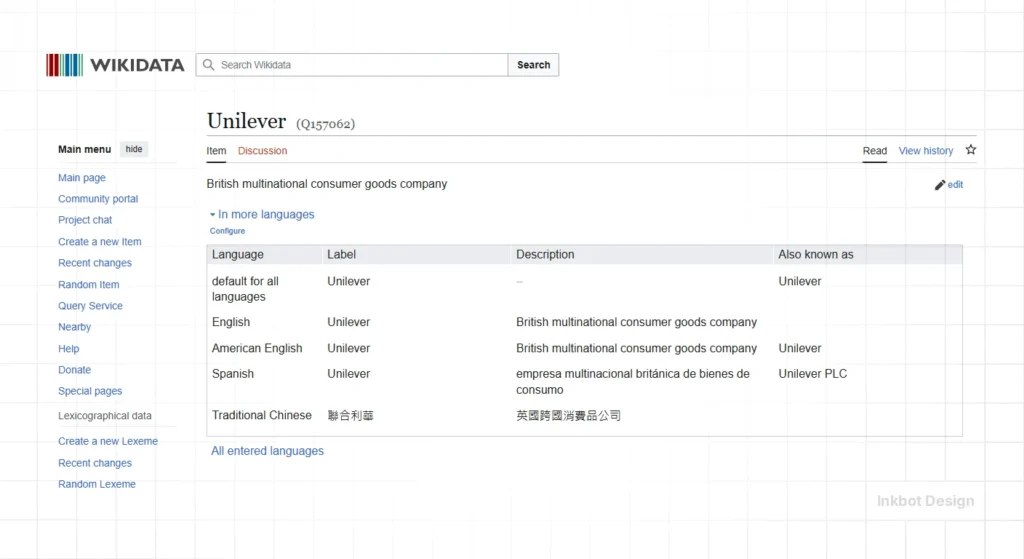
In 2026, Wikidata is the “single source of truth” for almost every major LLM.
If your brand doesn’t have a QID (Wikidata’s unique identifier), you are essentially a ghost in the machine. While Wikipedia is for humans, Wikidata is for agents.
How to Secure Your Node
- Search First: Check if your brand already exists as a “stub” or an unlinked entity.
- Define Properties: Use standard properties like P112 (founder), P127 (owned by), and P856 (official website).
- Link the URI: Once your QID is established (e.g., Q12345), insert it into your website’s Organization Schema using the identifier property.
This creates a “Knowledge Graph Loop.”
When Gemini encounters your website, it sees the ID, checks it against the global Wikidata database, and instantly gains 100% confidence in your brand’s claims. This is the fastest way to earn a “Verified” citation in AI Overviews.
Agentic Discovery: Preparing for the 2027 Shift
As we look toward 2027, the focus is shifting from “AI Search” to Agentic Discovery.
This is a world where users no longer look for brands; they give their AI agents a goal (e.g., “Find me a carbon-neutral laptop under £1,200 with 24-hour support”).
To win this “Invisible Sale,” your brand architecture must be Agent-Ready. This requires:
- Verifiable Credentials: Using W3C standards to prove your “Carbon Neutral” claim is a fact, not just a marketing slogan.
- Actionable Nodes: Structuring your data so an agent can not only “find” you but also “buy” from you via an API or a structured product feed.
- Contextual Relevance: Ensuring your brand graph includes LocalBusiness entities if you have physical locations, as proximity remains a dominant weight for autonomous personal assistants.
The Verdict
The days of “set it and forget it” branding are over.
In 2026, your brand architecture is a living data structure. It requires technical precision, semantic depth, and a ruthless focus on entity clarity.
If you are still relying on a 2010-era “House of Brands” strategy without a corresponding JSON-LD map, you are essentially invisible to the future of commerce.
Stop focusing on how your brand looks and start focusing on how it is “understood.” Build a Brand Graph, link your entities, and protect your authority.
Ready to future-proof your brand? Explore our brand identity services or contact us today to start building an AI-ready architecture.
Frequently Asked Questions
What is the difference between brand architecture and a brand graph?
Brand architecture is the organisational strategy for a company’s brands. A brand graph is the technical, machine-readable map of those relationships, typically expressed in structured data such as Schema.org, which AI agents use to understand your business.
Why does AI care about my brand hierarchy?
AI agents use hierarchy to assign “Authority” and “Trust.” If a sub-brand is clearly linked to a reputable parent, the AI is more likely to recommend the sub-brand in response to high-stakes queries.
What is an RDF Triple, and why does my brand need them?
RDF stands for Resource Description Framework. A “triple” is a data statement in the form of Subject-Predicate-Object (e.g., “Company X” -> “is a” -> “Software Provider”). In 2026, these triples are the building blocks of the web; by providing them in your code, you eliminate any ambiguity for AI models trying to understand your business model.
How do I start building an AI-Ready Brand Architecture?
Start by auditing your current entity footprint. Use Schema.org to define your Organisation and its subOrganization or parentOrganization. Ensure your Wikidata and social profiles are linked via sameAs properties.
What is “Entity Dilution”?
Entity dilution occurs when a brand has too many confusing names or conflicting data points online. This causes AI agents to lose “confidence” in the brand’s true identity, leading to lower visibility in generative search.
How do I link my CEO’s personal brand to the company’s Brand Graph?
Use the founder or employee property within the Organization Schema and link it to the CEO’s personal Person schema. Ensure both profiles use the sameAs property to point to the same Wikipedia or LinkedIn URL. This transfers personal authority to the brand entity and vice versa.
Can I use AI to generate my Brand Graph?
While tools like WordLift or Inrupt can automate much of the “markup,” the strategic relationships must be defined by humans. If you let an AI “guess” your architecture, you risk Entity Hallucination, where the machine creates non-existent relationships that can take months to correct in the search indices.
How has brand architecture changed since 2024?
The focus has shifted from “Consumer Psychology” to “Agentic Certainty.” In 2026, branding is as much a technical SEO task as it is a creative design task.
Is a sub-domain or a sub-directory better for AI authority in 2026?
Almost always a sub-directory (brand.com/sub-brand). Sub-directories consolidate “Entity Strength” into a single root domain, making it easier for AI agents to crawl and verify the hierarchy. Sub-domains are often treated as separate entities, which can lead to “Authority Leakage.”
What role does Wikipedia play in brand architecture?
Wikipedia is a “Seed Site” for Google’s Knowledge Graph. Having a well-structured, factual Wikipedia entry that reflects your brand architecture is one of the strongest signals you can send to an AI.
What are “Verifiable Credentials” in branding?
These are cryptographically signed digital statements (using Decentralised Identity standards) that prove your brand’s claims, such as certifications or awards. In 2026, AI agents use these to distinguish between “Self-Claimed Authority” and “Verified Authority.”
How do I measure the success of my AI-Ready Brand Architecture?
Monitor your “Entity Visibility” in tools that track AI Overviews (SGE) and check your “Confidence Score” in Knowledge Graph API tools. If your brand is correctly appearing in “People Also Ask” for related entities, your architecture is working.