Hybrid Brand Architecture: How to Manage a Complex Portfolio
Most companies don’t wake up and decide to adopt a hybrid brand architecture. It usually happens by accident.
You launch a product. Then you launch another that doesn’t quite fit the first one’s mould. Then you acquire a competitor who refuses to let their legacy name die.
Suddenly, you aren’t running a sleek, singular brand; you are herding cats.
You have a “Master Brand” here, a “Sub-brand” there, and a “Standalone” brand floating in the ether, all fighting for the same marketing budget.
This chaos is what consultants politely refer to as a “Hybrid” model. In reality, it is often just a mess waiting to be organised.
When executed with intent, however, a hybrid system is a powerful strategic tool. It allows you to protect your master brand’s reputation while taking risks in new markets. It lets you extract value from acquired equity without confusing your core customer base.
But be warned: it is expensive. Managing multiple layers of brand hierarchy requires strict governance, clear visual systems, and the discipline to say “no” to the VP of Sales who wants a new logo for every minor product update.
This guide isn’t about theory. It is about fixing the structural integrity of your business.
- Hybrid architecture mixes Branded House and House of Brands to manage diverse markets and acquired equity with strategic intent.
- Three core components: Master Brand (anchor), Sub-brands (endorsed extensions), and Freestanding brands (independent entities).
- Use hybrid when acquisitions, conflicting product positioning, or moonshot innovation make a single model untenable.
- Hybrid is costly: marketing, design, and legal "taxes" demand strict governance and clear visual systems.
- Audit annually, define driver/endorser roles, and include a "kill switch" to consolidate weak sub-brands for SEO and clarity.
What is Hybrid Brand Architecture?
Hybrid brand architecture is a portfolio management strategy that combines elements of the “Branded House” (monolithic) and “House of Brands” (pluralistic) models. Instead of adhering to a single rigid structure, it permits different brands within the same organisation to relate to the Master Brand in different ways based on market need, rather than internal consistency.
The Three Core Components:
- The Master Brand: The corporate anchor (e.g., Google, Coca-Cola) that provides endorsement and credibility.
- Sub-Brands: Extensions closely tied to the master brand but with specific modifiers (e.g., Google Maps, Coke Zero).
- Freestanding Brands: Independent entities that may or may not show a connection to the parent (e.g., Waymo, Innocent Smoothies).
This approach recognises that a “one-size-fits-all” strategy rarely survives contact with the real world. Markets fragment. Audiences diverge. A hybrid model is the pragmatic answer to a complex reality.
The Architecture Spectrum: Where Hybrid Fits
To understand the hybrid middle ground, it is essential to first understand the extremes. If you are reading this, you likely already know the basics, so I won’t bore you with a review of Marketing 101. But for clarity:
- Branded House (Monolithic): One brand, one voice. FedEx Express, FedEx Ground, FedEx Office. Efficient, but risky if the master brand takes a hit.
- House of Brands (Pluralistic): The parent is invisible. P&G owns Pampers and Gillette. The consumer doesn’t know, nor do they care. Expensive, but insulates risk.
Hybrid is the deliberate mix of both.
Take Microsoft.
- Branded House elements, including Windows, Office (now Microsoft 365), and Surface, are all tightly aligned with the Microsoft master brand. They borrow equity directly.
- House of Brands elements: Xbox. While we know it’s Microsoft, the branding is distinct. The visual language is aggressive, dark, and gamer-centric. It doesn’t look like an Excel spreadsheet.
- Acquisition integration: LinkedIn and GitHub. These operate almost entirely independently. Microsoft knows that slapping a corporate Windows logo on GitHub would alienate the developer community.
This is a functional brand architecture because it leverages the relationship between brands to drive value, rather than imposing a visual consistency that lacks strategic sense.
The Three Triggers: When to Go Hybrid
You should not choose a hybrid model because you “like the flexibility.” You choose it because the alternative is failure. In our consultancy work, we typically see three scenarios where a hybrid structure is the only viable path.
1. The “Merger & Acquisition” Reality
This is the most common trigger. You buy a company. That company has 20 years of brand equity, a loyal customer base, and a distinct culture.
If you immediately rebrand them to your Master Brand (Monolithic), you risk destroying the very value you just bought. Customers revolt; employees leave.
If you leave them entirely alone (Freestanding), you miss out on the “synergy” you promised the board.
The Hybrid Solution: You endorse the acquired brand. “LinkedIn, a Microsoft Company.” Over time, you might migrate them closer, or you might not. The hybrid model buys you time to assess the equity transfer.
2. The “Toxic” Product Extension
Sometimes, you need to launch a product that your Master Brand simply cannot support.
Toyota creates reliable, sensible cars. If Toyota launched a £100,000 luxury vehicle, nobody would buy it. The “sensible” attribute of the Master Brand actively hurts the “luxury” attribute of the product. Hence, Lexus. Lexus is a freestanding brand within a hybrid portfolio. Toyota endorses it internally for quality (manufacturing), but externally, they are distinct.
Conversely, the Toyota Prius is a model within the Toyota brand. It benefits from Toyota’s reliability. This mixture—Lexus (Freestanding) and Prius (Sub-brand)—is the definition of hybrid.
3. The “Moonshot” Innovation
Google’s restructure into Alphabet in 2015 is the textbook example.
Google (Search, Maps, YouTube) creates massive cash flow.
“Other Bets” (Calico, Waymo, Verily) burn massive cash and take high risks.
Keeping them all under the “Google” banner was confusing investors and consumers. Why is the search engine company building self-driving cars? By adopting a hybrid/holding company structure, Alphabet enabled Google to remain Google, while Waymo could establish its own distinct brand authority in the automotive sector without being tied to search algorithm controversies.
Consultant’s Note: Do not confuse “innovation” with “boredom.” Just because your marketing team is bored with the current brand guidelines does not mean you need a new sub-brand.
The Hidden Costs of Hybrid Architecture
This is the section most agencies won’t write because they want to sell you more logos.
Running a hybrid brand portfolio is significantly more expensive than running a Branded House. Every time you create a degree of separation from the Master Brand, you incur a “Tax.”
1. The Marketing Tax
If you have one brand (FedEx), every dollar you spend on advertising reinforces that one name.
If you have a hybrid portfolio (Coca-Cola, Sprite, Fanta, Dasani, Smartwater), you are splitting your budget across multiple brands. A dollar spent on Fanta does almost nothing for Dasani. You need separate campaigns, separate social media channels, and separate strategies.
2. The Design Tax
A Branded House needs one design system. A hybrid portfolio needs a “system of systems.” You need to define how the Master Brand appears on the Sub-brand (Endorsement), how it appears on the Freestanding brand (Shadow Endorsement), and where it doesn’t appear at all.
This leads to “Logo Soup”—that awkward moment at the bottom of a website where you have 15 different logos of varying shapes and sizes trying to coexist.
3. The Legal Tax
More brands mean more trademarks. More trademarks mean more opposition filings, more renewal fees, and more territory disputes.
The Cost of Complexity
| Feature | Branded House (Single) | Hybrid (Mixed) | House of Brands (Multiple) |
| Brand Equity | Concentrated on Master’s | Shared & Independent | Fragmented |
| Marketing Efficiency | High (Economies of scale) | Moderate | Low (High distinct costs) |
| Risk Mitigation | Low (One bad story hurts all) | Moderate | High (Insulated silos) |
| Management Effort | Low | Very High | High |
| Flexibility | Low | Maximum | High |
Designing the Hybrid System: Visual Rules
If you are committed to this path, you need rules. Without rules, your brand portfolio becomes a dumping ground for bad ideas.
The “Driver” vs. “Endorser” Ratio
In any hybrid relationship, you must decide which brand drives the purchase decision.
- Master Brand Driver: The parent is the hero. The product is the descriptor.
- Example: FedEx Office. You buy FedEx. The office just tells you what service it is.
- Co-Driver: Both brands carry equal weight.
- Example: Marriott Bonvoy. Is it Marriott? Is it Bonvoy? It is a messy middle, but they are trying to transfer equity from the hotel chains to the loyalty program.
- Sub-Brand Driver (Endorsed): The product is the hero. The parent validates it.
- Example: Polo by Ralph Lauren. You are buying the Polo shirt. Ralph Lauren provides quality assurance.
The Design Rule: Determine the hierarchy before you open Illustrator. If the Master Brand is an endorser, it should never exceed 25-30% of the visual weight of the lockup. If it is the driver, the sub-brand text should be neutral and descriptive.
The “Kill Switch” Protocol
A robust hybrid architecture requires a mechanism to kill brands.
Over time, sub-brands lose relevance. Remember “Coca-Cola Life” (the green one)? It cluttered the shelf and confused the proposition. Coca-Cola killed it to protect the core portfolio.

You must audit your hybrid architecture annually. Ask these three questions:
- Does this sub-brand still attract a distinct audience that the Master Brand cannot reach?
- Is the cost of maintaining this separate identity lower than the revenue it generates?
- If we folded this back into the Master Brand tomorrow, would we lose customers?
If the answer to any of the following is “No,” you request a quote for a consolidation project.
Real-World Case Study: Marriott International
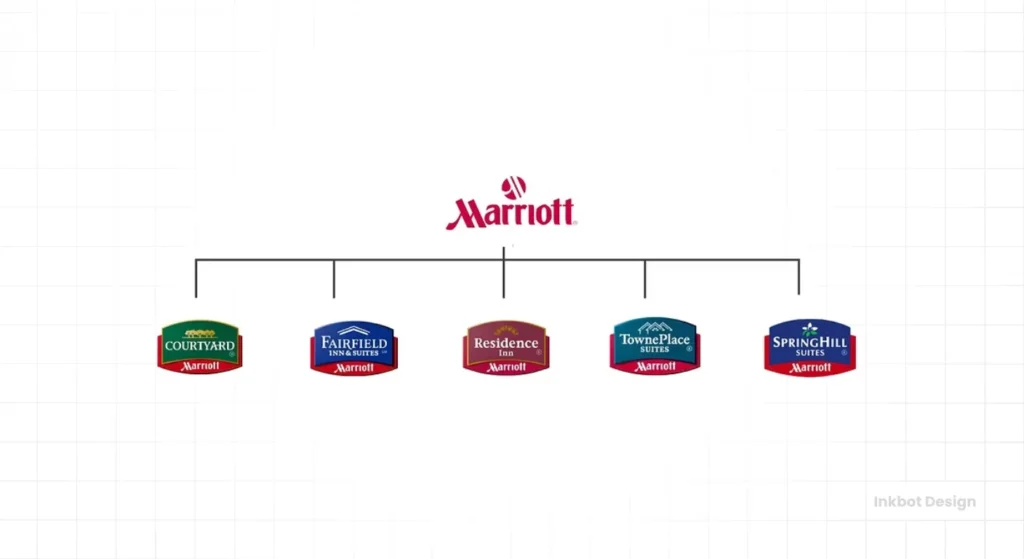
Marriott is the ultimate example of Hybrid Architecture stretched to its absolute limit.
Following the acquisition of Starwood Hotels (Sheraton, Westin, W Hotels, St. Regis), Marriott found itself with 30 distinct hotel brands.
- Luxury: Ritz-Carlton, St. Regis.
- Premium: Marriott, Sheraton, Westin.
- Select: Courtyard, Fairfield.
The Strategy:
They used a hybrid model to keep the distinct identities of the hotels (essential, because a W Hotel guest is very different from a Courtyard guest) but unified them under a single loyalty program: Marriott Bonvoy.
The Execution:
- Visuals: The “Marriott” name acts as a silent endorser on the luxury properties (you rarely see a Marriott logo on the front of a Ritz-Carlton), but acts as a loud driver on the mid-range properties (Courtyard by Marriott).
- The Glue: The loyalty program became the connecting thread. This allows them to cross-sell. A business traveller stays at a Courtyard for work (earning points) and redeems them at a St. Regis for a holiday.
Without a hybrid architecture, this would fail. If they renamed everything “Marriott Luxury” and “Marriott Budget,” they would destroy the cachet of the Ritz-Carlton.
The State of Hybrid Architecture in 2026
The landscape is shifting. Over the last decade, the trend has been towards fragmentation—launching “start-up-like” brands to compete with disruptors.
In late 2025 and moving into 2026, we are seeing a “Great Re-bundling.”
The AI Search Factor:
With the rise of Generative AI search (ChatGPT, Google Gemini), “Brand Authority” is becoming the primary ranking factor. AI engines trust large, authoritative entities.
If you have 10 tiny micro-brands, none of them has enough data authority to dominate search results. If you consolidate them under one powerful Master Brand, your aggregate authority grows.
We are seeing clients move away from “House of Brands” and towards “Hybrid/Branded House” structures. They are killing weak sub-brands and turning them into product lines to pool their SEO and Reputation equity.
The Lesson: Unless a sub-brand has a radically different audience or risk profile, keep it closely aligned with the Master Brand.
The Consultant’s Reality Check
I once audited a mid-sized tech firm that had seven different logos for seven different software modules.
When I asked the CEO why, he said, “The product leads wanted their own identity to feel like they owned the product.”
This is not a brand strategy. This is therapy.
Brand architecture is not about making your product managers feel special. It is about making it easy for the customer to buy. When a customer sees seven logos, they assume they have to sign seven contracts, manage seven logins, and talk to seven support teams. Friction kills sales.
We consolidated them into one Master Brand with a simple colour-coding system for the modules. Sales velocity increased by 15% in the first quarter simply because the proposition was easier to understand.
Before you commission a brand identity for your new “innovation lab” or “sub-division,” ask yourself: Does this help the customer navigate our offer, or does it just satisfy our internal ego?
The Verdict
Hybrid brand architecture is messy, difficult, and expensive. It is also essential for any business that intends to scale through acquisition or diversification into multiple product lines.
The secret is not to let it happen by accident. You must design the chaos.
- Define the relationship: Is the new brand a child (Sub-brand), a distant cousin (Freestanding), or a sibling (Endorsed)?
- Calculate the tax: Can you afford to market this new name?
- Visualise the hierarchy: Create a rigid design system that dictates exactly how the Master Brand appears.
If your portfolio is currently looking more like a “House of Cards” than a “House of Brands,” it is time to restructure.
Frequently Asked Questions (FAQ)
What is the difference between hybrid brand architecture and a house of brands?
A House of Brands (like P&G) keeps the parent company invisible to the consumer, with brands operating independently. Hybrid architecture mixes this with endorsed or branded strategies, where some brands are independent while others leverage the parent company’s equity (like Microsoft with Office vs Xbox).
When should I use a hybrid brand strategy?
Use a hybrid strategy when you have diverse products that target conflicting audiences (e.g., luxury vs. budget), or when you acquire a company with strong existing equity that would be destroyed by a rebrand. It allows for flexibility that a monolithic strategy cannot provide.
Is hybrid brand architecture more expensive to manage?
Yes. It requires maintaining multiple visual identities, separate marketing budgets, and distinct legal trademarks. Unlike a Branded House, where one campaign lifts all boats, a hybrid model often requires separate spend for each distinct brand entity to build awareness.
Can a small business use a hybrid architecture?
Generally, no. Small businesses rarely have the budget or market share to justify splitting their equity. It is almost always better to build a strong Branded House first. Only diversify when a new product creates a genuine conflict with your existing brand reputation.
How do I merge an acquired brand into my architecture?
Start with an “Endorsed” phase (e.g., “Brand X, a Company Y Company”). This reassures existing customers while introducing the new ownership. Over the course of 1-3 years, you can gradually increase the visual dominance of the parent brand if the goal is eventual consolidation.
What is a “Sub-brand” in a hybrid model?
A sub-brand acts as a modifier to the master brand. It creates a new section of the portfolio without losing the master brand’s trust. For example, “Samsung Galaxy” is a sub-brand. It is distinct from Samsung appliances, but clearly relies on Samsung’s master equity.
Does hybrid architecture dilute brand equity?
It can if managed poorly. If the master brand endorses low-quality products, its reputation suffers. Conversely, if the master brand is applied to a niche product where it doesn’t belong (such as a corporate bank logo on a cool streetwear brand), it dilutes the niche product’s appeal.
What is an “Endorsed Brand”?
An endorsed brand has its own unique name and visual style but features a “badge” from the parent company (e.g., “Courtyard by Marriott”). This provides a trust guarantee to the consumer while allowing the endorsed brand to have its own personality.
How does hybrid architecture affect SEO?
It splits your domain authority. If you use separate websites for freestanding brands, you must build SEO for each from scratch. If you use sub-folders (brand.com/sub-brand) or sub-domains, you retain some authority. A Branded House is always superior in terms of aggregate SEO power.
What is the biggest mistake in hybrid branding?
Inconsistency. The most common failure is a lack of clear guidelines regarding how the master brand is presented across the portfolio. This leads to customer confusion, as they struggle to understand the relationship between the products, resulting in cross-selling failures.