Brand Growth Strategy: A Guide to Scaling Equity
Most businesses are not growing; they are merely inflating.
There is a violent difference between the two. Inflation is the result of pumping money into performance marketing—such as Google Ads, Meta campaigns, and “limited-time offers”—to buy temporary spikes in visibility.
Growth, a genuine brand growth strategy, involves the structural expansion of a brand’s footprint in the market and in the minds of its customers.
If you are spending more every year to acquire the same number of customers, your strategy is failing. You are on a hamster wheel of digital attribution that ignores the fundamental laws of how brands actually scale.
Ignoring the structural integrity of your brand identity while chasing growth is the fastest way to bankrupt your reputation.
- Prioritise penetration over loyalty: grow by increasing the number of buyers, especially light buyers, not by obsessively boosting frequency.
- Build distinctiveness and visual identity: create unique DBAs that trigger instant recognition across digital and physical touchpoints.
- Allocate investment for long-term brand building: follow a ~60/40 split (brand building vs activation) to compound market share and price power.
What is a Brand Growth Strategy?
A brand growth strategy is a formalised framework designed to increase a company’s market share by enhancing its mental and physical availability.
It is the calculated process of making a brand easier to buy for more people, more often, by strengthening the cognitive links between the brand and specific buying situations.
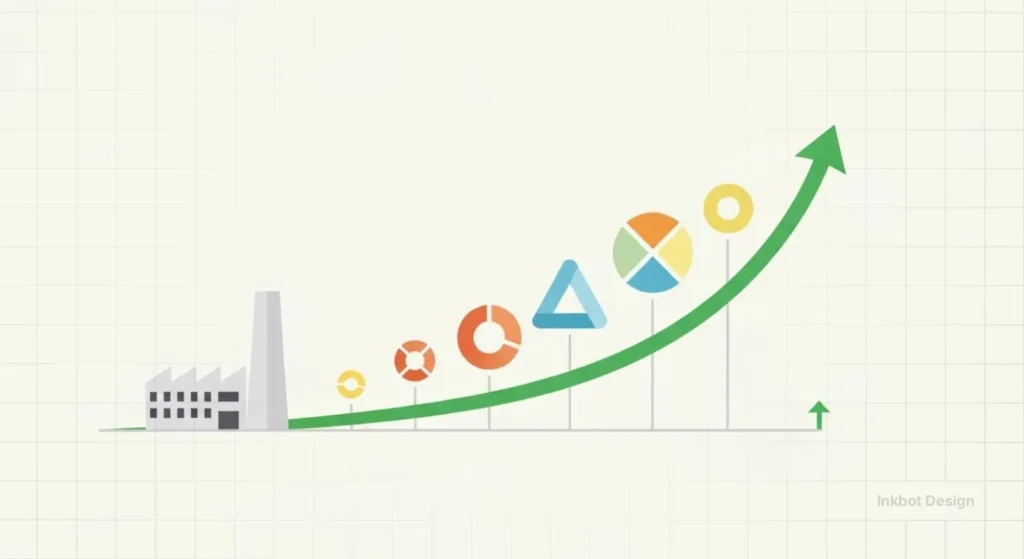
The three core elements of this strategy are:
- Market Penetration: Increasing the number of people who buy the brand at least once.
- Mental Availability: Ensuring the brand “pops up” in a consumer’s mind during a Category Entry Point (CEP).
- Physical Availability: Reducing the friction of purchase by being present across all relevant distribution channels.
The Growth Paradox: Why Your Scaling Efforts Stall
I once audited a client in the B2B SaaS space who had tripled their ad spend over six months. Their leads increased by 10%, but their customer acquisition cost (CAC) skyrocketed by 400%. They thought they had a “targeting” problem.
In reality, they had a brand equity problem. They were shouting at a market that didn’t recognise them, didn’t trust them, and couldn’t distinguish them from a dozen cheaper alternatives.
They were trying to build a skyscraper on a foundation of sand. Without a robust brand equity foundation, your growth strategy is merely a costly way to subsidise your competitors’ market research.
The Law of Double Jeopardy
In the world of brand science, specifically the work pioneered by the Ehrenberg-Bass Institute, the Law of Double Jeopardy states that brands with smaller market shares have fewer buyers who are also slightly less loyal.
The Law of Double Jeopardy
(Low Loyalty)
(High Loyalty)
Data Principle: Ehrenberg-Bass Institute
The “Amateur” mistake is trying to grow by “increasing loyalty.” The “Professional” reality is that you grow by increasing penetration. You need more “light buyers”—the people who only buy from you once a year—to move the needle.
Debunking the “Niche-Down” Myth
One of the most pervasive, and frankly dangerous, pieces of advice given to SMB owners is to “find your niche and stay there.” While focus is vital for a startup, it is a ceiling for a growing brand.
If you want to scale, you must eventually appeal to the “unconverted.” According to research by Byron Sharp, brands that focus solely on a narrow niche eventually reach a point where they have no room to grow.
Real brand growth requires mass-market mental availability. You don’t need to be everything to everyone, but you must be something to as many people as possible within your category.
The Growth Lever Simulator
Where should you invest your budget? In finding New Customers (Penetration) or in Loyalty (Frequency)? Input your data to simulate the outcome.
The Infrastructure of Visual Identity in Scaling
Growth requires a visual language that scales. Many SMBs start with a “placeholder” identity—a cheap logo from a crowdsourcing site or a DIY attempt. This approach works particularly well when selling to friends and early adopters. It fails when you try to move into the mid-market or enterprise space.
Professional brand identity services are not about “making things look pretty.” They are about creating Distinctive Brand Assets (DBAs). These are non-copyable sensory cues (colours, shapes, fonts) that trigger brand recall without the need for a name. Think of the Cadbury purple or the Nike swoosh.
Real-World Example: Airbnb’s Strategic Pivot

In 2021, Airbnb made a radical move. They slashed their performance marketing budget and shifted their focus to brand-building. Critics predicted a collapse. Instead, Airbnb reported its most profitable year ever.
By focusing on their unique brand story and identity, they reduced their reliance on expensive search terms and increased direct traffic. They stopped “buying” customers and started “owning” a category.
| Feature | Amateur Growth (The “Hacker” Way) | Professional Growth (The “Forensic” Way) |
| Primary Metric | Return on Ad Spend (ROAS) | Market Share & Brand Salience |
| Focus | Heavy Buyers / Loyalty | Light Buyers / Penetration |
| Creative | A/B testing “Click-Bait” | Building Distinctive Brand Assets |
| Timeline | Quarterly Spikes | 3-5 Year Compounding Equity |
| Pricing | Constant Discounting | Price Premium Maintenance |
| Identity | Inconsistent / DIY | Strategic Brand Identity |
The Four Pillars of the Growth Framework
To execute a brand growth strategy that actually sticks, we look at the business through four forensic lenses.
1. Mental Availability (Salience)
Does the brand come to mind when the need arises? This isn’t “brand awareness” (a useless metric). This is “brand salience.” If I am hungry and want something healthy but fast, does your brand occupy that specific mental slot?
To build this, you must map out your Category Entry Points (CEPs). These are the internal and external cues that lead a consumer to think of a category. For a coffee brand, a CEP might be “I have a long drive ahead” or “I need to wake up for a 9 AM meeting.” Your growth strategy must link your brand to these specific moments.

2. Physical Availability
If they want you, can they find you? For digital brands, this means appearing in the right search results, being compatible with the right platforms, and having a seamless checkout process. For physical brands, it’s shelf space and distribution.
A common mistake in the brand identity vs visual identity debate is ignoring how the brand looks on a mobile screen versus a physical billboard. If your logo is too complex to be recognised at 16 pixels, you have a physical availability barrier.
3. Distinctiveness over Differentiation
The old school taught “differentiation”—being better or different. The new school (and the data) teaches “distinctiveness.” You don’t need to explain why you are better in every ad; you just need to make sure the consumer knows it’s you.
When a consumer sees a flash of your brand colours, do they know it’s you before they even see the logo? Use a brand identity checklist to ensure your assets are unique, famous, and consistent.
4. Price Elasticity and Brand Power
The ultimate test of a brand growth strategy is the ability to raise prices without losing volume. This is where brand identity and brand image converge. A strong brand acts as a “risk reducer” for the consumer. They pay more because they trust the outcome.
According to Deloitte Insights, high-growth brands are 2.5 times more likely to have a clear brand purpose that allows them to maintain price premiums even during inflationary periods.
Protocol: How to Calculate Share of Search
This is your proxy for market share.
- Go to Google Trends.
- Enter your Brand Name.
- Add your top 3 Competitors.
- Set the timeline to Past 12 Months.
- Formula: (Your Searches / Total Searches for All 4 Brands) * 100.
- If your line is trending up while theirs is flat, you are growing market share.
From Marginal to Mainstream
You are trapped in a “zero-sum game,” fighting for 1% share gains in a saturated market while your brand slowly suffocates. This is the fix. From Marginal to Mainstream argues that the next billion-dollar opportunity isn’t in the centre of the aisle—it’s hiding in the “weird,” the “repulsive,” and the “untested” behaviours at the edges of society.
As an Amazon Partner, when you buy through our links, we may earn a commission.
The State of Brand Growth in 2026: The Post-Cookie Reality
As we move through 2025 and into 2026, the mechanics of growth have undergone a shift. The “Easy Era” of hyper-targeted digital ads is dead.
Privacy regulations and the deprecation of third-party cookies have made “performance-only” strategies prohibitively expensive.
The shift is back to broad-reach brand building. In 2026, the most successful brands are those that have built “First-Party Equity.” This means people are specifically searching for the brand name, not just the generic product category. If 80% of your traffic comes from “Brand” search terms, you are winning. If 80% of your traffic comes from “Generic” terms, you are renting your audience from Google.
Forensic Observation: The Death of the “Minimalist” Logo
In our fieldwork, we are seeing a significant backlash against the “blanding” trend—where every tech company adopted the same sans-serif font and neutral palette. In 2026, growth is being driven by “Visual Maximalism.” Brands are reclaiming their quirks.
They are using Kapferer’s Brand Identity Prism to build deeper, more textured personalities that cut through the AI-generated noise of the modern web.
Implementing the Strategy: A Step-by-Step Audit
If you are serious about scaling, you must stop “marketing” and start “architecting.”
Step 1: The DBA Audit
List every asset you own: logo, typeface, colour, tagline, tone of voice, jingle, mascot. Now, ask two questions:
- Uniqueness: Does any competitor use something similar?
- Prevalence: If I showed this asset to a stranger without the logo, would they recognise it as mine?
If you fail this audit, your growth spend is being “gifted” to your category leaders. You are essentially advertising “shoes” rather than “Nikes.”
The Asset Strength Scorecard
Grade your assets (Logo, Colour, Sound, Mascot) out of 10.
- Uniqueness (0-5): If you removed your logo, would customers confuse this asset with a competitor? (5 = Totally Unique, 0 = Generic).
- Fame (0-5): What % of your audience links this asset to your brand instantly? (5 = Everyone, 0 = No one).
Score < 5? Kill the asset. Score 6-8? Invest to build fame. Score 9-10? Protect at all costs.
Step 2: Mapping CEPs (Category Entry Points)
Identify the top 5 reasons people enter your category.
- Example (Accounting Firm): “I just got a tax bill I don’t understand.”
- Example (Graphic Design): “I’m embarrassed to show my website to a big prospect.”
Your content and brand growth strategy should focus on building “mental bridges” between these pain points and your visual identity.
Category Entry Point (CEP) Mapping
BRAND
Linking your brand to specific “Buying Situations”
Workshop: Finding Your Entry Points
Get your team in a room and ask these 4 questions (The 4 W’s):
- When are they? (Time of day, season, life stage).
- Where are they? (Physical location, device context).
- With Whom? (Alone, with kids, with boss).
- Why? (The immediate functional or emotional goal).
Example Output: “I need a snack (Why) that I can eat one-handed (How) while driving to work (When/Where) without spilling on my suit.”
Step 3: Distribution Friction Removal
Audit your “Path to Purchase.”
- How many clicks to a quote?
- Is the mobile experience seamless?
- Is the language professional and UK-English compliant for your local market?
Step 4: The Investment Split
Follow the 60/40 rule established by Les Binet and Peter Field in their landmark study for the IPA.
Approximately 60% of your budget should be allocated toward long-term brand building (broad reach and emotional connection), and 40% should be allocated toward short-term sales activation (direct response and offers).
The Golden Ratio of Growth
Source: Binet & Field (The Long and the Short of It)
Most SMBs have this reversed, or worse, they spend 100% on activation. This leads to the “SaaS Plateau,” where growth flatlines because you’ve exhausted the “low-hanging fruit” of people already looking to buy.
The Verdict
Growth is not an accident of “going viral.” It is a forensic application of market science.
A robust brand growth strategy requires the courage to stop chasing vanity metrics and start building structural equity.
If your brand identity is weak, your growth will be expensive. If your identity is distinctive, your growth will be inevitable. You cannot “hack” your way to a legacy brand. You have to design it.
If your current identity feels like a liability rather than an asset, it’s time for a forensic intervention. Stop guessing and start scaling with intention.
Ready to fix your foundation?
Request a quote for a professional brand audit or explore our Brand Identity Services to see how we build assets that scale.
Frequently Asked Questions
What is the difference between brand growth and sales growth?
Sales growth refers to a short-term increase in revenue, typically driven by discounts or increased advertising spending. Brand growth refers to an increase in market share and brand equity, enabling sustainable, long-term revenue and higher profit margins without the need for constant reinvestment in “buying” clicks.
How long does a brand growth strategy take to show results?
While sales activation can show results in days, a true brand growth strategy typically takes 6 to 18 months to manifest in increased market share and price resilience. It is a compounding investment, not a one-off campaign.
Why is market penetration more important than customer loyalty?
Data from the Ehrenberg-Bass Institute shows that all brands lose customers. The only way to grow is to replace them faster than they leave by reaching “light buyers” who aren’t yet loyal to your brand.
Can a small business afford a professional brand growth strategy?
Yes. In fact, SMBs cannot afford not to have one. A small budget spent on a distinctive, well-researched identity is far more effective than a large budget spent on generic, forgettable advertising.
What are Distinctive Brand Assets (DBAs)?
DBAs are sensory cues—like the shape of a bottle, a specific shade of blue, or a unique font—that allow consumers to recognise your brand instantly without needing to see your name or logo.
How do I measure brand salience?
Salience is measured through “Share of Search” and prompted/unprompted recall tests within specific Category Entry Points. It’s about how often your brand is the “first to mind” in a buying situation.
Is “niche marketing” a bad growth strategy?
It is a good starting strategy but a poor scaling strategy. To grow beyond a certain point, you must broaden your appeal to reach a wider segment of the market.
What role does visual identity play in growth?
Visual identity provides the “mental shortcuts” for consumers. A professional identity ensures that your growth efforts are attributed to your brand and not a generic competitor.
What is the “60/40 rule” in marketing?
Proposed by Binet and Field, this approach suggests that for optimal growth, 60% of the marketing budget should be allocated to long-term brand building and 40% to short-term sales activation.
How has brand growth changed in 2026?
With the death of third-party cookies, brands can no longer rely on hyper-targeting. Growth in 2026 is driven by broad-reach creative and building “First-Party” brand equity that drives direct traffic.
What is a Category Entry Point (CEP)?
A CEP is a specific situation or thought that triggers a consumer to consider a product category. Effective growth strategies link a brand to as many relevant CEPs as possible.
Why should I use UK English for my UK-based brand?
Localisation builds trust and reduces cognitive friction. Using ‘optimisation’ instead of ‘optimization’ signals that you are a local, attentive partner who understands the nuances of the British market.