6 Salesforce Development Companies You Can Trust
Salesforce helps many companies manage sales, customer support, and marketing.
More than 150,000 businesses use it to stay on top of their customers and reduce repetitive work. Even so, many teams still struggle to maximise their potential.
Industry research shows more than half of CRM rollouts fail to meet expectations; usually because the setup doesn’t fit how people actually work.
When that happens, dashboards turn into clutter. Reps stop updating records. Integrations break quietly.
Leaders wonder why the investment isn’t yielding the expected results. The issue isn’t Salesforce itself. It’s how the system was planned and built.
That’s why so many teams now bring in outside experts. Good partners begin by understanding how a business truly sells and serves its customers.
They design Salesforce around those processes, add automation where it helps, and train people so adoption sticks.
Companies often seek specialised Salesforce development services rather than attempting to do it all in-house.
Choosing the right firm matters even more as Salesforce continues to expand. Businesses now mix Sales, Service, and Marketing Clouds with analytics and AI tools. Getting that ecosystem to work well takes experience.
- Choose partners who map your real processes first, then configure Salesforce to match for better adoption and fewer failed rollouts.
- Prioritise integration, data migration, and automation skills to keep systems synced, accurate, and scalable across clouds.
- Match partner size and industry fit to your needs: boutique for senior-led work, large firms for enterprise scale, specialists for sector tools.
What Salesforce Development Companies Do

Salesforce can feel simple when you first log in.
Add a few contacts, build a pipeline, and track some deals. However, most companies quickly outgrow the basics.
Fields multiply. Workflows break. People start running spreadsheets on the side again.
That’s where outside help comes in. A solid partner begins by watching how your team actually works. How a lead becomes an opportunity. Where a service request goes when it lands. What slows a deal at the final stage? They map it out before touching any settings.
Next comes configuration and build. Consultants set up the right Clouds, create custom fields, automate routine steps, and design dashboards that display useful information without overwhelming users with noise.
If the standard tools don’t cover what you need, developers can code new features or build apps that plug straight into Salesforce.
Integration is another big job. Sales teams require data from various sources, including billing, inventory, websites, and marketing systems. Experienced developers know how to connect those tools so updates flow both ways, and nothing gets lost.
Then there’s moving old data. Cleaning it. Importing it safely so that history remains intact and duplicates are not introduced. Many CRM projects fail here.
Finally, a good firm trains people and stays available after launch. Some even act as an outsourced admin team, fixing issues and improving the setup over time.
Done right, this work turns Salesforce from a confusing blank slate into a tool your staff will actually use.
How to Choose the Right Salesforce Partner
There are thousands of certified partners. On paper, many look the same. The real differences become apparent once a project begins.
Look first at industry fit. A team that understands your space, whether that’s SaaS, real estate, or healthcare, will know the pitfalls before you hit them.
Check scale and support. Small firms tend to stay close to each project but can only take on a limited amount of work at a time. Large consultancies bring deep resources but may feel slow or process-heavy for smaller teams.
Pay attention to integration skills. Salesforce rarely runs alone. If you depend on billing, ERP, or marketing tools, ask how they’ll connect everything.
And test their communication early. A partner that answers questions clearly before the contract is signed will usually stay clear and responsive when the build gets tough.
With that in mind, here are some firms proving they can make Salesforce work in the real world.
Routine Automation: Best for Clean, Scalable Implementations
Routine Automation is a certified Salesforce Partner with more than 250 finished projects and a team of about 50 specialists.
They keep the work small enough that senior specialists stay involved from start to finish.
Their strength is planning before building. They study how a company sells and serves customers, then shape Salesforce to match.
Automations and AI tools are implemented they reduce effort or minimise mistakes. The team frequently integrates Salesforce with other systems, such as billing, ERP, and analytics, ensuring that data flows smoothly.
They work across the main Salesforce Clouds, including complex areas like Revenue Cloud and field service.
Routine Automation is regularly named among the top Salesforce consulting companies because their builds stay clean, scale well, and are simple for teams to use.
Pros
- Strong skills in automation and AI features
- Senior-led projects with close client contact
- Broad Cloud coverage and integration expertise
- Proven record with more than 250 deliveries
Cons
- Limited slots because of the boutique size
- Pricing varies by project complexity
DevsData: Flexible Salesforce Talent and AI Expertise
DevsData is an international tech company with offices in the U.S., Europe, and Latin America.
They combine custom Salesforce development with a strong recruitment arm. That means they can supply full teams or single specialists when a business needs extra hands fast.
Their network comprises over 65,000 vetted IT professionals. The firm also works in areas such as AI and machine learning, making it a suitable choice for companies that want Salesforce integrated with data-heavy or predictive tools.
DevsData builds, integrates, and can scale teams up or down as projects grow.
Pros
- Large, pre-screened talent pool for fast team building
- Experience with AI and data-driven Salesforce features
- Flexible engagement: full projects or dedicated staff
- Global presence across several time zones
Cons
- Less focused on strategy and change management
- Pricing varies by developer level and region
Abelian: Agile and Highly Certified
Abelian is a Silver Salesforce Partner based in California. Their team holds 50+ Salesforce certifications and works with an agile, iterative delivery style.
They help companies configure Salesforce, migrate data, and build custom apps when needed.
Abelian puts effort into keeping projects transparent. Clients know who is doing the work and where each sprint stands.
They’re a good fit for mid-sized firms that want their marketing and sales teams to have a clean, usable system without a lengthy enterprise process.
Pros
- Highly certified team with cross-cloud skills
- Clear, transparent project management
- Strong for marketing and sales-driven organisations
- Flexible, iterative build approach
Cons
- Small size limits the capacity for very large programs
- Few proprietary tools or prebuilt accelerators
Ascendix: Real Estate and Finance Specialists
Ascendix has worked with Salesforce since 2001. The company is based in Dallas and runs delivery teams in Eastern Europe.
It focuses on real estate and financial services, two areas where standard Salesforce setups often fail to accurately track deals and properties.
The firm doesn’t only consult. It also builds its own apps for capital markets and commercial real estate.
These tools handle mapping, portfolio management, and deal pipelines. For companies in those industries, the ready-made features reduce build time and lower custom development costs.
Pros
- Long history with real estate and finance workflows
- Proprietary apps that extend Salesforce functionality
- Flexible delivery models: managed, dedicated, fractional
- Experienced team comfortable with complex data setups
Cons
- Narrow focus – less useful outside its key industries
- Process can feel heavy for small or fast-changing teams
ScienceSoft: Enterprise Integration and Long-Term Support
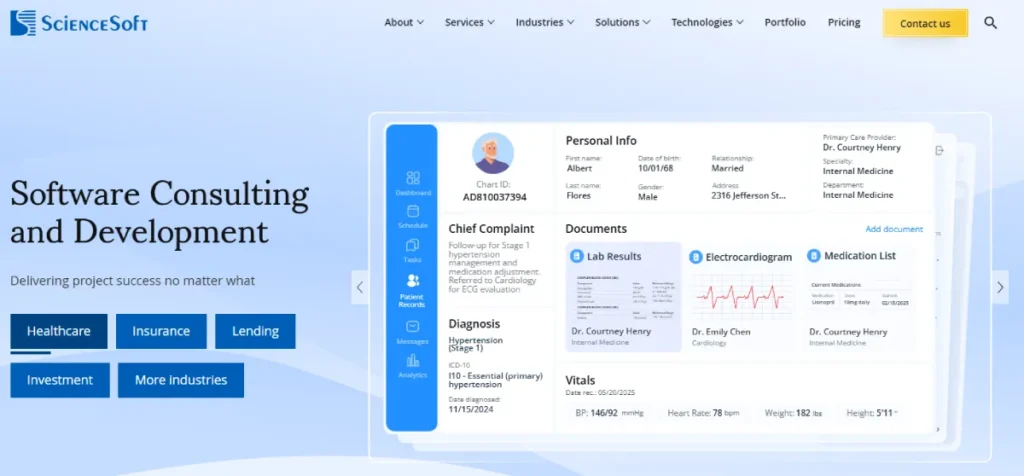
ScienceSoft has been providing IT consulting services for over 35 years and has been working with CRM platforms for more than 16 years.
It employs about 750 specialists worldwide and holds ISO 9001 and ISO 27001 certifications. Its approach is structured and risk-aware, aimed at large organisations.
The company delivers Salesforce implementation, migration, integration, custom development, analytics, and ongoing support. Projects are planned carefully and follow clear processes.
This helps avoid failed rollouts, but the pace can feel slow for small or rapidly changing teams.
Pros
- Long track record in enterprise IT and CRM
- Large, certified global staff
- Strong process and security standards
- Complete services from planning to support
Cons
- Less adaptable for small or fast-moving companies
- The design approach is more traditional than modern
Dazeworks: Fast Global Delivery with Deep Technical Skills
Dazeworks is a Platinum Salesforce Partner with 120+ certified developers and 10 Salesforce MVPs.
It has offices in nine countries, which allows the company to run development almost around the clock.
Services cover implementation, custom development, AppExchange apps, system integration, and admin-as-a-service. Dazeworks is often brought in to expedite projects or resolve builds that have stalled.
The approach is developer-led and focused on technical execution. Large and complex programs may require additional planning before work begins.
Pros
- Strong developer team with global coverage
- Ability to move fast on builds and fixes
- Offers admin-as-a-service for ongoing support
- Community presence with multiple Salesforce MVPs
Cons
- Best suited for technical builds, less for deep strategy
- Large enterprise programs can require extra structure
Finding a Partner for Salesforce Success
Salesforce projects are changing. More companies now run multiple clouds together, including Sales, Service, Marketing, Analytics, and more, rather than a single sales CRM.
AI is evolving from a promising concept to a core feature, influencing lead scoring, forecasting, and service automation.
Data privacy rules and security standards are becoming increasingly stringent, making reliable integrations and secure migrations even more crucial. Many firms also use admin-as-a-service rather than building large internal teams.
These changes make the choice of partner critical. The right firm can help a company move quickly while maintaining stable systems. The wrong fit can lead to stalled adoption and wasted budgets.
The partners listed above each serve a different type of business.
Routine Automation is well-suited for companies that want a clean, scalable build with strong automation capabilities. DevsData suits teams that need skilled developers quickly and may want AI features.
Abelian fits mid-sized, marketing-driven firms that need agile delivery. Ascendix is strong in real estate and finance. ScienceSoft supports large, risk-averse programs. Dazeworks moves fast and fixes broken builds.
No single firm is perfect for everyone. Size, industry focus, and support model should guide the decision.
A short conversation with a few partners can reveal how they communicate and plan. That early experience often predicts how the project will feel later.