The Sales Ladder: Your Stairway to Success
Imagine you’re an adventurer setting out to climb the highest peak.
You can’t just start scrambling up the sheer face of the mountain. You need a path to guide you, with firm footholds and handholds to pull you up. That’s precisely what a sales ladder provides for your sales team – a clearly defined route to reach new heights of success.
At its core, a sales ladder outlines a prospect’s sequential stages before becoming a customer.
It’s a strategic framework that aligns your entire sales process, equipping your reps with a consistent methodology for qualifying, nurturing, and closing more deals effectively.
But a sales ladder is more than just a process. It’s a powerful visualisation tool that keeps everyone laser-focused on the same goal: helping prospects climb aboard and advance step by step toward making that all-important purchase decision.
- Define a clear, repeatable sales ladder with 5–7 stages so reps follow a consistent, tactical path from prospect to close and nurture.
- Use strict qualification (eg MEDDIC) and stage exit criteria to prevent pipeline bloat and ensure deals are truly winnable before advancing.
- Make the ladder visible and enforceable with CRM tools, coaching checkpoints, and KPIs to improve velocity, forecasting and win rates.
The Hierarchy of Growth: Ladder, Funnel, or Flywheel?
While the terms are often used interchangeably, they represent different perspectives on the growth journey. Understanding these nuances ensures your team uses the right tool for the right task.
- The Sales Ladder: This is the Rep’s Perspective. It focuses on the sequential actions a salesperson must take. It is tactical, granular, and provides a clear “next step” for every lead.
- The Sales Funnel: This is the Manager’s Perspective. It focuses on volume and conversion rates. It helps leadership understand how many leads are needed at the top to produce one customer at the bottom.
- The Sales Flywheel: The Company’s Perspective. Popularised by HubSpot, it focuses on how happy customers drive referrals and repeat business, creating a self-sustaining momentum that powers the other two models.
| Feature | Sales Ladder | Sales Funnel | Sales Flywheel |
| Primary Focus | Individual deal milestones | Mathematical conversion | Customer experience & momentum |
| Best For | Daily rep activities | Revenue forecasting | Long-term brand growth |
| Key Metric | Stage-to-stage velocity | Volume and “leakage” | Referral rate and LTV |
Why Your Business Needs a Solid Sales Ladder
In the fast-paced sales world, having a well-constructed sales ladder is like strapping on a fortified climbing harness before scaling a treacherous cliff face. It provides the security and support you need to make that daring ascent. Here’s why it’s so crucial:
- Consistency: With a defined ladder, your team follows the same proven path, ensuring a uniform experience for every prospect that aligns with your brand.
- Efficiency: No more aimless wandering or wasted effort. The ladder keeps reps focused, productive, and continuously advancing opportunities.
- Clarity: At any given moment, you know exactly where each prospect stands and what needs to happen next to move the sale forward.
- Teamwork: The shared ladder methodology facilitates seamless handoffs between sales development reps (SDRs) and account executives (AEs), avoiding confusion or dropped balls.
- Training: Onboarding new hires is a breeze when you have an established ladder process. It accelerates their ramp-up time and effectiveness.
Without a solid sales ladder to guide you, your team will be left flailing in the dark, losing precious opportunities or resorting to pushy, inconsistent tactics that repel buyers. In short, it’s the backbone of a well-oiled sales operation.
Designing Your Optimal Sales Ladder
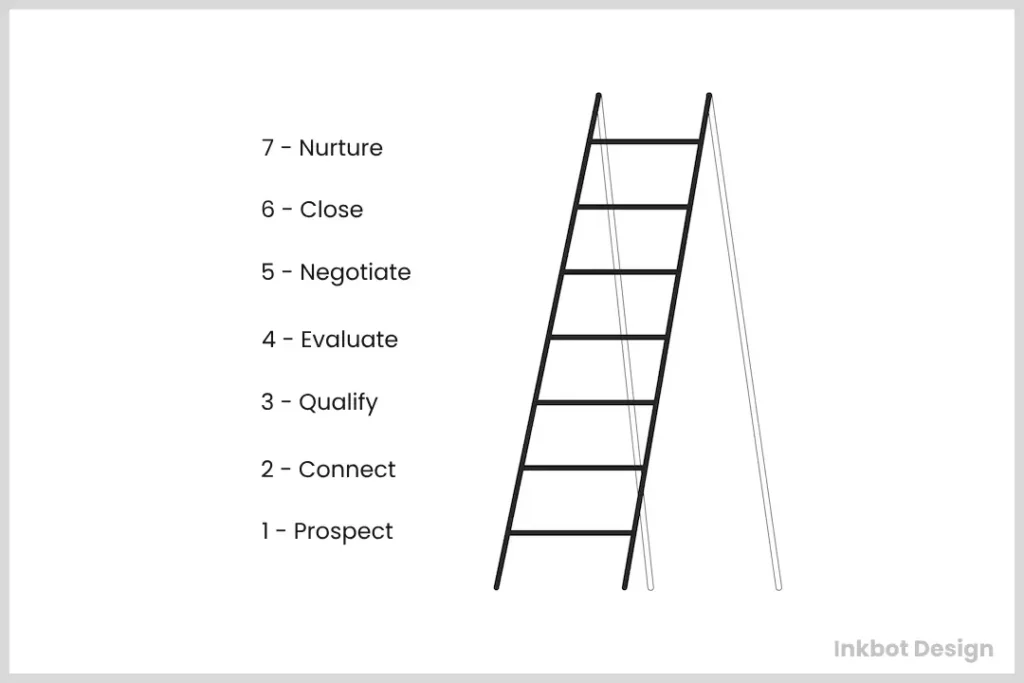
A sales ladder is pretty darn important. But how do you build one that fits your unique business? While there’s no one-size-fits-all solution, the most effective ladders have 5-7 rungs that represent the key stages a prospect moves through.
Here’s a typical example of what those stages might look like:
Stage 1 – Prospect
You’ve got raw leads or potential buyers who match your ideal customer profile at the base of the ladder. The challenge at this point is separating the genuine prospects (with real need, budget and authority) from the rest.
Stage 2 – Connect
Your SDRs attempt to initiate contact to determine if there’s a legitimate sales opportunity worth pursuing. This often involves calling, emailing, social outreach, researching the account, you name it.
Stage 3 – Qualify
Assuming you’ve made contact, it’s time to dig deeper and understand if their requirements, timelines, and situation align with your offering. The best sales ladder processes include thorough qualification criteria to invest your resources wisely.
The Science of Qualification: MEDDIC on the Ladder
To move a prospect from Qualify to Evaluate, you need more than a “good feeling”. Top-performing organisations in 2026 use the MEDDIC framework (or its evolution, MEDDPICC) to ensure deals are actually winnable.
- Metrics: What is the quantifiable economic impact for the prospect?
- Economic Buyer: Have you spoken to the person who actually controls the budget?
- Decision Criteria: What technical and business requirements are they using to judge you?
- Decision Process: How do they actually sign off on a purchase?
- Identify Pain: What is the “burning platform” that is driving them to seek a solution?
- Champion: Is there a powerful person inside their company fighting for you?
By requiring these six data points before a deal can reach the Evaluate rung, you prevent “pipeline bloat”—where your ladder is full of deals that will never actually close.
Stage 4 – Evaluate
At this stage, you’ve identified a qualified opportunity, and it’s time for the heavy lifting: conducting discovery calls, demos, proposals, and whatever else is needed to help the prospect thoroughly evaluate and vet your solution.
Stage 5 – Negotiate
If the evaluation goes well, you’ll enter the negotiation phase to resolve any final objections, terms, or pricing details. This is the make-or-break point where deals are often won or lost.
Stage 6 – Close
You’ve earned their trust and commitment! Now it’s time to dot the i’s and cross the t’s to finalise the agreement and welcome them aboard as a valued new customer.
Stage 7 – Nurture
Just because the deal is sealed doesn’t mean the ladder ends there. This crucial final phase is about delivering an exceptional post-sale experience to expand your footprint, renew contracts, and generate referrals.
Of course, this is just one example of structure. You may opt for more or fewer stages based on the complexity of your sales cycle and specific milestones that make sense for your business.
Modern sales engagement solutions can help streamline these stages and ensure consistency across your sales process. The key is tailoring the ladder steps to reflect your authentic buying journey.
Optimising the Climb – Tips for Sales Ladder Success
Simply having a sales ladder as your guiding framework isn’t enough – you need to make sure it’s rock solid, and your team is equipped to navigate it flawlessly. Here are some tips to help you optimise for maximum traction:
- Clearly Define Each Rung’s Criteria: Don’t be ambiguous about what actions, deliverables or qualification factors are required to advance from one stage to the next. Get granular!
- Built-in Coaching Checkpoints: Designate specific rungs where frontline managers must assess each opportunity, provide guidance, and grant permission for the rep to proceed to the next rung. This instils accountability and quality control.
- Establish Stage Exit Criteria: Have predetermined disqualification criteria that kick deals off the ladder if the fit isn’t right—no need to keep spinning your wheels fruitlessly.
- Equip Your Reps: Provide tailored coaching, tools, and resources for each stage, so reps know exactly what to do and say as opportunities progress.
- Make it Visible: Leverage CRM tools or visual dashboards that depict your live pipeline and each deal’s position on the sales ladder. Visibility breeds transparency and focus.
- Reinforce, Reinforce, Reinforce: Your sales ladder methodology needs to be deeply instilled through regular training, team meetings, call monitoring, and leading by example. Consistency is key!
Examples From the Real World

To visualise some real-life examples, let’s look at how a few major B2B companies have structured their ladders:
Salesforce’s Sales Cloud maps its process across seven linear stages:
- Lead
- Open
- Nurture
- Qualify
- Develop
- Negotiate
- Closure
Meanwhile, HubSpot uses a 7-stage circular “cycle” comprising:
- Prospect
- Appointment Set
- Qualify
- Presentation
- Decision
- Negotiation
- Closed/Won
For a more straightforward SMB example, a local marketing agency might have a 5-rung ladder like:
- Lead
- Qualified
- Proposal Sent
- Negotiating
- Closed Won
As you can see, there’s no single way to construct your ladder. The ideal setup depends on your unique sales motion, offering complexity, deal cycles and more.
The “Bottom-Up” Ladder: Sales in a PLG World
In 2026, many companies follow a Product-Led Growth (PLG) model. In this scenario, the prospect doesn’t start at the bottom of a traditional ladder; they are already using a free version of your software.
- Rung 1: Product Sign-up: The prospect becomes a user.
- Rung 2: Product Qualified Lead (PQL): The user reaches a “Eureka!” moment (e.g., they invite five teammates).
- Rung 3: The Human Touch: An SDR reaches out, not to sell, but to help the user get more value.
- Rung 4: Enterprise Expansion: The ladder shifts from “selling a tool” to “selling a site-wide solution.”
This hybrid approach requires a “soft climb.” If your reps are too aggressive too early, they will break the user’s trust and cause them to churn before they even reach the Evaluate stage.
Standard Sales Ladder Struggles (And How to Overcome Them)
Like any strenuous uphill journey, navigating the sales ladder comes with its fair share of obstacles and pitfalls to avoid. Here are some of the most frequent challenges and how to conquer them:
The Silo Effect
The Problem: Each department or sales role views the ladder from a limited vantage point—marketing hands off ill-qualified leads. SDRs don’t align with how AEs manage the process, etc. These silos lead to significant breakdowns and stagnation.
The Solution: Foster cross-functional collaboration and alignment from the outset. Have collective ownership, over-optimising the entire ladder as one cohesive team. Implement consistent service-level agreements (SLAs) to ensure seamless handoffs.
Getting Stuck in Park
The Problem: Reps get opportunities stranded indefinitely on the same ladder rung, unable to advance them or make the tough disqualification call. Deals languish in limbo, draining resources and productivity.
The Solution: Rigorously enforce qualifying criteria and stage exit policies so deals cannot idle endlessly without clear next steps. Provide decisive coaching to overcome sticking points or exit gracefully.
Contradictory Ladder Anarchy
The Problem: Reps arbitrarily mix and match components from different sales methodologies or impose their makeshift ladders, undermining standardisation and creating apples-to-oranges reporting nightmares.
The Solution: Establish one sanctioned, universally adopted sales ladder as the definitive playbook – no exceptions. Any deviations or shadow processes must be rooted out through consistent coaching and accountability.
Runaway Ladder Jumping
The Problem: Reps get overly eager or try to take shortcuts by skipping crucial ladder stages or qualification milestones. This leads to sloppy, premature proposals that inevitably stall or get rejected.
The Solution: Bark if not bite, emphasising the rationale behind each sales funnel stage and instilling discipline around earning the right to progress. Use technology controls in your CRM to prevent stage advancement when the required criteria are not met.
Diagnosing the “Stuck Deal” Syndrome
If your pipeline looks like a “bulge” in the middle, you have a Ladder Leakage problem. This usually happens at the transition between Qualify and Evaluate.
- The Symptom: Your team has 100 “Qualified” deals but only 5 “Demos” scheduled.
- The Cause: Your Exit Criteria are too weak. Reps are moving leads up the ladder simply because they had a nice chat, not because the prospect has a confirmed budget or timeline.
- The Fix: Implement a “Hard Gate.” A deal cannot move to Evaluate until the prospect’s Economic Buyer signs off on the Discovery Document.
Ladder Gradation – Seeing the Satisfying Payoff
Okay, let’s talk about the gratifying feeling of seeing all that hard ladder work translate into closed deals and thrilled new customers! When your team internalises and diligently follows your sales ladder steps, the benefits quickly emerge:
- Higher Close Rates: By qualifying opportunities thoroughly and guiding them down the most fitting path, you’ll convert more of your pipeline into actual revenue. To support this process, Lative can help teams track and plan their sales capacity more effectively.
- Bigger Deals: Following a strategic, consultative process positions you for larger, more expansive purchases.
- Shorter Sales Cycles: There’s less wasted time or backtracking since you’re always focused on the next relevant milestone.
- Better Forecasting: With an orderly ladder methodology, you’ll gain far greater visibility into your sales pipeline and the ability to accurately project what’s coming down the line.
- Improved Customer Experience: Buyers will appreciate your ladder’s value-driven, hassle-free purchasing journey rather than a disjointed, high-pressure mess.
But beyond those tangible metrics, the true graduate-level payoff comes from the overall culture shift a successful sales ladder creates. Your organisation will exude professionalism, credibility, and trustworthiness, enhancing your brand reputation.
Prospects will relish the straightforward educational experience. Your reps will operate with defined purpose, control, and efficiency rather than shooting from the hip.
And leadership gains supreme confidence that revenue projections are grounded in reality rather than hopeful guesswork. That kind of transformation makes the climb more than worth the effort!
Measuring Success: The KPIs of the Climb
To master the ladder, you must move beyond just counting “Closed-Won” deals. You need to measure the physics of your sales process.
- Stage Conversion Rate: What percentage of leads move from Rung 2 to Rung 3? If this is below 15%, your ICP (Ideal Customer Profile) is likely too broad.
- Pipeline Velocity: This is the speed at which a lead moves from the bottom to the top. Formula: (Number of Opportunities x Deal Value x Win Rate) / Sales Cycle Length.
- Stall Rate: The percentage of deals that haven’t moved rungs in 30 days. In 2026, a stall rate over 40% is a leading indicator of a missed quarterly revenue target.
The 2026 Sales Ladder Tech Stack
In the modern era, you cannot climb the ladder manually. High-velocity teams use a curated stack of “Autonomous Sales” tools to handle the heavy lifting.
Rungs 1-2: Prospecting and Connecting
Tools like LinkedIn Sales Navigator and ZoomInfo are essential for identifying the right people. However, the real shift in 2026 is the use of Outreach or SalesLoft to automate multi-channel sequences—emails, calls, and social touches—ensuring no lead is forgotten at the base of the ladder.
Rung 4: Evaluation and Discovery
This is where Revenue Intelligence comes in. Tools like Gong or Chorus.ai record and analyse discovery calls. They use AI to flag “competitor mentions” or “pricing objections,” giving managers the data they need to coach reps before they move to the Negotiate rung.
Rungs 5-6: Negotiation and Closing
Modern CRM platforms like Salesforce or Pipedrive now include “Predictive Forecasting.” These systems analyse historical data to estimate the probability of a deal closing based on how long it has been on a specific rung. If a deal stays in Negotiate for 20% longer than your average, the system alerts the Account Executive to take corrective action.
Sales Ladder FAQs
What is the difference between a sales ladder and a value ladder?
A sales ladder tracks the seller’s journey and the stages of a deal. A value ladder tracks the customer’s journey, specifically how they move from a low-priced introductory offer to your most expensive, high-value premium services over time.
How do I handle the handoff between an SDR and an AE on the ladder?
The handoff usually occurs between the Qualify and Evaluate rungs. The SDR is responsible for identifying the pain and the fit, while the Account Executive takes over once a formal discovery meeting or demo is scheduled. Use a “Sales Action Plan” document to ensure no context is lost during the jump.
Is a 5-step ladder better than a 7-step ladder?
Complexity is the enemy of execution. For transactional sales (lower price point, shorter cycle), a 5-step ladder is ideal. For enterprise B2B sales involving multiple stakeholders, a 7-step ladder—including a specific “Legal & Procurement” rung—is necessary to accurately forecast closing dates.
How does AI change the sales ladder in 2026?
AI primarily automates the “Prospect” and “Connect” rungs. Autonomous agents can now research a prospect’s LinkedIn profile, financial reports, and recent news to craft a hyper-personalised outreach message, allowing humans to focus their energy on the Negotiate and Close rungs.
What should I do if a prospect wants to skip rungs?
When a prospect asks for a price (the Negotiate stage) before you’ve done a demo (the Evaluate stage), they are “jumping the ladder.” This often leads to price-shopping. Gently guide them back by saying, “I want to give you an accurate quote, but first, I need to ensure our solution fits your specific technical requirements.”
Conclusion
In the ever-evolving sales funnel, having a well-designed and faithfully executed sales ladder isn’t just a nice-to-have – it’s an absolute necessity for driving consistent revenue growth.
Providing a clearly defined path with tangible milestones aligns your team around a uniform methodology for qualifying, nurturing, and closing more deals effectively and efficiently.
More than just a process, though, a robust sales ladder is the backbone for delivering a professional, credible buying experience that nurtures lasting customer relationships. With its help, your reps trade aimless ramblings for purposeful progression up an intentional path paved with training, tools, and visibility at every step.
Traversing the sales ladder still requires immense skill, determination and strategic decision-making from your frontline crew. But by equipping them with this vital framework, you’ll empower them to scale new heights rather than get entangled in contradictory approaches or wasteful busywork.
So don’t leave your sales efforts to happenstance – construct that solid sales ladder and watch as your team ascends it to the performance peaks you’ve only envisioned until now. The view from the top, with a systematic pipeline overflowing with new potential customers, will make the climb more than worthwhile.