Newspaper Advertising Guide: ROI, Design & Strategy
Let’s get the elephant out of the room immediately.
You have likely heard that “print is dead.”
Digital marketers have been screaming this from the rooftops for the better part of two decades. They have charts, graphs, and a vested interest in selling you PPC management services.
But here is the uncomfortable truth: if print were truly dead, why do luxury brands, supermarkets, and astute local businesses still pour billions into it?
The answer is Trust.
In an era of deepfakes, bot traffic, and fleeting 3-second attention spans on TikTok, the newspaper remains a bastion of authority.
When an audience reads a newspaper, they are not scrolling while waiting for a bus; they are engaged in a singular task. They are focused.
For the entrepreneur, newspaper advertising is no longer about mass awareness—it is about prestige and permanence. This guide removes the fluff. We are going to look at the mechanics, the maths, and the design principles required to make newsprint work for your bottom line.
- Print builds trust and prestige by associating your brand with vetted journalism and focused reader attention.
- Negotiate off the rate card; pursue remnant space and speed to secure steep discounts for better ROI.
- Design for newsprint: CMYK, max 240% ink coverage, 300 DPI, 100% K for body text, high contrast.
- Track print performance with dynamic QR codes, vanity URLs and dedicated phone numbers to measure offline-to-online ROI.
What is Newspaper Advertising?
Newspaper advertising is the practice of placing paid commercial messages within print publications, ranging from local community weeklies to national dailies.
Unlike digital inventory, which is infinite and algorithmic, newspaper space is finite, physical, and static.
To execute this correctly, you must understand its three core components:
- The Inventory: The physical space on the page (measured in column inches or modules).
- The Circulation: The total number of copies distributed (paid and free).
- The Readership: The actual number of people who read the paper (usually 2.5x the circulation due to pass-along rates).
Note: Do not confuse circulation with readership. You pay for circulation, but you benefit from readership. Always ask for the latter data when negotiating.
The “Trust Architecture”: Why Print Still Works
We deal with clients daily who are obsessed with “going viral.” But viral is fleeting. Trust is currency.
According to data from Nielsen’s Trust in Advertising Report, consumers consistently trust print advertising (newspapers and magazines) more than search engine ads, social networks, and online video ads.
Why?
Because the barrier to entry is higher. Any scammer can spin up a Facebook ad for £50. Taking out a half-page ad in The Times or even your local Manchester Evening News requires capital, intent, and identity verification.
The medium itself validates the message. This is the Halo Effect. When your brand appears alongside vetted journalism, it borrows the publication’s credibility.
The Haptic Memory Advantage
There is also a biological factor at play. A study by Temple University and the USPS found that physical advertisements trigger activity in the ventral striatum (the brain’s valuation centre) more significantly than digital ads.
Touching the paper creates a stronger memory encoding—a concept known as “haptic memory.” You remember what you touch. You forget what you scroll past.
The Mechanics of Buying Space: Don’t Pay Rate Card
If there is one rule you take away from this guide, let it be this: The Rate Card is a work of fiction.
Newspaper sales representatives are under immense pressure to fill the paper. A blank space on page 4 acts as a monument to their failure. This gives you, the buyer, a level of leverage.

The “Remnant Space” Strategy
“Remnant space” refers to unsold ad spots that exist right before the paper goes to print. The publisher would rather sell this space at an 80% discount than print a house ad (an ad for the newspaper itself).
How to get it:
- Contact the advertising department.
- State clearly: “I have a budget of £X. I am interested in any remnant space available for next Tuesday’s edition.”
- Have your creative (artwork) ready to go immediately. Speed is your bargaining chip.
Script: How to Talk to a Media Sales Rep
Sales reps smell fear. Use this script to signal you are a pro who won’t pay the Rate Card.
You: “Hi, I’m looking at the [Publication Name]. I have a strict budget of £[X] for a direct response campaign.”
Rep: “Our rate card for a quarter page is £2,000.”
You: “That won’t work for my ROI model. I’m not interested in prime positioning. Do you have any Remnant Space or Standby slots available for next week’s run? I can have the artwork ready in 24 hours if the price is right.”
Why it works: You offer speed and flexibility (which helps them fill a hole) in exchange for a discount.
ROP vs. Preferred Positioning
- ROP (Run of Paper): The newspaper places your ad wherever it fits. This is the cheapest option.
- Preferred Positioning: You pay a premium to ensure your ad appears in a specific section (e.g., Finance, Sport) or on a specific page (e.g., Page 3, or the right-hand page).
The Consultant’s Reality Check:
I once audited a client who was paying a 25% premium for “Early Right Hand Page” positioning. We switched them to ROP, saving them £4,000 a month. Their response rate dropped by… zero. For most SMBs, position matters less than the offer. Save the premium; spend it on better design.
Designing for Newsprint: The Technical Minefield
This is where 90% of businesses fail. You cannot simply take your shiny Facebook ad, export it as a PDF, and stick it in a newspaper.
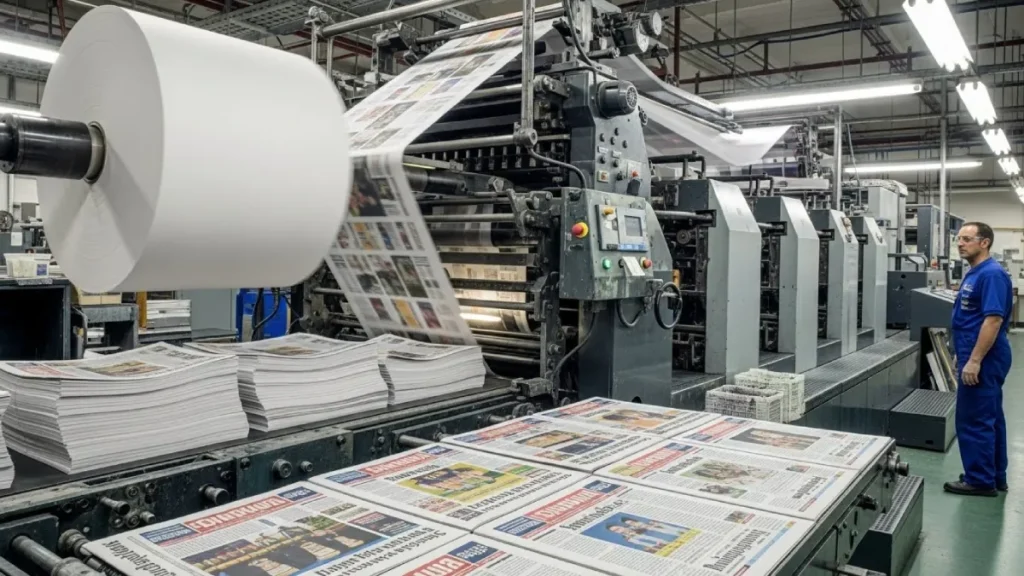
Newsprint is porous. It acts like a paper towel. If you put a drop of ink on it, that dot spreads. This phenomenon is called Dot Gain.
1. The Ink Density Rule
If your total ink coverage (TIC) exceeds 240-260% (depending on the paper grade), the paper will become oversaturated. The ink will smudge, the text will blur, and your ad will look like a muddy bruise.
- Fix: Ensure your designer converts images to the correct CMYK profile for uncoated newsprint (often ISO Coated v4).
2. Typography and Contrast
Newsprint is not white; it is off-white or grey. Low-contrast text (such as light grey on white) will be difficult to read.
- Do: Use 100% Black (K) for body text.
- Do Not: Use rich black (C+M+Y+K) for small text—registration errors will cause “ghosting” where the colours don’t align perfectly, making the text unreadable.
Copy-Paste: The Technical Brief for Your Designer
Don’t let your web designer guess. Copy this and send it to them.
Project: Newspaper Ad Creative Specs:
- Colour Mode: CMYK (Not RGB).
- Resolution: 300 DPI minimum at 100% scale.
- Ink Density (TIC): Max 240%. (Do not use “Rich Black” for text; use 100% K).
- Fonts: Using a sans-serif font for body text is safer. Minimum size 10pt.
- Contrast: High contrast only. No dark text on dark backgrounds.
- Bleed: usually 0mm (Newspaper ads sit inside a border), but check specific publication specs.
3. The “Z” Pattern
Readers scan newspaper pages in a “Z” pattern. They start at the top-left, scan across to the top-right, cut diagonally to the bottom-left, and finish at the bottom-right.
- Strategy: Place your headline top-left/centre. Place your CTA (Call to Action) bottom-right. This aligns with natural eye movement.
For more information on visual structure, refer to our guide on Visual Hierarchy.
The Hybrid Strategy: Bridging Analogue and Digital
The biggest criticism of print is its inability to track. “How do I know it worked?”
If you simply put your homepage URL (www.yoursite.com) at the bottom of the ad, you deserve to lose your money. You must bridge the gap between the physical and digital worlds.
1. QR Codes (Done Correctly)
Post-2020, everyone knows how to use a QR code.
- The tactic: “Scan to unlock a 20% discount.”
- The tech: Use a dynamic QR code that points to a specific UTM-tagged URL. This allows you to see exactly how many people scanned the ad in the Tuesday Gazette versus the Friday Post.
2. Vanity URLs
Use a short, memorable URL that redirects to a tracking page.
- Example: yoursite.com/times (for an ad in The Times).
- Why: It is easy to type and easy to track.
3. Call Tracking
Use a dedicated phone number for the print run. Services like CallRail allow you to purchase a local number for a fraction of the cost. If that phone rings, you know it came from the newspaper ad 100%.
Types of Newspaper Ads: Choosing Your Weapon
Not all ads are created equal. The format you choose dictates the perception of your brand.
| Ad Type | Description | Best Use Case | Cost Profile |
| Display Ad | Graphical ads can appear anywhere. Sizes vary from 1/8 page to Full Page. | Brand building, major product launches. | High. |
| Classifieds | Text-heavy, small listings grouped by category (Jobs, Services, Autos). | Recruitment, local trades, direct response. | Low. |
| Inserts (FSI) | Loose-leaf flyers tucked inside the paper. | Retail offers, supermarket coupons, takeaways. | Medium (Print + Distribution cost). |
| Advertorial | Ads designed to look like editorial content. | Complex products requiring education (Health, Finance). | High. |
Quick Guide: Standard Ad Sizes
While every paper varies slightly (Tabloid vs. Broadsheet), these are the industry standards.
| Name | Approx Size (mm) | Best For |
| Full Page | 340 x 265 (Tabloid) | Major launches, big impact. |
| Half Page (Horizontal) | 170 x 265 | Storytelling, “Above the fold” dominance. |
| Quarter Page | 170 x 130 | The workhorse. Good for offers/coupons. |
| Strip / Banner | 50 x 265 | Footer placement. Brand frequency. |
| Ear / Solus | Small square on Front Page | High visibility, prestige. |
The Power of the Advertorial
An advertorial (or “native advertising“) often outperforms standard display ads because it bypasses the reader’s “ad blindness.” If your ad resembles an informative article about “New Tax Laws for Landlords,” landlords will be more likely to read it. If the content is valuable, they will trust the pitch at the end.
Real-World Examples: The Good, The Bad, and The Genius
Let’s look at who did it right. To see a curated list of high-calibre print work, check out our collection of the best print ads.
1. KFC’s “FCK” Apology (2018)
When KFC ran out of chicken in the UK due to a logistics failure, they didn’t send a tweet. They took out full-page ads in The Sun and The Metro. The image showed an empty bucket with the letters rearranged to read “FCK.”

- Why it worked: It was humble, self-deprecating, and the medium (print) showed they were taking the apology seriously. It turned a PR disaster into a masterclass in brand voice.
2. The Local Estate Agent Strategy
A client of ours, a bespoke estate agent, stopped spending on Rightmove banners and purchased the “Footer Strip” (the bottom 2 inches) of the front page of their local village paper for 52 consecutive weeks.
- The Result: They became the “default” agent for that postcode. The repetition built familiarity that digital retargeting (which feels like stalking) could not achieve.
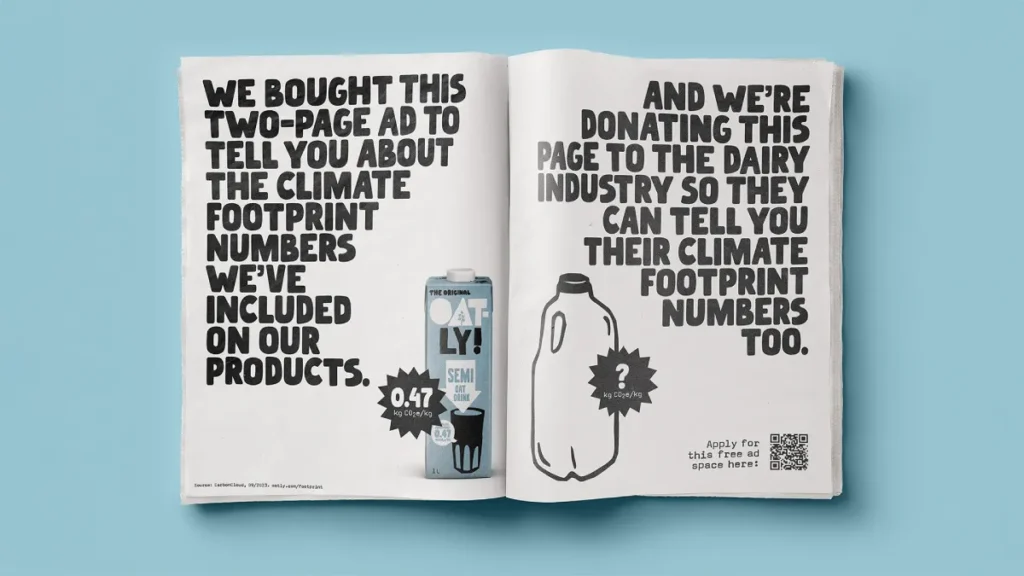
3. Oatly’s Long-Copy Ads
Oatly often uses text-heavy, self-aware ads in newspapers. They know that newspaper readers are a discerning audience. They are willing to read 300 words if it is entertaining. This counters the trend of “make the logo bigger and cut the copy.”
The State of Newspaper Advertising in 2026
We are seeing a shift. The “death of print” has plateaued, and we are entering the “Premium Niche” phase.
Hyper-Local Renaissance
National circulation is declining, but hyper-local community papers are experiencing a resurgence. People care about their council tax, their local schools, and their bin collections. These papers have extremely high engagement rates. For a local SMB, a mention in the Highgate Wood news is worth 10x a mention on a generic London blog.
Programmatic Print
Yes, this is real. Platforms are emerging that enable media buyers to purchase print inventory programmatically, much like digital display. This reduces the friction of negotiation and booking, making it easier to execute multi-publication campaigns across the UK.
The Consultant’s Verdict
Newspaper advertising is not a magic bullet. If your offer is weak or your design is cluttered, you will fail. But if you are selling a high-value product or service, or you need to build trust in a specific geographical area, it is an essential part of the mix.
Do not treat it as a legacy channel. Treat it as a trust channel.
Next Steps
If you are ready to integrate high-impact print into your strategy, stop guessing.
- Audit your creative: Is it designed for ink absorption and contrast?
- Define your tracking: How will you measure the “Offline to Online” hop?
- Get professional help: Print is expensive to get wrong.
Frequently Asked Questions
Is newspaper advertising still effective in the UK?
Yes, particularly for reaching older demographics (45+) and building local brand trust. Data shows that print ads generate higher recall rates than digital banner ads due to the focused nature of the reading environment.
How much does a newspaper ad cost?
Costs vary wildly. A local weekly might charge £200 for a quarter-page, while a national daily like The Daily Telegraph could charge £20,000+ for a full page. Always negotiate off the rate card; discounts of 50-80% are common for remnant space.
What is the difference between ROP and Preferred Positioning?
ROP (Run of Paper) means the newspaper decides where your ad appears, which is cheaper. Preferred Positioning guarantees a specific spot (e.g., Page 3, Sports Section) but attracts a premium surcharge.
How do I track the ROI of a newspaper ad?
Use direct response mechanisms. Include a dedicated phone number (call tracking), a custom QR code, or a “vanity URL” (e.g., yoursite.com/offer) to measure traffic specifically generated by the print ad.
What is the best day to advertise in a newspaper?
It depends on the industry. Recruitment works best on Wednesdays or Thursdays. Entertainment and Retail perform well on Fridays and Saturdays. Sunday papers offer the highest engagement time as readers are more relaxed.
What is “Dot Gain” in print design?
Dot gain occurs when ink spreads as it absorbs into porous newsprint, making images look darker and text blurry. Designers must compensate for this by lightening images and avoiding heavy ink coverage (TIC).
Should I use colour or black and white?
Colour attracts more attention, but it also costs significantly more. For text-heavy classifieds or simple service offers, black and white is a more cost-effective option. For brand awareness and food products, colour is essential.
What are “Inserts” in newspaper advertising?
Inserts (also known as Free Standing Inserts – FSIs) are separate flyers inserted into the newspaper. They are effective because they fall out when the reader opens the paper, demanding physical attention.
How long should my newspaper ad copy be?
Newspaper readers are willing to read more than social media users. If the headline is compelling, long-copy ads (200+ words) can work exceptionally well to educate customers and build a persuasive argument.
Why do newspapers have different column widths?
Historically, this was due to the mechanics of printing presses. Standard Advertising Units (SAUs) have standardised this somewhat, but you must always request the specific “mechanical specs” from the publication before designing.