What is Greenwashing? The Truth About Sustainability
If you walk into a boardroom today and suggest “slapping a green leaf” on your packaging to boost sales, you aren’t just out of touch—you’re a liability.
I’ve spent years auditing brands that think they can “vibes-based” their way into the sustainability market.
They use soft-focus photography of forests and sprinkle words like “natural” or “earth-friendly” across their websites as if it’s a magical shield against cynicism.
It isn’t. In 2026, your customers are smarter than your marketing department, and the regulators are faster than your PR team.
Greenwashing is the most expensive shortcut an entrepreneur can take. It’s a brand-killer masquerading as a growth strategy.
When you get caught—and you will—the cost isn’t just a fine from the CMA; it’s the total evaporation of consumer trust. You can’t buy that back with a “planting trees” pop-up at checkout.
- Greenwashing is making inflated or false environmental claims using vague language, selective data, or symbolic imagery to mislead consumers.
- Regulators (e.g., CMA, ASA, FTC) and AI audits now detect and penalise unverified claims, risking fines and reputational collapse.
- Authentic sustainability requires proof: public Life Cycle Assessment, Scope 1–3 transparency, third‑party standards, and specific measurable claims.
What is Greenwashing?

Greenwashing is the practice of making inflated, misleading, or outright false claims about the environmental benefits of a product, service, or corporate strategy.
It is a form of marketing spin where “green” PR is used to overcompensate for a lack of substantive environmental action.
In the context of ethical branding, greenwashing represents a fundamental breach of the contract between a brand and its audience.
It relies on the “Halo Effect,” in which a single positive attribute (such as recyclable packaging) is used to distract from a systemic negative impact (such as high-carbon manufacturing).
The three core elements of greenwashing include:
- Selective Disclosure: Highlighting a narrow set of “green” data points while obscuring a larger, more damaging environmental footprint.
- Vague Language: Using terms that have no legal or technical definition—such as “eco-conscious” or “sustainable-ish”—to imply a benefit that does not exist.
- Symbolic Decoupling: Aligning a brand with environmental symbols (the colour green, leaves, earthy textures) without any underlying change in business operations.
The Evolution of the “Green” Lie
We’ve moved past the era of simple lies. In the early 2010s, greenwashing was often amateurish—think of a plastic bottle with a picture of a mountain on it. Today, it has evolved into a sophisticated technical deception.
According to McKinsey & Company, there is a clear correlation between products making environmental claims and increased consumer spending. However, this financial incentive has birthed a culture of “claim inflation.”

The Seven Sins (and the 2026 Update)
While the original “Seven Sins of Greenwashing” provided a framework, we need to view them through a modern lens.
- The Sin of the Hidden Trade-off: A brand claims its product is “energy efficient” but ignores that the lithium in its battery was mined through environmentally devastating processes.
- The Sin of No Proof: Making a claim that cannot be verified by easily accessible supporting information. If I have to go to page 14 of a PDF footer to find your data, you’re hiding.
- The Sin of Vagueness: Words like “Green” or “Natural” are the “Live, Laugh, Love” of branding. They mean nothing and serve only to fill space.
- The Sin of Irrelevance: “CFC-free” was a classic example. CFCs have been banned for decades. Claiming it now is like a car manufacturer claiming their steering wheel won’t explode on impact. It’s the law, not a feature.
- The Sin of the Lesser of Two Evils: High-efficiency cigarettes or “organic” diesel. You’re still selling poison; you’ve just put a filter on it.
- The Sin of Fibbing: Outright lies. These are rarer in the age of internet sleuths, but still happen in supply chain reporting.
- The Sin of Worshipping False Labels: Creating your own “Certification Board” that looks official but is just a shell company you own.
The Rise of “Greenhushing”
An interesting phenomenon has emerged in 2025 and 2026: Greenhushing. This is when companies intentionally under-report their sustainability achievements because they are terrified of being “cancelled” for not being perfect.
This is equally dangerous for your brand identity. If you are doing the work but staying silent, you lose the competitive advantage. The goal isn’t silence; it’s precision.
The “Carbon Neutral” vs “Net Zero” Trap
In 2026, using the term “Carbon Neutral” in your branding is an effective invitation to an audit. To the uninitiated, these terms seem interchangeable; to a regulator, they represent the difference between a PR stunt and a scientific commitment.
Carbon Neutral typically relies heavily on Carbon Offsetting. A brand calculates its emissions and pays a third party to “cancel them out” by planting trees or protecting a forest. The problem? Most offsets are technically flawed. Recent investigations into major carbon credit providers have shown that many “protected” forests were never at risk, or the trees planted died within three years.
Net Zero, as defined by the Science Based Targets initiative (SBTi), is far more rigorous. It requires a brand to reduce its absolute emissions by at least 90% across Scope 1, 2, and 3 before even considering offsets for the final 10% of “residual” emissions.
Scenario: A fashion brand claims to be “Carbon Neutral” by buying cheap credits while its factory in Bangladesh continues to run on coal power. In 2026, the Advertising Standards Authority (ASA) would likely ban this ad for misleading the public about the brand’s actual decarbonisation progress.
The State of Greenwashing in 2026: Regulation and AI
We are currently in a “Post-Vague” era. The UK’s Competition and Markets Authority (CMA) has fully implemented the Green Claims Code, and they are not playing games.
In the last 12 months, we’ve seen a shift toward “Algorithmic Auditing.”
Regulators are now using AI to scrape thousands of websites simultaneously, looking for specific trigger words and cross-referencing them with public ESG filings.
If your website claims you are “on track for Net Zero” but your financial reports show increased investment in heavy-duty logistics without offsets, an automated flag is raised before a human even looks at your site.
The Pricing of Carbon Risk
Pricing has also changed. In 2026, “Greenwashing Insurance” is a legitimate product—and the premiums are skyrocketing. Investors are now treating environmental missteps as “Material Financial Risks.”
If your branding is found to be deceptive, your credit rating could drop. This isn’t just about marketing; it’s about your bottom line.
The Global Regulatory Lockdown: Beyond the CMA
While the UK’s Competition and Markets Authority (CMA) remains the primary watchdog for British businesses, 2026 marks a shift toward global regulatory synchronisation.
If your brand operates across borders, you are no longer just subject to the Green Claims Code; you are now navigating a minefield of international enforcement.
The European Union (EU) has effectively ended the era of “self-certified” sustainability.
Under the Corporate Sustainability Reporting Directive (CSRD) and the Directive on Empowering Consumers for the Green Transition, vague claims such as “climate neutral” or “environmentally friendly” are now prohibited across the bloc unless backed by recognised, high environmental performance.
This isn’t a suggestion; it is a trade requirement.
In the United States, the Federal Trade Commission (FTC) has finalised the 2026 update to its “Green Guides.” The focus has shifted heavily onto “Carbon Offsets” and “Recyclability.”
For example, if your product is labelled “recyclable” but cannot be processed by at least 60% of recycling facilities in the communities where it is sold, the FTC now considers that deceptive marketing.
Key Regulatory Bodies to Watch:
- International Sustainability Standards Board (ISSB): The global baseline for sustainability-related financial disclosures.
- European Financial Reporting Advisory Group (EFRAG): The architects of the technical standards UK exporters must now meet.
- Financial Conduct Authority (FCA): In the UK, the FCA’s Sustainability Disclosure Requirements (SDR) now ensure that investment funds can only be labelled “Sustainable” if they meet strict criteria, ending “greenwashing” in the ISA and pension markets.
Why Technical SEO and Greenwashing are Linked
You might wonder why a branding agency is talking about SEO in a greenwashing guide. Here is the technical truth: Search engines are now built to detect “Trust Signals.”
Google’s E-E-A-T (Experience, Expertise, Authoritativeness, and Trustworthiness) updates have increasingly penalised sites that make unsubstantiated health or environmental claims. If your site is flagged by a regulatory body for deceptive practices, your organic rankings will tank.
When we help clients with sustainability branding, we ensure that every claim is backed by a dedicated landing page containing raw data, third-party audits, and clear definitions. This is how you win in 2026.

Comparing the Amateur vs. the Pro Approach
| Feature | The Amateur (Greenwashing) | The Professional (Authentic) |
| Terminology | Uses “Eco-friendly” and “Green.” | Uses “15% reduction in Scope 2 emissions.” |
| Imagery | Stock photos of hands holding soil. | Actual photos of the manufacturing facility. |
| Certifications | Self-made “Earth-First” badges. | B-Corp Certification, ISO 14001, or Carbon Trust. |
| Data Access | “Trust us, we’re trying.” | Real-time dashboard of supply chain metrics. |
| Call to Action | “Buy now to save the planet.” | “Read our 2026 Impact Report.” |
Select your current marketing focus to see if you’re hitting technical benchmarks or risking a CMA audit.
Need a technical audit of your brand strategy?
Request a QuoteDebunking the “Third-Party Shield” Myth
Here is the uncomfortable truth: Most third-party eco-labels are garbage.
There are currently over 450 different “eco-labels” globally. Many are “pay-to-play.” A common mistake I see entrepreneurs make is thinking that if they pay for a certain badge, they are safe from accusations of greenwashing.
In reality, the ASA and CMA have ruled that a brand is responsible for the accuracy of its claims regardless of whether a third party “certified” them.
If that third party’s standards don’t meet the legal requirements of the UK’s Green Claims Code, you are the one who pays the fine, not the certification body.
Data from a 2025 Deloitte study indicates that 40% of consumers find environmental logos “confusing” or “meaningless.” Relying solely on a badge without explaining the “how” behind it is a lazy branding strategy that will fail you.
Real-World Failure: The HSBC Tree Fiasco
In 2022, the ASA banned HSBC’s bus stop posters. The ads spoke about their “ambition” to provide up to $1 trillion in financing to help clients transition to net zero and their plan to plant trees.
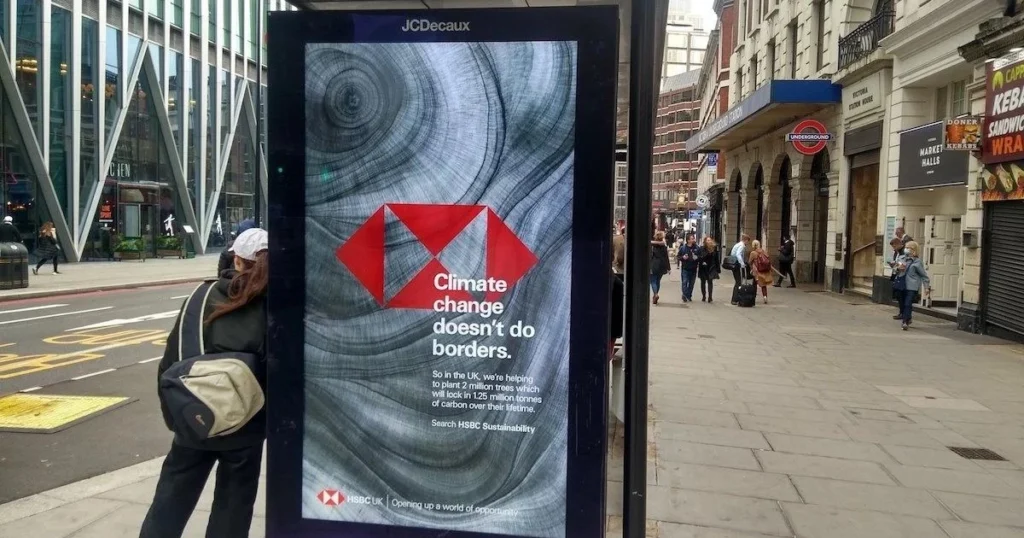
The problem? The ads conveniently ignored HSBC’s continued multi-billion dollar financing of thermal coal and oil, and gas. The ASA ruled that the ads omitted material information, making the “green” claims misleading.
The lesson here is simple: You cannot talk about your “Green” wins if you are hiding your “Brown” baggage.
Implementing a “Proof-First” Marketing Workflow
To survive a 2026 regulatory audit, your marketing department must operate more like a legal department. You need a “Verification Loop” for every single claim.
| Claim Type | The “Amateur” Approach | The 2026 “Pro” Approach |
| Recyclability | “100% Recyclable” | “Recyclable in 70% of UK local authorities. Check your postcode.” |
| Material Source | “Ethically Sourced” | Global Organic Textile Standard (GOTS) certification ID provided. |
| Carbon Impact | “Net Zero Brand” | “Scope 1 & 2 verified by Carbon Trust; Scope 3 roadmap published.” |
| Longevity | “Built to Last” | “Free repair service provided; 5-year durability testing data available.” |
The 3-Step Verification Checklist:
- Is it specific? Change “Eco-friendly” to “Reduced water usage by 30%.”
- Is there a link? Every claim on a social media tile or billboard must include a QR code or a short link to the Sustainability Data Hub.
- Is it the whole truth? If you are talking about your “Green” collection, is the “Brown” part of your business mentioned in your annual report?
The Technical Minimum: Life Cycle Assessment (LCA)
If you want to move beyond “vibes-based” marketing, you need a Life Cycle Assessment (LCA). This is the scientific methodology used to calculate a product’s environmental impact from “cradle to grave.”
An LCA doesn’t just look at the carbon emitted during shipping; it accounts for:
- Raw Material Extraction: The energy used to mine lithium or grow organic cotton.
- Manufacturing: The water consumption and chemical runoff at the factory.
- Distribution: The packaging weight and transport fuel.
- Use Phase: How much energy a consumer uses to run or wash the product.
- End of Life: Whether the product ends up in a landfill, a furnace, or a circular loop.
In 2026, “Proof-First” marketing means making your LCA data public. Brands like Allbirds and Oatly pioneered this by printing carbon footprints directly on their packaging.
Today, this is the gold standard for avoiding accusations of greenwashing. If you cannot provide a summary of your LCA, you should not be making environmental claims.
1. Master Your Supply Chain (Scope 1, 2, and 3)
You cannot make a claim about your product if you don’t know where the raw materials came from.
- Scope 1: Direct emissions (your office, your vehicles).
- Scope 2: Indirect emissions (the electricity you buy).
- Scope 3: Everything else (your suppliers, the end-of-life disposal of your product).
In 2026, circular branding is the only way to address Scope 3 effectively.
2. Use “Friction” as a Trust Signal
Paradoxically, telling your customers where you are failing builds more trust than claiming perfection.
“Our packaging is 80% recycled; we are still working on the last 20% because current technology makes it too fragile for shipping.”
That sentence is bulletproof. It shows you know your business, you’ve tested the tech, and you’re being honest about the limitations.
3. Focus on Inclusive and Active Design
Sustainability isn’t just about carbon; it’s about people. Integrating inclusive design and brand activism ensures that your “green” claims are part of a larger, more robust ethical framework.
This makes your brand harder to attack because your values are consistent across all departments, not just marketing.
Industry Spotlights: Where the Risks Live in 2026
1. The Fashion Industry: The “Recycled Polyester” Myth.
For years, fast-fashion giants claimed “sustainability” by using recycled polyester from plastic bottles (rPET). In 2026, this is viewed as a “hidden trade-off.” Taking a bottle that could have been recycled back into a bottle (a closed loop) and turning it into a garment that cannot be recycled (a linear dead-end) is now flagged as greenwashing by the Changing Markets Foundation.
2. The Tech Sector: The “AI Sustainability” Paradox.
Tech companies are currently under fire for claiming to be “Green” while rapidly scaling Artificial Intelligence models that consume massive amounts of electricity and water for cooling. A brand claiming to be “Powered by 100% Renewables” while ignoring the massive water-stress impact of its data centres is a prime candidate for a PR backlash.
3. Financial Services: “Green” Funds and the SFDR.
The Sustainable Finance Disclosure Regulation (SFDR) in the EU now requires investment funds to categorise themselves (Article 6, 8, or 9). If a fund is marketed as “Green” (Article 9) but holds stocks in airlines or traditional oil majors without a clear transition plan, it is now subject to massive “Greenwashing” fines from financial regulators.
The Verdict
Greenwashing is the death rattle of a brand that has run out of ideas. It is a cynical attempt to exploit the public’s genuine concern for a short-term spike in the share price.
In 2026, the technical and legal environment has made greenwashing a high-risk, low-reward gamble. If you want to build a brand that lasts, you need to stop looking for shortcuts.
You need to do the work, document the process, and speak with the precision of a scientist, not the fluff of a copywriter.
Authentic branding isn’t about perfection; it’s about accountability. If your brand identity isn’t rooted in reality, it isn’t an identity—it’s a costume. And costumes eventually wear out.
Ready to build a brand that actually stands for something?
Request a quote today to audit your current brand strategy or explore our services to see how we can help you navigate the complex world of ethical marketing.
FAQs
What is the simplest definition of greenwashing?
Greenwashing is the act of making a brand or product appear more environmentally friendly than it actually is. It involves using deceptive marketing, vague terminology, or selective data to mislead consumers about the true environmental impact of a company’s operations or products.
Is greenwashing illegal in the UK?
Yes, it can be. The Competition and Markets Authority (CMA) enforces the Green Claims Code. Companies that make misleading environmental claims can face legal action, heavy fines, and be forced to pull their advertising or change their packaging.
What is the difference between greenwashing and greenhushing?
Greenwashing is overstating your environmental credentials. GreenHUSHing is the opposite: when a company intentionally hides or underreports its sustainability efforts to avoid scrutiny or being accused of not doing enough. Both are detrimental to brand transparency.
How can I tell if a brand is greenwashing?
Look for vague buzzwords like “eco-friendly” or “natural” without any supporting data. Check for a lack of third-party certifications (e.g., B Corp) and whether they provide a detailed breakdown of their supply chain. If the claims seem too good to be true, they usually are.
What is the “Halo Effect” in greenwashing?
The “Halo Effect” occurs when a brand uses a single small “green” initiative—like using paper straws—to create a positive impression of the entire company, even if its core business (like oil extraction) is environmentally damaging.
Why is greenwashing bad for business?
Beyond the legal risks, greenwashing destroys consumer trust. Once a brand is exposed, the reputational damage is often permanent. In 2026, savvy consumers will boycott brands that lie, resulting in significant losses in market share and brand equity.
Does using the colour green on packaging count as greenwashing?
Not by itself, but it is a common tactic. If the visual branding implies an environmental benefit (using leaves, earth tones, or the colour green) that isn’t backed up by the product’s actual impact, it is considered a “symbolic” form of greenwashing.
What are Scope 3 emissions?
Scope 3 emissions are indirect emissions that occur in a company’s value chain, upstream and downstream. This includes everything from the production of raw materials to the disposal of the product by consumers. This is where most greenwashing occurs.
What is the “Sin of Symbolic Decoupling”?
This is a sophisticated form of greenwashing where a brand adopts the aesthetics of sustainability—natural colours, imagery of forests, or “green” sounding names—to create a psychological association with the environment while their core business model remains extractive or high-carbon.
How do I report a brand for greenwashing in the UK?
You can file a complaint with the Advertising Standards Authority (ASA) for misleading ads or report the business to the Competition and Markets Authority (CMA) via their online portal. For financial products, reports should go to the Financial Conduct Authority (FCA).
What are the fines for greenwashing in 2026?
Under the UK’s Digital Markets, Competition and Consumers Act, the CMA can now fine companies up to 10% of their global annual turnover for breaching consumer protection laws, which includes making misleading green claims.
Is “Biodegradable” a banned word?
While not banned, it is highly restricted. Unless a product can biodegrade in a specific, realistic timeframe (e.g., in a home compost heap or within 6 months in a landfill), the term is considered misleading. You must specify the conditions required for biodegradation.
What is “Blue Washing”?
Similar to greenwashing, bluewashing refers to companies that overstate their commitment to social responsibility, human rights, and “socially responsible” investing, often to distract from poor labour practices in their supply chains.