B-Corp Certification Guide: Branding for Good
In 2026, the market is too sophisticated to be fooled by a badge that isn’t backed by structural governance.
If you are pursuing B-Corp status solely for a PR win, you are wasting your time and capital.
The cost of getting this wrong is not just the certification fee. It is the permanent damage to your brand’s reputation when your internal culture or supply chain fails to meet the public promises your branding makes.
We have entered an era of “Radical Transparency,” where a single leaked Slack thread can dismantle a decade of ethical branding efforts.
- Integrate governance and brand: align legal changes, stakeholder governance, and visual identity so certification is more than a footer badge.
- Meet 10 Mandatory Impact Topics: achieve minimum performance floors across all relevant topics, not just overall BIA points.
- Document and publish verified impact: maintain audit-ready evidence, transparent reporting, and real-time dashboards to avoid greenwashing risks.
What is B-Corp Certification?
B-Corp certification is a private certification for for-profit companies of their “social and environmental performance.”
It is issued by B Lab, a global non-profit, to companies that achieve a minimum score on the B Impact Assessment (BIA) and amend their legal governing documents to consider all stakeholders, not just shareholders.
Core Elements of B-Corp Certification
- Performance: Achieving a verified score of 80+ points across five impact areas (Governance, Workers, Community, Environment, and Customers).
- Accountability: Legal requirement to change the company’s fiduciary duty to include social and environmental impact.
- Transparency: Requirement to publish a public profile of your B Impact Report on the B Lab website.
The New Architecture: 10 Mandatory Impact Topics for 2026
In 2026, the era of “points arbitrage”—where a company could offset poor environmental scores with high community scores—has officially ended.
B Lab has replaced the flexible assessment model with a framework of 10 Mandatory Impact Topics.
To achieve certification, your business must now meet specific performance floors in every category relevant to your size and sector.
- Purpose & Stakeholder Governance: You must prove that your “triple bottom line” is integrated into your legal DNA and day-to-day decision-making.
- Worker Engagement: This goes beyond surveys. You need evidence of two-way feedback loops and shared ownership models.
- Fair Wages: In the UK, this is benchmarked against the Living Wage Foundation rates and also includes a requirement to close internal gender and ethnicity pay gaps.
- Justice, Equity, Diversity & Inclusion (JEDI): You must demonstrate a measurable strategy for dismantling systemic barriers within your workforce and supply chain.
- Human Rights: Mandatory for larger firms, this requires a “Human Rights Due Diligence” (HRDD) process aligned with the UN Guiding Principles on Business and Human Rights.
- Climate Action: You must have a Science-Based Targets initiative (SBTi)-aligned plan to reach Net Zero by 2030, including a rigorous audit of Scope 3 Emissions.
- Environmental Management: Implementation of a formal Environmental Management System (EMS)—often aligned with ISO 14001—is now a baseline expectation.
- Complementarity and Circularity: For product-based brands, you must prove your products are designed for longevity, repairability, and end-of-life recycling.
- Government Affairs & Collective Action: You are expected to use your corporate voice to advocate for pro-climate and pro-social legislation.
- Community Engagement: Measuring the specific local impact of your physical offices or retail locations.
The “Must-Know” Rule: Even if you score 100 points overall, failing to meet the “Minimum Requirement” in just one of these topics will result in a certification block. This is the “Radical Accountability” phase of the B-Corp movement.
2026 B-Corp Gap Analyser
Check your compliance against the new mandatory 2026 standards.
Governance & Purpose
- Legal DNA: Articles of Association amended with mandatory B Lab wording.
- Triple Bottom Line: Evidence of social/environmental goals in board minutes.
- Radical Transparency: Impact reports published annually, not just once.
Worker Engagement
- Fair Wages: Verified Living Wage for 100% of staff (including contractors).
- JEDI Strategy: Documented plan to dismantle systemic barriers in hiring.
- Feedback Loops: Evidence of two-way engagement and shared ownership models.
Climate & Environment
- Climate Action: SBTi-aligned plan for Net Zero by 2030 (not 2050).
- Scope 3 Audits: Rigorous reporting on all purchased goods and services.
- Circularity: Products designed for longevity, repairability, and recycling.
Justice & Community
- Human Rights: Mandatory “Human Rights Due Diligence” (HRDD) process.
- Supply Chain: Mapping at least 80% of “Tier 1” suppliers for ethical compliance.
- Advocacy: Using your corporate voice to support pro-climate legislation.
Is your visual identity aligned with your ethical governance?
Request a B-Corp Branding QuoteWhy Your Brand Identity Must Reflect Your B-Corp Status
A common failure we see at Inkbot Design is the “Badge Gap.” This occurs when a company achieves certification but fails to integrate those values into its brand identity.
The B-Corp logo is slapped onto a website footer like an afterthought, rather than being the heartbeat of the brand’s visual and verbal language.
Real-World Example: Patagonia vs. The “Badge Hunters”
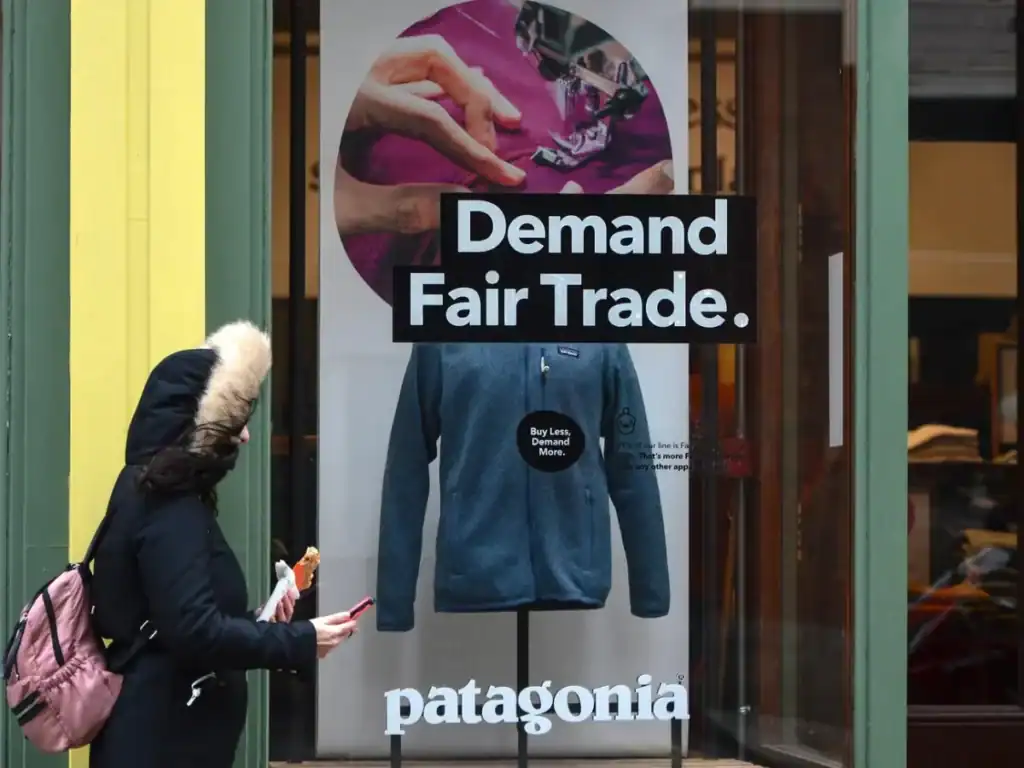
Patagonia doesn’t just use the B-Corp logo; they embody the movement. When Yvon Chouinard transferred ownership to a trust and a non-profit, it was the logical conclusion of a B-Corp journey.
Contrast this with companies that hide their B Impact Report because they barely scraped the 80-point minimum.
McKinsey & Company reports that companies with high ESG ratings consistently outperform the market, but only when those values are integrated into the core business strategy.
The 2026 Comparison: Pro vs. Amateur Branding
| Feature | Amateur (Badge-Hunting) | Pro (Governance-First) |
| Logo Usage | Footer icon, rarely mentioned. | Integrated into brand identity and packaging. |
| Transparency | The public report is hidden or vague. | Real-time impact dashboards for stakeholders. |
| Messaging | “We are eco-friendly.” | “We have reduced carbon output by 22% in 12 months.” |
| Supply Chain | Third-party audits ignored. | Direct circular branding and audit trails. |
| Employee Tone | Corporate and disconnected. | Inclusive design and high worker engagement. |
Automating the BIA: Your 2026 B-Corp Tech Stack
Gone are the days of managing your B-Corp data in a sprawling Excel spreadsheet. The 2026 verification process is data-hungry, requiring “Verification Ready” evidence for every claim.
- Carbon Accounting: Greenly or Sweep. These platforms integrate with your accounting software (such as Xero or QuickBooks) to automatically estimate your carbon footprint.
- Employee Sentiment: Culture Amp or Peakon. Use these to gather the “Worker Engagement” data required for the new mandatory JEDI topics.
- Supply Chain Transparency: EcoVadis. Many B-Corps use EcoVadis to audit their suppliers, as the data can be directly mapped into the BIA.
- Governance & Compliance: Diligent. For mid-market firms, this helps track board minutes and stakeholder governance to ensure you are meeting the “Legal Requirement” in practice, not just on paper.
- Impact Reporting: Pulsar. A dedicated tool for creating the “Real-time Impact Dashboards” mentioned in the Pro vs. Amateur comparison.
The Financial Case: B-Corp as a Competitive Moat
The question of whether B-Corp is “worth it” has shifted from marketing to the balance sheet.
In 2026, certification acts as a primary de-risking signal for two critical groups: Institutional Investors and B2B Procurement Officers.

1. The Procurement Advantage
For B2B service providers, B-Corp status is increasingly a “hard gate” in Request for Proposals (RFPs). Research from Forrester suggests that 58% of FTSE 100 companies now require their “Tier 1” suppliers to hold either a B-Corp certification or an equivalent EcoVadis Gold rating. By being certified, you bypass months of individual sustainability questionnaires, as B Lab’s verification is accepted as the ultimate “Proof of Performance.”
2. Access to Sustainable Capital
The “Green Premium” is real. Venture capital firms like Obvious Ventures and TowerBrook Capital Partners prioritised B-Corps because they demonstrate lower “Governance Risk.” In a high-interest-rate environment, having a third-party-verified ESG framework makes your business more attractive for “Sustainability-Linked Loans” (SLLs), where your interest rate actually drops as your BIA score improves.
| Benefit Area | Impact Metric (2025/26 Data) | Real-World Result |
| Talent Acquisition | 4.2x higher Gen Z application rate | Reduced recruitment marketing spend by ~20%. |
| B2B Sales | 15% increase in RFP ‘Win Rate’ | Direct access to enterprise-level ethical supply chains. |
| Brand Loyalty | 2.1% higher retention in B2C | Customers view the brand as a “partner” in their own values. |
| Operational Efficiency | 12% reduction in energy costs | Driven by the BIA’s Environmental Management requirements. |
The UK Legal Transition: Amending Your Articles of Association
To become a B-Corp in the UK, you must amend your Articles of Association to satisfy the “Legal Requirement.”
This change ensures that your directors’ fiduciary duty under Section 172 of the Companies Act 2006 is permanently expanded to include the “Triple Bottom Line.”
The Mandatory Wording
You must include two specific clauses. Failure to use the exact language provided by B Corp UK can result in your application being sent back to the start of the queue.
1. The Object Clause: “The objects of the Company are to promote the success of the Company for the benefit of its members as a whole and, through its business and operations, to have a material positive impact on society and the environment, taken as a whole.”
2. The Stakeholder Clause: “In discharging their duties… a Director shall have regard to (amongst other matters): (i) the likely consequences of any decision in the long term, (ii) the interests of the Company’s employees, (iii) the need to foster the Company’s business relationships with suppliers, customers and others, (iv) the impact of the Company’s operations on the community and the environment…”
Managing the Boardroom Friction
For companies with external investors, this is often the point of highest friction. Traditional “Shareholder Primacy” suggests that profit is the only metric.
However, the 2026 legal landscape is shifting. In the UK, the Better Business Act campaign is pushing to make this the default for all companies.
Adopting it now isn’t just a B-Corp requirement; it is future-proofing your business against upcoming changes to corporate law.
The State of B-Corp Certification in 2026

The “points-only” model is dead. B Lab now requires companies to demonstrate performance in “Impact Topics.” These include Climate Action, Fair Wages, and Justice, Equity, Diversity & Inclusion (JEDI).
Over the last 18 months, the cost of verification has increased by approximately 15% for mid-market firms due to more rigorous site audits.
Furthermore, the UK’s Competition and Markets Authority (CMA) has stepped up enforcement of the “Green Claims Code.”
If your branding makes a claim that your BIA score doesn’t support, you are looking at significant fines. This is why brand activism must be grounded in data, not just slogans.
Tailoring the BIA: The Three Primary Assessment Tracks
A common mistake is treating the B Impact Assessment as a static checklist. In reality, the BIA adapts to your “Track” based on your industry, size, and geography.
The “Service” Track (Tech, Agencies, Consultants)
For service-based firms, the “Environment” section is often the hardest to score points in because you lack a physical manufacturing footprint.
- The Strategy: Focus on Virtual Office policies and Scope 3 “Purchased Goods and Services.”
- Key Entity: Use tools like Watershed to track the carbon footprint of your cloud servers (AWS/Azure) and your employees’ home offices.
- The Win: High scores in the “Workers” section through transparent pay scales and “Inclusive Hiring” frameworks.
The “Manufacturing” Track (FMCG, Fashion, Hardware)
For those making physical products, the focus shifts heavily to the Supply Chain and Circular Economy.
- The Strategy: You must map at least 80% of your “Tier 1” suppliers.
- Key Entity: Platforms such as Sedex or SourceMap are essential for demonstrating that your suppliers meet the B-Corp “Supplier Code of Conduct.”
- The Win: “Toxins Reduction” and “Waste Diversion” points are the highest value here.
The “Wholesale/Retail” Track
The bridge between production and the consumer.
- The Strategy: Focus on Packaging Innovation and “Local First” sourcing.
- The Win: Earning the “Mission Locked” points by proving your retail locations serve as community hubs or support local non-profits through formal partnerships like Work for Good.
Debunking the Myth: “B-Corp is Only for Consumer Brands”
A common misconception is that B-Corp status is only valuable for B2C companies like Ben & Jerry’s or Allbirds.
This is objectively false. B2B companies are increasingly using B-Corp status as a prerequisite for procurement.
Forrester Research indicates that 40% of B2B buyers now include ESG criteria in their RFP evaluations. If you are a service provider, becoming a B-Corp is your entry ticket to high-value contracts with multinational corporations that need to de-risk their supply chains.
How to Integrate B-Corp into Your Content Strategy
Achieving certification is a “hero moment,” but the real work is the “everyday impact.” Your content strategy should move away from the “We Got Certified!” announcement and toward “How We Are Improving.”
- Document the Struggle: Show the areas where you failed to score points in the BIA. It builds immense trust.
- Highlight the Supply Chain: Use your blog to feature the partners that helped you achieve your score.
- Educational Content: Teach your audience about circular branding or how you implemented inclusive design.
If you need help aligning your visual identity with your new ethical standards, you can request a quote from our team. We don’t do fluff; we build brands that survive scrutiny.
The Verdict
B-Corp certification in 2026 is no longer a “nice-to-have” for the ethically curious. It is a rigorous, legally binding commitment that requires complete alignment between governance and brand.
If you treat it like a marketing project, you will fail the recertification. If you treat it like a business transformation, you will unlock a level of brand loyalty that traditional advertising cannot buy.
Stop looking for shortcuts. Fix your governance, document your impact, and then build a brand that tells that story with conviction.
Frequently Asked Questions (FAQ)
What is the “B-Corp Verification Queue” wait time in 2026?
Due to the surge in global applications, expect a 10–14-month journey. This is split into “Evaluation” (an initial scan by B Lab) and “Verification” (a deep dive with a B Lab analyst). Preparing your documentation in an “Audit-Ready” format before submission can shave 3 months off this timeline.
Can a UK company with an Employee Ownership Trust (EOT) become a B-Corp?
Yes, and they are often the highest scorers. The EOT structure naturally aligns with the “Worker Engagement” and “Stakeholder Governance” impact topics, often fast-tracking the “Accountability” points.
Does B-Corp certification satisfy the UK’s “Green Claims Code”?
Not automatically. While B-Corp status is a powerful proof point, the CMA requires that specific product claims (e.g., “100% Carbon Neutral”) be backed by specific data. You cannot use the B-Corp logo to imply a product is “Eco-Friendly” if the certification was earned primarily through worker governance.
What happens if our score drops below 80 during the 3-year cycle?
You enter a “Remediation Period.” You have 90 days to implement changes and prove your score has returned to 80+. If you fail this, your certification is suspended, and you must remove the logo from all digital and physical assets.
Is “Pending B-Corp” status worth it for a pre-revenue startup?
Absolutely. It signals to early-stage investors that your governance is “built-to-last.” In 2026, many impact-focused VCs make Pending B-Corp status a condition of their “Term Sheet.”
What is the difference between B-Corp and PBC?
B-Corp is a certification from the non-profit B Lab. A Public Benefit Corporation (PBC) is a legal business structure available in some jurisdictions (like the US). You can be both, but they are not the same thing.
Why do companies lose their B-Corp status?
The most common reasons are failing to achieve 80 points during the three-year recertification cycle, failing to update legal documents, or major ethical breaches that violate the B Corp community’s trust, as seen in some high-profile cases.
Is B-Corp certification worth it for B2B companies?
Absolutely. Many enterprise-level companies now require ESG compliance from their vendors. B-Corp status simplifies the procurement process by providing a third-party-verified standard for your business ethics and sustainability.
How does B-Corp impact SEO?
Directly, it doesn’t. Indirectly, it’s a goldmine. It provides high-authority backlink opportunities, unique content for “Information Gain,” and improves E-E-A-T (Experience, Expertise, Authoritativeness, and Trustworthiness) signals, which are critical for ranking in 2026.
What is the B Impact Assessment (BIA)?
The BIA is a free, online tool used by B Lab to measure a company’s impact on its workers, community, environment, and customers. It serves as the technical backbone of the certification process.
How often do you need to recertify?
B-Corps must recertify every three years. This process is often more rigorous than the initial certification, as B Lab expects to see “continuous improvement” in your impact scores.
Does B-Corp certification prevent greenwashing?
It is one of the best tools to combat it. Because the certification requires verified data and legal accountability, it is much harder for a B-Corp to make false environmental claims without risking its status and facing legal repercussions.