What is Account-Based Marketing? 2026 ABM Guide
Most B2B marketing is a vanity project.
You spend thousands on “awareness” campaigns, celebrate a few hundred clicks from people who will never buy, and then wonder why your sales team looks like they want to throttle the marketing department.
This “spray and pray” approach is an expensive mistake. It treats your potential clients like a faceless crowd rather than high-value targets.
If you are tired of chasing low-quality leads that clog your CRM and waste your time, you need to understand account-based marketing.
In my years of fixing broken brand strategies, I’ve seen that the most successful companies don’t try to talk to everyone. They identify exactly who they want to work with and treat those targets like a market of one.
Ignoring ABM isn’t just a missed opportunity; it is a financial drain.
According to research from the Alterra Group, 97% of marketers achieved a higher ROI with ABM than with any other marketing initiative. If you aren’t doing this, you’re effectively subsidising your competitor’s growth.
- ABM targets a defined set of high-value accounts with personalised, sales-marketing aligned experiences to maximise ROI.
- Prioritise account selection using firmographics, technographics, intent, and psychographics for precise targeting.
- Segment into Strategic (1:1), ABM Lite (1:few) and Programmatic (1:many) to match investment to account value.
- Win the Dark Funnel with ungated insight, zero-party data and demonstrated industry-specific knowledge.
- Use an orchestration tech stack and shared revenue goals to measure account penetration, pipeline velocity and contract value.
What is Account-Based Marketing?
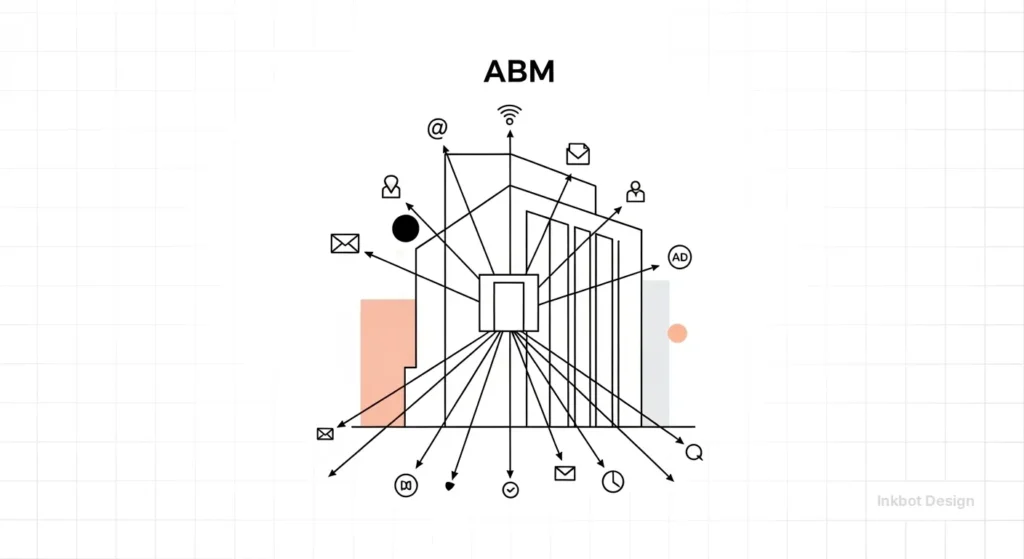
Account-Based Marketing (ABM) is a strategic approach to B2B marketing where sales and marketing teams collaborate to create personalised buying experiences for a mutually identified set of high-value accounts.
Instead of casting a wide net to catch any available lead, ABM uses a spear to target specific companies.
The 3 Core Elements of ABM
- Target Account Identification: Using data to select companies that fit your “perfect” client profile.
- Multi-Channel Personalisation: Delivering specific messages to multiple decision-makers within those companies.
- Sales and Marketing Synchronisation: Removing the silos so both teams work toward the same revenue goals.
Why Modern Marketing is Failing Your Bottom Line
Traditional lead generation is built on a lie: that more leads equal more revenue. It doesn’t.
In 2026, the cost of acquiring a customer (CAC) has skyrocketed because every channel is saturated with AI-generated noise.
When you treat your marketing like a numbers game, you’re competing on volume. You will lose that fight to whoever has the bigger budget.
ABM flips the script. It forces you to embrace niche marketing by narrowing your focus to the accounts that actually move the needle. This isn’t about being “exclusive” for the sake of it; it’s about efficiency.
The 95:5 Rule and the Need for Precision
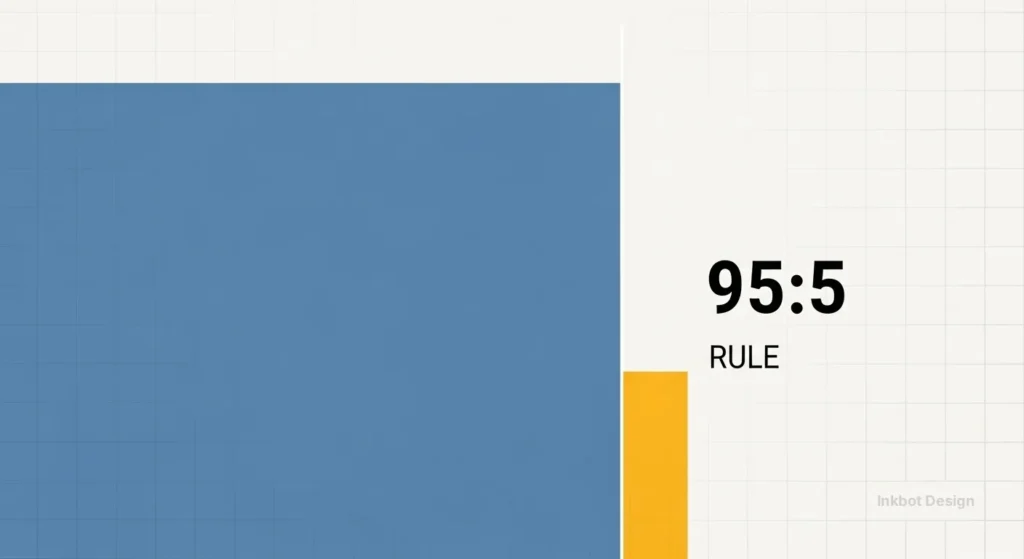
The LinkedIn B2B Institute popularised the “95:5 rule,” which suggests that at any given time, only 5% of your target market is actually looking to buy. The other 95% are “out-of-market.”
Traditional marketing wastes money trying to sell to the 95% who aren’t ready to buy. ABM allows you to build a relationship with that 95% through brand authority, so that when they do enter the 5% “buying zone,” your firm is the only logical choice.
This requires a deep understanding of psychographics vs demographics to know what truly motivates the humans behind the corporate titles.
Navigating the Dark Funnel: Capturing Intent in 2026
Traditional ABM relied on “IP Tracking”—knowing that someone from Microsoft visited your pricing page.
But with the rise of remote work and advanced VPNs, IP data has become a secondary signal. The real battleground in 2026 is the Dark Funnel.
The Dark Funnel refers to the places where B2B buyers do their research that you cannot track with traditional software:
- Private Communities: Slack groups like Pavilion or Revenue Collective.
- Peer Recommendations: Direct messages on LinkedIn or WhatsApp.
- Content Consumption: Podcasts, YouTube, and third-party industry news sites.
How to Win the Dark Funnel: Instead of trying to “track” these users with gated content (which buyers now despise), you must optimise for consumption.
Give your best insights away for free. When a buyer in a private Slack group asks, “Who is the best provider for X?”, your brand should be the first name mentioned because they’ve been consuming your high-value, ungated content for months.
Transitioning to Zero-Party Data: Ask your prospects directly. Simple “How did you hear about us?” fields on your demo request forms often provide more accurate attribution than a £10,000-a-month software platform.
This is Zero-Party Data—information the customer intentionally shares with you.
The Three Tiers of Account-Based Marketing
Not every account deserves the same level of investment. I often see businesses fail because they try to do “One-to-One” ABM for five hundred different companies.
That’s not a strategy; that’s a suicide mission for your staff. You must categorise your efforts.

1. Strategic ABM (One-to-One)
This is the gold standard. You treat a single company as its own market. You might spend months researching their specific pain points, their annual reports, and their internal politics. The goal is a massive contract.
- Example: A software firm creating a custom demo specifically for the CTO of a Fortune 500 company, addressing a problem they mentioned in a recent podcast interview.
2. ABM Lite (One-to-Few)
You group a small number of accounts (usually 5-10) that share similar challenges or belong to the same micro-niche. You personalise at the industry or sub-sector level.
- Example: Creating a whitepaper specifically for “Mid-sized UK Fintech firms facing New Regulatory Compliance.”
3. Programmatic ABM (One-to-Many)
This uses technology to scale personalisation across hundreds or thousands of accounts. While it is the least “personal,” it is far more targeted than general advertising.
You might use IP-based advertising to ensure only employees at specific companies see your banners.
| Feature | Strategic ABM (1:1) | ABM Lite (1:Few) | Programmatic ABM (1:Many) |
| Account Count | 1-10 | 10-100 | 100-1,000+ |
| Personalisation | Highly bespoke content | Cluster-specific content | Industry-specific content |
| Primary Goal | Massive Contract Value | High-Value Pipeline | Brand Awareness in Target Accounts |
| Sales Involvement | High (Co-creation) | Moderate (Feedback) | Low (Trigger-based) |
ABM Persona Content Mapper
Select a stakeholder to reveal their 2026 engagement strategy.
The Champion
Motivation: Professional growth and solving daily friction. They want to be the one who introduced the “game-changing” solution.
The Strategy: Arm them with the internal “selling kit” they need to convince their superiors.
Interactive Benchmarking Reports, Technical Blueprints, and “How-to” Loom Videos.
The Economic Buyer (CFO)
Motivation: Fiscal responsibility and risk mitigation. They care about the “Cost of Inaction” (COI) more than the cost of the tool.
The Strategy: Use cold, hard data. Avoid jargon; focus on EBITDA and ROI timelines.
ROI Calculators, 1-Page Executive Summaries, and Industry Risk Assessments.
The Technical Gatekeeper
Motivation: Security, stability, and integration. Their biggest fear is a tool that breaks existing workflows or leaks data.
The Strategy: Provide transparency. Give them the technical documentation before they even ask for it.
API Documentation, SOC2 Compliance Certificates, and Integration Maps.
The VP of Sales
Motivation: Pipeline velocity and hitting revenue targets. They want to know how this helps their team close deals faster.
The Strategy: Show them success stories from their direct competitors. Use social proof as your primary weapon.
Competitor Case Studies, Pipeline Acceleration Data, and Sales Enablement Kits.
The 2026 Shift: Why “Personalisation” Isn’t Enough
We have entered the era of “Hyper-Scepticism.”
In 2025, the market was flooded with “automated personalisation” tools. Every C-suite executive now receives twenty emails a day that start with “I saw your post about [Topic] and thought…”
People aren’t stupid. They know it’s a bot.
In 2026, real ABM isn’t about using a merge tag to insert a company name into an email. It’s about Demonstrated Insight.
If you want to land a £100,000 contract, you have to prove you’ve done the work. This is where customer interviews become your secret weapon.
By understanding the actual language and frustrations of your target’s peers, you can write copy that sounds like it comes from a colleague, not a salesman.
The Role of Brand Identity in ABM
I’ve audited countless ABM campaigns that were technically perfect—the data and timing were right—but the landing pages looked like they were designed in 2005.
If your digital marketing services don’t look premium, your ABM will fail. Why? Because high-value accounts are risk-averse. They don’t just buy a solution; they buy “not getting fired.”
If your brand looks amateur, you represent a professional risk to the buyer. Your visual identity must match the level of the contract you are chasing.
The Rise of Generative ABM: Scaling Quality with AI
The “automated personalisation” of 2024—where bots just scraped LinkedIn profiles—failed because it lacked Empathy and Context. In 2026, Generative AI will be used for Deep Research, not just copywriting.
- AI Research Agents: Instead of an SDR spending two hours reading a company’s 10-K annual report, an AI agent can synthesise the report in seconds, identifying the three key strategic priorities mentioned by the CEO.
- Dynamic Content Hubs: Using tools like Mutiny, you can now change the headlines, logos, and case studies on your website in real-time based on the visitor’s industry. If a visitor from Goldman Sachs arrives, the site shows “Financial Services” success stories; if someone from Tesla arrives, it flips to “Automotive Manufacturing.”
- Predictive Churn Modelling: AI now analyses “Product Usage Signals.” If a high-value account stops logging in as frequently, the ABM system automatically triggers a “Check-in” sequence for the Account Executive.
The 2026 ABM Tech Stack: Building Your Orchestration Engine
In 2026, the distinction between “Marketing Tech” and “Sales Tech” has dissolved.
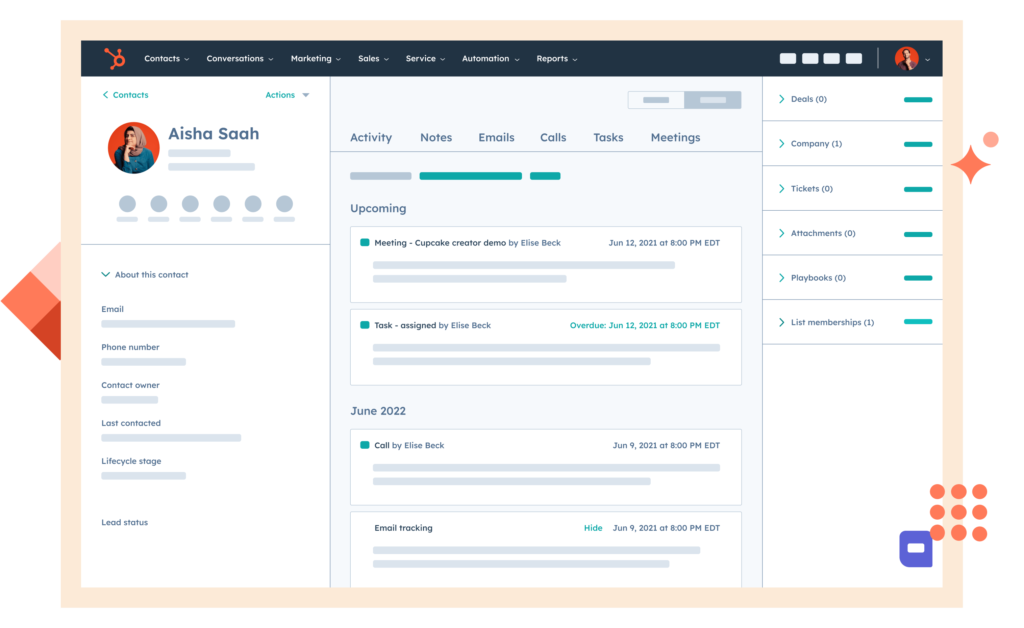
To run a successful programme, you no longer need a bloated suite of thirty tools; you need an Orchestration Layer that connects your data to your delivery channels.
1. The Data Foundation (The Intelligence Layer)
Everything starts with Account Intelligence. You cannot target what you cannot see.
- Intent Data Providers: Tools like 6sense and Demandbase now use predictive AI to tell you not just who is visiting your site, but which stage of the buying journey they are in based on “bombora” signals across the web.
- Identity Resolution: As third-party cookies have phased out, First-party Data is king. Platforms like HubSpot Operations Hub or Segment help you unify signals from your website, email, and product usage to create a single view of the account.
2. The Engagement Layer (The Delivery)
- LinkedIn Sales Navigator: Still the gold standard for identifying the Buying Committee. In 2026, the focus has shifted to “Relationship Intelligence”—seeing who in your company has a warm connection to the target account.
- Digital Sales Rooms (DSRs): Instead of sending PDF attachments, modern ABM uses platforms like Highspot or GetAccept. These are personalised microsites where all stakeholders can access case studies, contracts, and video demos.
- Personalised Video: Tools like Loom or Vidyard, integrated into the CRM, allow SDRs to send 30-second, bespoke “state of the industry” clips that achieve 4x higher click-through rates than text-only emails.
3. The Measurement Layer (The Analytics)
Move beyond the “Lead.” You need Account-Based Attribution.
Tools like Dreamdata or HockeyStack let you see the entire path to purchase, including Dark Social touches—untrackable conversations in private Slack communities or podcasts that eventually lead to a high-value demo request.
The “Alignment” Lie
In my fieldwork, I often see companies claiming to do ABM while their sales and marketing teams are still in a cold war.
Marketing sends “MQLs” (Marketing Qualified Leads) that Sales ignores because they’re “garbage.” Sales closes deals that Marketing didn’t even know were in the pipeline.
If you don’t fix this culture, no amount of ABM software will save you. I once audited a client who spent £200,000 on an ABM platform but hadn’t even defined a “Target Account” with their Sales Director.
They were targeting companies that the Sales team had already blacklisted due to poor credit.
ABM is not a marketing strategy. It is a business strategy.
Before you send a single targeted ad, sit your Sales and Marketing heads in a room. They must agree on:
- Which accounts are we going after?
- What does a “win” look like?
- Who owns the relationship at each stage of the customer journey mapping?
Step-by-Step: How to Execute a Modern ABM Campaign
Step 1: Define Your ICP (Beyond Firmographics)
Don’t just look at company size and location. Look at technographics (what software do they use?), intent (are they searching for a solution?), and triggers (did they just hire a new VP of Operations?).
Step 2: Identify the Buying Committee
The biggest mistake in ABM is treating “the company” as the buyer. Companies don’t buy software; people do. By 2026, the average B2B deal size will involve 8.4 stakeholders.
If you only have a relationship with one, your deal is at high risk of “silent death” when that person leaves or loses internal budget.
The Four Key Personas You Must Target:
- The Champion (The Internal Seller): Usually a middle manager who experiences the pain point daily. They want to look like a hero. Content for them: Technical “how-to” guides and implementation blueprints.
- The Economic Buyer (The CFO/V-Level): They don’t care about features; they care about ROI, Risk Mitigation, and Compliance. Content for them: One-page executive summaries focusing on “Cost of Inaction” (COI).
- The Technical Gatekeeper (IT/Security): Their job is to say “No” to protect the company’s infrastructure. Content for them: Security whitepapers, API documentation, and SOC2 compliance certifications.
- The End User: If they hate the tool, they won’t use it, and the contract won’t renew. Content for them: Ease-of-use videos and “Day in the Life” testimonials.
| Persona | Primary Motivation | Content Format | Key Metric They Care About |
| Champion | Career Progression | Benchmarking Reports | Efficiency / Time Saved |
| CFO | Profitability | ROI Calculator | CAC / Payback Period |
| IT Director | Security / Stability | Security FAQ | Integration Time |
| VP Sales | Revenue Growth | Case Studies | Pipeline Velocity |
Step 3: Content Mapping
Create content that speaks to each persona. The CFO doesn’t want to read your “Ultimate Guide to [Feature].” They want a one-page case study on how you saved a competitor £50k.
Step 4: Choose Your Channels
Don’t just rely on email. Use a mix of:
- LinkedIn Ads: Targeted by company name and job title.
- Direct Mail: Something physical and valuable.
- Custom Landing Pages: A URL like yourbrand.com/target-company.
- Event Marketing: Small, exclusive webinars or dinners.
Step 5: Measure What Matters
Stop looking at clicks. Look at:
- Account Penetration: How many people at the target company have we engaged with?
- Pipeline Velocity: Are these accounts moving through the funnel faster?
- Contract Value: Is the average deal size increasing?
Why Your Best Prospects Are Already Your Customers
Most companies spend 90% of their ABM budget on New Logo Acquisition.
In 2026, when acquisition cost (CAC) is at an all-time high, the most profitable companies use ABM to expand within existing accounts. This is often called the “Land and Expand” model.
The Three Expansion Plays:
- Cross-Sell: You sold the marketing team a CRM; now you use ABM to target the Sales or Customer Success departments with a related module.
- Upsell: Moving a client from a “Professional” tier to an “Enterprise” tier by demonstrating the value they are currently missing.
- Global Rollout: You have won the UK branch of a multinational; now you run a targeted campaign for the US and APAC leadership teams, using the UK success as a built-in case study.
The “Retention ABM” Tactic: Run “Ads for One” (Programmatic ABM) specifically for your customers 6 months before their contract renewal.
Show them ads highlighting new features they haven’t used yet or success stories from other clients.
This reinforces your brand’s value before the renewal conversation starts, making the “save” much easier for the Account Manager.
The Verdict
Account-Based Marketing is the only way to remain relevant in a world of infinite noise. By narrowing your focus, you increase your impact.
It requires a shift from “How many people can I reach?” to “How can I be indispensable to these ten companies?”
If your brand isn’t ready to face the scrutiny of a high-value buyer, you are wasting your time with ABM. Precision marketing requires a precision brand.
If you’re ready to stop the “spray and pray” madness and start winning the accounts that actually matter, it’s time to get serious about your strategy.
Ready to transform your approach?
Request a quote for a comprehensive brand audit, or explore how our digital marketing services can fuel your ABM engine. Visit Inkbot Design to learn more.
Frequently Asked Questions (FAQ)
How do I balance ABM with traditional Inbound Marketing?
They are two sides of the same coin. Inbound creates a “wide net” that captures intent you didn’t know existed, while ABM is a “spear” for the accounts you know you want. Use Inbound to discover new accounts, and then move them into an ABM programme once they show high-fit signals.
What is the ideal “Account to Sales Rep” ratio for 1:1 ABM?
For Strategic 1:1 ABM, a single Account Executive or SDR should focus on no more than 5–10 accounts. Any more, and the level of bespoke research required to win those deals becomes impossible to maintain.
Is email dead for ABM in 2026?
Cold email is dead; Contextual Outreach is thriving. If you send a generic “circling back” email, it will be filtered by AI-driven spam guards. However, if you send an email that references a specific business challenge mentioned in their latest earnings call, it will still get a response.
How does GDPR impact Account-Based Marketing?
ABM is actually more GDPR-friendly than mass-market spam. Because you are targeting a small number of people with highly relevant information based on “Legitimate Interest,” you are less likely to fall foul of privacy regulations, provided you offer clear opt-outs and handle data transparently.
What is “Pipeline Velocity” and why does it matter for ABM?
Pipeline Velocity is a formula that measures how fast an account moves from “First Touch” to “Closed-Won.” ABM usually has a slower “start” than lead gen, but once an account is engaged, the velocity is often 30–50% higher because you have already educated the entire buying committee.
Do I need expensive software to start ABM?
No. You can start with a simple CRM, LinkedIn Sales Navigator, and a well-defined strategy. Technology should only be used to scale a process that already works manually.
How do I get Sales and Marketing to align?
Start by giving them a shared revenue goal. If both teams are measured by the same “Closed-Won” revenue rather than “leads” or “calls,” alignment happens naturally.
Can I use ABM for existing customers?
Absolutely. ABM is highly effective for “upselling” or “cross-selling” to existing high-value clients by identifying new departments or needs within the organisation.
What kind of content works best for ABM?
Bespoke content that addresses a specific business problem for the target account. This includes custom reports, personalised video demos, and case studies relevant to their specific industry.
Why do ABM campaigns fail?
Most fail due to poor data, a lack of sales and marketing alignment, or “fake personalisation” that offers no real value to the recipient.
Is ABM compatible with SEO?
Yes. You can create content designed for the “clusters” you target in ABM Lite, which also helps build topical authority for search engines.
How does branding affect ABM?
Branding provides the “trust foundation.” If your marketing reaches the right person but your brand comes across as untrustworthy or cheap, the prospect will not engage, regardless of how good the offer is.