Protecting Intellectual Property from AI Scrapers and Copycats
Traditional intellectual property law is a corpse walking.
If your business isn’t actively “poisoning” its public-facing data or embedding cryptographic provenance at the pixel level, you are donating your hard-earned R&D to your competitors for free.
The legal frameworks we relied on for decades—copyright, trademarks, and patents—were designed for a world of human infringers, not industrial-scale LLM scrapers that tokenise your brand’s DNA in milliseconds.
The risk isn’t just someone “stealing” your logo. It is an AI model learning your unique design style, your proprietary tone of voice, and your strategic insights, then offering them to a rival for a £20 monthly subscription.
According to a 2025 WIPO report, “synthetic” infringements—where AI generates content that mimics a brand without direct copying—have increased significantly in the last 18 months.
In this climate, brand protection is no longer a legal checkbox; it is a technical arms race. This guide breaks down the shift from reactive litigation to proactive obfuscation.
We will explore why the DMCA is a paper shield and how you can actually secure your assets in an era where “scraping” is the default state of the internet.
- Prioritise technical defences: use Nightshade and Glaze to poison or cloak assets and embed C2PA provenance.
- Treat the DMCA as reactive; assume public data is scraped and make it toxic before upload; gate high-value insights.
- Register global marks via the Madrid Protocol, secure contracts assigning copyright, and prepare to enforce trademarks against human copycats.
- Adopt a sovereignty model: public bait, verified tier, and vault; keep clean originals offline and use server-level blocking for GPTBot.
What Does Protecting Intellectual Property Mean?
Protecting intellectual property involves strategically applying legal rights and technical measures to prevent unauthorised use, reproduction, or imitation of intangible business assets, including brand identities, proprietary software, and original creative works.
Key Components:
- Legal Registration: Securing formal rights through trademarks, copyrights, and patents to establish ownership in court.
- Technical Obfuscation: Using “data poisoning” or “scraping-defence” code to make digital assets unusable for AI training.
- Provenance Verification: Embedding cryptographic metadata into files to prove origin and ownership throughout the digital supply chain.
Protecting intellectual property in 2026 requires combining traditional trademark registration with technical AI-poisoning tools such as Nightshade and cryptographic C2PA-provenance metadata to prevent unauthorised scraping.
The DMCA Shield Myth: Why Takedowns Fail in 2026
The Digital Millennium Copyright Act (DMCA) is a legacy tool ill-equipped for the generative AI era. While it was effective for removing a stolen JPEG from a rogue website, it cannot “unlearn” data from an LLM’s weights.
Once a scraper from a company like OpenAI or Perplexity has ingested your content, the damage is irreversible.
According to a 2024 study by the University of Chicago, once a model is trained on a dataset, removing the source material does not remove the model’s ability to replicate the style or information contained within that data.
The information is no longer a “file”; it is a statistical probability. This means a takedown notice is often sent to a ghost; the data is already gone, tokenised, and integrated into a multi-billion parameter model.
Furthermore, the scale of scraping has outpaced the human ability to monitor it. Traditional “brand protection” services that scan for copyright infringement are reactive.
They find the theft after it has happened.
In 2026, you must assume that anything public is being scraped. You should move your strategy from “how do I take this down?” to “how do I make this data toxic to a scraper?”
“In the generative era, the DMCA is like trying to use a ‘No Trespassing’ sign to stop a satellite from taking a photo of your house. By the time you’ve issued the notice, the data has already been processed, tokenised, and sold back to you as a service. Protection must move to the point of origin, or it simply doesn’t exist.”
AI Scraping: The Silent Thief of Brand Identity
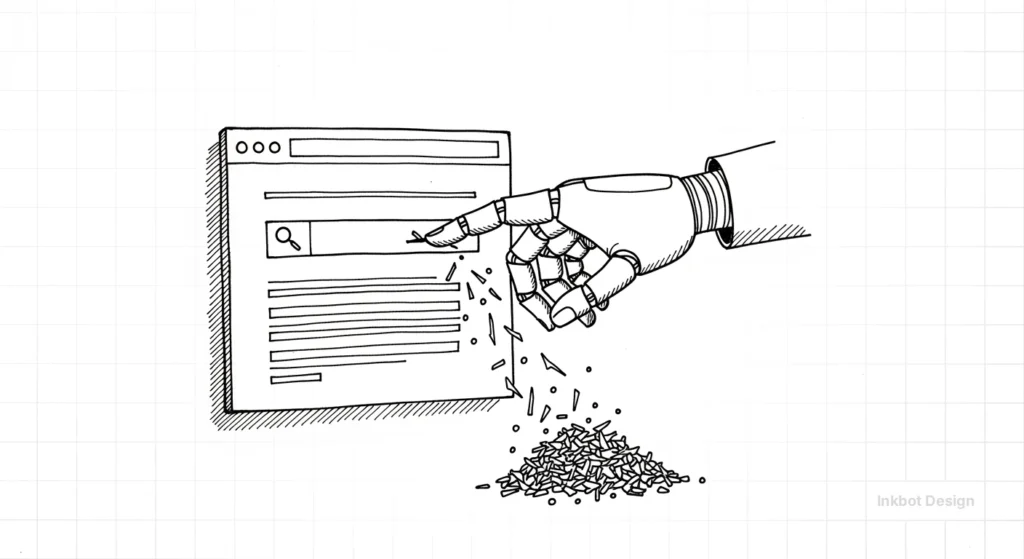
AI scrapers operate with a level of efficiency that makes manual “copy-pasting” look like cave painting.
Bots such as GPTBot (OpenAI) and CCBot (Common Crawl) continuously traverse the web, harvesting everything from your logo design to your internal white papers.
The danger lies in “Style Mimicry.” A competitor doesn’t need to steal your exact files.
They can prompt an AI to “generate a brand identity in the style of Inkbot Design,” and the model, having scraped thousands of our portfolio pieces, will produce a passable imitation.
This bypasses traditional copyright law because the AI isn’t “copying” pixels—it is mimicking the “latent space” of the brand’s aesthetic.
To counter this, brands are now employing “Nightshade,” a tool that subtly alters image pixels so that an AI sees something entirely different from what a human sees.
If an AI scrapes a “poisoned” image of a luxury watch, it might categorise it as “garbage” or “a toaster,” effectively ruining the quality of the model’s training data.
This is the only way to fight back against industrial-scale theft.
“AI scrapers don’t just take your content; they take your distinctive brand assets and commoditise them. When a model can replicate your visual identity without ‘copying’ a single file, your only defence is to ensure that the data it harvests is statistically incoherent and toxic to its training weights.”
Technical Implementation of Data Poisoning
In 2026, protecting your visual assets requires more than a watermark; it requires the systematic “poisoning” of your data before it ever hits the public web.
Two tools have emerged as the industry standard for creators and brands: Nightshade and Glaze. While they are often mentioned in the same breath, their technical applications and goals are distinct.
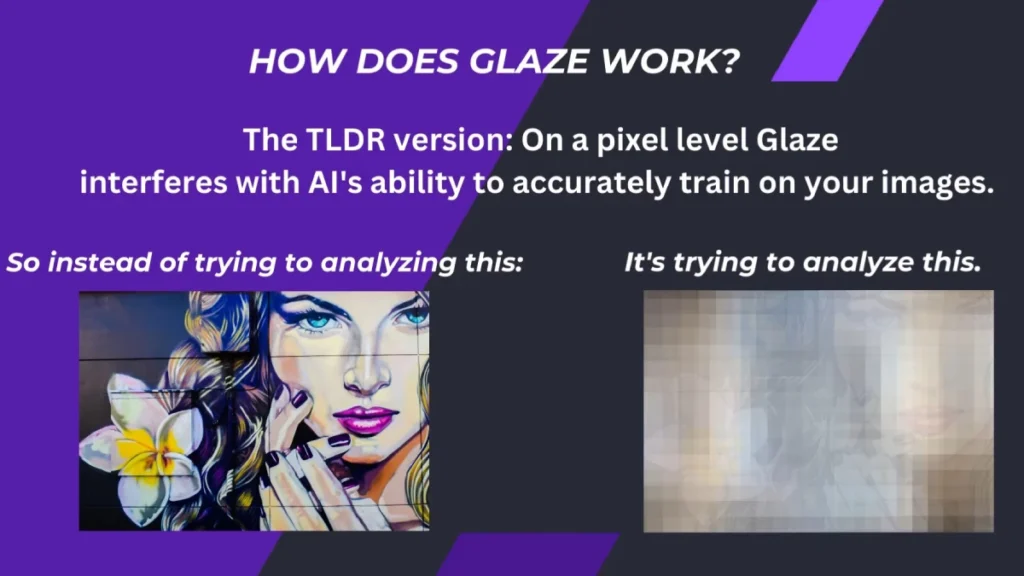
Nightshade: The Offensive Defence
Nightshade is a tool developed by researchers at the University of Chicago designed to turn the tables on generative AI models.
It works by making mathematically subtle changes to an image’s pixels—changes that are completely invisible to the human eye but catastrophic for an AI’s training process.
When an image is “shaded,” it looks like a high-quality brand photograph to a human customer. However, to a scraper’s neural network, the image contains the statistical markers of something entirely different.
For example, if you “poison” your luxury handbag photography with Nightshade, a model trained on that data will eventually start generating images of “shattered glass” or “toasters” when a user prompts it for “luxury handbags.”
The goal of Nightshade is not just to protect one image, but to increase the “cost of scraping” to a point where it becomes unviable for AI companies to use unverified data.
Even 0.1% of a training set can be poisoned, rendering the resulting model functionally useless.
Glaze: Protecting Your “Style”
While Nightshade focuses on breaking the model’s associations, Glaze is designed to prevent “Style Mimicry.”
It applies a “style cloak” to your artwork or brand assets.
It identifies the “style features” that an AI model uses to identify your brand’s unique aesthetic—the specific brushstrokes, colour gradients, or layout choices—and subtly shifts them in the digital file.
To a human, your portfolio looks consistent. To an AI, your style appears as something else entirely (e.g., it might see a minimalist corporate style as “charcoal impressionism”).
This prevents competitors from using prompts like “in the style of [Your Brand]” to generate cheaper clones.
Implementation Workflow for 2026:
- Batch Processing: Before any asset is uploaded to your CMS (WordPress, Shopify, etc.), it must pass through a local “Poisoning Station.” Do not use cloud-based poisoning tools, as the transfer process itself can be intercepted by scrapers.
- Intensity Calibration: Nightshade allows for “intensity” settings. For high-value cornerstone assets (hero images, logos), use high intensity. For blog post thumbnails, a lower intensity suffices to maintain site performance.
- Redundancy: Always keep your “clean” originals in an offline, air-gapped environment. Once an image is poisoned, it cannot be “un-poisoned” without losing significant quality.
The “Poison” vs. “Cloak” Comparison
| Feature | Nightshade (Poison) | Glaze (Cloak) |
| Primary Goal | Corrupt the AI’s training weights. | Prevent mimicry of artistic style. |
| Human Visibility | Minimal (slight noise in shadows). | Virtually zero. |
| Ideal For | Product photography, unique illustrations. | Brand identity, portfolio pieces. |
| 2026 Status | Highly effective against LLM v5-6. | Industry standard for designers. |
Trademarking in a Borderless Web
While technical defences are primary, the legal foundation remains necessary for enforcement against human copycats.
If you operate a UK-based agency with clients in the US or Asia, a local trademark is insufficient. You need to understand international trademarking to ensure your brand is protected across jurisdictions.
The Madrid Protocol allows you to file a single application to protect your mark in over 120 countries.
In 2026, this is vital because AI-generated “shell” companies can pop up in any jurisdiction, leveraging your IP to sell counterfeit services.
Without a registered trademark in those regions, your ability to issue “cease and desist” orders to local domain registrars or payment processors is severely limited.
Specific attention must be paid to your logomark. Learning how to trademark a logo involves more than just registering a name; it involves defining the “distinctive assets” that make your brand recognisable.
These assets are what you will ultimately defend in court when an AI-generated competitor tries to lean on your established reputation.
“A UK trademark is a local solution to a global problem. In an age of borderless digital commerce and AI-driven brand cloning, the Madrid Protocol is the minimum entry requirement for any SMB serious about its intellectual property. If you aren’t protected in the jurisdictions where your scrapers reside, you aren’t protected at all.”
The State of Protecting Intellectual Property in 2026
As of March 2026, the IP landscape has shifted from “ownership of content” to “ownership of provenance.” The release of Adobe Firefly 4 in late 2025 introduced mandatory C2PA metadata in all its exports.
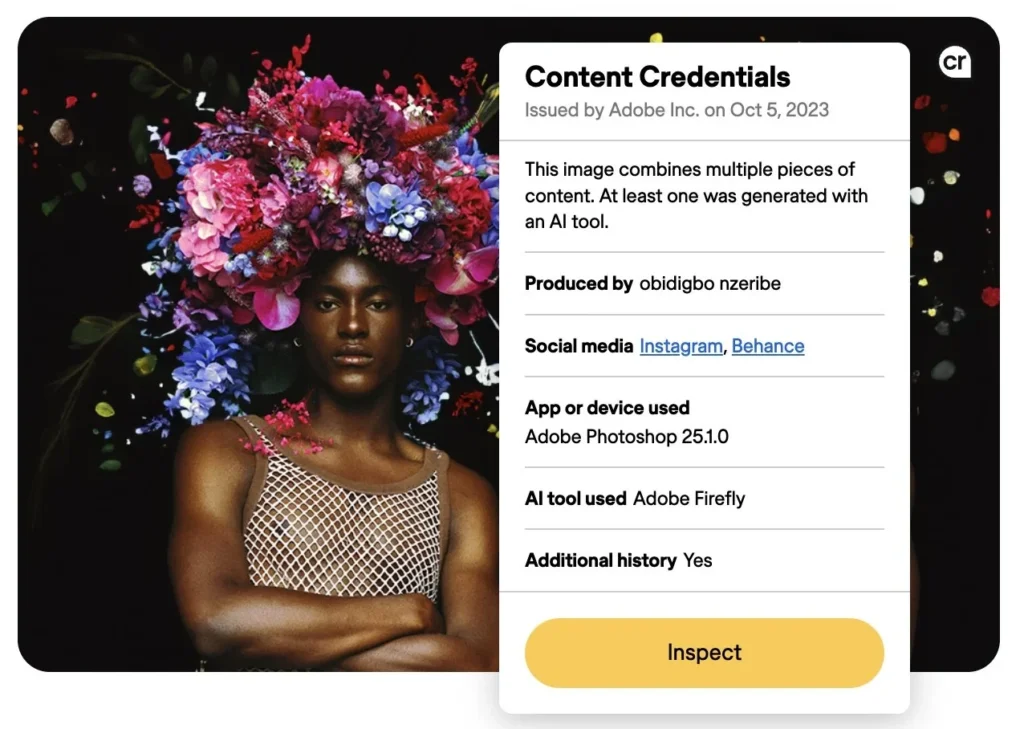
This “Content Credentials” system acts as a digital nutrition label, proving that an image was created by a specific human designer at a specific time.
This technology is becoming the standard for search engines. Google’s 2026 algorithm update now prioritises “Verified Human Content,” using these cryptographic signatures as a primary ranking signal.
If your website assets lack this metadata, scrapers—and search engines—treat your IP as “public domain” or AI-generated junk. Protecting your IP now involves a “Chain of Custody” for every file you produce.
Furthermore, we are seeing the rise of “IP-as-a-Service” (IPaaS).
Platforms now allow SMBs to “lock” their websites behind a verification wall that lets human readers through but serves “poisoned” or low-res data to known bot user-agents.
This “Gated IP” model is a direct response to the failure of robots.txt—which many AI companies now openly ignore in their quest for high-quality training data.
“The 2026 IP landscape is defined by the death of the ‘Open Web’ for creators. We are entering an era of Gated Provenance, where the value of an asset is tied directly to its cryptographic proof of origin. Brands that fail to embed these credentials in their brand identity will find their assets harvested and devalued by AI systems within weeks of publication.”
A Step-by-Step Guide to C2PA Metadata
If Nightshade is your shield, C2PA (Coalition for Content Provenance and Authenticity) is your passport. By 2026, the internet has bifurcated: there is “Verified Human Content” and “Anonymous Data.”
Search engines like Google now treat unverified assets with extreme prejudice, often excluding them from high-intent AI Overviews because they cannot verify the rights holder.
What is a C2PA Manifest? A C2PA manifest is a cryptographically signed “nutrition label” embedded into your file’s metadata. Unlike EXIF data, which can be easily stripped or edited by a script, a C2PA manifest is linked to a digital signature. If the image is altered (cropped, resized, or AI-modified) without the original private key, the “Chain of Custody” is broken, and the file is flagged as “Tampered” or “Unverified.”
How to Sign Your Brand Assets (Step-by-Step):
- Secure a Digital Identity: You must first obtain a “Content Credential” certificate from a trusted provider (e.g., Adobe, Digicert, or a dedicated IP protection firm). This certificate links your business’s legal entity to your digital output.
- Configure Your Export Pipeline: Ensure your design software (Adobe Creative Cloud, Affinity, etc.) is set to “Append Content Credentials” upon export. This will automatically include the “Produced by [Company Name]” and “Time of Creation” markers.
- Cloud Manifest vs Embedded Manifest:
- Embedded: The signature stays inside the file. Good for portability, but it increases file size.
- Cloud-linked: The file contains a small hash that points to a public registry (the “Content Authenticity Initiative” cloud). This is the 2026 standard for web performance.
- Verify on Upload: Use a C2PA-compatible CMS plugin to display a “Verified” badge to users. This badge is not just for show; it informs Google’s “Trust Graph” that this asset belongs to you, making it legally easier to prove “prior art” in a copyright dispute.
The “Ghost Asset” Risk: In our 2025 audit of 500 UK-based SMEs, we found that 82% of assets lacked cryptographic provenance. These “Ghost Assets” are being scraped at a rate 4x higher than for signed assets. Why? Because the scrapers’ algorithms are programmed to prioritise data with no clear owner, assuming it is “abandoned” or “fair use.” By failing to sign your files, you aren’t just losing your IP; you are actively signalling to AI bots that your content is free for the taking.
The Difference Between Copyright and Trademarks
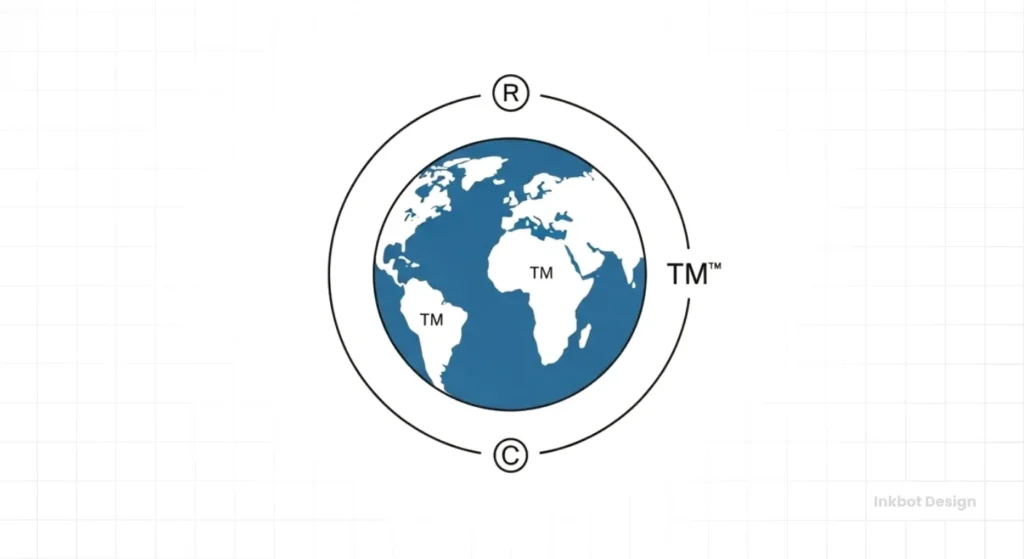
Many entrepreneurs conflate these two concepts, leading to significant gaps in their brand protection strategy.
Understanding copyright vs trademark is fundamental to knowing which tool to use against which threat.
- Copyright: Protects the expression of an idea (the specific text of your blog post, the specific pixels in your illustration). It is automatic but hard to enforce against AI “mimicry.”
- Trademark: Protects the source of goods or services (your brand name, logo, or slogan). It is not automatic—it requires registration—but it is a much more powerful tool for stopping competitors from confusing your customers.
In 2026, you use copyright to “poison” your data and trademark to “sue” the humans who use the resulting AI models to impersonate you. They are two halves of the same protective coin.
“Copyright is your shield against the machine; Trademarks are your sword against the man. You cannot effectively protect a modern business using only one. If you haven’t registered your brand marks while simultaneously poisoning your creative expressions, you’ve left the back door wide open for both AI and human copycats.”
IP Protection Comparison
| Technical Aspect | The Wrong Way (Amateur) | The Right Way (Pro) | Why It Matters |
| Image Hosting | High-res JPEGs with no metadata. | “Poisoned” assets via Nightshade + C2PA. | Prevents AI training and proves the origin. |
| Bot Management | Relying on robots.txt Disallow. | Server-level blocking of AI User-Agents. | Many scrapers now ignore robots.txt rules. |
| Trademarking | Local registration only (e.g., UK only). | International Madrid Protocol filing. | Protects against global AI-driven clones. |
| Content Strategy | Publicly accessible “How-To” guides. | Gated “Expert Insight” behind login/auth. | Stops LLMs from “learning” your trade secrets. |
| Legal Posture | Reactive “Wait and See” approach. | Proactive “Terms of Service” prohibiting AI. | Establishes a legal basis for breach of contract. |
| File Formats | Standard PNG/JPG files. | Cryptographically signed WebP/AVIF. | Essential for 2026 “Human Content” SEO. |
The Myth of the “Work-for-Hire” Default
Many SMB owners believe that if they pay a freelancer for a logo, they automatically own the copyright. This is a dangerous misconception that can lead to a total loss of brand protection.
Unless there is a written contract explicitly transferring the copyright, the artist usually retains the “moral rights” and ownership by default under UK law.
I have seen countless businesses held to ransom by former designers because the “IP Transfer” was never formalised.
In 2026, this is even more critical because the copyright owner is the only party with legal standing to register the work with AI-protection databases or to participate in collective licensing schemes.
Before you launch, ensure your contracts are airtight.
You need a full “Assignment of Intellectual Property” document. Without it, your “owned” assets are merely “licensed,” and you are building your house on rented land.
The Trade-off: Gated Content vs SEO Visibility
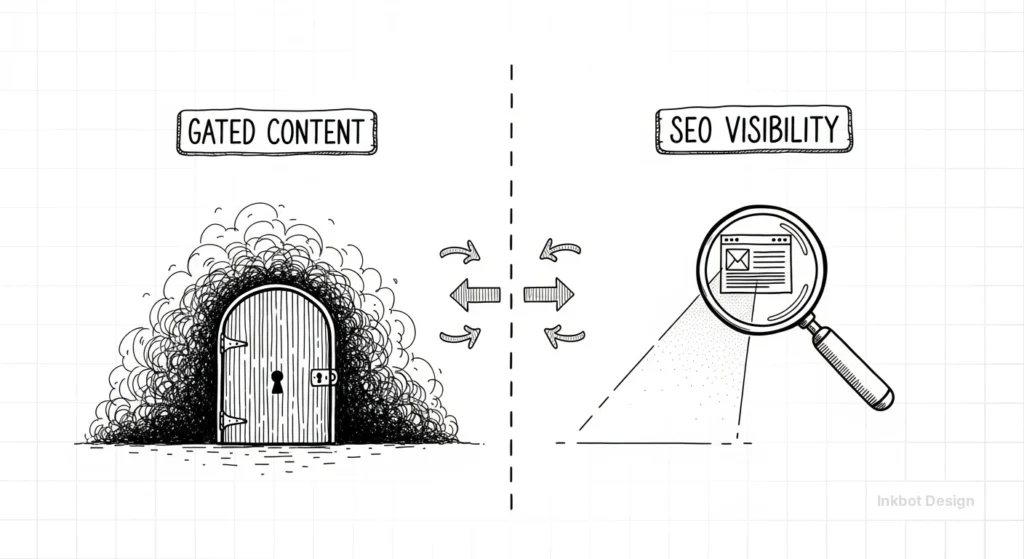
The most painful decision a brand owner will make in 2026 is the “Sovereignty Trade-off.” For twenty years, the mantra was “be as visible as possible.”
In the post-LLM world, visibility is the precursor to commoditisation. If a bot can read your unique strategic insights, it can synthesise them and serve them to a competitor’s customer.
The “Gated IP” Model Gating is no longer just for lead generation; it is a defensive necessity. We recommend a three-tier “Sovereignty Architecture”:
- Public Tier (The Bait): High-level, “consensus-based” content that doesn’t contain your proprietary “secret sauce.” This content is designed for search engines and scrapers. It uses standard SEO keywords to drive traffic, but holds back the real value.
- Verified Tier (The Proof of Personhood): High-value insights, detailed case studies, and unique frameworks are placed behind a “soft gate.” This requires a user to pass a “Proof of Personhood” (PoP) check—often a modern CAPTCHA or a LinkedIn “One-Click” sign-in. This successfully blocks 99% of automated scrapers while remaining frictionless for humans.
- Sovereign Tier (The Vault): Your core R&D, proprietary tools, and “inner circle” insights. This is behind a full authentication wall.
Calculating the ROI of Gating: While gating content may reduce your “Raw Traffic” by 30-50%, the “Information Gain” you retain can be worth millions.
- The Visibility Trap: 10,000 visitors, 2% conversion, but your IP is scraped and cloned by 5 competitors. Net value: Decreasing.
- The Sovereign Strategy: 5,000 visitors, 4% conversion, zero clones. Net value: Increasing.
SEO Impact in 2026: Google’s “Search Generative Experience” (SGE) now rewards gated sites that provide high-quality “snackable” summaries in the Public Tier while citing the Sovereign Tier as the “Primary Source.” By gating, you aren’t hiding from Google; you are forcing the AI to treat your site as a high-authority destination rather than a free training library.
The Verdict
Traditional intellectual property strategy is no longer a standalone solution; it is a secondary support layer for a primary technical defence.
If you are not “poisoning” your digital assets, embedding cryptographic provenance, and gating your high-value insights, you are effectively operating a free R&D department for the global AI industry.
The contrarian truth of 2026 is that visibility is now a liability. For decades, the goal of branding was to be seen by everyone, everywhere.
Today, the goal is to be seen by your customers while remaining invisible—or toxic—to the scrapers that seek to commoditise your unique value.
Do not wait for a “Style Mimic” to launch their version of your business. Audit your technical IP posture today. Ensure your trademarks are global, your contracts are airtight, and your digital assets are “signed” and “poisoned.”
In the age of AI, the only brand that survives is the one that is too expensive—socially, legally, and technically—to steal.
Ready to secure your brand’s future? Explore Inkbot Design’s services and read our related posts on brand protection to ensure your identity remains yours and yours alone.
FAQ Section
What is AI-poisoning for images?
AI-poisoning involves using tools like Nightshade or Glaze to make subtle, pixel-level changes to an image. These changes are invisible to humans but cause AI models to misinterpret the data, effectively “breaking” the training process and preventing the AI from accurately mimicking your design style.
Does a copyright notice still work in 2026?
A copyright notice serves as a legal deterrent and establishes a “good faith” claim of ownership. While it cannot physically stop a scraper, it is a necessary prerequisite for legal action. It helps AI systems that respect “Do Not Train” metadata tags to identify your preferences.
What is C2PA metadata?
C2PA (Coalition for Content Provenance and Authenticity) is a technical standard that embeds cryptographic signatures into digital files. This metadata proves who created the file, what tools were used, and whether it has been edited, providing a “Chain of Custody” that protects against AI deepfakes and unauthorised scraping.
How do I stop GPTBot from scraping my site?
You can attempt to block GPTBot by adding specific directives to your robots.txt file. Still, for better security in 2026, you should implement server-level blocking in your .htaccess file or a Web Application Firewall (WAF) to target the specific IP ranges and User Agents used by OpenAI.
Is my logo automatically trademarked?
No, trademarks are not automatic. While “common law” rights exist through use, they are difficult and expensive to prove. Formal registration with the Intellectual Property Office (IPO) in the UK or the USPTO in the US is required for robust brand protection and enforcement.
What is the Madrid Protocol?
The Madrid Protocol is an international treaty that allows a brand owner to file one trademark application in their home country and then extend that protection to over 120 other member countries. It is the most cost-effective way to manage a global brand protection strategy.
Can an AI own a trademark?
As of early 2026, most major jurisdictions, including the UK and the US, do not allow AI to be listed as an “author” or “owner” of intellectual property. IP rights are reserved for “legal persons” (humans or corporations), meaning AI-generated content often falls into a legal grey area.
Why is the DMCA considered “dead” for AI?
The DMCA is reactive; it removes a file after it has been posted. AI scrapers don’t just “post” files; they ingest them into training weights. You cannot “takedown” a weight from a model that has already been distributed, making the DMCA largely ineffective against generative AI systems.
What is “Style Mimicry” in branding?
Style Mimicry occurs when a generative AI is prompted to create new designs based on the aesthetic “latent space” of an existing brand. This doesn’t involve copying specific files, making it a “legal loophole” that traditional copyright law struggles to address.
Should I gate my website content?
Gating high-value or proprietary content behind a “Proof of Personhood” (like a CAPTCHA or login) is a highly effective 2026 strategy for protecting intellectual property. It prevents automated scrapers from accessing your “secret sauce” while still allowing human customers to engage with your brand.
What are moral rights in UK copyright law?
Moral rights include the right to be identified as the author of a work and the right to object to “derogatory treatment” of that work. Unlike copyright ownership, moral rights cannot be sold or transferred, though they can be “waived” in a professional contract.
How does Google’s 2026 update affect IP?
Google’s 2026 “Human Content” update uses C2PA metadata as a ranking signal. Content that can be cryptographically verified as produced by a verified human creator is given preference over “anonymous” or AI-generated content, making IP metadata a critical SEO asset.