Personal Branding on LinkedIn for B2B Leaders
LinkedIn is currently a bonfire of “hustle-culture” relics.
If you are a B2B leader still following the 2022 playbook—posting generic “I’m humbled to announce” updates and using a corporate headshot from 2018—you aren’t just invisible; you are actively damaging your firm’s market value.
The stakes have shifted. In an era where AI can churn out 10,000 words of “thought leadership” in seconds, your audience has developed a high-functioning immune system against fluff.
According to the 2025 Edelman-LinkedIn B2B Thought Leadership Impact Report, 70% of C-suite buyers claim that a leader’s LinkedIn presence directly influences which companies they invite to the RFP (Request for Proposal) process.
Ignoring your personal branding is no longer a “social media choice”; it is a dereliction of fiduciary duty.
- Treat LinkedIn as a conversion landing page: optimise your headline, banner, and first lines to solve a specific problem within six seconds.
- Publish high-information content: 2–3 deep-dive, zero-click posts weekly focused on technical authority, contrarian insight, or human leadership.
- Verify and prove authority: secure the Human-Verified badge, align credentials across touchpoints, and contribute original insights to collaborative articles.
What is Personal Branding on LinkedIn?
Personal Branding on LinkedIn is the strategic curation of a professional identity designed to build trust, establish authority, and drive specific business outcomes through a combination of visual consistency, technical profile optimisation, and high-information-gain content.
The three core elements include:
- Authority Signal: The technical proof of your expertise (Profile, endorsements, and verified credentials).
- Narrative Architecture: The consistent story you tell about the problems you solve, not the jobs you’ve held.
- Engagement Friction: The ability to spark meaningful, high-level dialogue with other industry entities.
The Technical Architecture of a 2026 B2B Profile
Most B2B leaders treat their profile like a static CV. This is a mistake.
In 2026, your profile will serve as a landing page. If it doesn’t convert a visitor into a follower or a lead within six seconds, it has failed.
The Banner: Your “Visual Pitch Deck”
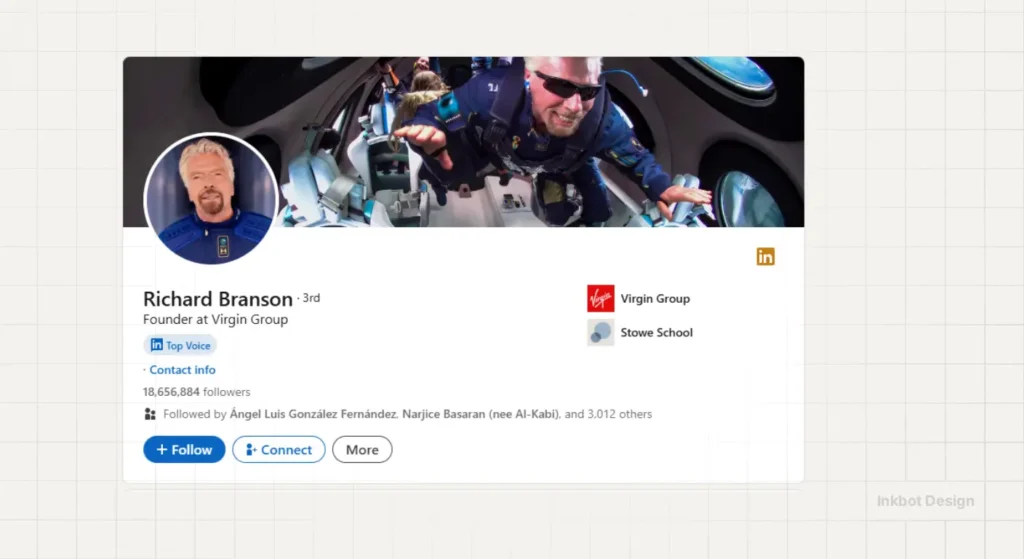
Stop using photos of city skylines or “teamwork” puzzles. Your banner is prime real estate. It should visually articulate your “Unique Value Proposition” (UVP).
For example, when we work on brand identity, we ensure the personal and corporate visuals align without being identical. Your banner should feature you “in the arena”—speaking, consulting, or looking like someone who actually does the work.
The Headline: Beyond the Job Title
LinkedIn’s search engine has evolved from simple keyword matching to Semantic Search. This means the platform understands the relationship between your skills and the problems you solve.
- Amateur: “Managed a team of 20 in the London office.”
- Pro (Semantic Ready): “Led a 20-person Digital Transformation team to migrate Legacy Infrastructure to AWS, resulting in a 15% reduction in operational latency.”
Voice Search Optimisation. As more leaders use voice assistants (Siri, Alexa, or LinkedIn’s internal voice-to-text) to find partners, your profile must mirror natural language. Use long-tail phrases in your “About” section that answer specific questions, such as: “How do I scale a FinTech team in the UK?” or “Best consultant for B2B lead generation.”
The “About” Section: The “Problem-First” Framework
The first three lines of your “About” section are all that appear before the “See More” button. Do not waste them on “I am an experienced leader with a demonstrated history…”
Start with a painful truth about your industry. Address the elephant in the room. Use the personal branding statement model to hook the reader immediately.
The 2026 B2B Content Performance Matrix
| Content Format | Primary Goal | Ideal B2B Scenario | 2026 Engagement Lever |
| Native Document (PDF) | Dwell Time | Sharing a 10-page “Industry Audit” or “Price Comparison”. | The “Save” button. High saves signal high value. |
| LinkedIn Native Video | Human Connection | A 60-second “Behind the Scenes” or “Contrarian Take”. | Subtitles + Hook. 80% of B2B users watch with the sound off. |
| Polls (Purpose-Driven) | Market Research | “Which B2B hurdle is costing you the most this Q3?” | Comments. Use the poll to spark a debate, not just a vote. |
| Collaborative Contributions | Badge Acquisition | Proving expertise in a narrow niche (e.g. “SaaS Retention”). | Expert Reactions from other C-suite peers. |
| LinkedIn Newsletters | Retention | Weekly “C-Suite Briefing” sent directly to inboxes. | Recurring Subscriber notifications. |
The 2026 Algorithm: From Reach to Resonance
LinkedIn’s algorithm underwent a massive shift in late 2025. The platform now prioritises “Dwell Time” and “Meaningful Social Actions” over raw likes.
The “Zero-Click” Content Mandate
LinkedIn wants to keep users on the platform. If your posts constantly try to drive traffic to your website, the algorithm will bury you. You must provide the value within the post itself.
A Gartner study suggests that B2B buyers complete 70% of their journey before ever contacting a salesperson. If your LinkedIn content doesn’t fully educate them about the platform, they will never reach your contact page.
The “Signal-to-Noise” Ratio
In our fieldwork, we often see leaders who think “more is better.”
They post three times a day using AI tools. This creates a “content debt.” When your audience sees your name and associates it with low-value noise, they stop listening.
Once their dwell time on your posts drops, LinkedIn stops showing your content to them entirely.
| Feature | The Amateur Way (Pre-2024) | The Pro Way (2026+) |
| Post Frequency | Daily (or multiple times daily) | 2-3 High-Impact posts per week |
| Content Type | Self-promotional / “Humbled” | Problem-solving / Contrarian |
| Visuals | Stock photos / Generic AI | Authentic photography / Custom data visualisations |
| Engagement | “Great post!” comments | Nuanced, technical debate |
| Outbound Links | In every post | Rarely, value is delivered on-platform |
The Myth of “Consistency is King”
Let’s debunk the most persistent lie in social media: “You must post every day to stay relevant.”
Data from the Ehrenberg-Bass Institute on brand salience suggests that quality and “Mental Availability” are far more critical than sheer frequency. For a B2B leader, posting a mediocre update every day actually erodes your authority. It makes you look like you have nothing better to do.
The 2026 Reality: One “Deep-Dive” post per week—supported by original data, a case study, or a controversial industry observation—will outperform seven days of “Monday Motivation” every single time.
I once audited a client, a CTO of a mid-sized logistics firm. He was posting daily updates about his morning coffee and “leadership thoughts.”
His reach was declining. We moved him to a fortnightly “Technical Audit” post where he tore down failed logistics implementations. His profile views increased by 400%, and he secured three high-value consultations within a month.
Mastering LinkedIn Collaborative Articles for “Top Voice” Status
One of the most effective ways to build Topical Authority in 2026 is through LinkedIn Collaborative Articles. These are AI-generated base articles that the platform invites “experts” to contribute to.
By adding “Human Insights”—real-world anecdotes or contrarian data—to these articles, you earn the LinkedIn Top Voice badge in specific niches (e.g., “Top Strategy Voice”).
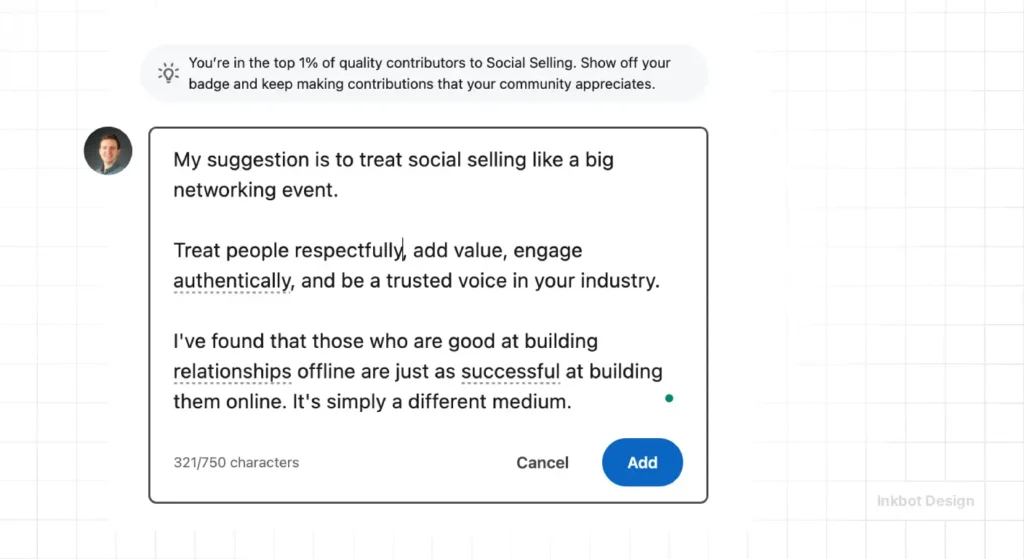
This badge is a massive signal to the LinkedIn Knowledge Graph that your account is a primary source of information.
Pro Tip: Do not just agree with the AI-generated text. Use your “Antagonist Pillar” to point out where the AI’s logic fails. High-quality contributions that receive “Insightful” reactions from other verified peers carry triple the weight of a standard post.
Strategic Content Pillars for B2B Leaders
To achieve topical authority, your content should fall into three distinct buckets.
1. The “Architect” Pillar (Technical Authority)
This is where you show how the sausage is made. Share frameworks, thought leadership strategy, and technical “how-to” guides.
- Example: “Why 90% of B2B SaaS implementations fail in the first 6 months (and the 3 variables that matter).”
2. The “Antagonist” Pillar (Contrarian Views)
Identify a common “best practice” in your industry and explain why it’s wrong. This creates “Information Gain”—the holy grail of 2026 SEO and social algorithms.
- Example: “Stop hiring for ‘Culture Fit.’ It’s the fastest way to kill innovation.”
3. The “Human” Pillar (Vulnerability and Ethics)
This isn’t about what you had for lunch. It’s about the hard choices you make as a leader.
- Example: “The time I had to fire my biggest client to save my team’s mental health.”
The State of LinkedIn in 2026: The Rise of Verified Entities
As of 2026, LinkedIn has fully implemented its “Human-Verified” badge system. With the explosion of AI-generated profiles, the platform now prioritises accounts that have verified their identities with government IDs or workplace credentials.
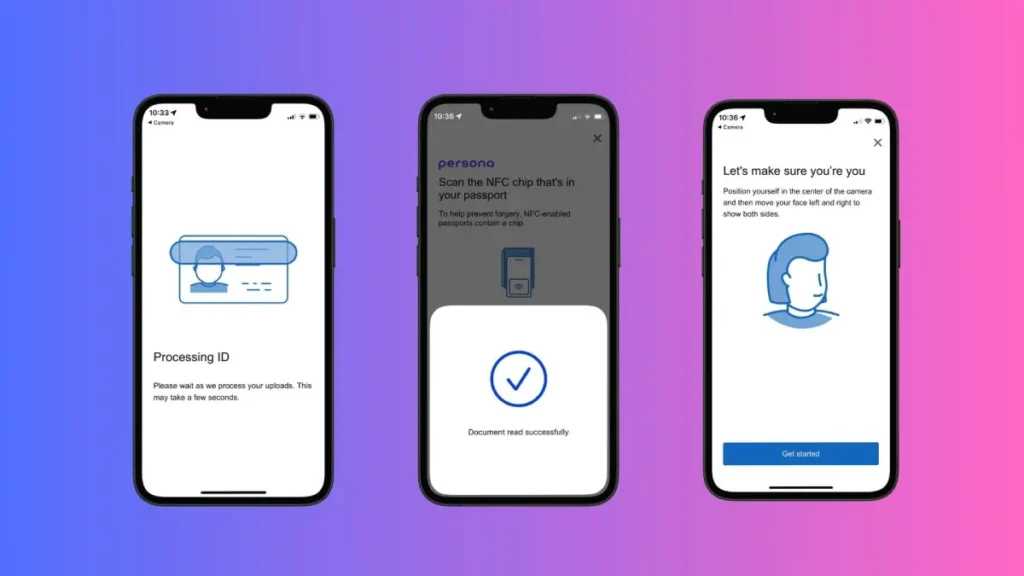
If you are not “Verified,” your reach is artificially capped. LinkedIn’s 2026 updates have also integrated “Semantic Verification.”
The algorithm now checks if your claims (e.g., “I led a team of 500”) match the data available in the broader “Knowledge Graph.”
Action Step: Ensure your association is correctly mapped and that your personal brand history is consistent across all digital touchpoints. Discrepancies between your LinkedIn and your corporate site’s “About” page now act as a negative ranking signal.
The Human-Verified Badge: Your 2026 Trust Mandate
In 2026, the LinkedIn Human-Verified badge (often appearing as a shield or black checkmark) is no longer a vanity metric—it is a functional filter.
LinkedIn’s current algorithm deprioritises “unverified” accounts in search results to combat the flood of AI-generated deepfake profiles.
How to Secure Your Verification
- Identity Check: Navigate to your profile on mobile and select “Verify.” LinkedIn utilises third-party partners like CLEAR or Persona to scan a government-issued ID (passport or driver’s licence) and perform a biometric “liveness” selfie check.
- Workplace Validation: You must verify your current role using a company email address or via Microsoft Entra (for enterprise-level firms). This establishes a cryptographic link between your profile and your employer’s LinkedIn Company Page.
- Educational Credentials: For those in academic or research-led B2B sectors, verifying your degree through platforms like Parchment adds a layer of “Educational Authority” that search engines prioritise.
Scenario: A B2B consultant in London recently reported a 60% increase in profile views within 14 days of achieving “Verified” status. The algorithm identified them as a “High-Trust Entity,” placing their posts above non-verified competitors in the “Top Match” feed.
I’m going to be blunt: most of you are too dull for LinkedIn.
You are terrified of offending a potential client, so you post “safe” content. Safe content is expensive content because it requires a massive ad spend to get anyone to notice it.
If you want organic reach in 2026, you must have an edge.
In our work with personal branding for freelancers and C-suite executives alike, the biggest hurdle is always the “Corporate Filter.”
You need to sound like a human who has seen some things and fixed some things. If your post sounds like a committee wrote it, delete it.
Frequently Asked Questions
How do I use ChatGPT or Claude for LinkedIn without getting penalised?
Use AI for “Synthetic Brainstorming”—outlining and data analysis. Never copy-paste. The 2026 algorithm detects “AI Fingerprints” (patterns of low information gain). Always rewrite the hook and add a personal anecdote.
What is the “Dwell Time” benchmark I should aim for?
For a 500-word post, you want an average dwell time of 45+ seconds. If users “See More” and then leave immediately, the algorithm flags it as “Clickbait” and kills the reach.
Is LinkedIn Premium (Sales Navigator) necessary for personal branding?
For branding, no; for commercial ROI, yes. Sales Navigator lets you see who is searching for your “Rare Attributes” and “Entities,” so you can tailor your content to the specific companies visiting your profile.
Should I link to my company website in my posts?
Only in the “First Comment” or via a “Zero-Click” approach. If you must include a link in the post, ensure it’s a LinkedIn Article, as these are the only long-form formats where the algorithm tolerates outbound traffic without significant reach suppression.
How does the Social Selling Index (SSI) affect my visibility?
Your SSI is a lead indicator. A score above 75 (specifically in “Establishing your professional brand” and “Engaging with insights”) acts as a multiplier for your content’s initial “test” reach.
Why is my LinkedIn reach declining in 2026?
LinkedIn has shifted away from viral “engagement bait.” If your posts get likes but no dwell time (people actually reading the text) or meaningful comments, the algorithm stops pushing them. The “Human-Verified” status also plays a massive role in visibility now.
How do I balance a personal brand with my corporate brand?
Your personal brand should be the “Human Lens” for the corporate brand. While the company page shares news and product updates, the leader shares the philosophy and struggles behind those updates. They should complement, not duplicate, each other.
What is the most essential part of a LinkedIn profile?
Your headline and your “About” section’s first two lines. These are your “hook.” If they don’t solve a specific problem for your target audience, the rest of the profile is irrelevant.
How often should a B2B leader post?
Quality over frequency. 2-3 high-value posts per week is the sweet spot. Anything more often risks “Content Fatigue” among your target audience.
How do I handle negative comments on my posts?
Do not delete them unless they are abusive. Engaging in a professional, data-backed debate with a sceptic is one of the fastest ways to prove your authority to silent observers.
What is “Zero-Click Content”?
Content that provides the full value (the “answer”) within the LinkedIn post itself, rather than asking the user to click a link to a blog or website. The algorithm favours this.
Can I outsource my personal branding?
You can outsource the strategy, the design, and the editing, but you cannot outsource the “soul.” Your unique experiences and “Rare Attributes” must come from you.
The Verdict
Personal Branding on LinkedIn in 2026 is a technical discipline, not a hobby. You are competing against the “AI Tsunami” and a B2B buyer who is more sceptical than ever.
To win, you must move beyond generic “Best Practices” and embrace a strategy of high-information gain, visual authority, and radical transparency.
If your profile still looks like a CV, you are losing money. It is time to treat your personal brand with the same rigour you apply to your P&L.
