
Professional Logo Design Pricing: The True Cost in 2026
The cheapest logo you will ever buy is the one that costs below £3,000, because anything less is usually a high-interest loan against your brand’s future.
If you think that sounds like agency posturing, look at the numbers.
Brands that invest in professional Logo design cost strategies early avoid the “rebranding multiplier”—the reality that fixing a bad logo costs four times more than doing it right the first time, once you factor in signage, staff uniforms, and lost consumer trust.
Redesigning a brand within three years of launch results in an average 15% loss in brand equity, according to research by the Ehrenberg-Bass Institute.
For a small business with a £200,000 turnover, that is a £30,000 invisible tax for being “thrifty” during the startup phase.
In 2026, logo design pricing isn’t about the hours a designer spends in a vector program. It is about the legal and strategic validation required to ensure your mark is actually yours to keep.
- Professional logo budgets typically start £1,500 to £3,500; higher brackets add strategy, legal vetting, and team-led brand systems.
- Cheap commodity logos (£50–£500) often lack trademark checks, risking infringement and rebrand costs far exceeding original savings.
- 2026 pricing centres on legal validation, human curation, audit trails, and metadata to ensure trademarkability and AI discoverability.
- UK IPO fee rise in April 2026 increased trademark costs; factor government disbursements and rollout expenses into total rebrand budgets.
- AI-generated marks are legally fragile; designers use AI for ideation, but human-led work is required for copyright and distinctiveness.
The 4 Brackets of Professional Logo Design Pricing in 2026
Professional logo design pricing in the UK is now divided by the level of risk mitigation provided rather than just “creativity.” In a market saturated by AI-generated noise, the price you pay determines the level of human-led strategy that protects your brand from being ignored or sued.
1. The Entry-Level Professional (£1,500 – £3,500)
This bracket is typical for established freelancers or small boutique studios. At this price point, you are paying for a designer who understands technical execution but may not have a full team for deep-dive market research. You will receive a high-quality vector mark, a basic style guide, and a limited set of revisions.
The British Design Council reports that for every £1 spent on design, businesses can expect over £20 in increased revenue. At this level, the ROI is highest for startups that need a professional face without the five-figure overhead of a London agency. You are buying competence and a clean file structure that won’t break when you send it to a printer.
2. The Mid-Market Studio (£5,000 – £15,000)
This is the “Sweet Spot” for SMEs and high-growth scale-ups. Mid-market pricing includes a team approach. You aren’t just getting a “logo”; you are getting a brand system. This includes typography pairings, secondary marks, and often a basic Logo design workshop to align the visuals with your business goals.
A study by McKinsey & Company found that companies in the top quartile of the McKinsey Design Index outperformed industry benchmarks by as much as 2:1. At the £10,000 mark, you are paying for that performance. You are buying a brand that is built to scale into international markets without looking like an amateur.
3. The Specialist Agency (£20,000 – £50,000+)
This level is reserved for established brands, corporate entities, and well-funded ventures. The pricing here reflects the massive “Cost of Being Wrong.” When a company like BP or Airbnb rebrands, the internal logistics of updating every touchpoint cost millions; the agency fee is essentially an insurance policy against a public relations disaster.
The BP “Helios” logo cost an estimated £136 million in 2000 and remains a benchmark for the upper end of the scale. While most UK businesses won’t hit those heights, the principle remains: the more stakeholders you have, the more the price increases to manage the consensus-building and legal vetting required.
4. The Commodity Tier (£50 – £500) — A Warning
This is the realm of Fiverr, Upwork, and AI logo generators. While tempting, these options often bypass the most critical step in branding: the trademark search. A logo bought for £50 has a high risk of being a modified template or, worse, a direct rip-off of an existing brand.
“Logo design pricing in 2026 is no longer a metric of artistic effort but a reflection of strategic insurance. High-tier pricing protects a business from the catastrophic costs of trademark litigation and the silent revenue drain of a misaligned brand identity that fails to resonate with its target audience.”
The “AI Is Free” Myth: Why it is Killing New Brands

The most dangerous lie in 2026 is the idea that AI tools like Midjourney or DALL-E 3 have made professional logo design free.
While these tools generate stunning visuals, they are legally hollow. Under current UK Intellectual Property Office (IPO) guidelines, works generated entirely by AI without significant human intervention struggle to qualify for copyright protection.
If you cannot copyright your logo, you cannot own it. If you do not own it, you cannot stop a competitor from using a nearly identical mark.
In 2026, professional designers use AI as a mood-boarding tool, not a final-output engine. The “real” work—and the reason for the price—is the human curation that turns an AI suggestion into a legally defensible brand asset.
Tropicana’s 2009 packaging redesign—which replaced its iconic logo—cost the brand an estimated $35 million in lost sales within two months, according to AdAge.
This failure wasn’t due to “bad art” but a lack of understanding of consumer psychology and “distinctive brand assets.” AI lacks the empathy to understand why a consumer reaches for one orange juice over another; a human strategist does not.
“The 2026 design market has bifurcated into low-value automated generation and high-value strategic curation. Businesses that rely on the former save on initial costs but sacrifice the legal exclusivity and psychological resonance required to build long-term brand equity in a competitive digital economy.”
The “Human-Curation” Premium
As of April 2026, we are seeing a massive market correction. After the AI hype of 2024 and 2025, many brands that used automated logo tools are now facing “Visual Homogenisation.”
Because AI models are trained on the same data sets, they tend to produce “average” results. This has led to a sea of brands that all look the same—clean, minimalist, and entirely forgettable.
The 2026 “Human-Curation Premium” is a pricing shift in which agencies charge more for demonstrably unique, handcrafted elements.
Adobe Firefly 4’s “Audit Trail” feature, released in late 2025, allows designers to prove the percentage of human vs AI input in a file. Professional pricing now often includes this authenticity certification, which is essential for brands seeking Tier 1 trademark protection.
Furthermore, the rise of “GEO” (Generative Engine Optimisation) means your logo needs to be more than just pretty. It needs to be “Entity-Ready.”
In 2026, AI systems like Gemini and Perplexity categorise brands based on their visual and semantic consistency. A professional logo package now includes metadata-optimised SVG files and “Brand Schema” that helps AI systems identify and cite your brand correctly in search results.
The 2026 UK IPO Fee Reality: Why Your Budget Just Changed
On 1 April 2026, the UK Intellectual Property Office implemented its first major fee restructuring since 1998.
This was not a minor adjustment; it was a corrective 25% increase across the board, designed to account for a 32% inflation rise since 2016 and the massive capital requirements for new digital filing systems.
For any business owner commissioning a professional mark, the “hidden” legal costs of protection have shifted significantly.
UK IPO Fee Comparison (Effective 1 April 2026)
| Service Type | Old Fee (Pre-April 2026) | New Fee (Current) | % Increase |
| Trademark Application (1st Class) | £170 | £205 | 20.5% |
| Additional Class (per class) | £50 | £60 | 20.0% |
| Trademark Renewal (1st Class) | £200 | £245 | 22.5% |
| Trademark Opposition Fee | £200 | £250 | 25.0% |
| Invalidation Application | £200 | £250 | 25.0% |
| Registered Design (Single) | £50 | £60 | 20.0% |
The Data (Use and Access) Act 2025 mandated these updates. If you are calculating the total cost of a rebrand in 2026, you must factor in these updated government disbursements. A typical small business trademarking in three classes (e.g., software, consulting, and training) now faces a £325 minimum government fee before any legal or designer time is billed.
Why the IPO Fee Increase Matters for Creative Strategy
In previous years, many “commodity” designers would bundle the application fee into their price. In 2026, this is nearly impossible for low-cost providers.
Professional agencies now explicitly separate “Design Fees” from “Government Disbursements.” This transparency is a key indicator of a professional firm.
If a provider offers an “all-inclusive” price of £500, and £325 of that must go to the government for three classes of protection, the designer is effectively earning £175 per week of work.
This is the clearest warning sign of template-driven or AI-generated output that lacks original human authorship.
Strategic Timing of Trademark Filings
The IPO has confirmed that applications submitted before 31 March 2026 benefit from the “Grace Period” and pay the old rates.
However, for any new project starting now, the higher rates are the baseline. This has led to a “Quality Premium” in the market; since the cost of protection is higher, the value of the mark being protected must justify that expense.
The £40,000 Rebrand I Had to Fix
In my time at Inkbot Design, I have seen more money wasted on “cheap” fixes than on expensive agencies. A few years ago, I audited a client who had purchased a £200 logo from a popular freelance platform.
They spent £15,000 on storefront signage and another £25,000 on branded vehicle wraps.
Six months later, they received a Cease and Desist from a company in a related sector. The “unique” logo they bought was a slightly modified vector icon from a stock site that another company had already trademarked.
The freelancer was gone, and my client was left with a £40,000 bill for physical assets they had to destroy.
The mistake wasn’t the £200 logo; it was the failure to understand that a logo is a legal document as much as a visual one. We had to perform an emergency rebrand, which cost them significantly more than if they had come to us from the start.
In 2026, if a price seems too good to be true, it is because you are the one taking all the risk.
Industry-Specific Pricing Benchmarks: What Your Sector Pays
Professional brand development is not a “one size fits all” cost. In 2026, pricing is determined by the Complexity of the application and the Competitive Density of the sector.
1. The SaaS & Fintech Benchmark (£15,000 – £45,000)
In the technology sector, your logo is rarely seen in isolation. It lives within app interfaces, on 16px favicons, and within complex dashboard ecosystems.
- Key Deliverable: Responsive Logo System. This includes up to 5 variants of the mark that adapt based on screen size.
- Why the cost? The price includes “Interaction Design”—ensuring the logo looks as good in “Dark Mode” as it does on a printed invoice.
2. Physical Retail & Hospitality (£8,000 – £25,000)
For a brick-and-mortar business, the “Logo” is only 40% of the visual identity.
- Key Deliverable: Signage & Environmental Graphics.
- Why the cost? Agencies must test the mark against physical constraints. How does it look when cut from brushed steel? Can it be backlit without losing legibility?
3. Professional B2B Services (£5,000 – £15,000)
For law firms, consultancies, and recruiters, the brand is about “Authoritative Trust.”
- Key Deliverable: Editorial System & Stationery.
- Why the cost? The focus is on typography and “Visual Silence.” The price reflects the strategic effort to make the brand look “established”, even if it is a new venture.
2026 Sector Pricing Matrix
| Sector | Median Budget | Focus Area | Critical Risk |
| SaaS | £22,000 | App Scalability | High Homogenisation |
| Fintech | £35,000 | Regulatory Trust | Legal Compliance |
| E-commerce | £12,000 | Conversion Symbols | Mobile Legibility |
| Construction | £7,500 | Physical Durability | Print Reproduction |
| SME Services | £5,000 | Local Differentiation | Trademark Infringement |
The Invisible 60%: Why Design is Only Half the Battle
A common mistake in 2026 is spending the entire branding budget on the “Logo Design” itself. Industry data from March 2026 suggests that, for a successful launch, the design fee typically accounts for only 40% of total capital expenditure.
The Rollout Multiplier
If you pay an agency £10,000 for a new identity, you should have an additional £15,000 ready for the “Physical and Digital Implementation.”
Breakdown of Rollout Costs:
- Digital Asset Replacement (15%): Updating every template in your CRM, email signatures, presentation decks, and social media headers.
- Physical Signage & Wayfinding (30%): For businesses with premises, this is the highest single cost. In 2026, the price of high-quality sustainable materials (recycled acrylics and low-energy LED) has risen by 18% YoY.
- Vehicle & Uniform Branding (10%): A fleet of 5 vans can cost upwards of £4,000 to re-wrap professionally.
- Legal & Trademarking (5%): Using the new 1 April 2026 IPO fees, a comprehensive multi-class filing will cost roughly £500–£1,000, including legal consultation.
Total Cost of Ownership (TCO) Case Study
| Phase | Item | Cost (2026 Estimate) |
| Strategy | Market Analysis & Positioning | £3,500 |
| Design | Logo Suite & Visual System | £6,500 |
| Legal | UK IPO Filing (3 classes) | £325 |
| Rollout | Website Theme Update | £2,500 |
| Rollout | Signage (Standard Office) | £4,200 |
| Rollout | Stationery & Merchandise | £1,500 |
| TOTAL | The Real Cost of Rebranding | £18,525 |
Businesses that fail to budget for the rollout often end up with a “Fractured Identity”—where the new logo is on the website, but the old logo remains on the building and the staff uniforms. This “Visual Cognitive Dissonance” reduces consumer trust by an estimated 22%, according to recent market signals.
Future-Proofing Your Brand: Beyond Human Eyes
In 2026, your logo is seen by machines more often than by humans.
Search engines, AI assistants, and generative discovery tools scan your brand’s digital presence to understand who you are. A “Professional” logo package in 2026 now includes Machine-Readable Metadata.
What is Brand Schema?
When an agency delivers your final files, they should include a JSON-LD Brand Schema file. This code tells AI systems exactly:
- Which image is your Official Logo?
- Your primary, secondary, and tertiary Brand Colours (hex codes).
- Your Legal Entity name and trademark registration number.
- Your Slogan and brand mission.
The “Entity-Ready” Logo
AI discovery engines use these signals to verify your brand’s authenticity. If your website has the new logo but your Google/Gemini Business Profile has the old one, the AI may lower your “Authority Score.”
The 2026 Deliverables Checklist (Professional Tier)
| Deliverable | Format | Purpose |
| Primary Logo | SVG / EPS | High-resolution print & web. |
| Responsive Variants | SVG | Adaptable for mobile/watch icons. |
| Audit Trail (Firefly 4) | PDF/JSON | Proves human-authorship & legal title. |
| Brand Schema | JSON-LD | For AI discovery & entity verification. |
| Logo Sting | MP4 / Lottie | For video headers and social media. |
| Trademark Certificate | Proof of ownership from the UK IPO. |
The Verdict
Logo design pricing in 2026 is based on value, not labour.
If you are an entrepreneur building a business that will last more than 2 years, the minimum entry price for a professional mark is £1,500. Anything less is a gamble with your brand’s legal and visual future.
The most expensive logo is not the one with the highest invoice; it is the one that fails to communicate your value to your audience or, worse, belongs to someone else.
Invest in the strategy, legal vetting, and human expertise that ensure your brand is an asset, not a liability.
If you are ready to stop guessing and start building a brand that survives the AI-saturated market of 2026, explore Inkbot Design’s logo design services or contact us for a custom quote. Let’s build something that you actually own.
FAQs
Why is logo design so expensive in 2026?
Logo design pricing reflects the cost of market research, strategic positioning, and legal validation. In 2026, the price includes ensuring the mark is legally protectable under evolving AI copyright laws and technically optimised for both human eyes and AI discovery engines.
Can I use an AI logo generator for my business?
AI logo generators are useful for brainstorming but carry significant legal risks. Most AI-generated marks cannot be trademarked in the UK, leaving your brand vulnerable to copycats. Professional designers use AI as a tool, but human curation is required for legal ownership and brand distinctiveness.
What is a fair price for a startup logo in the UK?
A professional startup logo typically costs between £1,500 and £3,500. This price bracket ensures you receive a unique, scalable mark from a designer who has performed basic competitor research and provided the necessary vector files for all business touchpoints.
How many revisions should be included in the price?
Most professional logo design packages include two to three rounds of revisions. This structure encourages focused feedback and ensures the project stays on schedule. Excessive revision cycles usually indicate a lack of a clear strategy at the project’s start.
Does the price include copyright transfer?
A professional logo design fee should always include a full transfer of copyright or a comprehensive usage licence. Ensure your contract explicitly states that you own the final mark once the balance is paid, as this is vital for your brand’s long-term value.
What is the difference between a logo and a brand identity?
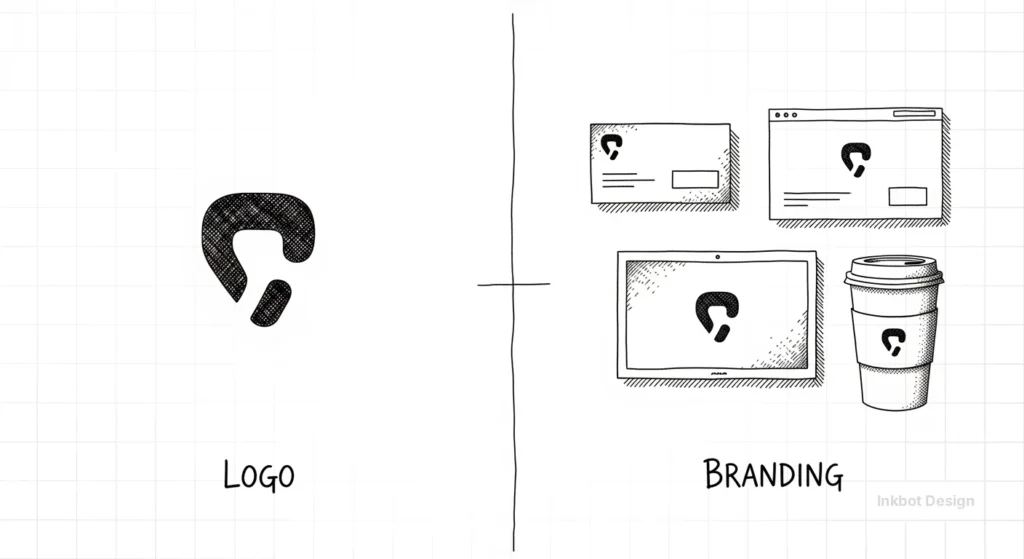
A logo is a single visual mark, while a brand identity is the entire system of colours, typography, voice, and imagery. Professional pricing for a full identity is higher because it provides the “rules” for how your business looks across every platform.
Why do agencies charge more than freelancers for logo design?
Agencies charge more because they provide a team of specialists, including strategists, designers, and project managers. This multi-disciplinary approach reduces the risk of brand failure and is necessary for larger organisations with complex stakeholder requirements.
How long does a professional logo design take?
A professional logo design project usually takes between four and eight weeks. This timeframe allows for deep-dive research, multiple conceptual stages, and the refinement of the final mark to ensure it meets all technical and strategic goals.
Should I pay for a logo up front?
Most professional designers and agencies require at least 50% deposit before work begins, with the balance due upon completion. This shared risk ensures both parties are committed to the project and is standard practice across the UK design industry.
What happens if I want to change my logo later?
Changing a logo later is known as a “Rebrand” and often costs significantly more than the original design. This is because you must update all existing assets, from websites to physical signage, and risk losing the brand recognition you have built.
